
Views: 256 Author: Maituohong Packaging Publish Time: 2026-10-25 Origin: Site


Content Menu
>> Corrugated Boxes vs. Cardboard Boxes
● Corrugated Flute Types: Which Profile Fits Your Product?
>> Is E-Flute Suitable for Shipping?
● Single-Wall vs. Double-Wall Corrugated Boxes
>> When Should You Consider Double-Wall Packaging?
● How to Choose Between Mailer Boxes and Shipping Boxes
>> Die-Cut Mailer Boxes for Branded Deliveries
>> Regular Slotted Containers for Practical Shipping
● Corrugated Box Strength: Understand the Tests
>> What Does a Box Maker's Certificate Tell You?
● A Six-Step Process for Specifying Custom Corrugated Boxes
>> 1. Define the Packed Product
>> 2. Describe the Distribution Route
>> 3. Confirm Internal and External Dimensions
>> 4. Develop the Insert and Closure
>> 5. Approve Materials and Artwork Separately
>> 6. Test Before Mass Production
● Design Premium Gift Packaging as a Complete System
● Reduce Packaging Costs Without Sacrificing Performance
>> Control Empty Space and Dimensional Weight
>> Compare Equivalent Supplier Quotations
● Recyclability, Recycled Content, and Moisture Resistance
● Start Your Custom Corrugated Packaging Project
● Frequently Asked Questions About Corrugated Boxes
>> What is the best corrugated box for e-commerce shipping?
>> Are double-wall boxes always stronger than single-wall boxes?
>> Can I print detailed graphics on corrugated boxes?
>> Does every custom shipping box need an ISTA test?
>> Can a magnetic gift box replace a corrugated shipping box?
>> What information should I send for a custom box quotation?
Corrugated boxes protect products, support efficient shipping, and create a branded unboxing experience. But choosing the right custom corrugated box requires more than selecting a size and adding a logo. Board construction, flute profile, inserts, printing, and delivery conditions all influence performance.
At Maituohong Packaging, our approach begins with a practical question: what must this package survive before the customer opens it? With over 18 years of experience designing and manufacturing premium paper packaging, we believe protection and presentation should be developed together.
This guide explains how to compare corrugated packaging options, avoid common specification mistakes, and prepare a clearer brief for your manufacturer.
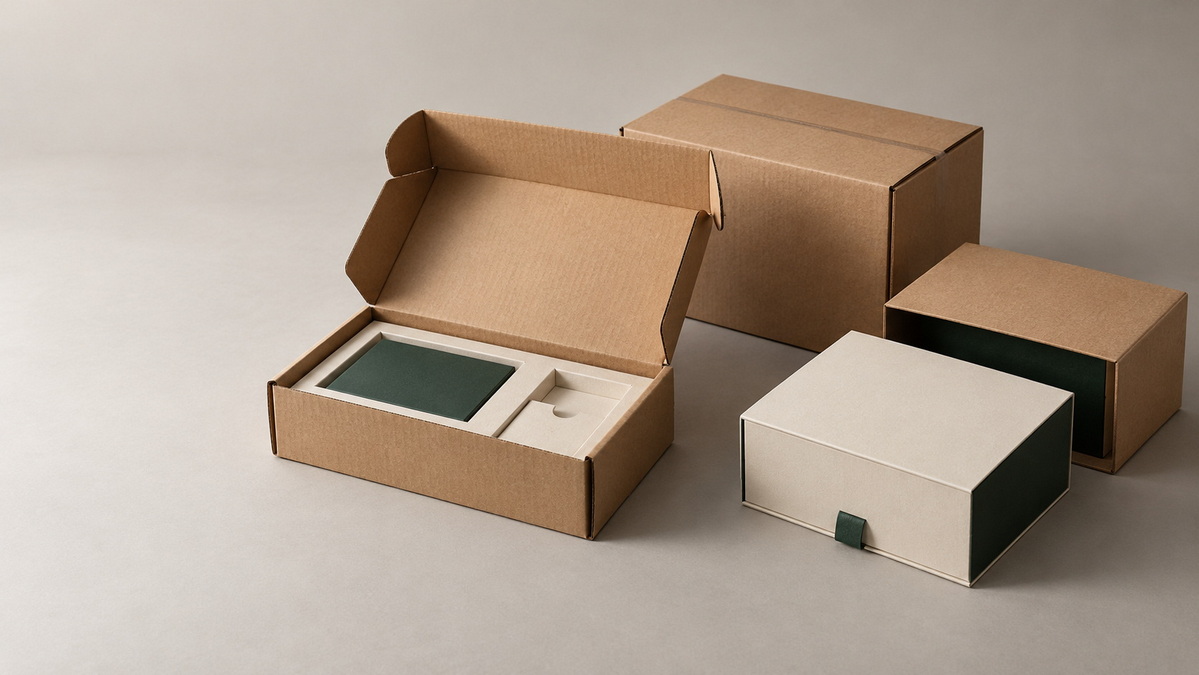
A corrugated box is a container made from corrugated fiberboard. Its structure combines flat sheets called liners with a wave-shaped paper layer called fluting.
A typical single-wall board contains:
- One outer liner for protection and printing.
- One fluted medium that provides structural depth.
- One inner liner facing the product.
The bonded structure offers cushioning and resistance to compression. However, performance depends on the complete board specification—not simply its thickness.
Corrugated packaging serves many applications, including e-commerce mailers, shipping cartons, product dividers, and protective outer boxes for premium gifts.
"Cardboard" is a broad everyday term rather than a precise packaging specification.
For purchasing purposes, distinguish between these materials:
| Material | Typical structure | Common application |
|---|---|---|
| Folding carton paperboard | Solid paperboard without fluting | Cosmetics, skincare, and retail cartons |
| Corrugated fiberboard | Liners bonded to fluted medium | Mailer boxes and shipping boxes |
| Rigid box board | Thick, solid board, usually covered with decorative paper | Magnetic boxes and premium gift boxes |
A magnetic rigid box can deliver an excellent presentation, but it should not automatically be treated as a shipping container. Depending on the product and delivery route, it may need a corrugated outer carton.
Flute profiles influence board thickness, cushioning, converting, and printing. They do not establish a universal weight capacity.
The following comparisons are starting points, not substitutes for material specifications and testing.
| Flute profile | General characteristics | Typical applications |
|---|---|---|
| A flute | Relatively thick profile with cushioning potential | Protective packaging and selected fragile-product applications |
| B flute | Relatively compact profile with a useful converting surface | Die-cut mailers, dividers, and shipping packaging |
| C flute | Balanced thickness and cushioning | General-purpose shipping cartons |
| E flute | Thin profile suited to detailed graphics | Branded mailers and retail packaging |
| F flute | Very thin microflute profile | Small retail packs and presentation-focused packaging |
Actual caliper varies with paper selection, manufacturing conditions, and flute geometry. Request the supplier's specification rather than relying on a generic thickness chart.
E-flute can work for appropriately designed shipping mailers. Suitability depends on product weight, fragility, dimensions, inserts, and handling conditions.
A lightweight accessory and a dense glass jar may require different packaging even when their external dimensions match.
The useful question is not "Can E-flute ship products?" It is "Can this complete E-flute package protect this particular product through its intended delivery system?"
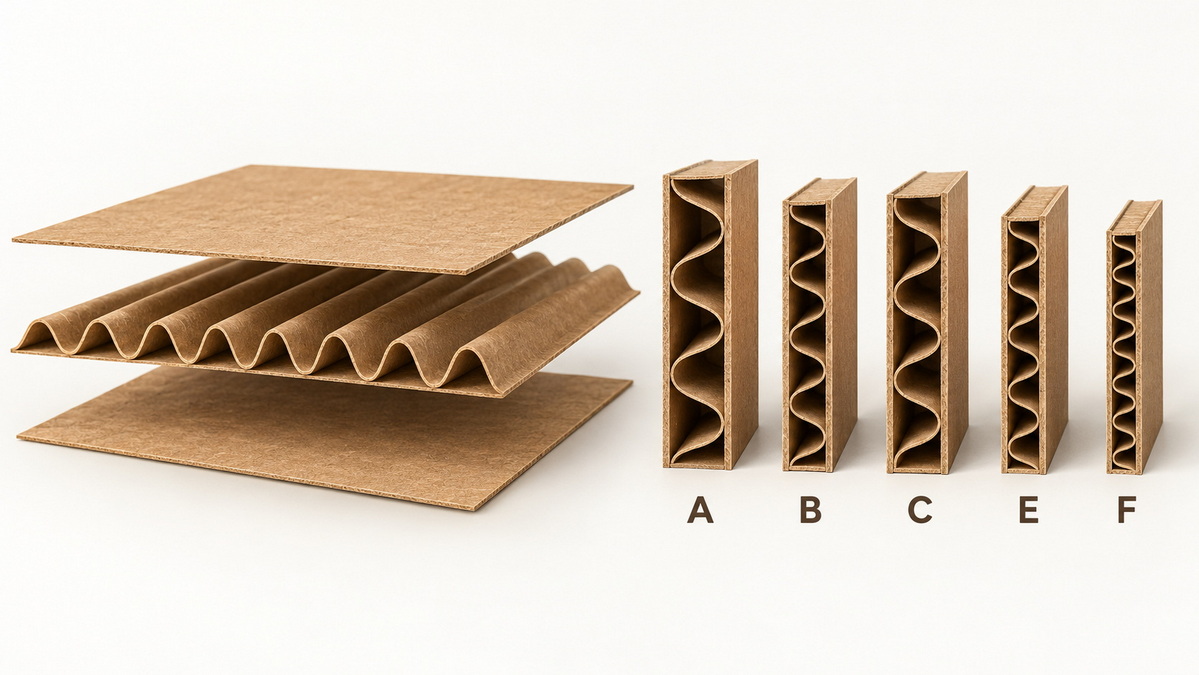
Wall construction describes the number of fluted layers and liners.
- Single-face board has one liner and one exposed fluted layer. It is commonly used for wrapping or cushioning.
- Single-wall board has two liners surrounding one fluted layer.
- Double-wall board has three liners and two fluted layers.
- Triple-wall board has four liners and three fluted layers.
Double-wall combinations such as BC or EB combine different profiles to balance structural depth, cushioning, and surface requirements.
Consider it when products are heavy, cartons face demanding stacking conditions, or distribution involves repeated handling.
However, adding another wall is not always the most efficient solution. A better-fitting carton, stronger paper combination, improved insert, or revised pallet arrangement may address the actual failure mechanism.
Compare alternatives using packed samples and defined acceptance criteria.
Box style affects packing speed, material use, closure security, and customer experience.
Die-cut mailers commonly use an integrated lid and interlocking panels. They suit subscription products, accessories, cosmetics, and curated gift sets.
Check whether the design needs additional sealing. A tuck closure that looks secure during a presentation may not remain closed throughout parcel handling.
Also consider the customer's opening experience: tear strips and return features should be specified deliberately.
A regular slotted container, often called an RSC, has flaps that meet at the center when closed.
This style is useful when buyers prioritize straightforward packing and sealing. It can also serve as an outer shipper around a decorative gift box.
For Maituohong Packaging customers combining magnetic boxes, folding gift boxes, and shipping cartons, the key is coordinating dimensions across the complete packaging system.
Strength terminology can be confusing because different tests measure different properties.
| Test | What it evaluates | What buyers should understand |
|---|---|---|
| Edge crush test, or ECT | Edgewise compression resistance of board | Relevant to estimating stacking performance |
| Burst test | Resistance to increasing pressure applied through a diaphragm | Not interchangeable with puncture resistance |
| Flat crush test | Resistance of fluting to crushing under perpendicular pressure | Evaluates flute integrity rather than complete-box stacking strength |
| Box compression test | Compression resistance of an assembled box | More directly evaluates the finished container |
A 32 ECT rating does not mean a box can universally hold 32 pounds. ECT is a board property, not a direct payload allowance.
Similarly, a burst rating does not establish complete-package protection.
A Box Maker's Certificate may identify the manufacturer, board construction, strength rating, size limit, and gross weight limit.
It helps buyers check specifications, but it is not proof that a particular product will survive transportation.
Inserts, closures, moisture exposure, handling, and product fragility still matter.
A strong purchasing brief reduces assumptions and makes supplier quotations easier to compare.
Provide product dimensions, weight, quantity per box, and photographs or samples.
Identify vulnerable areas, including glass edges, pumps, lids, polished surfaces, and projecting components. Include accessories that could move independently.
Explain whether the package will travel through parcel delivery, palletized freight, retail distribution, or a combination.
Mention expected storage duration and exposure to humid conditions.
Specify which measurements appear on drawings.
Internal dimensions determine product fit. External dimensions influence shipping charges, storage, and pallet layout.
Approve fit using a physical sample rather than dimensions alone.
Evaluate the carton, insert, tape, and product together.
Corrugated dividers or paperboard inserts may control movement, but their contact points must suit the product. An insert that holds an item tightly can still concentrate force on a vulnerable area.
Confirm the board specification, print process, color expectations, surface finish, and artwork version.
A visually approved sample should not silently replace the agreed structural specification.
Use representative products, production-intent materials, and the intended closure method.
Define acceptable product damage and package deterioration before testing. Record failures so revisions address the cause rather than merely adding material.
Luxury presentation and transport protection solve different problems.
Consider an illustrative skincare gift set with glass containers inside a magnetic rigid box. The rigid box provides the presentation. A fitted insert controls movement. A corrugated outer carton protects the assembled gift package during distribution.
The design review should ask:
- Can the containers contact each other?
- Could the insert load a fragile cap or pump?
- Does the gift box move inside the shipper?
- Can the exterior finish scuff during vibration?
- Is the outer carton easy to seal consistently?
This example is a design scenario, not a reported customer case. No customer reviews were supplied for this article, so no testimonials or customer outcomes are attributed.

The lowest unit price does not necessarily produce the lowest delivered cost.
Compare:
> Total packaging-related cost = packaging materials + packing labor + freight + damage-related costs.
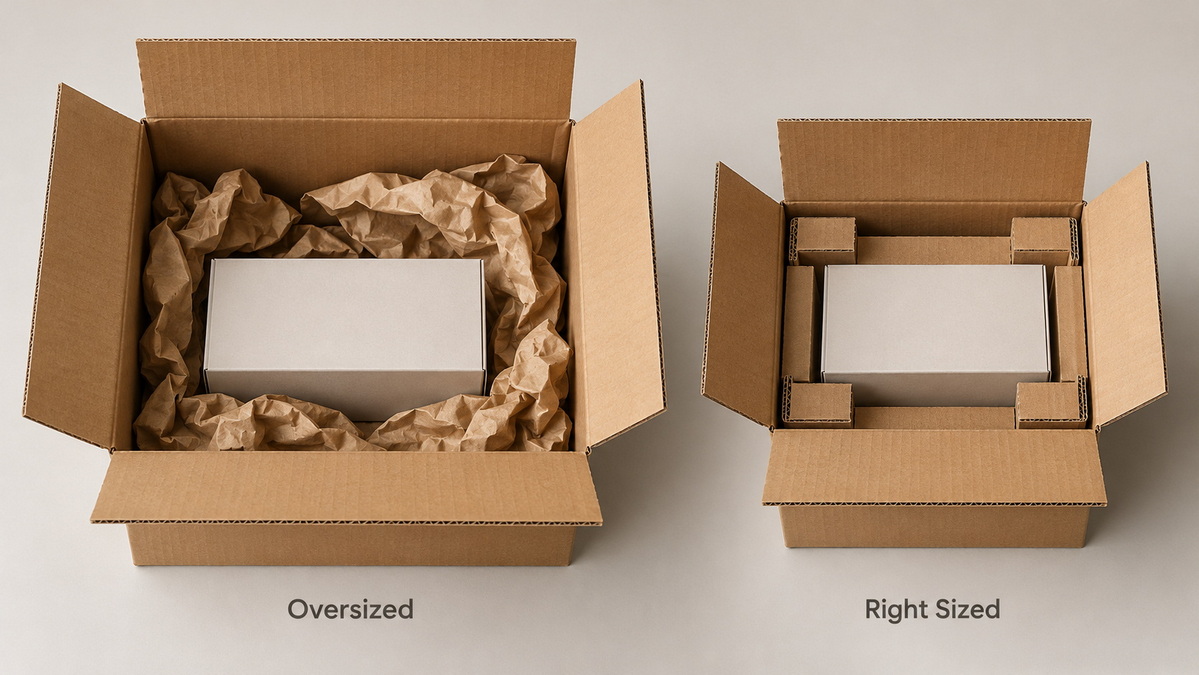
Carriers may calculate charges using dimensional weight when a package occupies substantial space relative to its actual weight.
For example, reducing external dimensions from 30 × 25 × 15 cm to 30 × 25 × 12 cm reduces volume from 11,250 to 9,000 cubic centimeters—a 20% reduction.
That does not guarantee a 20% freight saving. Carrier rules, rounding, service selection, and actual weight determine the bill.
Never remove protective clearance solely to reduce volume.
Ask each manufacturer to quote the same:
- Internal dimensions and dimensional tolerances.
- Board construction and strength requirements.
- Printing coverage and finishing.
- Inserts and closure components.
- Order quantity and delivery terms.
Otherwise, an apparently cheaper quotation may describe a materially different package.
Corrugated packaging can support fiber recovery, but environmental claims need qualification.
Recycled content describes the material entering the package. Recyclability concerns whether the finished package can be collected and processed in the relevant recycling system.
Do not assume that virgin-fiber kraft is always the most sustainable option, or that recycled liners are automatically unsuitable for demanding packaging.
Evaluate the complete specification and required performance.
Laminations, coatings, adhesives, and attached components may affect recycling compatibility. Ask suppliers to identify them and verify disposal guidance for the destination market.
Corrugated board is also moisture-sensitive. If humidity or water exposure is foreseeable, discuss material selection, protective measures, and conditioning during testing rather than describing ordinary corrugated packaging as weatherproof.
Maituohong Packaging brings over 18 years of paper-packaging experience to magnetic boxes, mailer and shipping boxes, rigid boxes, folding gift boxes, and paper shopping bags.
Send us your product dimensions, packed weight, order quantity, destination market, and artwork brief. Ask for a coordinated proposal covering the presentation box, protective insert, and outer shipper—so you can evaluate the complete package before approving production.
There is no universal best option. A die-cut mailer may suit a lightweight branded order, while an RSC with an engineered insert may better protect a heavier or fragile product.
Wall count alone is insufficient. Paper properties, flute construction, dimensions, converting quality, and environmental conditions influence performance. Compare specifications and finished-box test results.
Yes. Results depend on the liner surface, flute profile, artwork, and printing process. Request a representative print sample, particularly for fine text, large solid areas, or demanding brand colors.
Not every project requires the same testing. Select a procedure based on the distribution route and applicable customer requirements. ISTA Procedure 3A addresses individual packaged products for parcel delivery weighing 150 pounds or less.
Not automatically. A magnetic gift box primarily supports presentation. Whether it can ship without additional protection depends on its construction, contents, closure, and validated distribution performance.
Send product dimensions, weight, quantity, destination, box style, artwork requirements, and insert needs. Include your delivery route, launch schedule, and any required testing or retailer specifications.
1.PakFactory. "The Ultimate Guide to Corrugated Boxes: Types, Uses & Benefits." Original article reviewed for topic coverage and reconstruction. Its generalized flute recommendations and testing descriptions were not adopted without qualification: https://pakfactory.com/blog/learn/corrugated-box-101/
2.FEFCO. "FEFCO Testing Methods & Recommendations." Technical reference distinguishing bursting strength, puncture resistance, flat crush resistance, edgewise crush resistance, water absorptiveness, and compression resistance: https://www.fefco.org/technical-information/fefco-testing-methods-recommendations
3.International Safe Transit Association. "Test Procedures." Reference for the scope of Procedure 3A and its application to individual packaged products in parcel distribution: https://ista.org/test_procedures.php
4.International Safe Transit Association. "Getting Started with Design & Testing." Guidance supporting representative test samples and advance definition of product-damage and package-degradation criteria: https://www.ista.org/getting_started_with_design.php
5.UPS. "Shipping Dimensions and Weight." Reference for external package measurements, dimensional-weight calculations, and carrier-specific charging considerations: https://www.ups.com/us/en/support/shipping-support/shipping-dimensions-weight
6.UPS. "Packaging Guidelines." Reference for corrugated packaging selection, Box Maker's Certificate information, and gross-weight limitations: https://www.ups.com/assets/resources/webcontent/en_US/Packaging_Guidelines.pdf


