
Views: 257 Author: Maituohong Packaging Publish Time: 2026-11-04 Origin: Site


Content Menu
● Paper Bags vs. Gift Boxes: Key Differences at a Glance
● What Are Paper Bags and Gift Boxes?
>> Paper Shopping Bags: Designed Around Carrying
>> Gift Boxes: Several Structures, Different Capabilities
● Product Protection: Carrying Convenience vs. Structural Support
>> When Paper Bags Provide Enough Protection
>> When Gift Boxes Are the Better Choice
>> Retail Packaging Is Not Automatically Shipping Packaging
● Branding and Customer Experience
>> Paper Bags Extend Brand Visibility Beyond Checkout
>> Gift Boxes Create a More Controlled Presentation
● Cost Comparison: Look Beyond the Unit Quote
● Storage, Assembly, and Retail Operations
● Sustainability: Compare the Complete Packaging System
>> Distinguish Fiber Sourcing from Recyclability
>> Examine Coatings, Inserts, and Attachments
● A Practical Selection Method for Retail Buyers
>> Step 1: Map the Product Journey
>> Step 2: Define the Required Experience
>> Step 3: Compare Complete Packaging Options
>> Step 4: Approve a Production-Equivalent Sample
>> Step 5: Pilot Before Scaling
● When Combining Paper Bags and Gift Boxes Makes Sense
● Develop the Right Packaging with Maituohong Packaging
>> Are paper bags cheaper than gift boxes?
>> Which is better for fragile products?
>> Can magnetic gift boxes be used for shipping?
>> Are paper bags more sustainable than gift boxes?
>> What should I include in a custom packaging inquiry?
>> Should a gift box fit tightly inside its shopping bag?
Choosing between paper bags and gift boxes is not simply a question of price or appearance. Paper bags make purchases convenient to carry, while gift boxes provide structure, product organization, and a more deliberate presentation. The right retail packaging depends on what you sell, how customers receive it, and what happens after checkout.
At Maituohong Packaging, our perspective comes from more than 18 years of experience designing and manufacturing custom paper packaging, including magnetic boxes, rigid boxes, folding gift boxes, paper shopping bags, and mailer boxes. We approach packaging selection around one principle: fit—matching the structure to the product, sales channel, and customer experience.
This guide compares paper bags vs. gift boxes across protection, cost, customization, storage, and sustainability, then explains how to turn those differences into a practical purchasing decision.
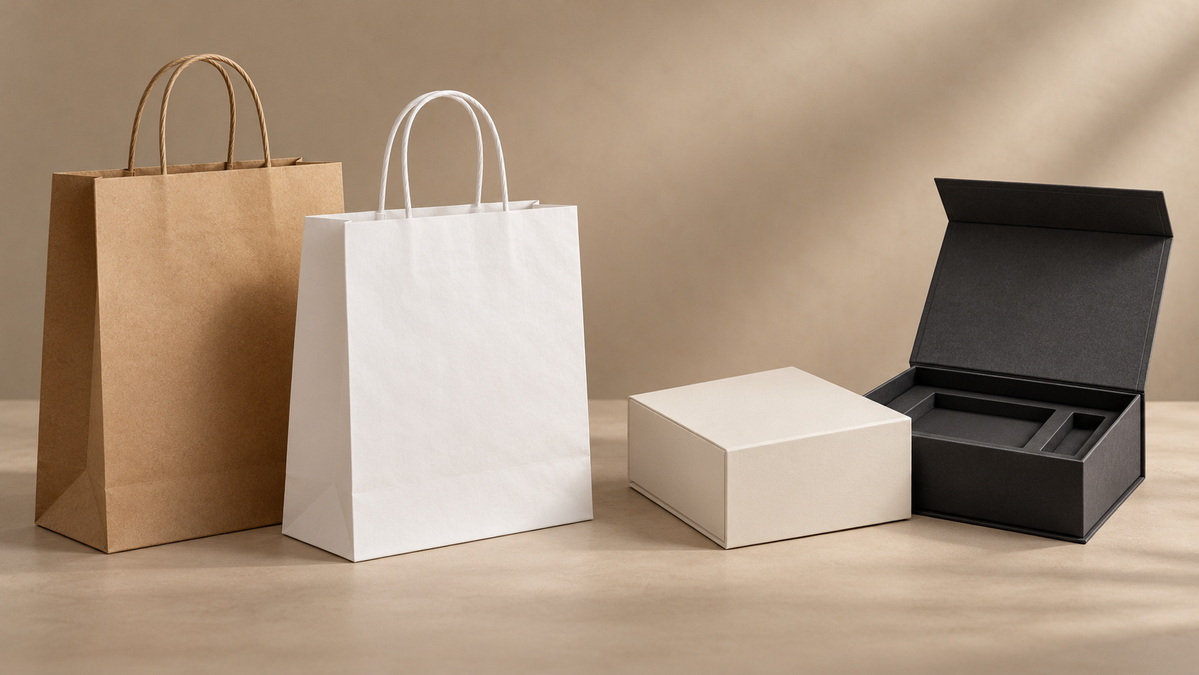
| Comparison factor | Paper shopping bags | Gift boxes |
|---|---|---|
| Primary purpose | Carrying purchases conveniently | Presenting and containing products |
| Structure | Flexible, usually with handles and gussets | Folding or rigid construction |
| Protection | Limited cushioning and crush resistance | More structural protection; inserts may be necessary |
| Presentation | Visible branding during customer transport | Controlled opening and product reveal |
| Storage | Usually supplied flat | Depends on whether the structure collapses |
| Cost drivers | Paper, handles, reinforcement, printing | Board, construction, wrapping, inserts, finishing |
| Suitable applications | Apparel, books, boutique purchases | Cosmetics, jewelry, curated sets, premium gifts |
| Parcel shipping | Generally requires separate transit packaging | Usually requires a suitable outer shipping package |
These categories overlap. A reinforced paper bag can carry a boxed product, while a folding gift box may occupy little space before assembly. Buyers should compare finished specifications rather than assume that every bag is inexpensive or every box is bulky.
Custom paper shopping bags typically combine a paper body, side gussets, a base, and handles. Materials may include kraft paper, coated printing paper, or specialty paper.
Performance depends on the complete construction. Handle attachment, reinforcement patches, paper properties, bottom bonding, and bag dimensions all influence how the package behaves when loaded.
For retail buyers, paper weight alone is not a reliable carrying-capacity specification. A production-equivalent sample should be tested with the actual contents.
"Gift box" describes a purpose, not one construction.
Common options include:
- Rigid boxes with wrapped paperboard walls.
- Magnetic closure boxes with hinged lids.
- Folding cartons made from creased paperboard.
- Collapsible rigid gift boxes designed for flatter storage.
These differences affect protection, assembly time, freight volume, and presentation. A lightweight folding carton should not be evaluated as though it performs like a rigid presentation box.
Paper bags suit products that already have adequate protection or tolerate normal hand-carrying.
Examples include folded clothing, boxed cosmetics, books, and accessories in protective pouches. Tissue paper can improve presentation and reduce light surface contact, but it should not be treated as impact protection.
Check whether products shift, handles pull against sharp edges, or concentrated weight strains the base.
Gift boxes are useful when products need separation, a defined position, or protection from routine handling.
For a glass fragrance bottle, the insert may matter as much as the outer box. A loose bottle can strike the walls even inside a substantial rigid structure.
Specify:
- Product dimensions, weight, and fragile areas.
- Clearances around the product.
- Insert material and retention method.
- Lid fit and closure performance.
- Acceptable cosmetic damage after handling.
A magnetic closure improves convenience and presentation, but it does not automatically make a package secure for delivery.
Neither a paper shopping bag nor a decorative gift box should be assumed suitable for parcel distribution.
A corrugated mailer or shipping box may be needed around the presentation packaging. Evaluate the product, insert, gift box, cushioning, and outer carton as one system.
ISTA Procedure 3A provides a general simulation framework for individual packaged products moving through parcel delivery networks. Testing should match the shipment profile rather than rely on an informal drop demonstration.
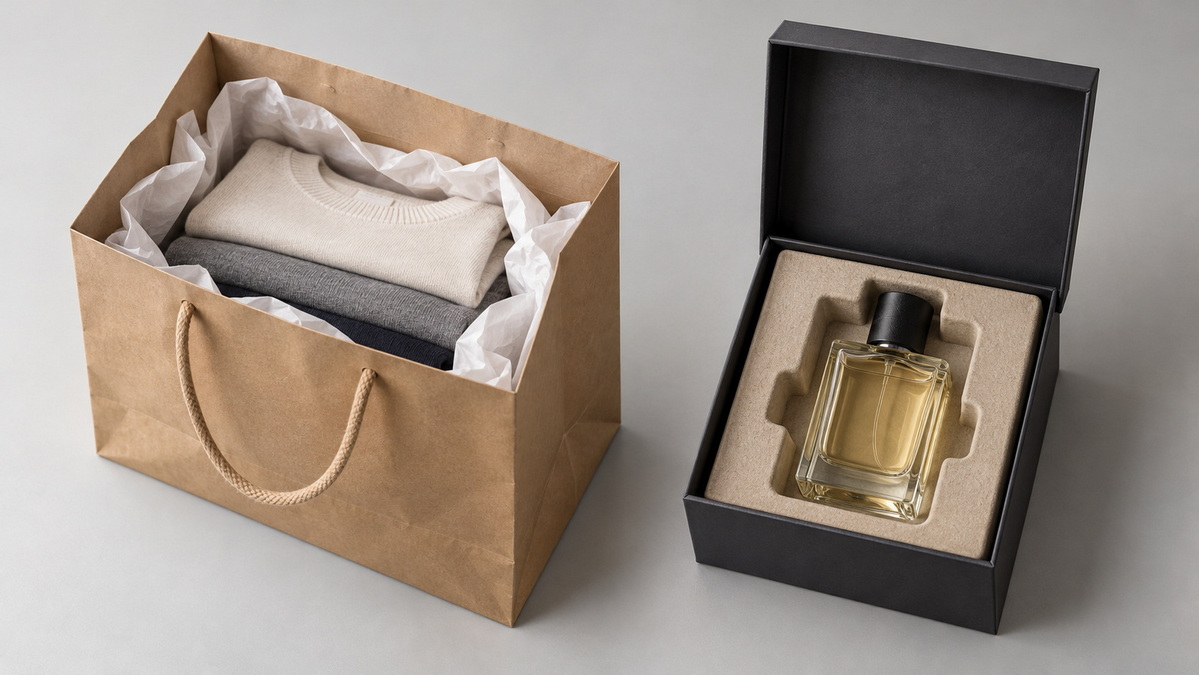
A paper bag exposes branding while customers carry their purchases. Its broad panels offer space for a logo, brand colors, and a simple visual identity.
However, visibility is an opportunity—not proof of additional sales. Keep artwork readable, handles comfortable, and proportions suitable for typical purchases.
An oversized bag may appear generous but allow small products to move around unnecessarily.
Gift boxes let brands organize how customers encounter the product.
A lid, tissue layer, insert, and printed message can establish a clear opening sequence. This is particularly useful for coordinated sets or products requiring orientation.
Premium presentation does not require every available finish. A well-fitted box with consistent color and clean wrapping can communicate more care than an oversized package covered in decorative effects.
For buyers, dimensional accuracy and finish consistency deserve as much attention as the initial artwork.
Paper bags often have a simpler construction than rigid gift boxes, but there is no universal price relationship.
A large specialty-paper bag with reinforced handles and elaborate finishing can cost more than a straightforward folding carton.
| Cost driver | Paper bags | Gift boxes |
|---|---|---|
| Material | Paper grade, size, reinforcement | Board grade, wrap, inserts |
| Decoration | Printing, foil, embossing, coatings | Printing, foil, wrapping, interior decoration |
| Components | Handles, eyelets, ribbons | Magnets, ribbons, trays, windows |
| Production | Bag forming and handle attachment | Cutting, wrapping, assembly, insert fitting |
| Logistics | Packed thickness and carton quantities | Assembled volume or flat-pack efficiency |
Compare quotations using the same order quantity, artwork coverage, dimensions, finish requirements, delivery terms, and quality criteria.
A useful comparison includes:
> Packaging materials + inbound freight + storage + packing labor + expected damage and replacement costs.
Consider a hypothetical gift-box upgrade costing $0.70 more per order. If it reduces damage from 3% to 1%, and each damaged order costs $25 to replace, the expected saving is $0.50 per order.
The remaining $0.20 requires justification through presentation, handling efficiency, or another measurable benefit.
These figures illustrate a calculation; they are not Maituohong customer results or industry benchmarks.
Paper bags generally store flat and open quickly at checkout. Traditional assembled rigid boxes occupy their full volume before use.
Collapsible rigid boxes can reduce empty-package storage volume, although the actual benefit depends on the design and packed configuration.
Compare operational details before ordering:
1. Units per master carton.
2. Master-carton dimensions and weight.
3. Time needed to open or assemble each package.
4. Space required at the packing station.
5. Ease of replenishing stock during busy periods.
Test more than one employee. A structure that looks efficient during a supplier demonstration may be awkward at a crowded retail counter.
Standardizing a few practical sizes can also reduce inventory complexity. Too many closely related sizes increase the chance of selection errors.
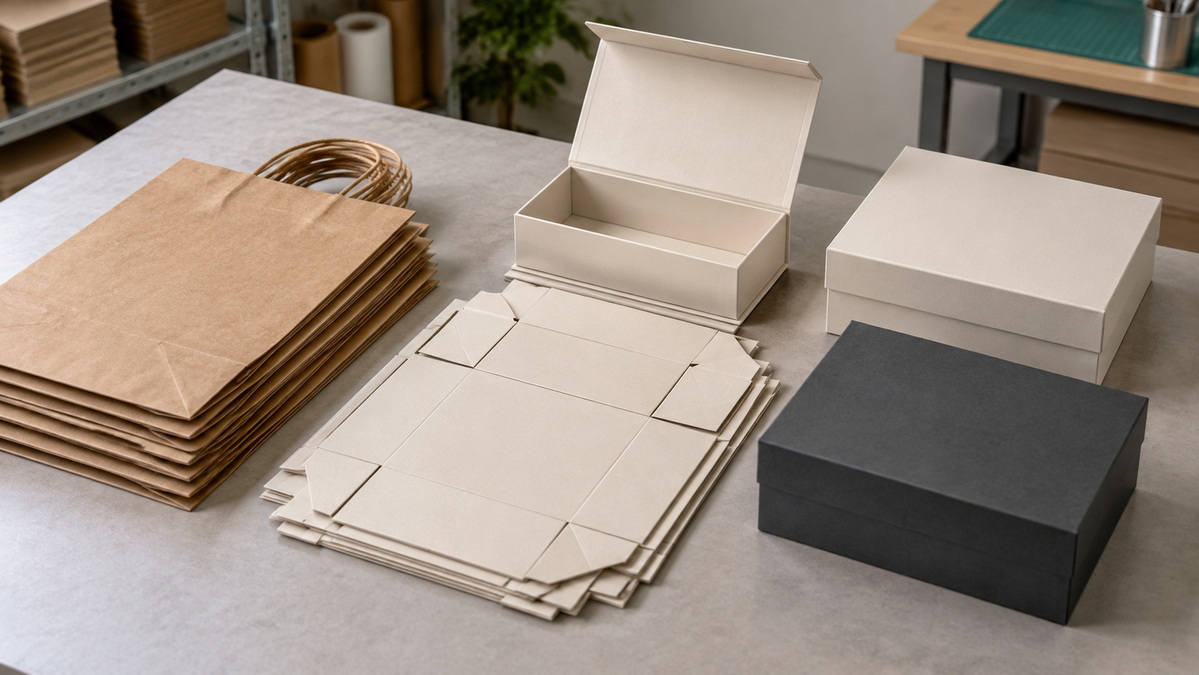
Neither paper bags nor gift boxes are automatically the more sustainable option.
A meaningful assessment considers material quantity, production, transport, reuse, product damage, and available end-of-life systems.
UNEP's life-cycle review of shopping-bag alternatives emphasizes that environmental outcomes depend on the full life cycle. It does not establish a universal environmental ranking between paper bags and gift boxes.
FSC labels communicate different sourcing categories:
- FSC 100% identifies forest-based material from FSC-certified forests.
- FSC Mix permits eligible combinations of certified, recycled, and controlled material.
- FSC Recycled identifies recycled forest-based material.
These labels should not be treated as interchangeable, nor as proof that every component of a finished package is recyclable.
Request documentation supporting the exact claim and confirm the permitted label use for the order.
Assess the whole package, including film laminations, foam inserts, magnets, ribbons, handles, and adhesives.
Ask which components consumers can separate and whether local collection systems accept the remaining material.
For US-facing environmental claims, FTC guidance requires appropriate qualification when recycling access is limited. Avoid broad promises such as "recyclable everywhere" without evidence.
A practical design review should ask whether unnecessary material can be removed without increasing damage or compromising essential functionality.
Record whether the order is collected in-store, carried home, shipped individually, or sent through several distribution stages.
Different journeys may justify different packaging combinations.
Decide whether the priority is convenient carrying, gift readiness, product organization, or presentation.
Rank these needs rather than treating every feature as equally important.
Evaluate a bag-only option, a box-only option, and a coordinated bag-and-box system where relevant.
Include tissue, inserts, labels, and outer shipping packaging in the comparison.
Check fit, handle comfort, closure alignment, print appearance, assembly, and component consistency.
A visual mock-up is useful, but it cannot establish the performance of materials or construction that differ from production.
Run a small operational trial. Record packing time, material consumption, damage, and customer comments.
Define acceptance criteria before reviewing the results so that packaging decisions do not depend only on appearance.
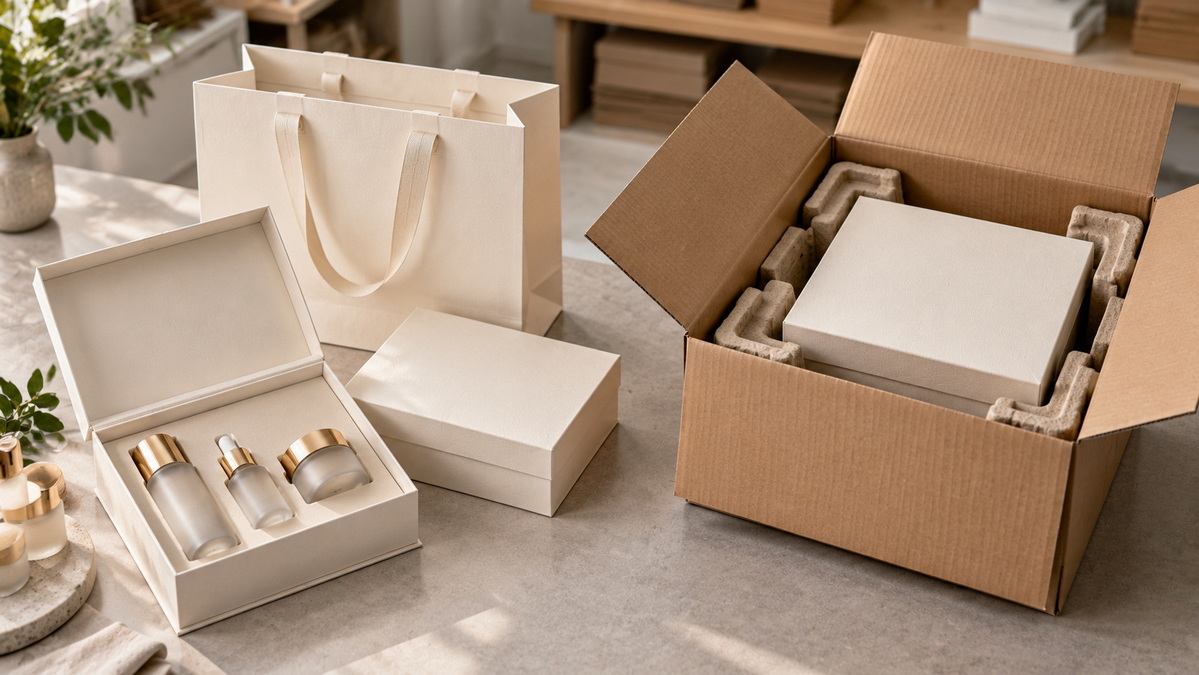
A combined system works when the box presents the product and the bag makes it convenient to carry.
For example, a hypothetical skincare gift set could use a fitted gift box for product organization and a shopping bag for in-store collection. Online orders might instead place that same box inside a tested corrugated shipping package.
This is an illustrative design scenario, not a documented client case.
Check the box's external dimensions against the bag's usable internal space. Include clearance for insertion, handle reinforcement, and any tissue or accessories.
The bag should support the complete purchase comfortably without making removal difficult.
The most useful packaging proposal starts with a product and a distribution requirement—not simply a request for "a luxury box" or "a strong bag."
Send Maituohong Packaging your product dimensions, weight, order quantity, destination market, sales channel, artwork, and required delivery date.
Request a side-by-side proposal for paper shopping bags, gift boxes, or a coordinated system, including material specifications, sample options, packed-carton dimensions, and quality checkpoints. This creates a clearer basis for comparing protection, presentation, and total delivered cost.
Often, especially compared with complex rigid boxes. However, size, paper grade, handles, finishing, quantity, and freight can change the result. Compare equivalent specifications and total order costs.
A properly engineered box-and-insert system is generally the stronger starting point. The complete package must still be evaluated against the product's fragility and expected handling.
They can form part of a shipping system, but should not automatically serve as the outer transit package. Assess the need for cushioning and a corrugated shipping box.
There is no universal answer. Compare the specific designs, material quantities, reuse patterns, transport requirements, damage performance, and local recycling options.
Provide product dimensions and weight, quantity, artwork, packaging purpose, destination, delivery requirements, and any sourcing or testing requirements. Include the full product set, not only the largest item.
It should fit securely but remain easy to insert and remove. Approve the combination using physical samples, allowing for handles, reinforcement, tissue, and normal dimensional variation.
1.United Nations Environment Programme. *Single-use Plastic Bags and Their Alternatives: Recommendations from Life Cycle Assessments.* Supports the life-cycle assessment discussion; it is not a direct paper-bag-versus-gift-box comparison. [Read the report]. [wedocs.unep]
2.International Safe Transit Association. *Test Procedure 3A: Overview.* Supports the distinction between presentation packaging and evaluating complete parcel-shipping systems. [View the procedure overview]. [ista]
3.Forest Stewardship Council, United States. *On-Product Labels.* Explains FSC 100%, FSC Mix, and FSC Recycled sourcing categories. [Read the label guidance]. [us.fsc]
4.US Federal Trade Commission. *Guides for the Use of Environmental Marketing Claims, 16 CFR Part 260.* Supports the discussion of recyclable claims, qualifications, and substantiation. [Read the guidance]. [ftc]


