
Views: 224 Author: Maituohong Packaging Publish Time: 2026-09-19 Origin: Site


Content Menu
● Paper Liquor Bags vs. Wine Bags: Quick Comparison
>> Typical Applications for Wine Bags
>> Core Design Features of Paper Wine Bags
>> Common Uses for Liquor Bags
>> Why Liquor Bags Need More Structural Attention
● The Biggest Difference: Bottle Geometry
>> Example: Same Volume, Different Bag Requirements
● Materials: Paper Choice Matters
● Load Capacity and Handle Design
>> Handle Options for Wine Bags
>> Handle Options for Liquor Bags
● Branding Differences Between Wine and Liquor Bags
● How to Choose the Correct Bag Size
● When Should You Use a Wine Bag?
● When Should You Use a Liquor Bag?
● Manufacturing Checklist for Custom Bottle Bags
● FAQ
>> What is the main difference between a paper liquor bag and a paper wine bag?
>> Can a wine bag be used for a whisky bottle?
>> What paper is best for custom wine bags?
>> Do liquor bags need reinforced bottoms?
>> What size paper bag fits a standard 750 ml wine bottle?
>> Can paper liquor bags include a logo and luxury finish?
>> Are paper wine bags suitable for two bottles?
>> How should I test a custom bottle bag before placing a bulk order?
Paper liquor bags and paper wine bags may look similar at first glance, but they are designed around different bottle shapes, weight profiles, retail uses, and brand expectations. For retailers, wineries, distilleries, gift companies, and alcohol distributors, choosing the correct paper bottle bag is essential for safe carrying, premium presentation, efficient packing, and consistent brand experience.
At Maituohong Packaging, we have spent more than 18 years designing and manufacturing custom paper shopping bags, rigid cardboard gift boxes, and paper packaging solutions. From our production experience, the key difference is simple: wine bags are usually optimized for tall, slim bottles, while liquor bags require greater flexibility for shorter, wider, heavier, or unusually shaped spirit bottles. However, the real decision involves much more than bag height.
This guide explains the differences between paper liquor bags and wine bags in detail, including materials, dimensions, handles, printing, protection, gifting applications, and practical sourcing considerations.
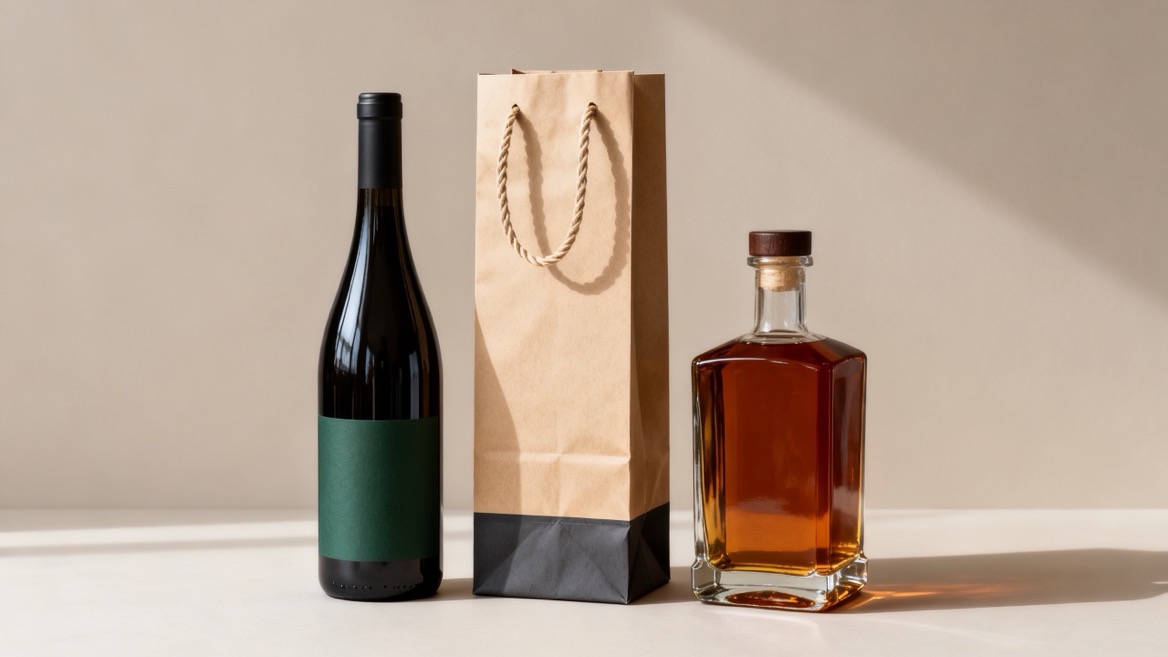
| Feature | Paper Wine Bags | Paper Liquor Bags |
|---|---|---|
| Primary use | Wine, champagne, prosecco, sparkling wine | Whisky, vodka, gin, rum, tequila, brandy, liqueurs |
| Typical bottle shape | Tall and narrow | Shorter, wider, round, square, or irregular |
| Common capacity | One, two, or three wine bottles | One bottle, gift set, multi-bottle pack, or customized configuration |
| Bag structure | Tall, narrow body with a stable bottom | Wider, more adaptable body with reinforced side and bottom support |
| Main priority | Bottle fit, vertical stability, elegant gifting | Weight capacity, shape compatibility, impact protection |
| Typical visual style | Refined, minimalist, winery-focused | Premium, bold, heritage-led, luxury-oriented |
| Common finishes | Kraft texture, embossed logo, foil stamping | Soft-touch lamination, foil, UV varnish, embossing, rigid inserts |
| Suitable bottles | Usually 750 ml wine bottles and champagne bottles | Standard and non-standard spirits bottles, including 700 ml, 750 ml, and 1 L formats |
| Custom inserts | Optional dividers for multiple bottles | Often recommended for gift sets and heavier glass bottles |
| Buying focus | Height, width, bottle neck clearance | Bottle shape, total weight, base strength, handle attachment |
The correct option should always be based on the actual bottle dimensions rather than the product category alone. A 750 ml square whisky bottle and a 750 ml Bordeaux wine bottle contain the same volume, but they place very different demands on the paper bag.
A paper wine bag is a specially designed paper shopping bag for carrying one or more wine bottles. Its defining feature is its tall and narrow structure.
Most wine bottles have a long neck, a relatively slim body, and a height that requires a vertical bag format. A typical single-bottle wine bag is often designed around a standard 750 ml bottle. In the market, one-bottle paper wine bags commonly measure around 5.25 × 3.5 × 13 inches, while double-bottle versions are often about 6.5 × 3.5 × 14 inches. Actual bag dimensions should still be verified against the customer's bottle sample before production.
Paper wine bags are commonly used by:
- Wineries and vineyards
- Wine shops and bottle stores
- Supermarkets and specialty retailers
- Restaurants offering takeaway wine
- Hotels and resorts
- Wine clubs
- Corporate gifting companies
- Event organizers
- Holiday gift campaigns
A wine bag should allow a customer to carry the bottle naturally in one hand while preventing excessive movement inside the bag. It must also create a gift-ready appearance without requiring additional wrapping.
A well-designed custom wine paper bag normally includes:
- A tall body proportion suitable for the bottle height
- A bottom gusset that supports the bottle base
- Strong paper stock, often kraft paper or coated art paper
- Reinforced bottom board when higher load capacity is needed
- Twisted paper handles, cotton rope handles, ribbon handles, or flat paper handles
- Optional printed logo, brand pattern, seasonal artwork, or wine-region storytelling
- Optional inner divider for two-bottle or three-bottle configurations
For a standard single 750 ml wine bottle, a practical starting point is often a tall bag around 4 × 4 × 14 inches. Champagne bags generally need extra height and sometimes more depth because sparkling-wine bottles are wider and heavier than many still-wine bottles.
A paper liquor bag is designed for carrying distilled spirits and related alcoholic beverages, including whisky, vodka, gin, rum, tequila, brandy, cognac, liqueurs, and premium gift bottles.
Unlike wine bottles, liquor bottles come in a far wider range of shapes. Some are rectangular. Some have wide shoulders. Some have heavy, thick glass bases. Others use decanter-inspired forms, faceted surfaces, or customized bottles intended to communicate luxury.
That variety makes the paper liquor bag more technically demanding.
Paper liquor bags are frequently used for:
- Distillery retail stores
- Duty-free shops
- Premium liquor retailers
- Whisky and bourbon brands
- Spirits gift boxes
- Holiday promotions
- Hotel minibar and concierge programs
- Corporate gifts
- Festival gift sets
- Airport retail programs
Many liquor brands use packaging as an extension of their product identity. A heritage whisky brand may prefer deep-color kraft paper, antique gold foil, textured stock, and rope handles. A modern gin brand may prefer a clean white bag, matte lamination, botanical illustrations, and a contrasting colored handle.
In our packaging projects, we often find that a liquor bag should not be selected only by bottle volume. A 700 ml or 750 ml spirit bottle may be significantly heavier than a wine bottle because of thicker glass, wider bases, decorative closures, or included accessories.
A strong custom liquor paper bag may require:
- Higher paper grammage
- Reinforced bottom cardboard
- Folded and glued side gussets
- Extra-strong handle patch reinforcement
- Wider bag depth
- Laminated paper for a premium surface
- Protective inner board or foam insert for gift bottles
- Partition inserts for multi-bottle sets
For high-value spirits, packaging failure can damage both the bottle and the brand. A torn handle, collapsed base, or poorly fitted bag makes a premium product feel less reliable before the customer has even opened it.
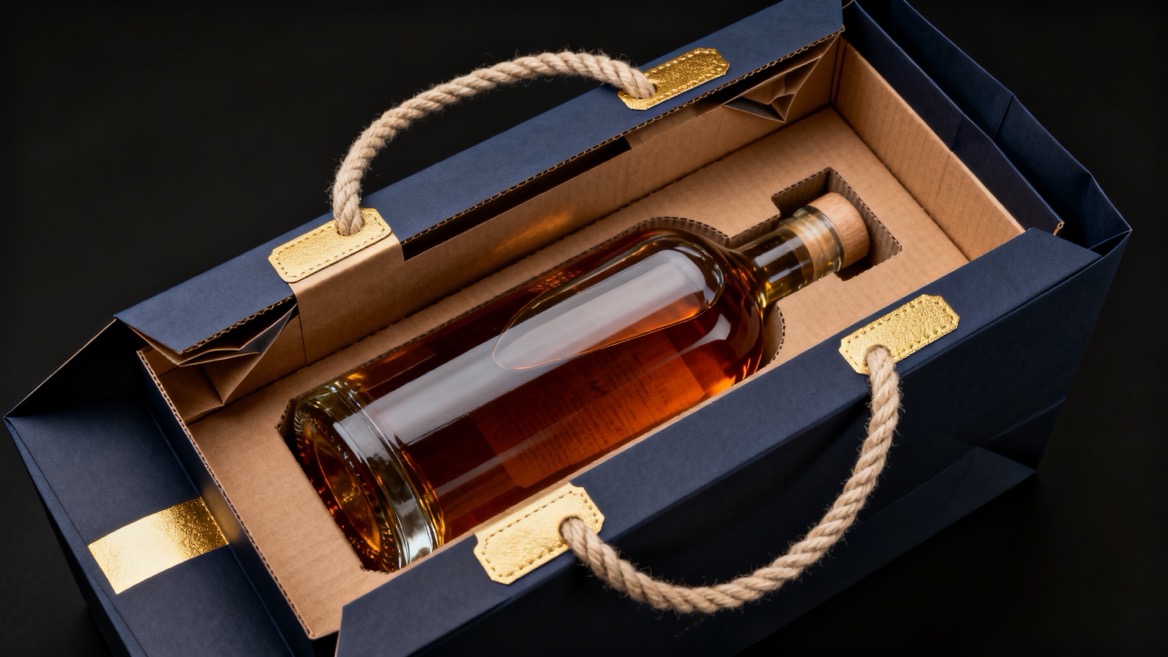
The most important distinction between paper liquor bags and wine bags is bottle geometry.
Wine bottles are comparatively standardized. While Bordeaux, Burgundy, Riesling, champagne, and magnum bottles differ in shape, their overall formats are usually tall and vertically oriented.
Liquor bottles are less predictable. They may be:
- Short and broad
- Tall with thick glass
- Square or rectangular
- Round with a large diameter
- Decanter-shaped
- Packed with a secondary carton
- Supplied as a bottle-and-glass gift set
- Designed with a large cap, wax seal, or decorative neck tag
This means a wine bag can often be developed using a small range of standard die-lines. A liquor bag is more likely to require bottle-specific engineering.
Consider two 750 ml bottles:
| Product | Typical Shape | Packaging Challenge | Recommended Bag Direction |
|---|---|---|---|
| Bordeaux wine | Tall, slim, long-necked | Needs vertical height and stable base fit | Tall, narrow wine bag |
| Champagne | Tall, broad-shouldered, heavier | Needs more depth and strong base | Taller wine bag with reinforced bottom |
| Square whisky bottle | Wide, flat-sided, thick glass | Needs greater depth and handle strength | Wider liquor bag with reinforced handle patch |
| Premium gin bottle | Round, heavy, decorative | Needs diameter clearance and movement control | Custom liquor bag with fitted base or insert |
| Cognac gift set | Bottle plus glasses or accessories | Needs separation and gift presentation | Luxury liquor bag with divider or rigid-box combination |
The volume printed on the bottle does not determine the correct bag. The external dimensions, weight, center of gravity, and retail presentation requirement do.
Both wine bags and liquor bags can use kraft paper, white kraft paper, coated paper, art paper, textured paper, or recycled paper. The best choice depends on the load requirement, printing design, and desired market position.
Kraft paper is a popular choice for wine bags because it combines a natural appearance with strong tear resistance. Natural brown kraft works especially well for wineries, organic wine brands, farm shops, and sustainable gift programs.
Common advantages include:
- Natural and authentic visual appeal
- Stronger feel than lightweight ordinary paper
- Good suitability for one-color or two-color printing
- Easy customization with stamped logos
- Appropriate for rustic, premium, and environmentally conscious branding
- Compatibility with twisted paper handles and flat paper handles
A heavyweight kraft wine bag is especially suitable for one- or two-bottle takeaway programs.
Premium liquor bags more often use coated art paper, laminated paper, or specialty paper because many spirits brands want a more luxurious retail experience.
Popular finishing options include:
- Matte lamination
- Gloss lamination
- Soft-touch lamination
- Hot foil stamping
- Spot UV
- Embossing
- Debossing
- Metallic ink
- Textured paper
- Ribbon or cotton rope handles
These finishes can create a higher perceived value, but they should never replace structural performance. A beautiful bag still needs the correct paper weight, bottom reinforcement, and handle construction.
Handles are often underestimated. In reality, handle failure is one of the most damaging packaging problems for bottled products.
For paper liquor bags and wine bags, the handle system must work with the bag body, paper strength, bottom construction, and expected bottle weight.
Wine bags often use:
- Twisted paper handles
- Flat paper handles
- Cotton rope handles
- Paper rope handles
- Satin ribbon handles for gift-focused projects
Twisted paper handles are a practical choice for many retail wine bags because they offer a clean look and reliable carrying performance. Cotton rope handles are more suitable when the wine is positioned as a premium gift.
Liquor bags often require more visible reinforcement, especially for heavy glass bottles or gift sets. Suitable options include:
- Cotton rope handles with reinforced patches
- Polyester rope handles
- Ribbon handles for lightweight gift packaging
- Die-cut handles for compact gift bags
- Premium paper handles with double-layer attachment boards
For high-end spirits, we recommend evaluating the full package weight, including the bottle, cap, secondary carton, promotional materials, and any accessories. This is particularly important for boxed whisky, multi-bottle gift packs, and duty-free retail packaging.
Wine and liquor bags can both support strong brand communication, but the visual language usually differs.
Wine packaging often communicates:
- Vineyard origin
- Grape variety
- Terroir
- Harvest story
- Food pairing
- Seasonal gifting
- Organic or natural positioning
- Local craftsmanship
Wine bags often perform well with restrained visual design. A natural kraft bag with a one-color winery logo, subtle embossing, and cotton rope handles can feel more credible than an overly decorated design.
Liquor packaging often emphasizes:
- Heritage
- Aging process
- Distillery story
- Craftsmanship
- Luxury
- Celebration
- Exclusivity
- Gift value
- Collector appeal
A liquor bag may include richer colors, metallic foil, dark backgrounds, detailed patterns, and tactile finishes. For example, a premium whisky retailer may use black matte paper, copper foil branding, and black cotton rope handles to communicate depth and sophistication.
The right design should match the product price point. A luxury bag should feel intentional, not merely expensive.
Selecting the right paper wine bag or liquor bag starts with measurement. Do not rely only on a "standard bottle bag" label.
Use the actual bottle or a verified technical drawing.
1. Bottle height
Measure from the bottom of the bottle to the top of the cap, cork, wax seal, or closure.
2. Maximum width or diameter
Measure the widest area, not only the base.
3. Bottle depth
This is critical for square, rectangular, oval, and decanter-shaped liquor bottles.
4. Total filled weight
Include glass, liquid, closure, carton, and accessories.
5. Neck and shoulder clearance
Ensure the bottle can enter and leave the bag without catching on the top edge.
6. Retail presentation requirement
Decide whether the bottle should be fully hidden, partially visible, or accompanied by a gift box.
For a single bottle, begin with these allowances:
Bag width=bottle width+10–20 mm
Bag depth=bottle depth+10–20 mm
Bag height=bottle height+20–40 mm
The exact allowance depends on the paper thickness, the bag's folded construction, whether an insert is used, and how tightly the bottle should fit. For a premium custom project, physical sampling is the most reliable way to confirm the dimensions.
Choose a paper wine bag when:
- Your product is primarily wine, prosecco, champagne, or sparkling wine
- Your bottle has a tall, narrow profile
- You need a straightforward one-bottle or two-bottle retail carry bag
- You want an elegant gifting solution without a full rigid box
- Your retail staff needs fast, easy packing
- You need a repeatable bag format for common bottle sizes
- You want a lower-complexity packaging solution for winery retail or events
A wine bag is ideal when the bottle itself is attractive and should remain the center of attention.
Choose a paper liquor bag when:
- Your bottles have square, round, broad, short, or irregular shapes
- The glass is heavy or thick
- You sell premium spirits, collector bottles, or gift sets
- You need a more luxurious unboxing and carrying experience
- You need extra bottom support or stronger handles
- The bag must hold a bottle plus accessories
- You want to use high-end finishes such as foil, embossing, and soft-touch lamination
A liquor bag is often the better choice when bottle protection and brand presentation are equally important.
Before approving production, confirm the following details with your paper bag manufacturer:
- Bottle sample or complete bottle dimensions
- Product weight
- One-bottle, two-bottle, or multi-bottle capacity
- Required load capacity
- Paper type and paper weight
- Handle style and handle reinforcement method
- Bottom board requirement
- Inner divider or protective insert requirement
- Printing colors and finish requirements
- Artwork files and logo placement
- Packaging quantity per carton
- Shipping method and destination
- Sample approval procedure
- Quality inspection standards
At Maituohong Packaging, we advise customers to test the prototype with the real filled bottle rather than an empty bottle. The filled product has different weight distribution, and that difference can affect base performance, handle tension, and customer carrying comfort.
The following problems are common in bottle-bag sourcing projects:
- Choosing the bag according to liquid volume instead of bottle dimensions
- Using a standard wine bag for a heavy square liquor bottle
- Selecting paper thickness without reviewing handle construction
- Forgetting the extra height created by large caps or wax seals
- Ignoring carton size and shipping efficiency
- Using a luxury surface finish on a weak bag structure
- Ordering multi-bottle bags without dividers
- Skipping physical load testing before mass production
- Designing artwork without considering folds, gussets, and handle placement
- Failing to check regional alcohol-carryout packaging requirements
Alcohol packaging requirements differ by market. In the United States, the Alcohol and Tobacco Tax and Trade Bureau regulates aspects of alcohol labeling, advertising, and marketing, while standard container-size rules may also apply to wine and spirits. Packaging teams should verify the applicable local requirements before launch.
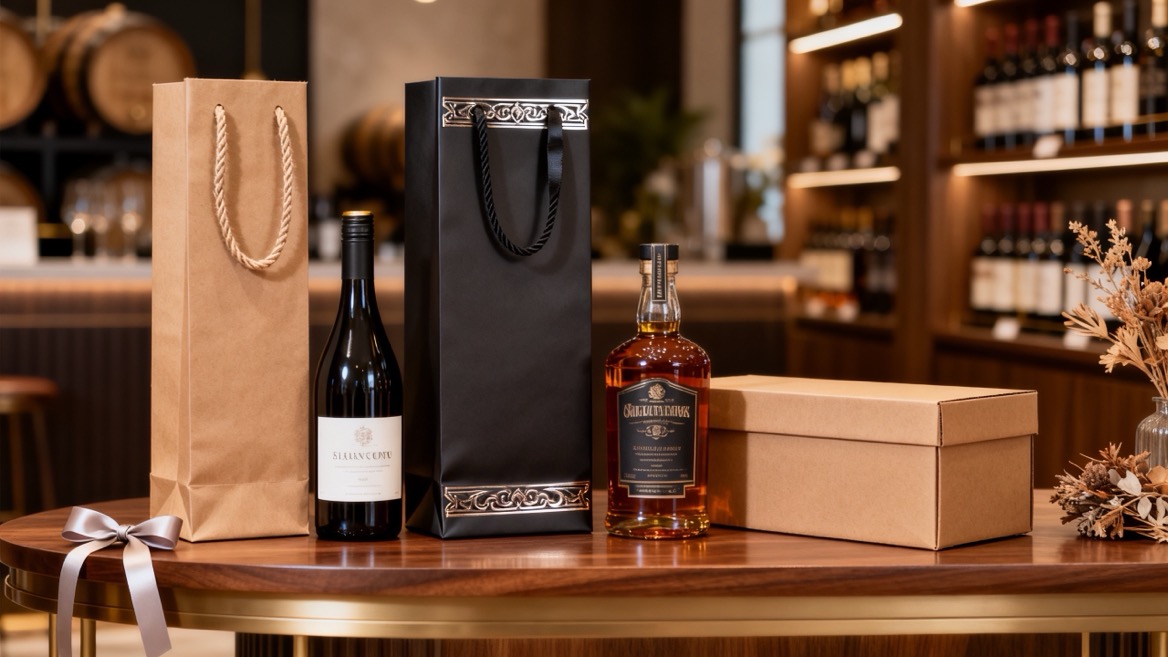
Paper liquor bags and wine bags are both valuable tools for alcohol retail, gifting, and brand presentation. Yet they should not be treated as interchangeable.
A paper wine bag is usually the best choice for tall, narrow bottles where elegant vertical presentation and efficient retail carrying are the main goals. A paper liquor bag is better suited to heavier, wider, more distinctive, or premium bottles that require stronger construction and more flexible dimensions.
The best packaging begins with the bottle itself. Measure the product, understand the customer journey, define the required brand position, and test the final bag under real carrying conditions.
If you are developing custom paper wine bags, liquor bags, rigid gift boxes, or branded paper shopping bags, Maituohong Packaging can help turn your bottle dimensions and brand concept into a practical packaging solution. Share your bottle sample, target quantity, artwork, and market requirements to begin a tailored packaging consultation.
The main difference is bottle compatibility. Paper wine bags are typically tall and narrow for wine bottles, while paper liquor bags are designed with more flexible width, depth, bottom support, and handle strength for spirit bottles with varied shapes and weights.
It depends on the whisky bottle. A tall, slim whisky bottle may fit a wine bag, but square, wide, or heavy whisky bottles usually need a custom liquor bag with greater depth and reinforced construction.
Heavyweight kraft paper is a strong and versatile option for many wine bags. For more premium projects, coated art paper, textured paper, or laminated specialty paper may be used, especially when detailed printing or luxury finishes are required.
Reinforced bottoms are highly recommended for heavy glass liquor bottles, premium gift sets, multi-bottle packs, and bottles with thick bases. A bottom board improves stability and reduces the risk of bag failure during carrying.
A common starting size is approximately 4 × 4 × 14 inches, but the right size depends on the actual bottle shape. Champagne, Burgundy, magnum, and decorative bottles may need additional width, depth, or height.
Yes. Custom liquor bags can include printed logos, foil stamping, embossing, matte lamination, soft-touch lamination, spot UV, ribbon handles, cotton rope handles, and custom inner inserts.
Yes. Double wine bags are commonly used for wine gifts, wine clubs, retail promotions, and holiday sales. A divider or reinforced bottom is recommended to prevent bottles from hitting each other during transport.
Test a physical sample using the actual filled bottle. Check the fit, handle comfort, base stability, bottle movement, print alignment, and carrying performance under the expected load. For heavier products, conduct repeated lift and transport tests before approving mass production.
1. [Rapp's Packaging: Paper Wine Bottle Bags]
2. [United States Metric Association: Packaging Regulations for Alcoholic Beverages]
3. [PackagingLaw.com: Regulation of Alcohol Packaging]
4. [Gilchrist Bag Manufacturing: Wine and Liquor Bags]
5. [Kriptee: Wine and Bottle Paper Bag Sizing Guide]


