
Views: 241 Author: Maituohong Packaging Publish Time: 2026-10-22 Origin: Site


Content Menu
● Why Source SOS Bags from China?
>> Regional Manufacturing Clusters Worth Understanding
● How These Suppliers Were Selected
● Top 10 SOS Bags Manufacturers and Packaging Partners in China
>> 2. Dongguan Xianda Printing Co., Ltd.
>> 3. Shenzhen XingKun Packing Products Co., Ltd.
>> 5. Fujian Nanwang Environment Protection Scien-Tech Co., Ltd.
>> 6. Zhejiang Qianlin Packaging Technology Co., Ltd.
>> 7. Guangzhou Maibao Package Co., Ltd.
>> 8. Guangdong Union Eco-Packaging Scien-Tech Co., Ltd.
>> 9. Jiangmen MST Packaging Group Limited
>> 10. Bestar Pack Group Limited
● Supplier Comparison: Capacity, MOQ, and Certification Evidence
● Technical Buying Guide: Specify Performance Before Price
>> Define the Bag Construction
>> Do Not Confuse Grammage with Strength
>> Ask for Relevant Compliance, Not Impressive Logos
● Common Sourcing Pitfalls—and How to Avoid Them
>> Pitfall 1: Approving a Sample That Does Not Represent Production
>> Pitfall 2: Accepting Material Substitution Without a Change Record
>> Pitfall 3: Mistaking Factory-Wide Capacity for Available Capacity
>> Pitfall 4: Treating Certification as Product Approval
● An Overlooked Purchasing Trap: The Wrong Production Route
● Sampling, Inspection, and Logistics
>> Use a Three-Stage Approval Process
>> Inspect Against Agreed Defects
● Conclusion: Choose the Supplier That Fits Your Packaging Programme
● Five Advanced Procurement FAQs
>> 1. How Can I Check Whether a Supplier's ISO Certificate Is Expired or Suspended?
>> 2. Does an FSC Logo on a Website Mean My Order Will Be FSC-Certified?
>> 3. Can One Food-Contact Report Cover Every Paper Colour, Ink, Coating, and Bag Size?
>> 4. How Can I Prevent Quality Deterioration After the First Order?
>> 5. How Should I Compare a Low-MOQ Packaging Company with a High-Volume SOS Specialist?
China offers a substantial sourcing base for SOS bags, from automated food-packaging producers to custom-printing companies that coordinate bags, gift boxes, and retail packaging. For international procurement teams, the challenge is not finding suppliers. It is identifying which suppliers can consistently deliver the required bag construction, material performance, compliance documentation, and production capacity.
SOS generally means "self-opening sack" or "self-opening satchel." These bags feature side gussets and a flat, usually rectangular bottom that allows them to stand upright when opened. Common applications include takeaway meals, bakery products, groceries, and selected dry-food products. However, an uncoated takeaway bag and a laminated flour bag are different packaging systems, even when both are marketed as SOS bags.
This guide evaluates suppliers through manufacturing relevance, material traceability, development support, quality control, and delivery evidence—not simply company size.
An important distinction is verification. The first four companies below offer broader custom-packaging capabilities and may suit coordinated brand-packaging projects. The remaining six publish more direct SOS bag or food-paper-bag offerings. A listing does not independently establish that a supplier manufactures every bag construction in-house.
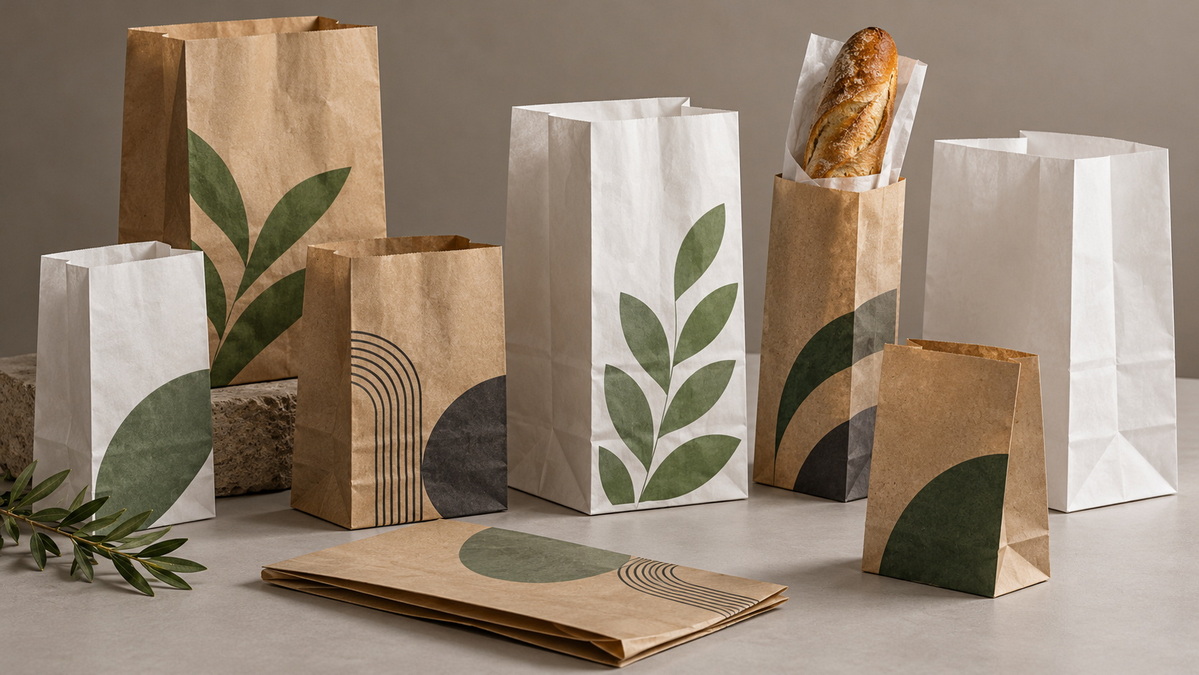
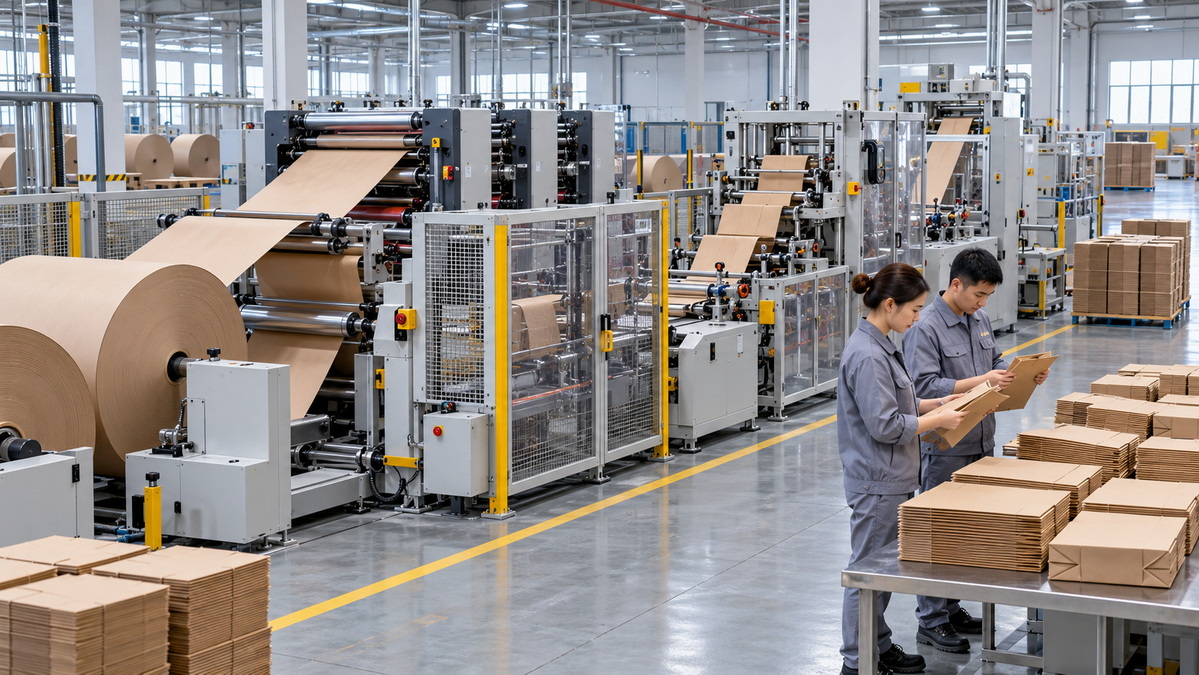
China's advantage extends beyond bag conversion. Buyers can access paper sourcing, printing, structural development, coatings, finishing, and export coordination within established regional supply networks.
The China Paper Association's 2025 annual industry report, published in 2026 and reproduced by the Sichuan Paper Industry Association, reports:
- Paper and paperboard production of 141.35 million tonnes, up 3.74% year on year.
- Packaging-paper production of 7.85 million tonnes, up 1.29%.
- Paper-products exports of 7 million tonnes, up 9.72%.
These figures describe the wider paper industry, not the SOS bag market specifically. They demonstrate supply-chain scale but should not be presented as evidence of SOS bag market share.
Three sourcing regions are particularly relevant to this shortlist:
- Longgang and Wenzhou, Zhejiang: Qianlin identifies Longgang as its production base and describes an integrated kraft-paper-bag operation with printing and automated bag-making equipment.
- Dongguan, Shenzhen, Guangzhou, and Huizhou, Guangdong: The companies reviewed here cover custom gift packaging, retail printing, and food-paper packaging across these connected manufacturing locations.
- Quanzhou, Fujian: Nanwang's headquarters and manufacturing presence support large-scale paper-bag and food-packaging procurement.
For buyers, the practical benefit is access to different production models. A retail brand may prioritize coordinated artwork and flexible development, while a restaurant distributor may need high-volume bag conversion and repeatable food-contact documentation.
This is a commercial sourcing shortlist, not an audited ranking by revenue, export volume, or independently measured product quality. Maituohong Packaging appears first as the publishing company; the other three requested custom-packaging businesses follow before the more directly documented SOS bag specialists.
The assessment uses six criteria:
| Selection criterion | Evidence buyers should request |
|---|---|
| Product relevance | Actual SOS bag samples, construction drawings, and relevant production footage |
| Factory capability | Site-specific equipment list, production route, and disclosure of subcontracted processes |
| Development support | Material recommendations, dielines, artwork review, and production-representative samples |
| Quality management | Incoming material inspection, in-process checks, finished-product testing, and batch traceability |
| Compliance | Current certificates and test reports matching the legal entity, factory, material, and intended use |
| Delivery stability | Capacity reserved for the project, previous shipment performance, and a documented replenishment plan |
Company websites provide useful starting evidence, but their capacity and certification statements remain supplier claims unless independently checked. Where an establishment date, numerical MOQ, or SOS-specific capacity was not clearly available, this guide identifies the gap rather than supplying an estimate.
Maituohong Packaging is a candidate for brands seeking coordinated paper bags, magnetic boxes, rigid boxes, folding gift boxes, and mailer packaging. Its published product range includes paper shopping bags alongside several custom box categories.
- Establishment and experience: The company background supplied for this guide states more than 18 years of experience. Its reviewed About page does not establish an exact founding year.
- Market focus: Custom packaging for international brands; a country-by-country sales breakdown was not available on the reviewed page.
- OEM/ODM scope: Structural development, material selection, printing, finishing, sampling, manufacturing, and delivery coordination.
- Published quality systems: The company describes incoming, in-process, final, and outgoing quality inspections and states ISO 9001, ISO 14001, and FSC credentials. Current certificates require verification.
Its potential value for small and midsized brands lies in combining packaging development with a direct consultation-to-sampling workflow. Buyers can use that process to coordinate bag graphics with gift boxes and shipping packaging rather than managing each item separately.
Maituohong also emphasizes cost optimization and responsive project support. These are useful evaluation points, but communication speed, development flexibility, and total cost should be tested through a real inquiry and sample project—not assumed from positioning alone.
Purchasing consideration: The reviewed page does not confirm a dedicated automated SOS bag line. Before awarding a recurring foodservice contract, request the precise bag specification, production location, conversion method, and disclosure of any partner manufacturing.
Xianda publishes custom paper bags alongside flower boxes, cosmetic packaging, jewelry boxes, and other printed gift-packaging products. Its website identifies design and sampling departments, making it relevant to buyers coordinating branded bags with premium secondary packaging.
- Establishment: Multiple company pages state 2006, although the homepage also contains a conflicting 2014 statement.
- Main markets: Domestic and international brand-packaging customers; the reviewed sources do not provide a reliable geographical revenue split.
- OEM/ODM scope: Custom structures, printing, gift packaging, and paper bags.
- Published scale: Approximately 15,000 square metres of factory space; this is not an SOS bag output figure.
Xianda's strongest documented fit is appearance-led packaging development. It may suit retailers that need coordinated shopping bags and presentation boxes.
Purchasing consideration: Its pages also use variations of the company name, including Dongguan Xianda Packaging Co., Ltd. Confirm the contracting entity, founding date, factory address, and certificate holder against the business licence. Do not infer automated food-grade SOS bag capability from a general paper-bag offering.
Shenzhen XingKun Packing Products Co., Ltd. offers printed packaging, display stands, cards, books, labels, and paper bags. Its integrated approach may suit brands that need bags as part of a wider retail launch.
- Establishment: The company states that it has operated in printing and packaging since 2004.
- Main markets: Brands and distributors across more than 30 countries and regions.
- OEM/ODM scope: Design-to-production support for printed packaging and related retail materials.
- Published service indicators: Prototyping in three to five days and general production turnaround in seven to fifteen days, subject to project requirements.
- Published credentials: ISO 9001 and FSC claims, plus a stated BSCI-related social-compliance credential.
Its relevant strength is coordinating multiple printed products under one development process.
Purchasing consideration: General turnaround claims are not contractual SOS bag lead times. Confirm the bag-making route, food-contact suitability, numerical MOQ, and whether samples use the same machinery and materials as the production order.
Bonito Packaging offers structural design, material selection, printing, finishing, inspection, and production for custom paper packaging. Its website focuses primarily on cartons, rigid boxes, gift boxes, and retail packaging rather than dedicated SOS bag conversion.
- Establishment: The reviewed homepage states more than a decade of experience but does not provide an exact founding year.
- Main markets: Global brands, retailers, and e-commerce companies across more than 20 countries and regions.
- OEM/ODM scope: Custom structures, printing, materials, and finishing for paper packaging.
- Published order flexibility: Selected custom box projects start from 100 units; this must not be treated as an SOS bag MOQ.
- Published credentials: ISO 9001 and FSC claims, BSCI references, and REACH-related compliance positioning.
Bonito's potential fit is a small-brand launch that combines bags with presentation or shipping boxes.
Purchasing consideration: The reviewed homepage does not clearly establish the full registered legal name or dedicated SOS bag manufacturing capability. Request both before supplier approval. REACH is a regulatory framework, not a blanket certification proving that every packaging SKU is compliant.
Nanwang is a more directly relevant candidate for large-volume SOS bag sourcing. Its website explicitly includes SOS bags within a broader paper-bag and food-packaging portfolio.
- Established: 2010.
- Main markets: International paper-bag and food-packaging customers.
- OEM/ODM scope: Customized paper bags and foodservice packaging.
- Published scale: More than 400 automated production units and annual output exceeding 2.7 billion environmentally positioned paper bags.
- Published credentials: ISO and FSC claims.
Nanwang's main procurement advantage is its stated manufacturing scale. Buyers managing recurring foodservice or retail demand should investigate its ability to reserve capacity and standardize specifications across repeated orders.
Purchasing consideration: The published figures cover broader operations, not a guaranteed SOS-only allocation. Ask for output on the exact bag size, paper grade, print coverage, and production site.
Qianlin explicitly markets SOS paper bags, square-bottom kraft bags, bakery packaging, and takeaway bags. Its company profile identifies automated bag-making and flexographic printing equipment.
- Established: 2007.
- Main markets: Europe, the United States, Japan, Southeast Asia, and the Middle East.
- OEM/ODM scope: Custom sizes, printing, materials, and food-paper-packaging development.
- Published capacity: 250 million units monthly across its stated production scope.
- Published MOQ: 30,000 units for traditional printing; separate digital-printing claims require confirmation for the intended bag format.
- Published credentials: BRC, FSC, and ISO 9001 claims, alongside social-audit references.
Qianlin is worth considering for repeat orders where buyers need a clearly identified square-bottom paper-bag offering.
Purchasing consideration: Clarify which products and factories the capacity statement covers. Also distinguish formal certification from social-audit participation: membership platforms and audit programmes should not be treated as interchangeable product-safety certificates.
Maibao publishes a dedicated SOS kraft paper bag offering and positions itself as a one-stop packaging provider. Its range spans foodservice and other consumer-facing packaging categories.
- Established: 2008.
- Main markets: Foodservice, consumer goods, apparel, and other domestic and export customers.
- OEM/ODM scope: Custom bag dimensions, printing, material selection, and coordinated packaging.
- Published scale: Its company story describes three production bases in Southern China and more than 600 employees.
- SOS-specific capacity and MOQ: Not established in the reviewed sources.
Maibao's documented advantage is breadth: a buyer can investigate bags, cartons, and related packaging through one development relationship.
Purchasing consideration: Its company-story page also uses Guangzhou Maibao Paper and Plastic Products Co., Ltd. Confirm the legal seller, manufacturing site, and relevant documents before purchase.
Union, also presented as Upack, explicitly lists SOS bags, bakery bags, tin-tie bags, and shopping bags. Its public information gives a clearer export-market description than many general packaging websites.
- Established: March 2012.
- Main markets: The United States, Australia, Japan, Europe, the United Kingdom, and Korea.
- OEM/ODM scope: Custom food-paper bags, printing, and related foodservice packaging.
- Published scale: Its website describes more than 20,000 square metres of GMP-positioned workshop space.
- Export orientation: The company states that 75% of its products are exported.
Union merits consideration for bakery and takeaway programmes requiring customized bag printing. An HKTDC product listing also describes SOS bags with printing options of up to eight colours and FSC-certified or recycled-material options.
Purchasing consideration: Confirm the current legal entity and actual manufacturing site. A GMP workshop description is not, by itself, proof of compliance for the finished bag.
MST publishes SOS bag products for flour, powder, and other food applications. Its offerings include paper and coated or laminated constructions, making it particularly relevant when barrier performance matters.
- Established: Supplier marketplace profiles state 1993.
- Main markets: Published export destinations include the United States, Australia, New Zealand, Europe, and other international regions.
- OEM/ODM scope: Custom bag dimensions, artwork, and material structures for food and industrial packaging.
- Capacity and MOQ: Require a product-specific quotation.
Its distinguishing feature is the range of material constructions presented under the SOS label.
Purchasing consideration: Specify whether the requirement is a conventional single-wall paper sack or a multilayer barrier package. A bag containing PE or aluminium cannot automatically carry the same recycling or compostability claims as an uncoated paper bag. MST's published constructions make that distinction especially important.
Bestar publishes SOS paper bags alongside packaging materials and food wrappers. Its company profile identifies a location in the printing and packaging industrial park in Ningyang County, Tai'an, Shandong.
- Establishment: Not stated on the reviewed company-profile page.
- Main markets: Europe, America, Australia, Southeast Asia, the Middle East, and Africa.
- OEM/ODM scope: Paper bags, food wrappers, and packaging-material solutions.
- Published credentials: ISO 9001, ISO 14001, and HACCP claims, plus general EU and US compliance wording.
- Numerical capacity and MOQ: Not disclosed on the reviewed page.
Bestar may suit buyers seeking bags and related wrapping materials from one supplier.
Purchasing consideration: Its profile describes the business as a supplier. Confirm which processes it owns and which it sources. General "EU" or "FDA" wording is insufficient without identifying the applicable requirement, tested material, and intended food-contact conditions.
The figures below are published company statements, not independently audited findings. General packaging capacity and box MOQs must not be substituted for SOS-specific commitments.
| Supplier | SOS sourcing fit | Published capacity indicator | Published MOQ position | Published credentials or documentation claims |
|---|---|---|---|---|
| Maituohong Packaging | Coordinated custom bags and boxes; confirm SOS route | SOS-specific output not disclosed | Quote required | ISO 9001, ISO 14001, FSC claims |
| Dongguan Xianda Printing | Branded paper bags and gift packaging | Around 15,000 m² factory space; not bag output | Quote required | FSC and social-compliance references |
| Shenzhen XingKun Packing Products | Integrated printing and retail packaging | SOS-specific output not disclosed | Low-MOQ positioning; obtain exact figure | ISO 9001, FSC, BSCI-related claims |
| Bonito Packaging | Small-brand packaging coordination | No verified SOS output figure | Selected boxes from 100; bags unconfirmed | ISO 9001, FSC, BSCI and REACH-related claims |
| Fujian Nanwang | Large-volume bags and food packaging | Over 2.7 billion paper bags annually; broader scope | Quote required | ISO and FSC claims |
| Zhejiang Qianlin | Direct SOS and food-paper-bag offering | 250 million units monthly; broader scope | Traditional printing: 30,000 | BRC, FSC, ISO 9001 claims |
| Guangzhou Maibao | SOS bags plus coordinated packaging | Three Southern China production bases | Quote required | Request current site-specific documents |
| Guangdong Union | SOS, bakery, and takeaway bags | Over 20,000 m² workshop claim; not output | Quote required | FSC options; request current certificates |
| Jiangmen MST | Paper or barrier SOS constructions | SOS-specific output unconfirmed | Quote required | Request structure-specific compliance evidence |
| Bestar Pack Group | SOS bags and wrapping materials | Numerical output not disclosed | Quote required | ISO 9001, ISO 14001, HACCP claims |
"Custom kraft SOS bag" is not a complete specification. Provide suppliers with:
- Finished width, gusset, and height, with a drawing showing measurement conventions.
- Intended contents and maximum filled weight.
- Direct or indirect food-contact status.
- Expected contact time and temperature.
- Paper grade, grammage, colour, and permitted recycled content.
- Coating, lining, window, or barrier requirements.
- Printing coverage, colours, artwork position, and barcode requirements.
- Agreed load, leakage, opening, odour, and appearance acceptance criteria.
Food-contact suitability depends on the finished material system and intended use—not simply whether the base paper is described as "food grade." European guidance addresses the combined responsibilities associated with paper, board, and other components.
Grammage measures mass per unit area. It does not, on its own, establish whether a finished bag will survive filling and carrying.
A practical qualification programme should compare finished bags under the same agreed conditions. Specify load, handling method, conditioning, duration, and failure definition. Record whether failure occurs in the paper, side seam, bottom fold, or adhesive bond.
This turns a vague request for "stronger paper" into a repeatable purchasing requirement.
Ordinary paper bags should not be assessed through an indiscriminate demand for CE and RoHS certificates.
CE marking applies only to products covered by legislation that specifically requires it. RoHS concerns restricted substances in electrical and electronic equipment; it is not the principal compliance framework for ordinary paper SOS bags.
For food-contact bags sold in the European Union, Regulation (EC) No 1935/2004 establishes the general safety framework. Paper and board do not have one fully harmonized material-specific measure covering every requirement, so destination-country provisions and relevant guidance also matter.
Ask the supplier and testing laboratory to identify the applicable requirements for the actual bag, contents, and market.
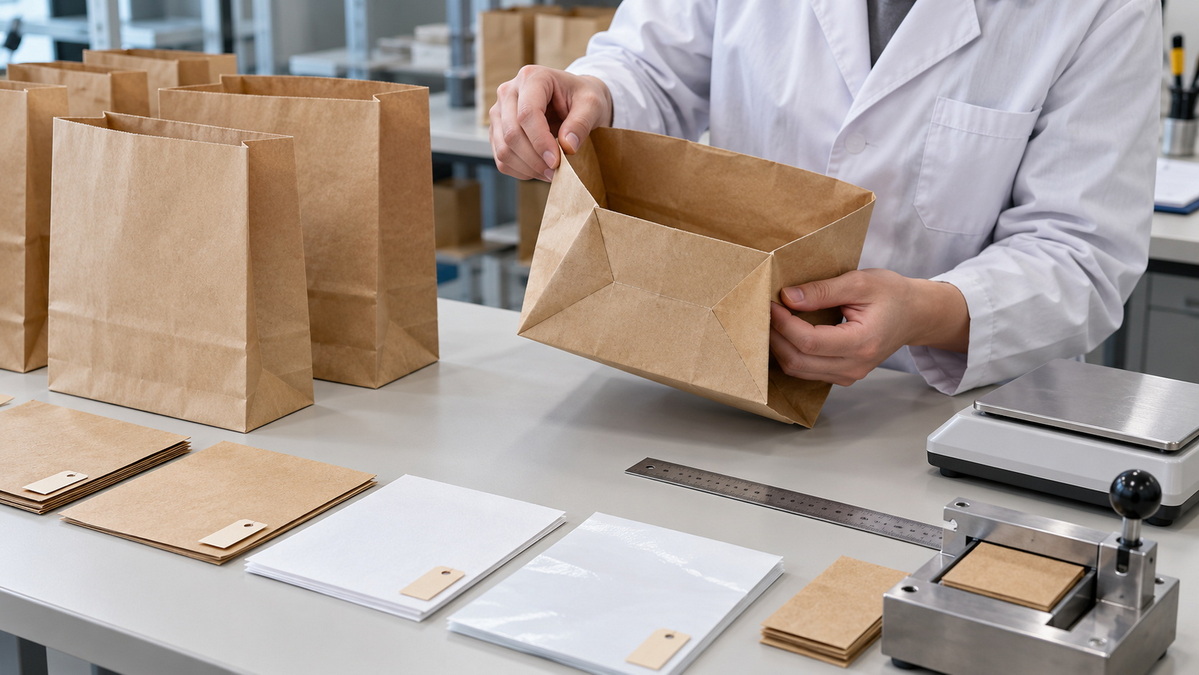
A hand-finished or digitally printed development sample may confirm size and artwork without demonstrating production-line performance. XingKun, for example, explicitly distinguishes digital, manually finished samples from samples made to resemble bulk production.
Avoidance: Approve separate structural, print, and production-representative samples. State which sample controls each characteristic.
An apparently similar paper or adhesive can change performance. A quotation that says only "brown kraft paper" leaves too much room for interpretation.
Avoidance: Attach an approved material specification to the purchase order. Require written approval before changing the paper source, grade, coating, adhesive, or production site.
A supplier's annual output may span multiple products, sites, and customers.
Avoidance: Request the planned line, achievable output for your SKU, existing commitments, maintenance allowance, and capacity reserved for repeat orders. Treat the answer as a project plan, not a marketing statistic.
FSC chain-of-custody certification concerns the traceability of forest-based material through the supply chain. It does not establish food-contact safety or the load-bearing performance of a finished bag.
Avoidance: Maintain separate approval records for sourcing claims, management systems, food-contact compliance, and product performance.
A less obvious risk is approving the right-looking bag from the wrong manufacturing route.
A general packaging company may be excellent at sheet printing and hand assembly but use a partner for automated SOS conversion. That arrangement can work well—provided it is disclosed and controlled. The problem arises when a buyer assumes the development sample, first order, and repeat orders all come from the same materials, equipment, and site.
Add a production-route record to supplier approval:
1. Identify the printing and bag-conversion sites.
2. Record which processes are subcontracted.
3. Identify the paper, adhesive, and coating specifications.
4. Retain samples from the first approved production run.
5. Require notification before any route or material change.
6. Requalify affected characteristics after a significant change.
The useful question is not merely, "Are you a factory?" It is, "Which factory performs each process for this exact bag?"
1. Structural approval: Check dimensions, opening behaviour, contents fit, and filling efficiency.
2. Material and print approval: Confirm paper, coating, artwork, colour expectations, and odour requirements.
3. Pilot-production approval: Evaluate production-made bags, packing consistency, and batch documentation.
Keep signed specifications and retained samples with both parties.
Define critical, major, and minor defects before production. Potential inspection points include open seams, incomplete bottom bonding, incorrect dimensions, print transfer, contamination, blocked bags, and incorrect counts.
Agree on sampling rules and the response to a failed inspection before shipment—not after goods arrive.
Request carton dimensions, net and gross weight, bags per carton, pallet configuration, shipment volume, and the named delivery term and location.
For flat-packed bags, an attractive unit price may be offset by inefficient packing or destination charges. Obtain freight quotations using the actual packing plan and have a customs broker confirm classification, duties, and importer responsibilities for the destination.

The strongest shortlist depends on the purchasing task.
Maituohong, Xianda, XingKun, and Bonito warrant investigation for coordinated brand-packaging projects, with SOS production capability confirmed before approval. Nanwang, Qianlin, Maibao, Union, MST, and Bestar provide more direct public evidence of SOS bag or related food-paper-packaging offerings.
For a Maituohong Packaging inquiry, submit your bag drawing, intended contents, destination market, artwork, order quantity, and annual forecast. Request a written proposal covering materials, sampling, manufacturing route, compliance evidence, inspection, and delivery.
That approach creates a more useful basis for a long-term partnership than comparing quotations by price alone.
Search the company name or certificate number in IAF CertSearch. Compare the legal entity, site, standard, scope, status, and issuing certification body with the supplier's documents.
The database distinguishes active, suspended, withdrawn, and expired certificates. If a record cannot be resolved, contact the issuing certification body rather than relying on a scanned certificate alone.
No. Check the certificate holder, current status, and relevant scope in FSC's public search system. Then confirm that the particular order will be supplied with the appropriate documented claim.
Chain-of-custody requirements concern material identification and tracking through production and distribution; a website logo is not sufficient transaction evidence.
Do not assume that it can. Ask the laboratory to confirm whether the report and sampling rationale cover the proposed finished construction and use conditions.
The EU framework requires food-contact materials not to transfer constituents at levels that endanger health or unacceptably affect food composition, taste, or odour. Compliance assessment must therefore address the actual material system and intended application.
Convert the approved sample into a controlled specification. Record materials, dimensions, printing requirements, production route, packing method, and performance tests.
Require batch identification, retain samples from each shipment, and prohibit unapproved substitutions. When a supplier proposes a change, assess its impact before releasing production.
Compare the same approved specification at your expected annual demand, not just the first order quantity.
A broader packaging partner may reduce development and coordination work across bags and boxes. A dedicated converter may better suit standardized, recurring bag demand. Compare sampling cost, tooling, inventory commitment, repeat-order capacity, inspection expense, and landed cost. The relevant distinction is production fit, not company size alone.
1.China Paper Association, 2025 annual industry report, reproduced by the Sichuan Paper Industry Association: industry production and export figures. [sczaozhi]
2.European Commission, Food Contact Materials and legislation guidance: applicable European safety framework. [food.ec.europa]
3.CEPI Eurokraft and EUROSAC, Food Contact Guideline, May 2025: paper-and-board compliance guidance. [eurosac]
4.European Commission, CE marking and RoHS guidance: scope and limitations. [europa]
5.IAF CertSearch: management-system certificate validation. [iafcertsearch]
6.FSC public search and chain-of-custody guidance: certificate checks and material traceability. [fsc]
7.Supplier profiles and product information: Maituohong, Xianda, XingKun, Bonito, Nanwang, Qianlin, Maibao, Union, MST, and Bestar. [mstpack]


