
Views: 282 Author: Maituohong Packaging Publish Time: 2026-08-22 Origin: Site


Content Menu
>> Common Die Cut Box Features
>> Common Corrugated Box Styles
● Die Cut Boxes vs. Corrugated Boxes
● The Key Difference: Process vs. Material
● When to Choose a Die Cut Box
>> Best Applications for Die Cut Boxes
>> Advantages of Die Cut Packaging
● When to Choose a Corrugated Box
>> Best Applications for Corrugated Shipping Boxes
>> Advantages of Corrugated Packaging
● How Material and Flute Selection Affect Performance
● Practical Example: Choosing a Box for Skincare Products
● Cost Factors: What Really Changes the Price?
>> Main Cost Drivers for Die Cut Boxes
>> Main Cost Drivers for Corrugated Boxes
● A Five-Step Box Selection Process
● Why Custom Die Cut Corrugated Boxes Often Win for E-Commerce
● Work With a Custom Packaging Manufacturer
● FAQs
>> Are die cut boxes stronger than corrugated boxes?
>> Can a die cut box be made from corrugated cardboard?
>> Are die cut boxes suitable for shipping?
>> Do corrugated boxes always need tape?
>> What is the best box for e-commerce packaging?
>> Are corrugated boxes recyclable?
>> What information should I provide for a custom box quote?
Die cut boxes and corrugated boxes are not opposite packaging categories. A die cut box describes how the box is cut and engineered, while a corrugated box describes the board material and protective structure used to make it. In practice, many premium mailer boxes and shipping boxes are both die cut and corrugated.
At Maituohong Packaging, our team has spent more than 18 years designing custom paper packaging for products that must arrive safely, present professionally, and support a strong unboxing experience. The most suitable option depends on your product weight, shipping route, branding goals, assembly needs, order quantity, and budget.
This guide explains the real differences between die cut boxes and corrugated boxes, including their structure, strength, cost drivers, applications, and selection process.

A die cut box is made from a flat sheet of paperboard or corrugated board that is cut, creased, and shaped using a custom cutting die. The die works like a highly precise industrial template. It creates the outline, folds, tabs, locking features, handles, inserts, windows, and other structural details in one repeatable production process.
The term "die cut" refers to the manufacturing method, not one particular material.
A die cut box may be made from:
- Corrugated cardboard
- Solid paperboard
- Kraft paperboard
- Coated paperboard
- Specialty laminated board
- Recycled paper-based materials
For example, a self-locking mailer box with tuck-in flaps is usually a die cut corrugated box. Its box blank is cut into a custom shape, then folded into a finished package without requiring separate outer shipping tape.
Die cutting gives packaging designers far more flexibility than a basic rectangular carton. It can create:
- Self-locking tabs that reduce tape use
- Roll-end panels for reinforced edges
- Dust flaps that help keep small items enclosed
- Custom inserts that reduce product movement
- Die cut handles for retail carry boxes
- Display windows for product visibility
- Tear strips for easier opening
- Custom-shaped closures for a stronger brand impression
A die cut box is especially useful when packaging must do more than contain a product. It can become a protective structure, an unboxing tool, a retail display surface, and a brand touchpoint at the same time.
A corrugated box is made from corrugated fiberboard. This material has at least three paper layers:
1. An outer linerboard
2. A fluted, arched middle layer
3. An inner linerboard
The wavy center layer is called fluting. It creates air spaces that provide cushioning, compression resistance, and stacking strength. This is why corrugated packaging is widely used for shipping, e-commerce fulfillment, industrial parts, electronics, food distribution, and export cartons.
Corrugated board is available in multiple flute profiles, board grades, liner weights, and wall constructions. A box can be engineered according to its transportation and protection requirements rather than selected only for appearance.
The fluted structure helps absorb impact and supports stacking loads during warehousing and transportation. It can also be designed in many combinations of board type, flute size, basis weight, coatings, and printing methods.
Corrugated boxes include many structures, such as:
- Regular slotted cartons for general shipping
- Full-overlap cartons for heavier or more fragile goods
- Die cut mailer boxes for direct-to-consumer orders
- Roll-end tuck-front boxes for subscriptions and retail-ready shipments
- Corrugated trays for product display or food transport
- Heavy-duty double-wall shipping boxes
- Custom corrugated inserts and dividers
A standard slotted carton may use simple scored folds and manufacturer's joints. A custom mailer box may use the same corrugated material but require a die to create its locking tabs, layered side panels, and branded opening experience.
The most important point is simple: die cut boxes can be corrugated boxes.
The following table compares the two terms based on what buyers usually mean when they search for them.
| Factor | Die Cut Boxes | Corrugated Boxes |
|---|---|---|
| Main meaning | A box cut and shaped with a custom die | A box made from fluted corrugated fiberboard |
| Classification | Production method and structural style | Material and board construction |
| Material options | Corrugated board, paperboard, kraft board, laminated board | Primarily corrugated fiberboard |
| Design flexibility | Very high; supports tabs, handles, windows, inserts, and custom contours | Can range from basic cartons to highly customized die cut structures |
| Protection level | Depends on selected material and structural design | Usually strong due to fluted cushioning and stacking strength |
| Best for | Branded mailers, retail packaging, subscription boxes, fitted packaging | Shipping cartons, export packaging, warehouse distribution, e-commerce |
| Setup style | Often self-locking or folding | May require tape, glue, stitching, or self-locking die cut construction |
| Tooling requirement | Custom die may be needed | Basic slotted cartons may not need custom dies; custom styles commonly do |
| Unit cost | May rise with complex shapes, special finishes, or low order volumes | Often economical for standard shipping formats and larger production runs |
| Brand presentation | Excellent for premium unboxing and custom visual details | Strong printing area, especially when upgraded with branded design |
| Typical example | Roll-end tuck-front mailer box | Regular slotted shipping carton |
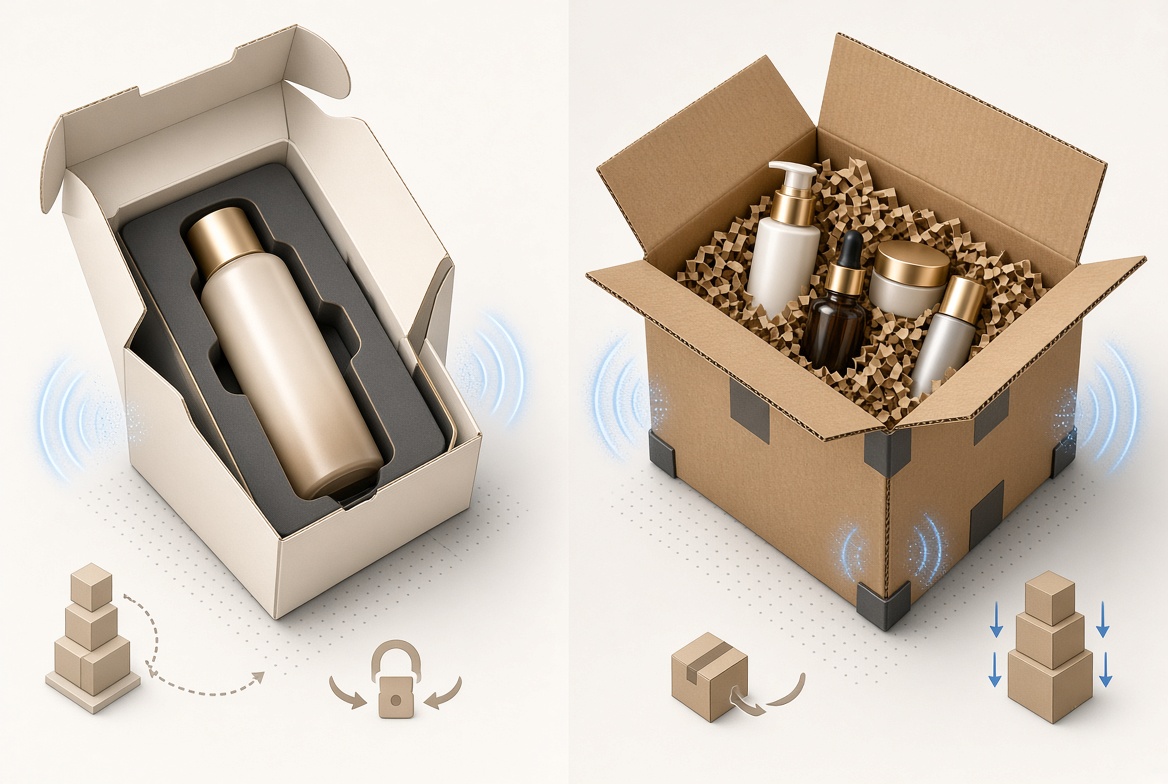
Many buyers compare "die cut packaging" with "corrugated packaging" as if they must choose only one. That creates confusion during quotation and structural design.
Think of it this way:
- Corrugated answers: "What is the packaging made from?"
- Die cut answers: "How is the packaging shaped and converted?"
A standard brown shipping carton can be corrugated but not highly customized. A premium e-commerce mailer can be made from corrugated board and die cut into a roll-end structure with locking tabs. A rigid gift box may use die cut paperboard components but not corrugated board at all.
This distinction matters because it changes the questions a packaging supplier must ask before recommending a solution.
Choose a die cut box when the package needs a specific function, polished appearance, or product-fit structure.
Die cut boxes are often the better choice for:
- E-commerce mailer boxes
- Subscription boxes
- Cosmetics and beauty packaging
- Apparel and accessories
- Consumer electronics
- Premium food and beverage products
- Influencer kits and promotional packs
- Small business branded shipments
- Retail-ready product packaging
- Products requiring custom inserts
A custom die cut mailer box can provide a clean, tape-free opening experience. It also creates a more consistent box shape, which helps brands protect presentation quality from fulfillment center to customer doorstep.
- Better product fit: Custom dimensions and inserts can minimize unused space.
- Improved unboxing: Locking tabs, tear strips, and internal printing can make opening memorable.
- Reduced assembly steps: Certain self-locking designs assemble quickly without tape.
- More branding opportunities: Custom surfaces, windows, cut-outs, and structural details differentiate the package.
- Potentially less void fill: A properly sized structure can reduce the need for extra filler material.
- Higher perceived value: Structural precision can make even a practical shipping box feel more premium.
Die cut boxes are not automatically the most economical solution.
They may require:
- A custom die or tooling investment
- More development time for structural testing
- Greater setup complexity for highly detailed forms
- Higher unit costs at very small quantities
- Careful design to prevent weak tabs, difficult folds, or inefficient nesting
For brands that ship a simple, durable product in high volume, a standard corrugated shipping carton can be more cost-effective.
Choose a corrugated box when your first priority is shipping protection, stacking performance, and transport efficiency.
Corrugated fiberboard is valued because its fluted middle layer combines rigidity with cushioning. The arched flutes help the box support loads and absorb shocks during transportation.
Corrugated boxes are widely used for:
- Heavy products
- Fragile products
- Export shipments
- Bulk warehouse shipments
- Industrial components
- Glassware and ceramics
- Appliances and electronics
- Books and printed materials
- Multi-unit e-commerce orders
- Products stored on pallets
- Strong protection: Suitable board grades can withstand handling and stacking pressure.
- Lightweight performance: Corrugated board can provide strength without the weight of many rigid alternatives.
- Versatile engineering: Single-wall, double-wall, and other board constructions can be selected for risk level.
- Broad size range: Suitable for small parcels, master cartons, and oversized goods.
- Printable surfaces: Outer liners can carry logos, instructions, warnings, and promotional graphics.
- Recycling potential: Corrugated boxes are widely collected and recycled. The U.S. EPA reported a 96.5% recycling rate for corrugated boxes in its cited dataset.
A basic corrugated carton can look functional rather than premium. It may also require tape for closure and may leave more open space around a product if the dimensions are not optimized.
These limitations can often be addressed by choosing a die cut corrugated mailer box, custom corrugated insert, stronger print treatment, or more exact box dimensions.
Not all corrugated boxes perform the same way. The board specification should match the actual shipping environment.
Key variables include:
- Flute profile: A, B, C, E, F, and combined flute configurations offer different thickness, crush resistance, and printability.
- Wall construction: Single-wall board suits many parcels; double-wall board is often selected for heavier loads and longer transport routes.
- Liner weight: Stronger liners can improve puncture resistance and overall durability.
- Box dimensions: Oversized boxes may increase crushing risk and require more internal support.
- Product weight: A lightweight cosmetic jar and a metal machine component need very different structures.
- Distribution cycle: Local delivery, parcel shipping, and international export create different risks.
- Moisture exposure: Humid environments can reduce paper-based packaging performance if material selection is not appropriate.
In our packaging development work, we recommend evaluating the whole system rather than choosing a box based on appearance alone. The box, insert, closure, product weight, void fill, shipping route, and stacking conditions should work together.
Imagine a skincare brand shipping a glass serum bottle, a cream jar, and a printed card directly to consumers.
A standard corrugated shipping carton may protect the products, but the brand may need tape, void fill, and a separate printed inner box. That adds steps and can reduce the unboxing impact.
A better approach may be a die cut corrugated mailer box with:
- A roll-end front tuck closure
- Custom die cut insert compartments
- E-flute or another suitable corrugated board specification
- Printed inner messaging
- Product-specific dimensions
- Optional tamper-evident seal
The result is a single packaging format that supports protection, organization, presentation, and more efficient fulfillment.
For heavier items, the same design concept may require stronger corrugated board, reinforced panels, or a separate outer shipping carton.
The lowest unit price does not always create the lowest total packaging cost. Buyers should consider material usage, packing efficiency, labor, product damage risk, and customer experience.
- Custom die complexity
- Box dimensions
- Board material and flute type
- Printing colors and coverage
- Coatings, laminations, or specialty finishes
- Inserts and partitions
- Order quantity
- Assembly requirements
- Shipping and storage efficiency
- Board grade and wall construction
- Box size and material consumption
- Standard versus custom dimensions
- Printing requirements
- Freight distance and delivery format
- Compression requirements
- Quantity per production run
- Internal protection components
A well-designed custom box can lower total costs by reducing damage claims, void-fill consumption, fulfillment time, and dimensional shipping waste.
Use this process before requesting a quote for die cut boxes or corrugated boxes.
1. Define the product. Record product dimensions, weight, fragility, surface sensitivity, and number of items per shipment.
2. Map the shipping journey. Identify whether products move by courier, air freight, sea freight, pallet transport, or retail replenishment.
3. Choose the packaging role. Decide whether the box is only an outer shipper, a retail package, a mailer, or a combined shipping-and-display solution.
4. Select a structure. Compare standard slotted cartons, die cut mailers, roll-end boxes, trays, inserts, and reinforced shipping cartons.
5. Test before scaling. Review prototypes for fit, assembly speed, closure security, stacking behavior, print appearance, and real shipping performance.
The most effective packaging projects begin with product data, not a generic box style. A supplier should be able to recommend board grades, dimensions, box structures, and inserts based on the risks your products actually face.
For modern e-commerce brands, the strongest option is often not "die cut versus corrugated." It is a custom die cut corrugated box.
This format combines:
- The protective performance of corrugated fiberboard
- A custom structure tailored to the product
- Faster, more consistent assembly
- Less dependence on tape
- Better branding inside and outside the box
- A more polished delivery experience
FEFCO is an internationally used system for classifying corrugated packaging designs. Its folder-type category includes die cut packaging structures, while styles such as 0201 identify standard slotted cartons.
For example, a roll-end tray with locking cover is formed from a single corrugated blank and commonly used for shipping applications, including electronics.

The right choice is based on your business priorities.
Choose a standard corrugated shipping box when you need a practical, economical outer carton for straightforward transport. Choose a die cut box when the packaging needs custom locking, fitted protection, visual distinction, or a refined opening experience. Choose a die cut corrugated box when you need both durable transit protection and branded e-commerce presentation.
Maituohong Packaging can help you develop custom mailer boxes, shipping boxes, rigid gift boxes, corrugated inserts, and paper packaging solutions that fit your product and distribution needs. Share your product dimensions, weight, artwork, target quantity, and shipping method to begin a structural packaging review.
Not necessarily. Die cutting is a shaping method, while corrugated describes the material. A die cut box made from corrugated board can be highly protective, but its performance depends on flute type, board grade, dimensions, closure design, and product weight.
Yes. Many mailer boxes, self-locking boxes, roll-end boxes, trays, and custom inserts are made from die cut corrugated cardboard.
Yes, when properly engineered. Die cut corrugated mailer boxes are widely used for e-commerce shipping. Heavy, fragile, or export-bound products may need stronger board, protective inserts, reinforced panels, or an additional outer carton.
No. Standard slotted cartons commonly use tape, but many die cut corrugated structures use locking tabs or tuck closures. The best closure depends on product weight, shipping risks, and fulfillment workflow.
A custom die cut corrugated mailer box is often a strong choice because it combines protection, branding, efficient assembly, and a better opening experience. The correct structure should still be chosen according to product weight and shipping conditions.
In many recycling systems, clean and dry corrugated boxes are widely recyclable. Flattening boxes and removing non-paper contaminants can support recycling collection.
Provide product dimensions, product weight, quantity per box, shipping method, destination market, estimated order quantity, preferred box style, printing requirements, insert needs, and any product protection concerns.
1. [U.S. Environmental Protection Agency — Containers and Packaging: Product-Specific Data]
2. [U.S. Environmental Protection Agency Archive — Commercial Recycling]
3. [Fibre Box Association — Protective Corrugated Packaging]
4. [Fibre Box Association — Fibre Box Handbook]
5. [FEFCO — Standards and Guidelines for the Corrugated Industry]


