Views: 222 Author: Maituohong Packaging Publish Time: 2026-05-20 Origin: Site


When you ship every day, every cardboard box, mailer, and roll of tape shows up on your profit‑and‑loss statement. Rising carrier rates and customer expectations for fast delivery leave very little room for waste, so understanding where you can use free USPS shipping supplies – and where you should invest in custom branded mailer boxes – is one of the quickest ways to improve margins. [freightamigo]
As a packaging manufacturer working with brands that ship thousands of orders a month, I've seen both sides: companies that rely only on free carrier boxes and quietly erode their brand, and companies that use USPS free materials strategically while protecting their unboxing experience with custom mailer and shipping boxes. This guide walks you through exactly how free USPS packing materials work in 2026, how to get them, the limits you must respect, and when upgrading to custom packaging makes better business sense. [ecwid]
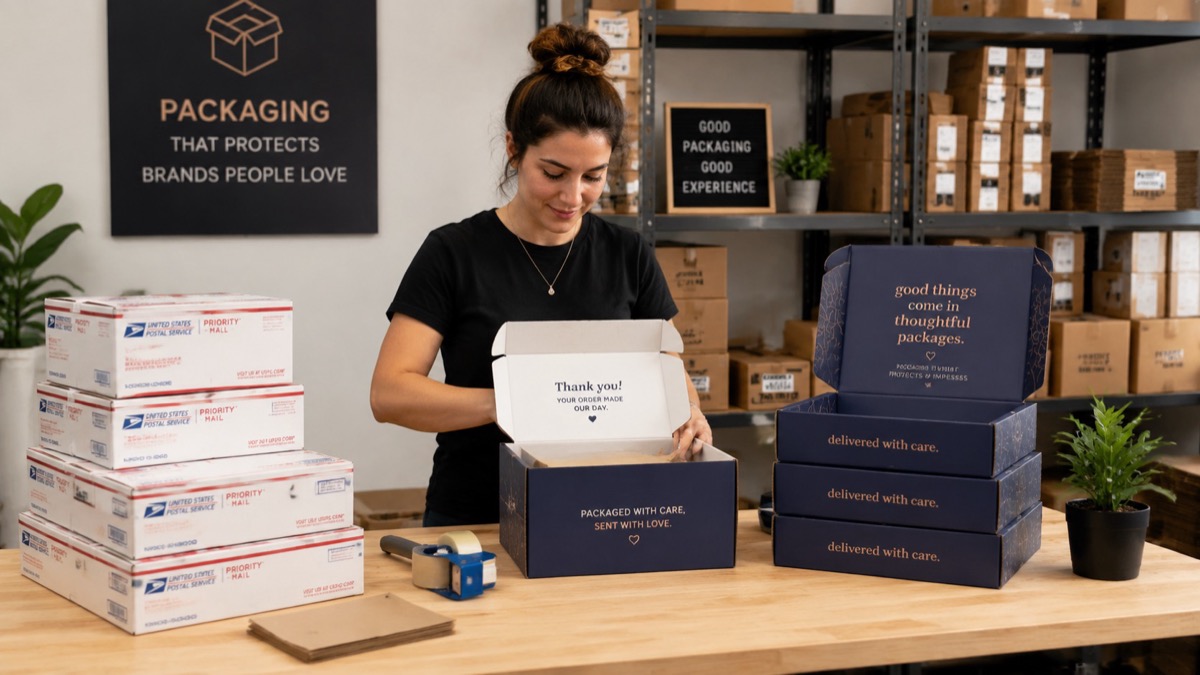
- Yes, USPS provides free packing materials – but only for Priority Mail and Priority Mail Express. [gushwork]
- You can get free USPS boxes and envelopes online or at your local post office, typically in packs of 10–25. [gushwork]
- Free packaging comes with strict usage rules: you must pay for the corresponding Priority service. [gushwork]
- Other carriers (UPS, FedEx, DHL) also offer free packaging for certain premium services, with similar restrictions. [ecwid]
- Growing brands often combine free USPS supplies for cost control with custom mailer boxes for branding and product protection. [ecwid]
USPS offers free packaging exclusively for Priority Mail and Priority Mail Express services. That means you do not pay for the box or envelope itself, as long as you pay for the matching Priority service. [gushwork]
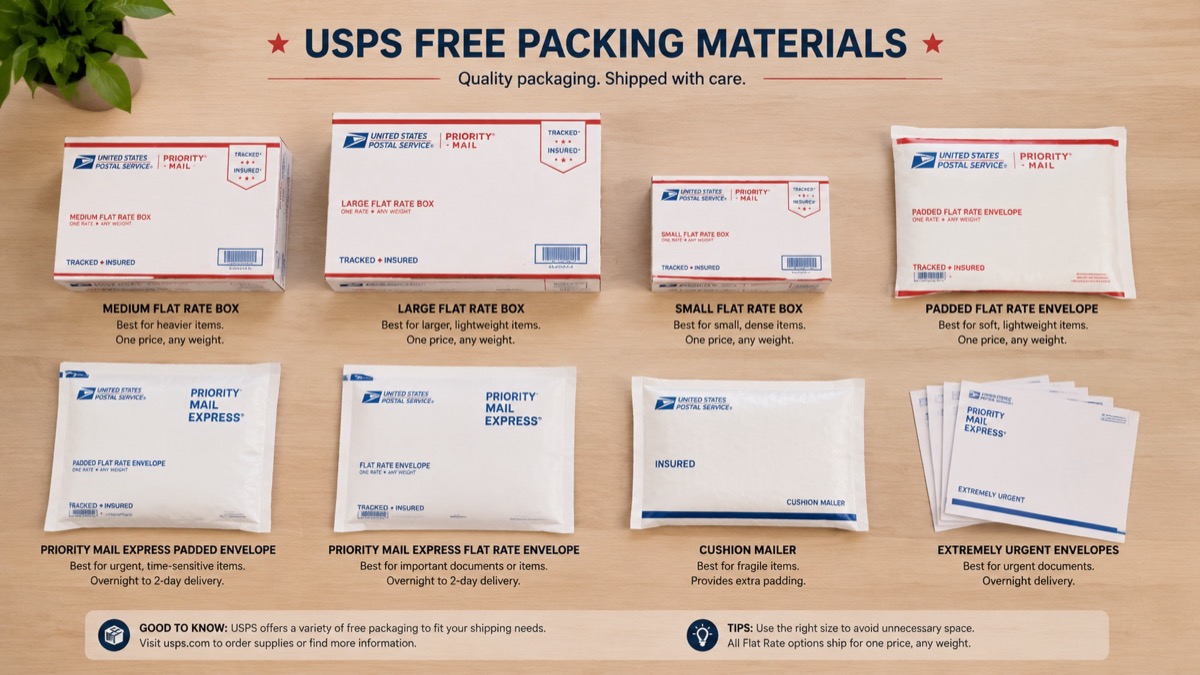
Typical free USPS supplies include: [gushwork]
- Priority Mail boxes in multiple sizes
- Priority Mail Flat Rate boxes (small, medium, large)
- Priority Mail Express boxes
- Priority Mail envelopes (including padded and flat‑rate options)
- Select labels and, in some locations, limited tape for Priority shipments
These supplies are designed to cover most standard parcel sizes, from small jewelry boxes and beauty products up to bulkier e‑commerce shipments. They are made from recyclable corrugated cardboard and are pre‑printed with USPS branding, which simplifies carrier handling but limits how much you can customize the look. [gushwork]
You can source free USPS packing materials in two main ways, both of which are simple once you know where to look. [gushwork]
For most businesses, ordering online is the most efficient way to build inventory. [gushwork]
1. Create or log into your USPS.com account.
2. Navigate to the Postal Store and select "Free Shipping Supplies." [gushwork]
3. Choose the types of Priority Mail and Priority Mail Express boxes or envelopes you need.
4. Add packs (usually 10–25 units per pack) to your cart.
5. Check out with a zero product cost and zero shipping fee. [gushwork]
Orders usually arrive within 7–10 business days, though rural or remote areas may see slightly longer transit times. For growing brands, it's smart to set a recurring reminder to reorder before peak seasons like Q4. [gushwork]
If you are running low and cannot wait for online delivery, you can walk into your local post office and request free boxes at the counter. [gushwork]
- Most branches maintain a stock of common Priority Mail and Flat Rate boxes.
- Availability can vary, especially for less common sizes or during holiday peaks.
- Staff can often help you choose the right box type for your specific shipment.
This option works well for urgent top‑ups or smaller shippers who don't yet have predictable volume.
To use free USPS packing materials correctly, you need a basic understanding of the two services they are tied to. [gushwork]
Priority Mail is USPS's core parcel service, targeting 1–3 day delivery across the United States. Free USPS boxes printed with the Priority Mail logo are intended for this service only. [gushwork]
Key points: [gushwork]
- Delivery target: 1–3 business days (not formally guaranteed)
- Free boxes in multiple sizes
- Available Flat Rate options where price is based on box size, not weight (within limits)
Flat Rate boxes are especially useful when you ship dense or heavy products – think jars, canned goods, metal components – because the postage does not change as weight increases, as long as it fits and closes properly. [gushwork]
- Small Flat Rate – ideal for jewelry, small accessories, spare parts. [gushwork]
- Medium Flat Rate – good for clothing, books, bundled cosmetics. [gushwork]
- Large Flat Rate – used for bulkier items or multi‑unit orders. [gushwork]
Priority Mail Express is USPS's fastest domestic service, often used for urgent, high‑value, or time‑critical shipments. [gushwork]
- Overnight or 2‑day delivery to most U.S. locations, with some guarantees.
- Dedicated Express boxes and envelopes provided free of charge.
- Higher postage cost, but ideal when delivery speed is part of your service promise.
Using the correct Priority Mail or Priority Mail Express box helps USPS route and process the shipment accurately and ensures your package receives the appropriate handling level. [gushwork]
USPS free packaging does not stop at boxes. For certain shipments, envelopes can be more cost‑effective and easier to pack. [gushwork]
Common free envelope options include: [gushwork]
- Padded envelopes – extra cushioning for fragile or semi‑rigid products.
- Flat rate envelopes – clothing, accessories, or soft items that can be compressed.
- Legal‑size envelopes – documents, contracts, and paperwork.
- Window envelopes – mailing materials where the address is pre‑printed.
Flat‑rate envelopes are particularly attractive for light but bulky soft goods such as T‑shirts, hoodies, or fabric samples, because they ship for one fixed rate nationwide. In some branches, you may also find free labels and limited packaging tape for Priority shipments, but availability is not guaranteed and varies by location. [gushwork]
This is where many small businesses accidentally lose money or face delays. Free USPS supplies come with strict conditions. [gushwork]
- You must use Priority Mail packaging with Priority Mail postage.
- Priority Mail Express boxes and envelopes must be used only with Priority Mail Express.
- You cannot legally obscure, remove, or ignore the USPS branding to ship via cheaper services.
Services that do not come with free USPS packaging include: [gushwork]
- USPS Ground Advantage
- First‑Class Mail
- Media Mail and other economy services
If you try to use a free Priority Mail box with a lower‑cost service, USPS can up‑charge your shipment to the correct Priority rate, return the package, or delay processing. This is not only a poor customer experience; it also creates unnecessary cost and operational noise for your team. [gushwork]
For Priority Mail and Priority Mail Express, the box itself is free – but the postage is not. USPS also sells plain, non‑branded boxes and mailing supplies that you can use with any service or even other carriers. [gushwork]
These paid boxes: [gushwork]
- Are not tied to any specific service.
- Can be used for Ground Advantage, First‑Class, or even UPS/FedEx shipments.
- Are still typically priced competitively versus many retail packaging suppliers.
The important distinction is between free, service‑locked USPS‑branded packaging and paid, generic packaging that is more flexible. [gushwork]
USPS is not the only carrier that uses free packaging to encourage usage of premium services. Several major carriers have similar programs: [ecwid]
| Carrier | Free packaging available for | Notes |
|---|---|---|
| USPS | Priority Mail, Priority Mail Express | Widest free box assortment domestically. |
| UPS | UPS Express and some SurePost services | Free boxes available via online account or at certain locations. ecwid |
| FedEx | FedEx Express and FedEx One Rate | Free boxes and envelopes for overnight and 2‑day services. ecwid |
| DHL Express | International express shipments | Free packaging for account holders on select lanes. ecwid |
Across all of these carriers, ground and economy services usually require your own packaging. This is where many brands turn to custom mailer boxes or shipping cartons to balance cost, brand, and durability. [ecwid]
The phrase "post office boxes" often confuses new shippers, because it can mean two different things: [gushwork]
1. PO Boxes (mailbox rental) – Locked mailboxes at the post office that you rent as an address. These do carry a recurring fee, usually billed every 6–12 months, and the cost varies based on size and location. [gushwork]
2. Post office shipping boxes – The free Priority Mail and Priority Mail Express boxes and envelopes you use for sending parcels. These are free when correctly matched with the service they are designed for. [gushwork]
When someone asks whether you "pay for post office boxes," be sure to clarify which meaning they intend. [gushwork]
In practice, the most successful small businesses treat free USPS packaging as one component of a broader shipping and branding strategy, not as a complete solution. [freightamigo]
Here are proven tactics we see working well in 2026:
1. Forecast and order in bulk
- Estimate your monthly Priority Mail volume and order enough free boxes (in packs of 10–25) to cover demand with a buffer. [gushwork]
- Schedule reorders ahead of major sales events or holiday peaks.
2. Match packaging type to product
- Use Flat Rate boxes for heavy, compact items where weight would otherwise drive postage up. [gushwork]
- Use padded or flat‑rate envelopes for soft goods and small accessories. [gushwork]
- Choose custom‑sized boxes for fragile, high‑value, or brand‑critical products where precise fit matters.
3. Combine services for cost control
- Reserve Priority Mail with free boxes for high‑value, time‑sensitive, or nationwide flat‑rate shipments. [gushwork]
- Use Ground Advantage or alternative carriers with your own packaging for less urgent, bulky, or regional deliveries. [gushwork]
4. Overlay branding instead of hiding USPS marks
- Add branded tissue, stickers, inserts, or inner mailer boxes inside USPS outer cartons instead of trying to cover postal branding on the outside. [gushwork]
- This lets you stay compliant while still delivering a branded unboxing experience.
5. Track actual savings
- Compare packaging costs with and without free supplies over a quarter.
- Many small e‑commerce brands shipping 100+ parcels per month discover they save hundreds of dollars per year on materials once they fully adopt free Priority supplies for suitable SKUs. [freightamigo]
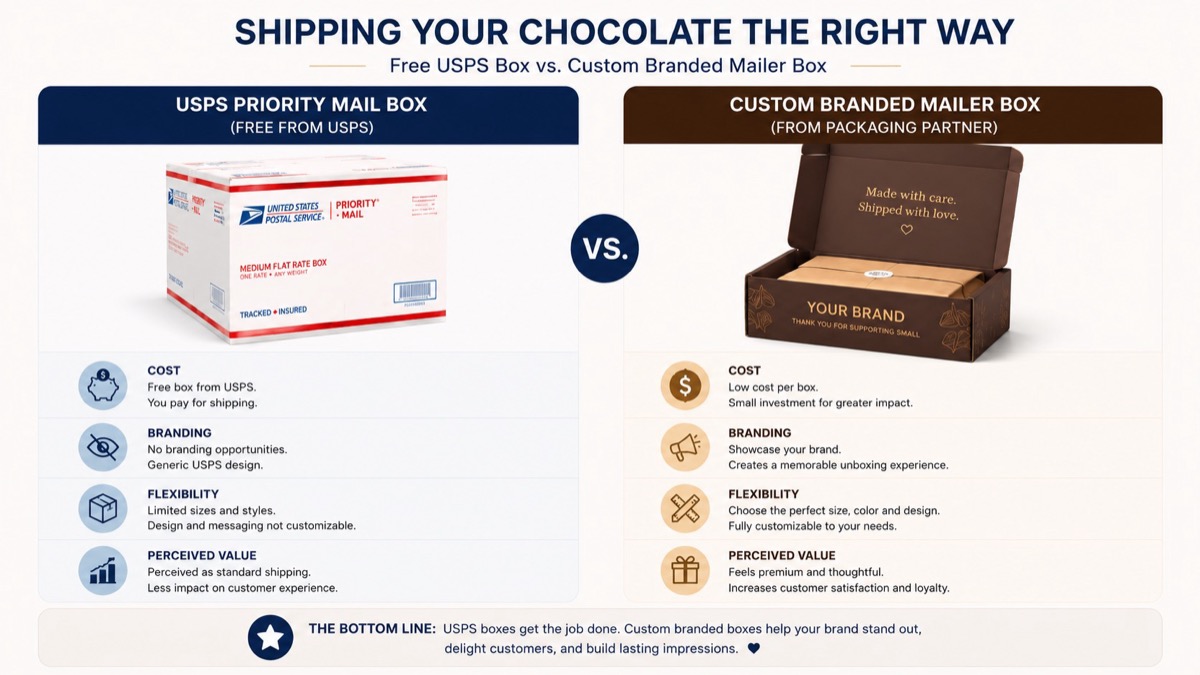
As a packaging manufacturer, we see a clear pattern: brands eventually outgrow a "free boxes only" approach. While USPS packaging is cost‑effective, it comes with limitations: [ecwid]
- No brand differentiation – Your parcels look like every other Priority box on the truck.
- Limited size flexibility – You must adapt to USPS's predefined dimensions.
- Perceived value – For premium products, a generic shipping box can cheapen the overall experience.
You should consider investing in custom mailer boxes or shipping boxes when:
- Your repeat purchase rate and referral traffic depend heavily on memorable unboxing.
- You ship fragile, high‑margin items that need more precise internal fit and structural strength.
- You want to unify your packaging across multiple carriers (USPS, UPS, FedEx, local couriers) without being locked to one service's branding.
A common hybrid approach is to: [ecwid]
- Use custom mailer boxes or rigid gift boxes as the primary product packaging.
- Place those inside a free USPS Priority Mail outer carton for certain routes and service levels.
This way, you protect both the product and your brand while still leveraging carrier programs for cost savings.
For decision‑makers, it helps to see the trade‑offs side by side.
| Aspect | Free USPS supplies | Custom/commercial packaging |
|---|---|---|
| Material cost | Free for Priority/Express services. gushwork | Unit cost per box; decreases at volume. |
| Branding | Fixed USPS design, no custom print. gushwork | Full control over color, logo, and messaging. |
| Service flexibility | Locked to specific USPS services. gushwork | Use with any carrier or service. |
| Size range | Standard USPS sizes only. gushwork | Tailored to product dimensions and protection. |
| Perceived value | Functional but generic. gushwork | Can reinforce "premium" or "gift‑ready" positioning. |
| Sustainability options | Recyclable; recycled content varies. gushwork | Can specify recycled content, eco‑inks, and finishes. |
For many brands, the optimal answer is not "either/or" but "both, used strategically".
To put all of this into practice, you can follow a simple, repeatable process. [freightamigo]
1. Audit your current shipping mix
- List your top 5–10 products and average order profiles.
- Note service levels, destinations, weights, and current packaging types.
2. Identify where Priority Mail is already a fit
- Look for orders that regularly ship in 1–3 days and where Flat Rate or standard Priority boxes would work. [gushwork]
3. Map products to USPS free packaging types
- Assign SKUs to specific Priority boxes or envelopes that fit correctly.
4. Order an initial test batch from USPS.com
- Start with conservative quantities across 2–3 box sizes and 1–2 envelope types. [gushwork]
5. Measure cost and performance for one month
- Track packaging cost per order, damage rates, and on‑time delivery.
- Collect feedback from customers on unboxing and perceived quality.
6. Layer in custom mailer boxes where brand impact is highest
- For flagship or premium products, design custom mailer boxes that can be used inside free USPS cartons or as stand‑alone packaging with other carriers.
7. Scale what works before peak periods
- Once you have validated the mix, increase order volumes of both free USPS supplies and custom packaging ahead of key seasons.
1. Are all USPS boxes free?
No. Only USPS‑branded Priority Mail and Priority Mail Express boxes and envelopes are free when you use the matching service. Generic boxes and non‑Priority supplies must be purchased. [gushwork]
2. Can I use a free USPS Priority Mail box for Ground Advantage?
No. USPS requires that Priority Mail packaging be used only with Priority Mail postage. Using it with cheaper services can result in up‑charges, delays, or returns. [gushwork]
3. How long does it take to receive free supplies ordered online?
Most businesses receive their free USPS supplies within about 7–10 business days, depending on location and carrier volume. [gushwork]
4. Is it better to use free USPS boxes or custom branded mailer boxes?
Free USPS boxes are excellent for controlling costs on Priority shipments, but custom mailer boxes are better for branding, precise sizing, and flexibility across multiple carriers. Many brands use both. [ecwid]
5. Do UPS, FedEx, and DHL also offer free packaging?
Yes. UPS, FedEx, and DHL all provide free packaging for select express and premium services, typically ordered through an account portal or picked up at authorized locations. [ecwid]
1. USPS Postal Store – Free Shipping Supplies. "[Shipping Supplies]" [gushwork]
2. USPS – "Priority Mail Service Overview" (service standards and features). [gushwork]
3. USPS – "Priority Mail Express Service Overview" (overnight and 2‑day details). [gushwork]
4. Ecwid – "廉价运输箱及其购买地点" (overview of cheap and free shipping box sources, including USPS, UPS, FedEx, DHL, and retail/online options). [ecwid]
5. FreightAmigo – "2025免费快递盒终极指南:来源与节省秘籍" (step‑by‑step approach to getting free boxes from carriers and retailers, plus cost‑saving tactics). [freightamigo]
6. LSDigital – "E‑E‑A‑T Guidelines 2025: How to Build Google‑Friendly Content" (principles on experience, expertise, authoritativeness, and trust in SEO content). [lsdigital]
7. Nautilus Marketing – "How to Write Killer Blogs: The Complete Guide to E‑E‑A‑T" (blog‑writing best practices aligned with E‑E‑A‑T). [nautilusmarketing.co]