
Views: 220 Author: Maituohong Packaging Publish Time: 2026-09-15 Origin: Site


Content Menu
● SOS Bags vs Die Cut Bags: Quick Comparison
● Structural Differences That Affect Performance
>> Square Bottom vs Flat Profile
>> Gussets and Internal Capacity
● Customization Options for Both Bag Types
● Cost Comparison: What Really Changes the Price?
● A Practical Selection Process
>> Step 1: Measure the Actual Product Set
>> Step 2: Define the Carrying Distance
>> Step 3: Choose the Required Brand Position
>> Step 4: Request a Physical Sample
● Sustainability Considerations
● Expert Recommendation: How to Choose
● Request a Custom Paper Bag Solution
>> 1. Are SOS bags stronger than die cut bags?
>> 2. Can SOS bags be printed with a full-color logo?
>> 3. Are die cut bags suitable for heavy products?
>> 4. Which bag is better for takeaway food packaging?
>> 5. Can die cut bags have side gussets?
>> 6. What paper is best for custom shopping bags?
>> 7. How do I choose the right paper bag size?
When choosing custom paper shopping bags, many brands compare SOS bags and die cut bags because both are practical, printable, and suitable for retail packaging. However, their structure, carrying performance, production method, cost profile, and brand presentation are very different.
At Maituohong Packaging, we have spent more than 18 years designing and producing rigid paper gift boxes, paper shopping bags, and custom paper packaging solutions. From our experience working with retail, food-service, promotional, fashion, and gift-packaging buyers, the best bag is not simply the cheapest option. It is the one that matches the product weight, customer journey, storage needs, visual identity, and target budget.
This guide explains the differences between SOS paper bags vs die cut bags, including their construction, uses, customization options, sustainability considerations, and purchasing criteria.
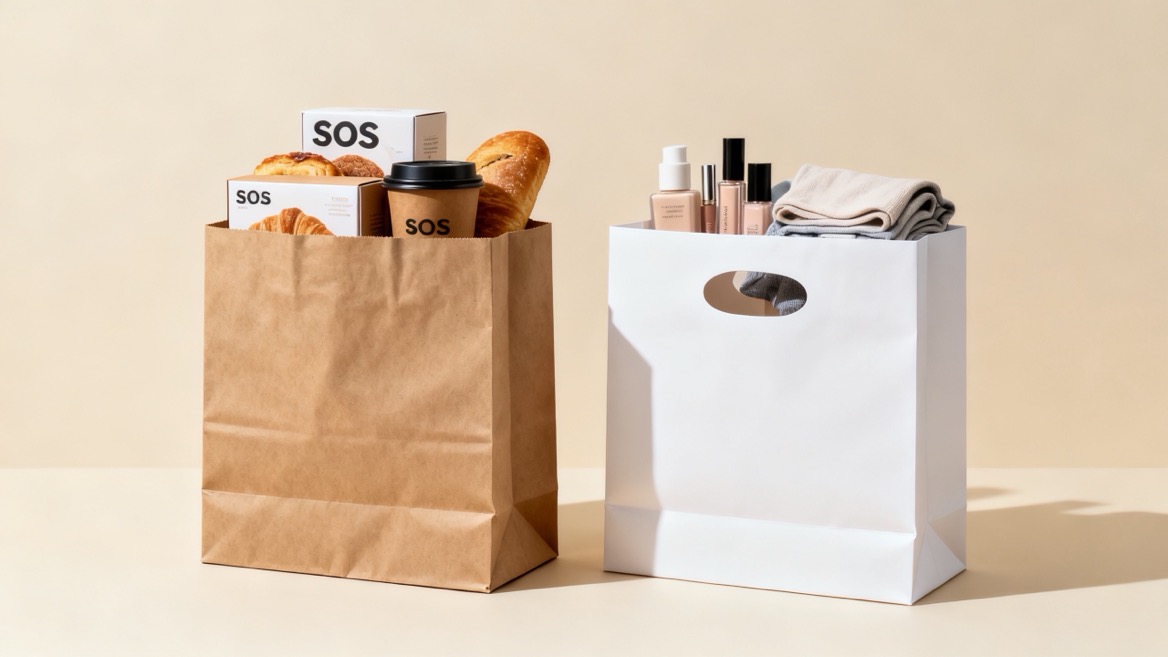
An SOS bag is a self-opening square-bottom paper bag. The name "SOS" is widely used in the packaging industry to describe a bag with a flat, rectangular bottom and side gussets that allow it to stand upright when opened.
Unlike a flat paper bag, an SOS paper bag expands into a box-like shape. This structure makes it especially useful for carrying food containers, bakery products, takeaway meals, grocery items, cosmetics, pharmacy products, and small retail purchases.
The defining features of an SOS bag include:
- A square, reinforced bottom
- Expandable side gussets
- A large internal capacity
- An upright shape for easy packing
- A folded top edge or open top
- Optional flat paper handles or twisted paper handles
- A printable front, back, and side panel area
In daily production, SOS bags are often made from kraft paper, white kraft paper, recycled paper, coated paper, or specialty paper. The right paper basis weight depends on the required load capacity, the bag size, the presence of handles, and whether the bag will carry items with sharp edges or moisture.
For example, a small bakery may use an unhandled SOS paper bag for cookies or pastries, while a supermarket may need a larger handled SOS bag for multiple grocery items. A boutique food brand may choose white kraft paper with full-color printing to create a cleaner and more premium presentation.
A die cut bag is a paper bag with a handle opening cut directly into the bag body. Instead of adding twisted rope handles, ribbon handles, cotton handles, or flat paper handles, the manufacturer uses a die-cutting process to create an integrated handle slot near the top of the bag.
The handle can be a simple oval opening, a kidney-shaped opening, a rounded rectangle, or a customized silhouette. In some cases, a reinforcement patch is added behind the die-cut handle to improve tear resistance.
Die cut bags are typically flatter than SOS bags. They may have no gussets, small gussets, or a foldable bottom depending on the design. Their streamlined construction makes them popular for lightweight retail products, event materials, promotional giveaways, cosmetics, accessories, documents, apparel, and gift items.
Common characteristics of die cut paper bags include:
- An integrated cut-out handle
- A flat or lightly gusseted structure
- Fewer added components than rope-handle bags
- A clean, minimal appearance
- Easy flat packing and storage
- Broad customization potential for shape and printing
- Best performance with light-to-medium-weight products
A die cut bag can look simple, but it should not be treated as a one-size-fits-all packaging solution. The strength of the handle opening depends on several factors, including paper type, paper thickness, bag width, handle shape, reinforcement design, glue quality, and actual carrying weight.
The following table summarizes the key differences between SOS bags and die cut bags.
| Feature | SOS Bags | Die Cut Bags |
|---|---|---|
| Basic structure | Square-bottom bag with side gussets | Flat or gusseted bag with an integrated cut-out handle |
| Bottom design | Reinforced flat bottom | Flat bottom, folded bottom, or limited gusset design |
| Carrying capacity | Medium to high | Light to medium |
| Best for | Food, groceries, retail purchases, takeaway items | Apparel, accessories, documents, promotions, lightweight gifts |
| Handle style | Open top, flat paper handle, or twisted paper handle | Handle cut directly into the bag body |
| Internal volume | Larger due to expanding gussets | More limited unless gussets are added |
| Packing efficiency | Excellent for upright loading | Better for thin or flat products |
| Storage before use | Flat-packed | Very compact and flat-packed |
| Branding appearance | Practical, retail-ready, versatile | Minimal, modern, sleek |
| Typical cost factors | Paper weight, gusset size, bottom strength, handle type | Die-cut shape, reinforcement patch, paper thickness, printing |
| Recommended product weight | Medium to heavier retail items | Lightweight items and short carrying distances |
The most important difference is simple: SOS bags are designed primarily for capacity and upright loading, while die cut bags are designed primarily for compactness, simplicity, and lightweight carrying convenience.
An SOS bag has a square-bottom construction. When opened, it forms a stable base that allows the bag to stand independently on a counter, shelf, packing table, or delivery area.
This is highly useful when staff need to pack multiple products quickly. Food containers, coffee bags, jars, boxed goods, bottles, and folded garments can be placed inside more efficiently because the bag remains open and upright.
A die cut bag usually has a flatter profile. It is ideal for products that are naturally thin, such as brochures, catalogs, T-shirts, scarves, stationery, greeting cards, cosmetics, or lightweight gift items.
If your product has height, width, and volume, an SOS bag usually offers a better fit. If your product is flat and visually presentation-focused, a die cut bag may be more appropriate.
Side gussets are one of the major advantages of SOS paper bags. The gussets expand when the bag is opened, increasing usable internal space without making the bag overly bulky during storage.
For example, a bag that appears compact when flat can open wide enough to hold:
- A takeaway meal set
- Several packaged bakery items
- A small clothing order
- Coffee beans and accessories
- Gift-boxed products
- Cosmetics with secondary packaging
- Small grocery purchases
Die cut bags can also include gussets, but many designs are intentionally narrow. This keeps the bag flat, clean, and economical. However, limited gussets also mean limited capacity.
If the customer needs to carry several products at once, a die cut bag may look attractive but become inconvenient in real use. This is why bag selection should begin with the product dimensions and estimated total carrying weight rather than only the desired visual style.
SOS bags can be produced without handles, with flat paper handles, or with twisted paper handles. Each option changes the customer experience.
Handled SOS bags are suitable for shoppers carrying heavier or bulkier purchases. Twisted paper handles often create a more natural retail look, while flat paper handles are commonly used for takeaway food, supermarkets, and larger-volume packing.
Die cut bags use an integrated handle opening. This creates a very clean appearance because there are no extra handle components attached to the bag. It can also reduce material complexity and make the bag easier to recycle when made from a single compatible paper-based structure.
However, the handle opening concentrates carrying stress in a relatively small area. If the paper is too thin, the handle slot is too close to the top edge, or the load is too heavy, tearing becomes more likely.
For this reason, a reinforced die-cut handle is often a practical choice for brands carrying heavier cosmetics, glass bottles, gift sets, or multiple apparel items.
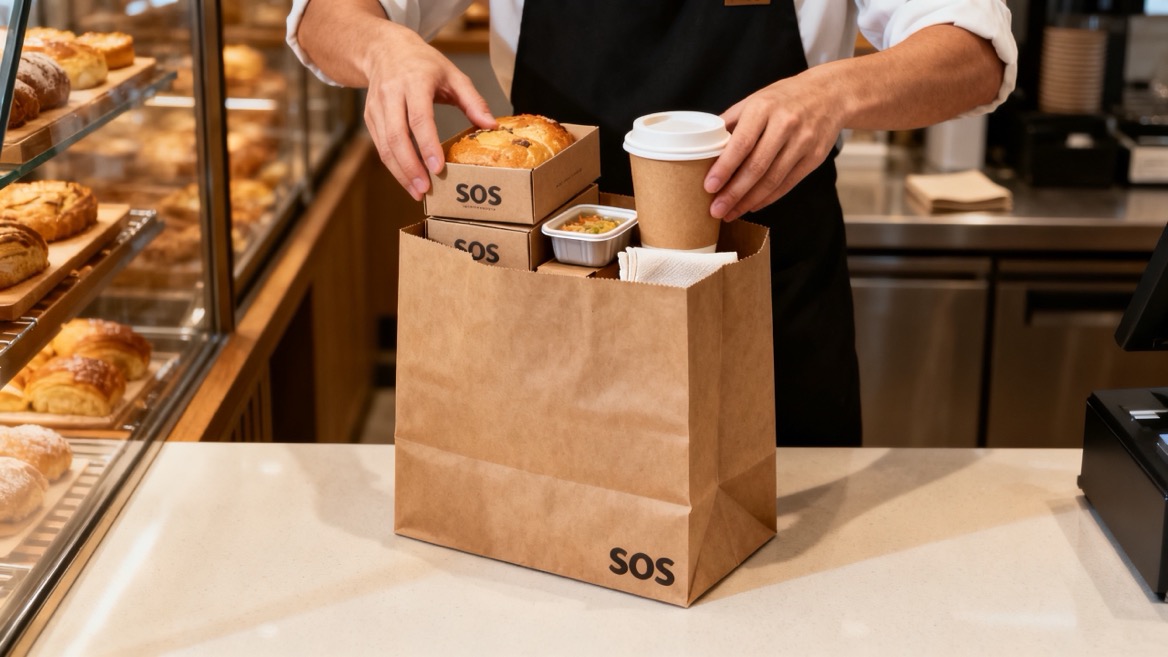
In most applications, SOS bags offer better overall load capacity because the square bottom and gusseted body distribute the product weight more evenly.
A properly specified SOS bag can support a wider and heavier load, especially when it includes:
- Higher-strength kraft paper
- A suitable paper basis weight
- Strong bottom glue construction
- Correct bag width and gusset depth
- Reinforced handle attachment
- Flat or twisted paper handles matched to the intended weight
Die cut bags can also be durable, but they are better suited to lighter products or short-distance carrying. Their performance depends heavily on the quality of the handle-cut area.
A useful rule is to consider not only the product's individual weight but also the real purchase scenario. A customer may buy one boxed product today but several products during a promotion, holiday season, or store visit.
Before mass production, brands should test bags with the likely maximum purchase load. This should include movement, lifting, walking, and repeated handling—not just placing a product inside the bag once.
SOS bags are highly versatile because they combine storage efficiency with strong retail functionality. They are especially effective when the product needs to remain upright during packing and transport.
Typical uses include:
- Bakery and pastry packaging
- Coffee shops and takeaway restaurants
- Grocery and convenience stores
- Delicatessens and food delivery
- Specialty food retailers
- Pharmacy and health-product stores
- Wine, tea, and gourmet-product packaging
- Fashion and lifestyle retail
- Gift shops and seasonal promotions
- E-commerce order pickup packaging
For food-service businesses, SOS bags can simplify counter operations. Staff can open the bag, place containers inside, add napkins or receipts, and hand over the completed order quickly.
For retail brands, a custom SOS bag provides a large visible surface for logos, artwork, brand messages, QR codes, seasonal campaigns, and product storytelling.

Die cut bags are often selected when a brand wants a neat, lightweight, and cost-conscious packaging format without the visual bulk of external handles.
They work particularly well for:
- Clothing stores
- Shoe accessories and small fashion items
- Cosmetic products
- Beauty and skincare samples
- Jewelry packaging
- Event and exhibition materials
- Printed catalogs and brochures
- Promotional gifts
- Stationery products
- Boutique retail packaging
- Lightweight boxed gifts
A die cut bag can be especially effective for a trade-show giveaway. It is easy to stack, easy to distribute, and easy for visitors to carry while moving between booths.
For a premium appearance, brands can combine die-cut handles with high-quality paper, matte lamination, spot UV, embossed logos, foil stamping, or custom-shaped handle openings. The bag may remain structurally simple while still delivering a polished brand experience.
Both SOS bags and die cut bags can be customized extensively. However, the customization approach should support the bag's functional purpose rather than reduce its usability.
Popular material options include:
- Natural brown kraft paper
- White kraft paper
- Recycled kraft paper
- Coated art paper
- Uncoated specialty paper
- Textured paper
- Food-grade paper where appropriate
- FSC-certified paper options when available through the required material chain
Kraft paper is a popular choice for SOS bags because it combines a natural appearance with practical durability. White kraft paper is often used when brands need brighter color reproduction and a cleaner printed background.
Depending on order quantity, design complexity, and color requirements, custom paper bag printing may include:
- Flexographic printing
- Offset printing
- Digital printing
- One-color logo printing
- Full-color artwork
- Pantone color matching
- Inside printing
- Side-gusset printing
- Bottom-panel printing
For brands with strong visual standards, color matching should be confirmed through a physical sample or production proof. Screen colors can differ from ink on kraft paper, white paper, coated paper, or recycled substrates.
For die cut bags and premium retail bags, common finishes include:
- Matte lamination
- Gloss lamination
- Soft-touch lamination
- Spot UV
- Hot foil stamping
- Embossing
- Debossing
- Window patching
- Custom handle shapes
A more decorative finish is not always better. A food takeaway bag may benefit more from grease resistance, strength, and quick production than from a luxury visual finish. A beauty gift bag, on the other hand, may require a refined tactile experience to support a higher-value product position.
The price difference between SOS bags and die cut bags is influenced by much more than the bag type itself.
For SOS bags, the main cost drivers are:
- Bag dimensions
- Paper grade and basis weight
- Bottom construction
- Side gusset size
- Handle type
- Handle reinforcement
- Number of printing colors
- Quantity ordered
- Special coatings or functional barriers
- Packing method and shipping volume
For die cut bags, the main cost drivers are:
- Paper thickness
- Bag size
- Die-cut handle shape
- Handle reinforcement patch
- Gussets or bottom structure
- Printing coverage
- Lamination or decorative finishing
- Custom die charges
- Order quantity
In many cases, a simple die cut bag can be lower in cost because it does not require separately attached handles. However, a premium die cut bag with thick paper, a custom handle shape, reinforced patches, lamination, and foil stamping may cost more than a standard SOS bag.
The right comparison is not "Which bag is cheaper?" Instead, ask: Which structure delivers the needed carrying performance and brand value at the lowest total cost per successful customer use?
Choosing between SOS bags and die cut bags becomes easier when brands use a structured evaluation process.
Do not measure only one product. Measure the typical customer purchase.
Record:
- Product length
- Product width
- Product height
- Total purchase weight
- Shape irregularities
- Sharp corners
- Moisture or grease exposure
- Secondary packaging dimensions
This prevents the common mistake of selecting a bag that fits a single product but fails when customers purchase multiple items.
Consider how long the customer will carry the bag.
A lightweight die cut bag may be suitable when the customer walks from a store counter to a nearby vehicle. For long shopping trips, public transportation, or takeaway delivery, an SOS bag with suitable handles may provide a better experience.
Ask what the bag should communicate:
- Natural and sustainable
- Premium and gift-ready
- Minimal and modern
- Strong and practical
- Food-safe and convenient
- Fashion-focused
- Promotional and budget-friendly
An SOS kraft bag can support a warm, natural, everyday retail image. A matte-laminated die cut bag can support a clean, premium boutique image.
A physical sample is one of the most valuable steps before final approval. It allows the buyer to evaluate:
- Color consistency
- Handle comfort
- Paper feel
- Fold accuracy
- Glue strength
- Product fit
- Standing stability
- Carrying performance
- Print quality
- Overall brand impression
For custom paper shopping bags, a sample is not simply a visual check. It is a functional test.
Paper bags can support more responsible packaging strategies when they are designed with material sourcing, print choices, product durability, and end-of-life handling in mind.
The Forest Stewardship Council explains that chain-of-custody certification tracks certified material through the supply chain and enables eligible companies to make verified claims about the sourced material. For buyers who need traceable paper packaging, this is an important requirement to discuss with the manufacturer before placing an order.
Paper bags also work best when they are designed for actual reuse. A durable SOS bag may be reused for small shopping trips, storage, or gift giving. A die cut bag may be reused for lightweight items, documents, or retail returns.
To improve the practical sustainability of either option, consider:
- Selecting responsibly sourced paper where applicable
- Avoiding unnecessary mixed-material components
- Using water-based inks when suitable for the project
- Designing for repeated use
- Choosing a bag size that reduces wasted material
- Avoiding oversized bags
- Using strong construction so the bag does not fail after one use
- Providing clear disposal guidance where appropriate
The most sustainable bag is often the one that is correctly sized, durable enough for its intended use, and made with a material strategy aligned with the brand's supply-chain requirements.
Choose an SOS bag when your priority is capacity, upright packing, food-service convenience, grocery use, or stronger carrying performance. It is often the better choice for products with volume, multiple-item purchases, and frequent retail handling.
Choose a die cut bag when your priority is a slim profile, lightweight product packaging, compact storage, promotional use, or a minimalist retail presentation. It is particularly effective for apparel, cosmetics, accessories, documents, and small gift items.
For high-value products, do not decide based on appearance alone. The bag should be tested with the real product weight, real product dimensions, and expected customer purchase behavior.
At Maituohong Packaging, we help buyers compare paper materials, dimensions, handle structures, printing options, and finishing methods before production. This early packaging consultation can reduce the risk of bag failure, unnecessary material cost, poor product fit, and inconsistent brand presentation.
Need help deciding between SOS bags and die cut bags for your retail or packaging project?
Share your product dimensions, estimated weight, preferred bag size, printing artwork, and target quantity with Maituohong Packaging. Our team can recommend a suitable structure, paper material, handle option, and customized printing solution based on your actual application.
Whether you need practical kraft SOS bags for food and retail or premium die cut bags for boutique packaging, we can help turn your packaging concept into a durable and professional finished product.
In most cases, yes. SOS bags generally provide better overall carrying capacity because their square bottom and gusseted structure distribute weight more effectively. However, the final strength depends on paper grade, dimensions, handle design, glue quality, and the actual product weight.
Yes. SOS paper bags can be printed with logos, graphics, brand messages, QR codes, and full-color artwork. The final printing method depends on the paper material, design requirements, quantity, and desired color accuracy.
Die cut bags are usually best for lightweight to medium-weight products. For heavier products, use a thicker paper, a reinforced handle patch, a stronger bottom structure, or consider an SOS bag with paper handles.
SOS bags are generally better for takeaway food because they stand upright, provide more volume, and can hold food containers more securely. They are also easier for staff to pack quickly at a counter.
Yes. Die cut bags can be made with side gussets to increase capacity. However, the gusset size and handle reinforcement should be designed according to the product dimensions and carrying weight.
Kraft paper is widely used because it offers a natural appearance and good strength. White kraft paper is often chosen for brighter printing. For luxury retail packaging, coated or specialty paper may be more suitable.
Measure the width, depth, and height of the typical product purchase, not only one product. Add appropriate clearance for easy packing, safe carrying, and a good customer experience. A packaging manufacturer can help recommend the final dimensions after reviewing the products.
1. Forest Stewardship Council. [Chain of Custody Certification]
2. Forest Stewardship Council. [Paper & Packaging]
3. The Paper Bag. [Paper Bags: Sustainable and Efficient Packaging of the Future]
4. Creative Retail Packaging. [Paper Shopping Bags: The Ultimate Design Guide]
5. Custom Box Makers. [Custom SOS Bags at Wholesale Rates]
6. Pregis. [FSC Chain of Custody Mix Certificate for Easypack Paper]


