
Views: 208 Author: Maituohong Packaging Publish Time: 2026-08-14 Origin: Site


Content Menu
● Why Pizza Box Dimensions Matter
● Standard Pizza Box Sizes and Dimensions Chart
● How to Choose the Right Pizza Box Size
>> 1. Measure the Finished Pizza
>> 2. Add Clearance Without Creating Excess Space
>> 3. Match Box Height to Pizza Style
>> 4. Consider Delivery Distance and Stacking
● Deep-Dish, Square, and Specialty Pizza Box Dimensions
>> Square and Detroit-Style Pizza Boxes
>> Pizza Slice and Calzone Boxes
● Material and Structure: What Makes a Pizza Box Perform Well?
● A Four-Step Pizza Box Testing Process
>> Step 2: Check Steam Management
>> Step 3: Test Stacking Strength
● Custom Pizza Boxes as a Brand Touchpoint
● Why Custom Sizing Can Reduce Total Packaging Cost
● Choose a Pizza Box Built Around Your Product
>> What is the most common pizza box size?
>> Should a pizza box be bigger than the pizza?
>> What size box is needed for a 12-inch pizza?
>> How tall should a deep-dish pizza box be?
>> What material is commonly used for pizza boxes?
>> Do pizza boxes need ventilation holes?
>> Can pizza boxes be customized with a logo and QR code?
Choosing the right pizza box sizes and dimensions is not simply a matter of matching a box to a pizza diameter. A well-designed pizza box must protect the crust, support toppings, manage steam, survive stacking, and present your brand properly from kitchen to customer.
At Maituohong Packaging, we have spent more than 18 years developing rigid paper boxes, folding gift boxes, and custom paper packaging for brands with demanding quality expectations. That experience has taught us one important lesson: a pizza box performs best when its dimensions, board structure, printing process, and delivery conditions are planned together.
This guide explains how to choose standard pizza box dimensions, when to use custom sizes, how to calculate suitable box clearance, and what to check before placing a bulk order.
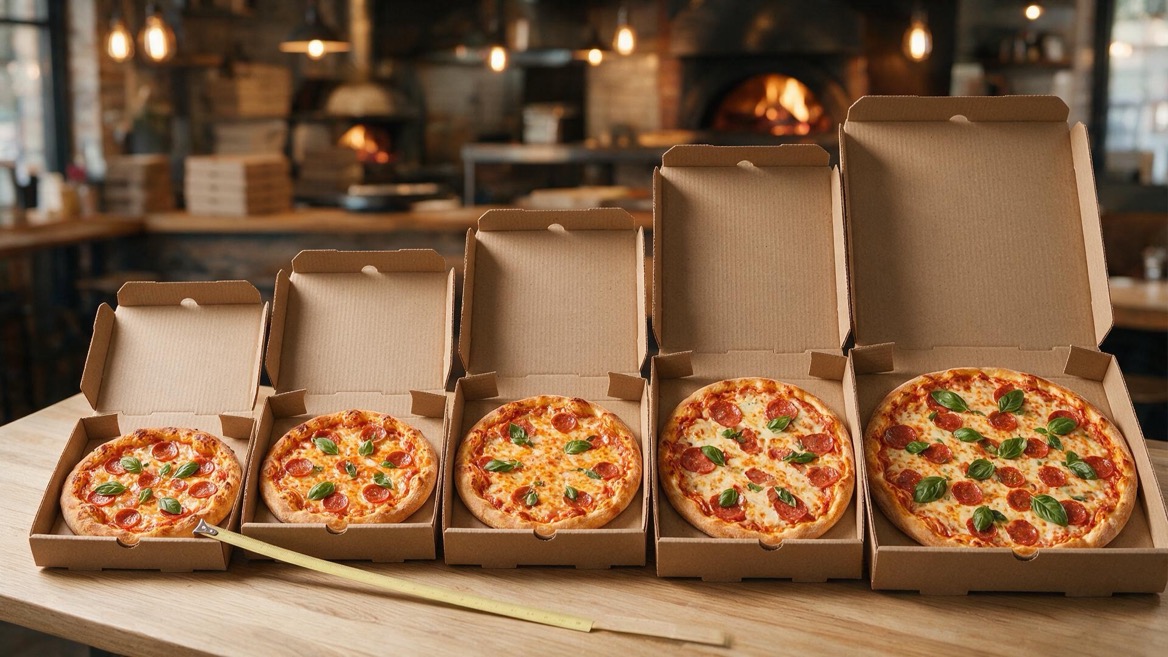
A pizza can leave the oven in perfect condition and still disappoint the customer if the packaging is poorly sized.
A box that is too small can press against the crust, cheese, or toppings. A box that is too large allows the pizza to slide during delivery. Both problems can create a poor unboxing experience, increase complaints, and weaken trust in the restaurant or food brand.
The correct pizza box size helps you achieve several practical goals:
- Keep toppings in position during handling and transport
- Reduce contact between the pizza and the lid
- Maintain a more attractive presentation on arrival
- Improve stacking stability for busy kitchens and delivery riders
- Avoid unnecessary board consumption and storage space
- Create a consistent surface for brand printing, promotions, and ordering messages
The key is to select a box based on the finished pizza, not only the advertised pizza size. Crust thickness, topping height, baking style, and packaging method all affect the required dimensions.
The table below provides practical starting points for common round pizzas. Dimensions refer to the recommended internal box space rather than a universal external specification. Actual die-cut dimensions may vary according to board thickness, folding structure, and the required manufacturing tolerance.
| Pizza Size | Typical Pizza Diameter | Recommended Internal Box Size | Typical Box Height | Common Use |
|---|---|---|---|---|
| Personal | 6–8 in / 15–20 cm | 8 × 8 in / 20.3 × 20.3 cm | 1.75–2 in / 4.5–5 cm | Individual meals, children's menus, tasting portions |
| Small | 9–10 in / 23–25 cm | 10.5–11 × 10.5–11 in / 26.7–28 cm | 1.75–2 in / 4.5–5 cm | Single diners, lunch offers |
| Medium | 11–12 in / 28–30 cm | 12.5–13 × 12.5–13 in / 31.8–33 cm | 1.75–2.25 in / 4.5–5.7 cm | Couples, standard takeaway orders |
| Large | 13–14 in / 33–36 cm | 14.5–15 × 14.5–15 in / 36.8–38 cm | 2–2.25 in / 5–5.7 cm | Family meals and sharing |
| Extra-Large | 15–16 in / 38–41 cm | 16.5–17 × 16.5–17 in / 41.9–43.2 cm | 2–2.5 in / 5–6.4 cm | Group orders and delivery |
| Jumbo | 18 in / 46 cm | 18.5–19 × 18.5–19 in / 47–48.3 cm | 2–2.5 in / 5–6.4 cm | Parties and high-volume orders |
| Catering | 20–24 in / 51–61 cm | Custom-made to product size | 2–3 in / 5–7.6 cm | Events, catering, oversized pizzas |
For a flat, conventional pizza, allowing approximately 0.25–0.5 inch of clearance around the finished pizza is often a useful working range. This provides enough room for easy loading without allowing excessive movement.
However, no sizing chart can replace a real sample test. A 12-inch thin-crust pizza and a 12-inch deep-dish pizza may need completely different box heights and structural support.
The most reliable approach is to measure the product exactly as it is sold, including its highest toppings and edge profile.
Measure the pizza after baking, not before preparation. Dough can expand, edges can rise, and toppings may create additional height.
Record:
- Maximum pizza diameter
- Crust height
- Highest topping point
- Weight of the finished pizza
- Whether the pizza is cut, folded, or served with an insert
- Whether sauces, condiments, or side dishes are placed inside the same box
For example, a pizza advertised as 12 inches may measure slightly more after baking. If the crust expands to 12.25 inches, a nominal 12 × 12-inch box may be too tight. A 13 × 13-inch internal format may provide a safer fit.
A small amount of clearance makes loading easier and helps prevent the crust from scraping the side walls.
Too much empty space, however, can create a different problem. During delivery, the pizza may move, cheese can shift, and the box may look oversized for the portion.
A practical rule is to avoid treating the box as a generic container. Select the size around your actual menu item and delivery conditions.
Most standard pizzas can fit into boxes around 1.75–2.25 inches high. Thick-crust, stuffed-crust, deep-dish, Detroit-style, or heavily topped pizzas often need more vertical space.
Consider a deeper box when your product has:
- A thick or raised crust
- Multiple cheese layers
- High-volume vegetable or meat toppings
- A pan-baked or deep-dish structure
- A pizza saver or elevated insert
- Extra garnish added after baking
If the lid touches the pizza, heat and moisture can cause cheese adhesion, topping damage, and an untidy appearance. A slightly taller format is usually more economical than replacing damaged orders.
A box suitable for counter collection may not perform equally well during a 30-minute delivery route.
For long-distance delivery, assess whether the box will be:
- Stacked with other hot food boxes
- Carried on a motorcycle or bicycle
- Placed inside an insulated delivery bag
- Exposed to movement, vibration, or changing weather
- Delivered with beverages or side dishes
Large pizzas require particular attention because wider box panels can flex under weight. The board grade, flute profile, and lid-locking design should be chosen based on actual handling conditions, not appearance alone.
Round pizza is only one part of the market. Specialty pizzas require a more tailored packaging approach.
Deep-dish pizzas need more than a larger square footprint. They require sufficient vertical clearance and a structure that resists compression.
For many deep-dish formats, a box height of 2.5–3.5 inches may be more suitable than a standard shallow pizza box. The correct height depends on the pan, crust profile, topping volume, and whether the pizza is removed from the pan before packing.
Always measure the pizza at its tallest point. Do not base the box height only on pan depth.
Square pizza boxes should be designed around the actual tray or finished product. A 10 × 14-inch pizza, for example, usually needs a larger internal footprint than its nominal dimensions to allow loading and removal without damaging the corners.
For rectangular pizzas, consider:
- Corner clearance
- Crust rise along the edges
- The position of cut lines
- Whether customers will eat directly from the box
- The strength of the long box panels during stacking
A custom rectangular die-line can reduce unused space and create a more premium visual presentation than adapting a square box to a rectangular product.
Single-slice packaging requires a different design logic. The pack should support the pointed tip, prevent grease transfer, and remain easy to carry with one hand.
Triangle slice boxes, folded sleeves, and narrow rectangular trays can work well depending on the serving style. For calzones, consider a taller profile with enough space to prevent the top crust from being compressed.
The visible dimensions are only one part of packaging performance. The board structure determines how well a box maintains its shape under heat, moisture, weight, and stacking pressure.
Corrugated board is widely used for pizza packaging because its fluted middle layer adds stiffness while keeping the pack relatively lightweight. It can also be converted into flat-packed designs that save storage space in restaurant kitchens.
When selecting a board and structure, discuss the following with your packaging supplier:
| Packaging Factor | Why It Matters |
|---|---|
| Board strength | Supports the pizza and reduces panel collapse during stacking |
| Flute profile | Influences thickness, cushioning, print surface, and folding behavior |
| Food-contact suitability | Helps ensure the selected material and inks are appropriate for the intended food-use application |
| Ventilation design | Helps release excess steam and reduce lid condensation |
| Grease resistance | Can help maintain box appearance and handling comfort |
| Locking structure | Keeps the lid closed during transport without slowing down kitchen staff |
| Print finish | Supports brand visibility while remaining practical for high-volume production |
Vent holes deserve special attention. Pizza is hot and releases steam after packing. If steam is trapped excessively, moisture can soften the crust and create condensation under the lid. If ventilation is too open, heat may escape too quickly. The best layout depends on pizza temperature, delivery time, crust style, and box structure.
Before approving mass production, test the box in conditions close to real service. This simple process can prevent expensive rework later.
Pack the hottest and highest-topped version of each pizza size. Check whether the pizza enters the box easily, whether the crust touches the walls, and whether the lid contacts the toppings.
Close the box immediately after packing. Open it after 10, 20, and 30 minutes. Inspect the lid for condensation and check whether the crust remains appealing.
Stack filled boxes in the same quantity used during peak operating hours. Review whether lower boxes deform, whether lids sink, and whether the pizzas remain protected.
Place filled boxes in the same insulated bag, vehicle, or handling system used by your team. A short movement test can reveal sliding, opening, or compression issues that are not visible on a packing table.
Document the results with photos and notes. This gives both the restaurant and packaging manufacturer a clearer basis for refining the structure.
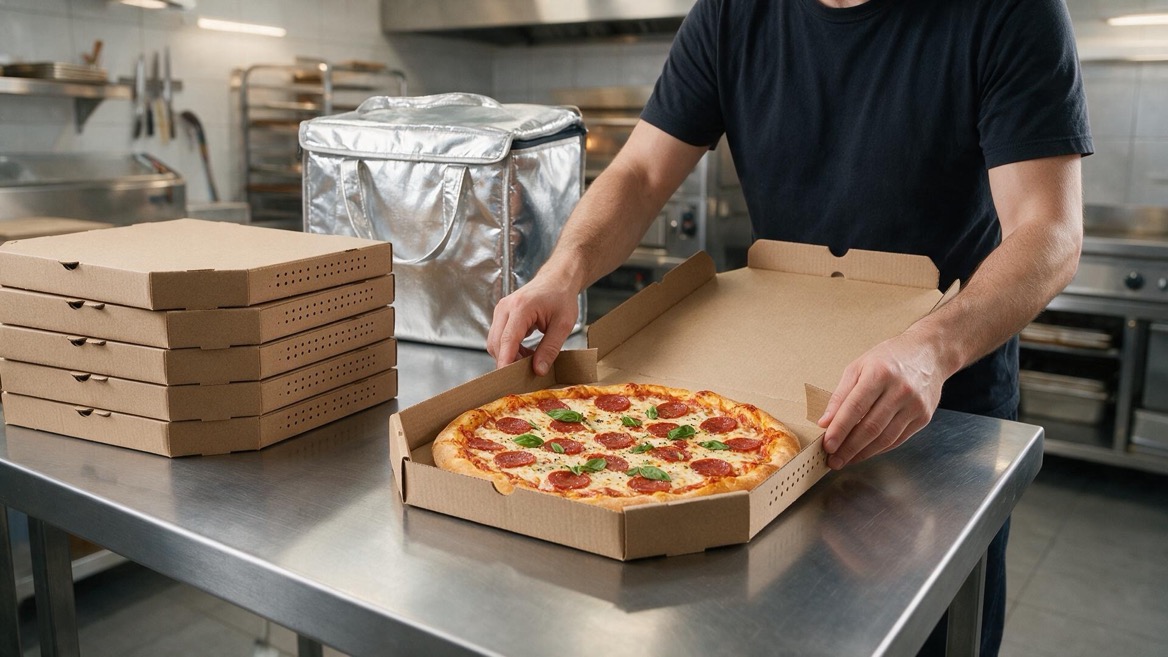
A pizza box is often the first physical brand element a customer sees at home. It can do more than carry food.
A well-designed custom pizza box can communicate product quality, make reordering easier, encourage social sharing, and create a memorable delivery experience. Clear design is usually more effective than overcrowded artwork.
Consider including:
- A prominent logo and recognizable brand colors
- A concise brand message or product promise
- Heating or serving instructions where appropriate
- A QR code linked to menu, loyalty, or ordering information
- A campaign message for seasonal offers
- Social media handles or a customer feedback prompt
- Simple graphics that make the box attractive in customer photos
For premium restaurants, a clean kraft or white exterior with one or two carefully selected print colors can feel more considered than a heavily printed surface. For fast-growing chains, consistent color management and repeatable production standards are essential across different order batches.
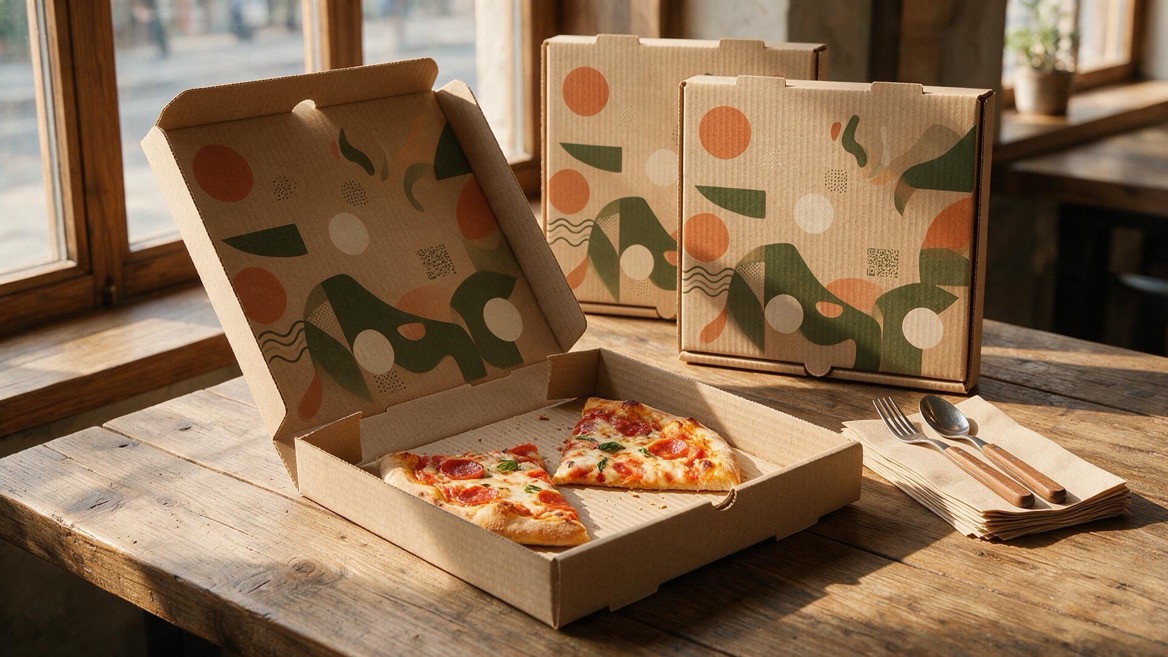
Custom packaging is not always about making a box look different. It can also improve operational efficiency.
A box that is correctly sized may use less unnecessary material than an oversized standard format. It can reduce storage volume, support faster packing, improve stacking, and lower the risk of compensation claims caused by damaged food.
The right question is not, "What is the cheapest pizza box?" Instead, ask, "Which box gives our product the best protection, presentation, and operating efficiency at the required order volume?"
For a multi-location pizza business, even a small improvement in box fit can create meaningful savings across thousands of deliveries.
The best pizza box dimensions depend on more than pizza diameter. They depend on crust style, topping height, delivery distance, stack pressure, brand positioning, and the experience you want customers to have when they open the lid.
Maituohong Packaging can help you develop folding pizza boxes and custom paper packaging that fit your menu, workflow, and visual identity. From structural sampling and material selection to printing and bulk production, our team can turn your packaging requirements into a practical, scalable solution.
Contact Maituohong Packaging today to request a custom quote, discuss your pizza box dimensions, or start a sample project for your next packaging launch.
Common pizza box sizes include 10 × 10 inches for small pizzas, 12 × 12 or 13 × 13 inches for medium pizzas, 14 × 14 or 15 × 15 inches for large pizzas, and 16 × 16 or 17 × 17 inches for extra-large pizzas. The best choice should be confirmed using the actual finished pizza diameter.
Yes. A pizza box should normally provide a small amount of clearance around the finished pizza. This helps kitchen staff load the pizza easily and reduces the risk of crust damage. Excessive clearance should be avoided because it allows movement during delivery.
A 12-inch pizza commonly fits in a box with approximately 12.5–13 inches of internal width and length. If the pizza has a thick crust, raised edge, or heavy toppings, choose a taller box and verify the fit with a physical sample.
Many deep-dish pizzas need a box around 2.5–3.5 inches high, but the correct height depends on the finished product. Measure the tallest point after baking, then allow suitable space so that the lid does not touch the toppings.
Corrugated paperboard is commonly used because it provides strength, cushioning, and stackability while remaining lightweight. The exact board grade, flute profile, surface treatment, and print process should be selected according to the pizza weight, delivery route, and branding requirements.
Ventilation can be helpful because hot pizza releases steam after packing. Properly positioned vent holes can reduce condensation and help preserve crust texture. The design should be tested because too much ventilation can also cause faster heat loss.
Yes. Custom pizza boxes can include logos, brand colors, promotional messages, QR codes, serving instructions, and ordering information. The artwork should be designed around the printable areas and folding lines of the box structure.
- Tycoon Packaging. "[Pizza Box Sizes and Dimensions Guide]." [tycoonpackaging]
- Easy Box Packaging. "[Pizza Box Sizes: Standard Dimensions Chart]." [easyboxpackaging]
- WebstaurantStore. "[Pizza Box Sizes & Dimensions Guide]." [webstaurantstore]
- YoonPak. "[Understanding Pizza Box Size: A Comprehensive Guide]." [yoonpak]
- FEFCO. "[European Federation of Corrugated Board Manufacturers]." The organization reports that corrugated packaging is extensively used for food packaging and that recycled content is a major part of corrugated material supply. [fefco]
- OD Packaging. "[Pizza Box Size Chart & Material Guide]." [odpack]


