
Views: 289 Author: Maituohong Packaging Publish Time: 2026-09-25 Origin: Site


Content Menu
● What Does Foam Do in Packaging?
>> How Foam Absorbs Impact Energy
● Why Custom Foam Inserts Improve Product Protection
>> Key Benefits of Custom Foam Packaging
● Common Types of Foam Used in Packaging
>> Polyethylene Foam for Shipping Protection
>> Polyurethane Foam for Premium Presentation
>> EPS Foam for Molded Protection
● Foam Packaging vs. Paper-Based Protective Inserts
● How to Choose the Right Foam for Your Product
>> Step 1: Identify the Product's Risk Areas
>> Step 2: Calculate Product Weight and Available Clearance
>> Step 3: Match the Outer Box to the Internal Protection
● Test Packaging Before You Scale
● Common Foam Packaging Mistakes to Avoid
>> Forgetting the Unboxing Experience
>> Making Broad Recycling Claims
● When Should You Use Foam Packaging?
● Build a Better Shipping Box with Maituohong Packaging
● FAQ
>> What is the main purpose of foam in packaging?
>> Is foam packaging suitable for e-commerce shipping?
>> What is the difference between PE foam and PU foam?
>> Can foam inserts be customized to product shapes?
>> Is foam packaging recyclable?
>> Are paper inserts better than foam inserts?
>> How do I know whether my packaging is protective enough?
Foam plays a critical role in packaging because it absorbs shock, controls movement, distributes pressure, and protects fragile products throughout storage, handling, and transportation. For brands shipping electronics, glassware, cosmetics, medical items, tools, or premium gift products, foam inserts can turn an ordinary shipping box into a reliable protective system.
At Maituohong Packaging, we have spent more than 18 years designing and manufacturing custom paper packaging, including mailer boxes, shipping boxes, rigid gift boxes, corrugated packaging, and protective interior solutions. From our practical experience, the best packaging is never just a box. It is a complete system in which the outer carton, internal structure, product orientation, void fill, and cushioning material work together.
Foam can be valuable in that system—but it is not always the only answer. A well-designed custom shipping box may use foam, molded pulp, corrugated inserts, paper honeycomb, or a hybrid solution depending on the product, shipping route, budget, unpacking experience, and recycling requirements.

The primary role of foam in packaging is to create a controlled protective zone around a product. During parcel delivery, products can be dropped, stacked, compressed, vibrated, and exposed to repeated impacts. Foam helps reduce the force that reaches the product.
In practical terms, foam packaging performs four essential jobs:
- Shock absorption: Foam cushions a product when the package is dropped or knocked during handling.
- Vibration control: It reduces repeated movement caused by truck, air, rail, or conveyor transportation.
- Void filling: It occupies empty space inside a shipping box, helping prevent the product from shifting.
- Surface protection: It helps prevent scratches, dents, scuffs, abrasion, and pressure marks on delicate surfaces.
A fragile item may survive one accidental drop with basic packaging. But repeated vibration, corner impacts, stacking pressure, and poor internal fit can create cumulative damage. This is why packaging should be designed for the full journey—not only for the moment it leaves the factory.
When a parcel hits the ground, the outer box slows suddenly, while the product inside continues moving due to inertia. Without enough cushioning, that movement transfers directly into the product. Glass may crack, electronics may fail, coatings may chip, and assembled components may become loose.
Foam reduces this risk by compressing during impact. Rather than allowing all force to reach the product at once, it spreads and moderates the force over a longer period.
The goal is not simply to use the thickest foam possible. Correct foam density, thickness, and shape matter more than foam volume.
If foam is too soft, a heavy product may bottom out and hit the corrugated wall. If it is too firm, it may transmit excessive force rather than cushioning the product. If the foam insert is poorly shaped, the product may shift, rotate, or concentrate pressure on a vulnerable point.
A custom foam insert is cut, molded, or fabricated to match the dimensions and contours of a specific item. It creates a dedicated cavity that holds the product in the intended position.
For example, a premium electronic device may require protection around its corners, display, charging port, and accessory compartment. A generic loose-fill material may reduce some movement, but it cannot reliably control orientation or support fragile areas. A fitted insert can.
- Improves product stability by keeping items centered inside the box
- Reduces product-to-product contact when multiple components are packed together
- Protects vulnerable edges and corners from drops and compression
- Creates a premium presentation for high-value products and gift packaging
- Supports repeatable packing for fulfillment teams and contract packers
- Reduces the risk of transit damage claims, replacements, and customer dissatisfaction
- Allows organized accessory placement for cables, manuals, tools, samples, and replacement parts
For high-value products, the cost of one damaged delivery can be much higher than the cost of properly engineered internal protection. This includes the direct cost of replacement, return shipping, inspection, repacking, customer-service time, and possible loss of future business.
> Expert packaging principle: The most effective package protects the product while using the least material necessary to achieve the intended transit performance.
Not all packaging foam performs the same way. Material selection should depend on product weight, fragility, surface sensitivity, environmental exposure, shipping method, and desired presentation.
| Foam Type | Main Characteristics | Typical Packaging Uses | Key Considerations |
|---|---|---|---|
| Polyethylene (PE) foam | Closed-cell, lightweight, moisture-resistant, durable | Electronics, glass, medical products, industrial parts, reusable cases | Good for repeated use and moisture-sensitive products |
| Expanded polyethylene (EPE) foam | Flexible, resilient, lightweight | Furniture edges, appliances, fragile goods, surface protection | Common for wraps, sheets, profiles, and protective layers |
| Cross-linked polyethylene (XLPE) foam | Fine cell structure, smooth appearance, strong performance | Premium kits, electronics, instruments, retail presentation packaging | Suitable when appearance matters as much as protection |
| Polyurethane (PU) foam | Soft, open-cell, highly adaptable | Cosmetics, tools, delicate components, promotional kits | Useful for products needing gentle cushioning and presentation |
| Expanded polystyrene (EPS) | Rigid, lightweight, molded, economical | Appliances, temperature-sensitive products, larger consumer goods | Local recycling acceptance can be limited |
| Antistatic foam | Designed to help reduce electrostatic risk | Circuit boards, electronic components, sensitive devices | Match the material to the item’s electrostatic requirements |
Polyethylene foam is widely used for shipping because it is durable, low-weight, and resistant to moisture. Its closed-cell structure helps it retain shape under repeated handling. It is often used as edge protection, sheets, die-cut pads, corner blocks, and fitted inserts.
For a manufacturer shipping metal parts, glass bottles, small appliances, or electronics, PE foam can provide reliable protection without adding excessive package weight.
Polyurethane foam is softer and more flexible. It is often selected for premium rigid boxes, cosmetic kits, tool cases, and display packaging because it can create a refined unboxing experience.
PU foam can also be laminated with fabric, paper, velvet-effect material, or printed top layers. This makes it useful when brands need packaging that protects the product while also communicating quality.
Expanded polystyrene is frequently used for molded packaging where a product needs to fit into a highly specific protective shape. It is common in appliance, electronics, and insulated packaging applications.
However, material selection should not be based on cost alone. EPS recycling access differs substantially by region, and many curbside recycling programs do not accept it. Businesses should assess local collection and recovery options before presenting any material as broadly recyclable.
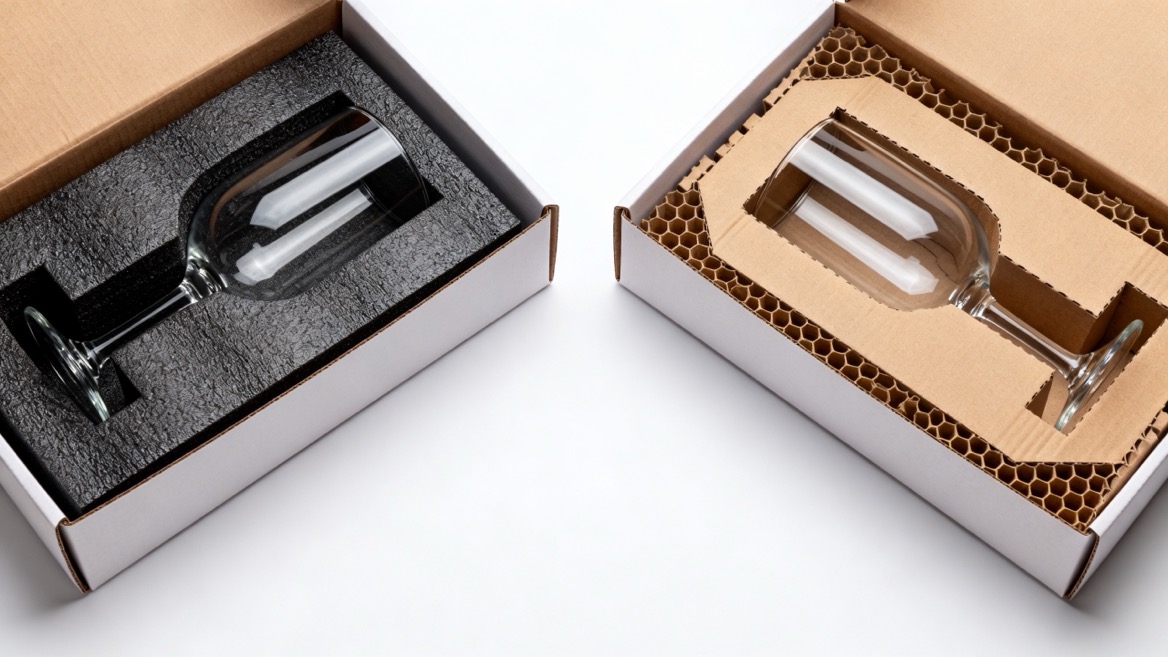
Foam is effective, but it is not the best solution for every product. More brands are reviewing paper-based alternatives because they want packaging that aligns with their recovery infrastructure, customer expectations, and material-reduction targets.
Custom corrugated inserts, molded pulp trays, paper honeycomb, folding paper cushions, and die-cut cardboard dividers can provide excellent protection when correctly designed.
| Packaging Solution | Best For | Main Strength | Limitation |
|---|---|---|---|
| Custom foam insert | Fragile, high-value, irregularly shaped products | Strong cushioning and precise product control | Recycling availability depends on foam type and location |
| Corrugated insert | Books, bottles, cosmetics, consumer goods, boxed items | Cost-effective, printable, paper-based, easy to integrate | May require more structure for very fragile products |
| Molded pulp tray | Consumer electronics, cosmetics, bottles, household goods | Product-shaped protection with a paper-based appearance | Tooling and design lead time may be required |
| Honeycomb paper | Furniture, ceramics, bottles, e-commerce fulfillment | Flexible cushioning and surface protection | Less precise than fitted inserts |
| Paper void fill | Lightweight products with moderate protection needs | Fast packing and adaptable fill | Not ideal for heavy or highly fragile items |
At Maituohong Packaging, we often recommend a hybrid packaging approach. For instance, a corrugated mailer box may use a die-cut paper insert to hold the product in place, plus a small protective foam pad only where sensitive components need extra shock absorption.
This approach can reduce material use without compromising protection.
Choosing foam should begin with the product—not with the material catalog. A practical packaging design process considers the complete transit environment and the product's actual failure points.
Start by asking the following questions:
- Is the product fragile, heavy, sharp-edged, polished, or sensitive to vibration?
- Which parts are most likely to break, scratch, bend, or malfunction?
- Does the product have glass, screens, coatings, lenses, corners, connectors, or moving parts?
- Does it need protection from moisture, dust, electrostatic discharge, or temperature change?
- Will it be shipped individually, in master cartons, on pallets, or directly to consumers?
A ceramic mug, for example, is mainly vulnerable to impact around the handle and rim. A handheld device may be vulnerable at the display, buttons, corners, and charging port. The internal packaging should support these weak points rather than applying pressure to them.
The gap between the product and the outer box is essential. Foam needs enough thickness to cushion the product, but the package also needs to remain compact and cost-efficient.
As a general design principle, heavier products require more robust support. However, the exact amount of cushioning should be verified through sample testing instead of assumptions.
A large box with loose foam can still fail if the item can move inside it. Conversely, a compact box with a properly fitted insert may provide better protection while reducing freight volume.
Foam alone cannot compensate for a weak shipping box. The outer corrugated box must be strong enough to resist compression, puncture, and handling stress.
A complete shipping package should include:
1. An appropriately sized corrugated shipping box
2. A fitted internal cushioning design
3. Adequate clearance between product and carton walls
4. Correct sealing tape and closure method
5. Clear handling instructions when necessary
6. Transit testing before large-scale production
This is especially important for direct-to-consumer shipping. Parcel networks expose packages to more individual handling events than palletized business shipments, which increases the importance of protective design.
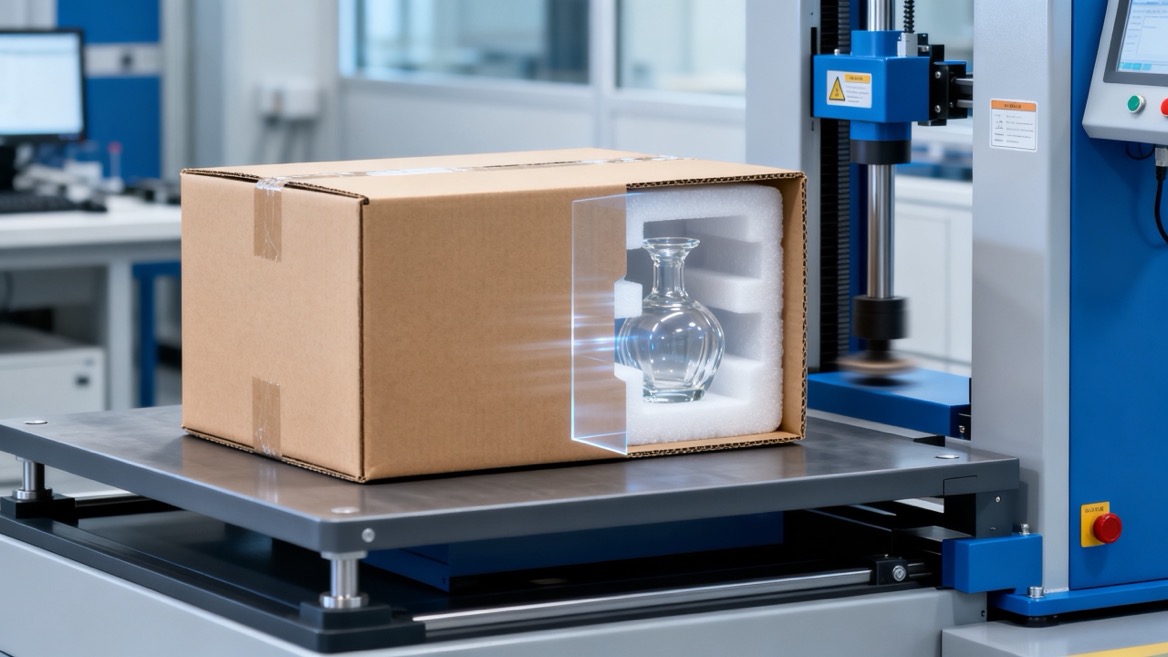
A packaging concept should not move directly from a computer drawing to mass production. Prototypes should be packed with the actual product and evaluated under conditions that reflect the intended distribution route.
Common package-performance evaluations include:
- Drop testing to assess impact protection
- Vibration testing to assess movement and abrasion during transportation
- Compression testing to evaluate stacking resistance
- Temperature and humidity conditioning when climate exposure is relevant
- Visual inspection for scuffing, cracking, looseness, and product movement
Industry test procedures may simulate drop, vibration, compression, and other distribution hazards. Formal testing can help brands compare design options and confirm whether a package protects its contents in a repeatable way.
For a growing e-commerce brand, even a simple internal trial can reveal important problems. Pack 10 to 20 samples, ship them through the actual delivery route, inspect returned packages, and document damage patterns. If damage occurs consistently on one corner, the solution may be a redesigned insert—not simply more material.
Foam packaging works best when it is engineered for the product and shipment. These common mistakes can increase cost while still leaving the product exposed.
More foam does not automatically mean better protection. Excess material can increase package size, shipping costs, storage requirements, and disposal burden. It can also make the box difficult to open or create an unnecessarily bulky customer experience.
Very soft foam may compress too easily under a heavy product. Very rigid foam may fail to cushion a delicate product adequately. The right balance depends on product weight, contact area, and drop risk.
If the product can move inside the insert, it can build momentum during vibration and impact. A product should be secure enough to remain stable, but not so tightly compressed that the foam creates pressure damage.
For premium brands, packaging is part of the product experience. Exposed rough-cut foam, difficult removal, strong odors, or poor accessory organization can weaken the perceived quality of the purchase.
A custom rigid box with a clean foam insert, finger notches, an organized accessory layout, and printed instructions can create a more polished experience without sacrificing protection.
Foam recycling depends on the specific polymer, local collection system, processing equipment, contamination level, and regional regulations. It is better to communicate clearly and specifically than to make a broad claim that customers cannot act on.
For example, "Please check local collection availability for polyethylene foam" is more responsible than stating that all foam packaging can be placed in a curbside recycling bin.
Foam packaging is often a strong choice when products are:
- Fragile and high-value
- Heavy relative to their size
- Irregularly shaped
- Sensitive to scratches or vibration
- Made with glass, ceramics, electronics, or precision components
- Shipped through parcel networks
- Sold in premium presentation boxes
- Packed with multiple accessories or replacement parts
However, paper-based inserts may be a better fit when the product is relatively durable, has a regular shape, or requires a packaging design that relies primarily on corrugated or molded fiber materials.
The best decision comes from testing the product inside the complete package—not from selecting a material in isolation.
Foam has an important role in packaging because it helps protect products from the real-world hazards of shipping: drops, vibration, compression, movement, and surface damage. But the most successful solution combines the right cushioning material with a properly engineered mailer box, shipping box, corrugated carton, or rigid gift box.
Maituohong Packaging provides custom paper packaging solutions backed by more than 18 years of design and manufacturing experience. We can help you develop protective packaging that balances product safety, brand presentation, packing efficiency, and material selection.
Whether you need a custom mailer box with corrugated inserts, a shipping box with protective foam, a luxury rigid box with fitted interiors, or a paper-based alternative for e-commerce fulfillment, our team can support your project from structural concept to production.
Contact Maituohong Packaging today to discuss your product dimensions, shipping method, protection requirements, and custom packaging goals.
The main purpose of foam is to cushion products against shock, vibration, compression, and movement during transportation. It helps reduce the risk of breakage, scratches, dents, and component damage.
Yes. Foam is often suitable for e-commerce shipments, particularly for fragile, high-value, heavy, or irregularly shaped products. It should be combined with a correctly sized and sufficiently strong shipping box.
PE foam is generally more durable, moisture-resistant, and suitable for shipping protection. PU foam is softer, more flexible, and often used for premium presentation packaging, cosmetic kits, tools, and delicate products.
Yes. Foam inserts can be die-cut, CNC-cut, molded, laminated, or fabricated into custom cavities that match a product's size, shape, and accessory layout. This helps prevent movement inside the box.
Some foam materials can be recycled, but actual recycling access depends on the foam type and local facilities. EPS, PE, and PU may have recycling pathways, but many local curbside systems do not accept every type of foam packaging.
Neither is universally better. Foam may provide stronger protection for fragile or irregularly shaped items, while corrugated inserts and molded pulp can work well for many products and may better fit paper-based packaging programs. The right option depends on product risk, shipping conditions, budget, and recovery requirements.
Use actual product samples and evaluate the package through drop, vibration, compression, and shipping trials. Check for product movement, broken components, scratches, damaged corners, and carton failure. Testing is more reliable than relying on material thickness alone.
- [International Safe Transit Association — Test Procedures]
- [Michigan State University School of Packaging — Package Performance Tests]
- [U.S. Environmental Protection Agency — Plastics: Material-Specific Data]
- [Washington State Department of Ecology — Expanded Polystyrene Ban]
- [DDL — ASTM D4169 Distribution Simulation Testing]
- [International Safe Transit Association — Packaging Test Procedures and Standards]


