
Views: 246 Author: Maituohong Packaging Publish Time: 2026-10-10 Origin: Site


Content Menu
● Wine Bags vs. Gift Boxes: A Quick Comparison
● How Wine Bags and Gift Boxes Differ in Construction
>> Paper Wine Bags: Flexible and Carry-Friendly
>> Wine Gift Boxes: Several Distinct Formats
● Which Offers Better Bottle Protection?
>> Wine Bags Provide Carrying Support, Not Engineered Cushioning
>> Gift Boxes Can Provide Better Restraint
● Wine Gift Packaging vs. Wine Shipping Packaging
● Cost Comparison: Look Beyond the Unit Price
>> When Wine Bags Can Be More Economical
>> When Gift Boxes Can Justify the Investment
● Branding and the Unboxing Experience
>> Wine Bags Favor Immediate Recognition
>> Gift Boxes Create a Sequenced Presentation
● Sustainability: Compare the Complete Package
>> Responsible Sourcing and Recyclability Are Different
>> Practical Questions for Suppliers
● A Practical Decision Framework for Packaging Buyers
>> Choose According to the Buying Journey
>> An Illustrative Two-Channel Project
● How to Develop Custom Wine Packaging in Five Steps
>> Are wine bags cheaper than gift boxes?
>> Can a magnetic wine gift box be shipped without an outer carton?
>> Are folding gift boxes as strong as rigid boxes?
>> Can one package fit different wine bottles?
>> Which option is better for luxury wine gifts?
>> What should I send when requesting a quotation?
The main differences between wine bags and gift boxes involve structure, protection, presentation, and total packaging cost. Wine bags offer convenient carrying and quick gifting, while gift boxes provide a more structured presentation and greater scope for fitted inserts. Neither format automatically qualifies as protective shipping packaging.
For wineries, retailers, and corporate gift buyers, the better choice depends on what happens after the bottle is packed. Will a customer carry it home, present it at an event, or send it through a parcel network?
At Maituohong Packaging, our perspective comes from more than 18 years in custom paper packaging design and production. We approach this comparison through fit-for-purpose design: matching the packaging to the bottle, brand, budget, and delivery journey.
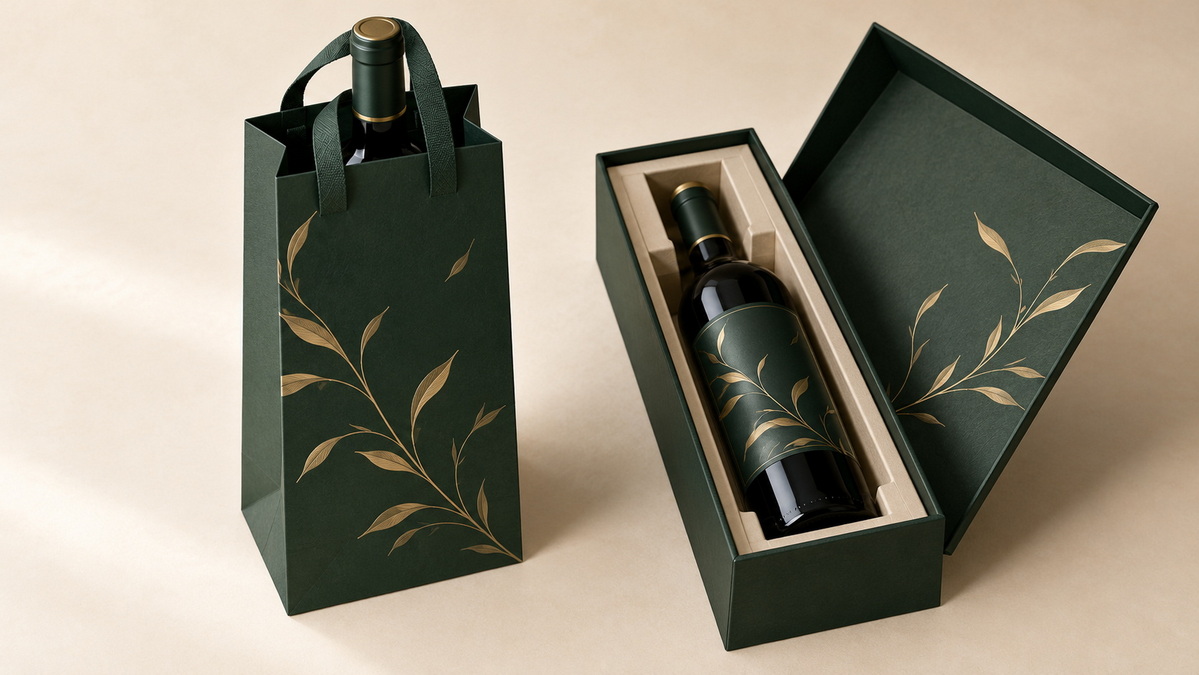
Here, "wine bags" means paper bottle gift bags, not insulated carriers or bag-in-box wine containers. "Gift boxes" includes folding cartons, rigid presentation boxes, and collapsible gift boxes.
| Comparison factor | Paper wine bags | Wine gift boxes |
|---|---|---|
| Main purpose | Convenient carrying and simple gifting | Structured presentation and organized gifting |
| Construction | Paper body with gussets, base, and handles | Folding board, wrapped rigid board, or collapsible construction |
| Protection | Limited cushioning and bottle restraint | Can accommodate fitted inserts and dividers |
| Presentation | Bottle neck may remain visible | Can conceal the bottle for a staged reveal |
| Packing process | Usually quick to open and fill | May require assembly and insert placement |
| Storage | Typically stores flat | Depends on whether construction is rigid or collapsible |
| Branding | Strong front-and-back graphics | Exterior, interior, inserts, and opening sequence |
| Typical application | Retail purchases and event handouts | Premium gifts and coordinated bottle sets |
| Parcel shipping | Not a standalone shipping solution | Presentation boxes require separate shipping assessment |
The important distinction is between carrying, presenting, and shipping a bottle. These are different packaging tasks, even when one order must accomplish all three.
A paper wine bag generally uses kraft, coated, or specialty paper. Side gussets create depth, while a reinforced base supports the bottle. Handles may use twisted paper, ribbon, cord, or die-cut openings.
The paper specification matters, but it is not the whole structure. Handle attachment, glued seams, base reinforcement, and bag proportions also affect performance.
For procurement, I would not approve a bag solely because its paper feels thick. I would request a sample carrying the actual filled bottle and inspect the handle area and bottom construction.
"Gift box" does not describe one construction.
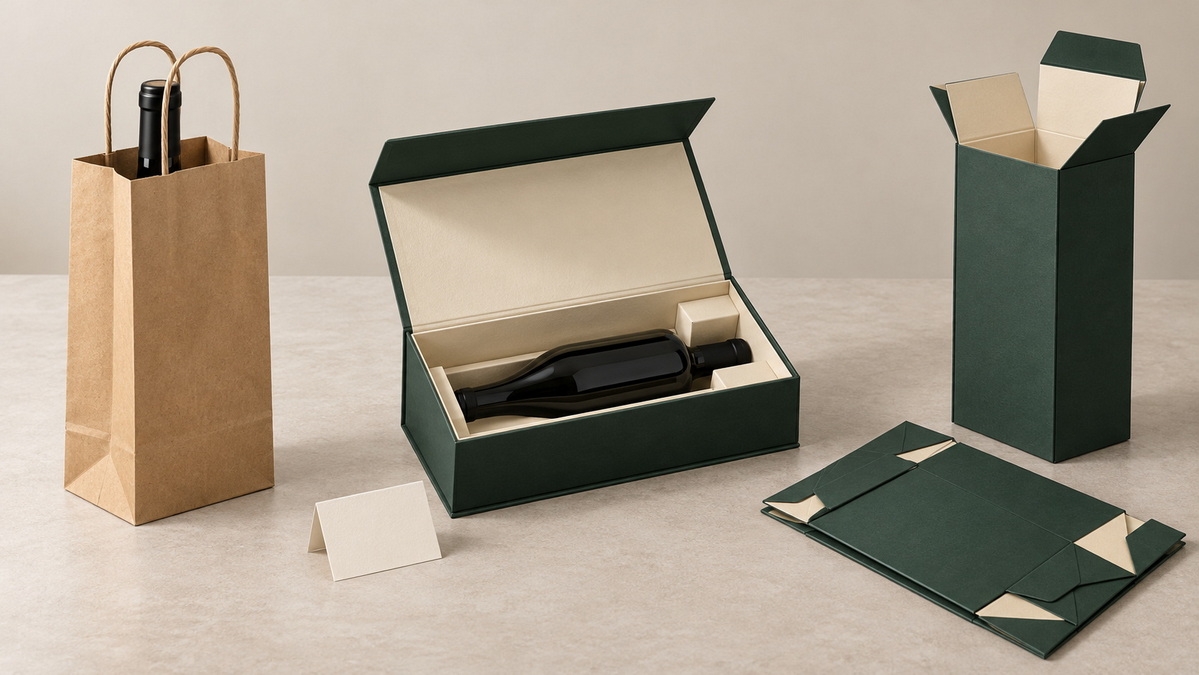
- Folding cartons use creased paperboard and usually ship flat.
- Rigid boxes use stiff board wrapped with printed or decorative paper.
- Collapsible rigid boxes combine a structured appearance with fold-down storage.
- Magnetic closure boxes use concealed magnets to hold a flap closed.
- Corrugated presentation boxes can combine printed surfaces with protective structural features.
These categories may overlap. For example, a magnetic box can also be collapsible.
A useful specification should identify the actual construction rather than simply request a "luxury wine box."
A well-made wine bag can support normal hand carrying, but it usually leaves the bottle relatively unrestrained. Decorative tissue can improve presentation without providing a validated cushioning system.
For multiple bottles, consider separate compartments or dividers. Bottles should not knock together during ordinary handling.
A reinforced base also does not make a bag suitable for parcel delivery. Carry strength and transit protection solve different problems.
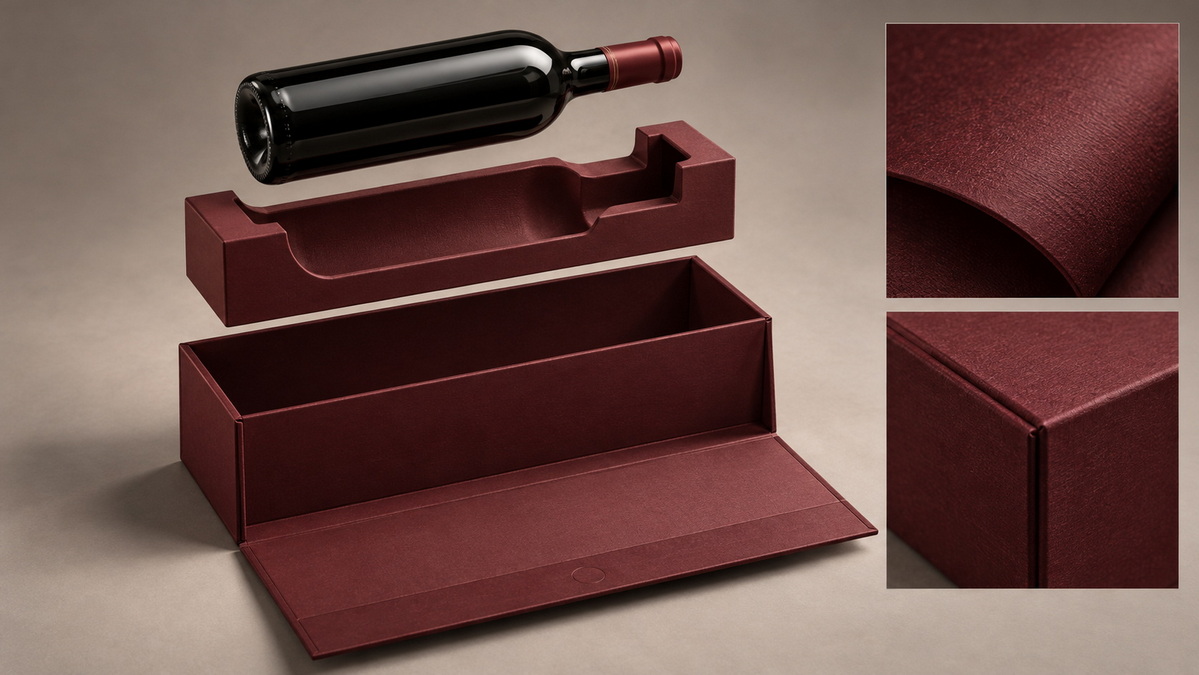
A gift box can incorporate a fitted insert that controls bottle movement. Paper-based wine packaging systems may use corrugated or molded-fiber components to hold bottles in position and separate them from surrounding surfaces. Commercial examples demonstrate how inserts can combine bottle protection with label visibility.
However, a rigid exterior alone does not establish protective performance. An oversized cavity can allow movement, and a poorly positioned insert may rub the label.
Evaluate the complete pack:
- Does the bottle sit securely?
- Are neighboring bottles separated?
- Does the insert avoid pressure on vulnerable decorative features?
- Can the bottle be removed comfortably?
- Does the pack still close correctly when fully loaded?
This is the most consequential distinction in the comparison.
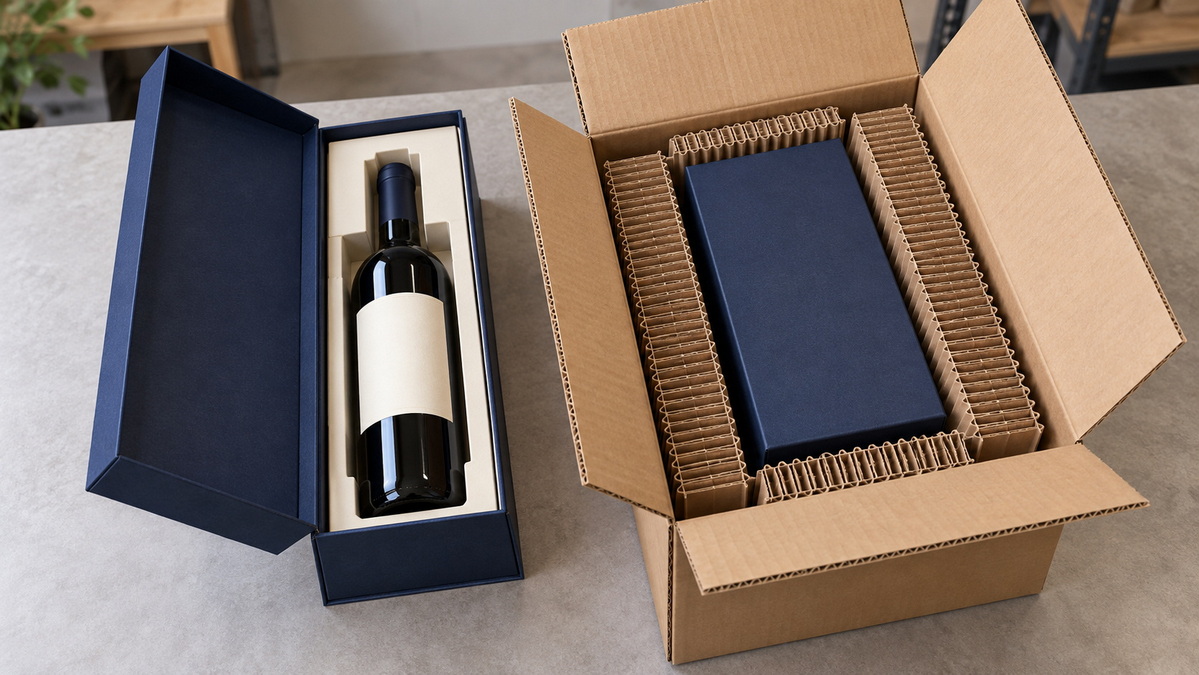
A magnetic gift box may look substantial, but it should not automatically be treated as a shipping carton. UPS specifies sturdy outer corrugated containers and accepted inner packaging that secures wine bottles centrally, away from the shipper's side walls.
For a mailed premium gift, plan the presentation and transport layers together. Depending on the design, the gift box may sit inside a protective shipping system, or presentation features may be integrated into an engineered shipper.
Testing should assess the actual bottle-and-package combination. ISTA Procedure 3A addresses individual packaged products moving through parcel delivery systems; it is not a guarantee attached to a box style or material name.
Before production, agree on the distribution environment, test method, and acceptance criteria. Packaging approval also does not replace applicable alcohol-shipping requirements.
For comparable order conditions and relatively simple specifications, paper wine bags can offer a lower-complexity solution. They generally require fewer presentation components and little packing preparation.
However, a large bag with specialty paper, elaborate handles, reinforcement, and multiple finishes may cost more than a simple folding gift carton.
Compare like-for-like quotations rather than assuming that every bag is cheaper than every box.
Gift boxes become more relevant when the order needs an organized presentation: two bottles, tasting notes, accessories, or a personalized message.
Their value should come from a defined customer experience, not an assumption that expensive packaging automatically increases sales.
For each option, compare:
1. Packaging and insert costs.
2. Freight and storage volume.
3. Assembly and packing labor.
4. Additional shipping protection.
5. Damage, rework, and replacement exposure.
Ask suppliers to quote the same bottle dimensions, quantity, artwork coverage, and delivery terms. Otherwise, apparent savings may reflect different specifications.
Custom wine bags work well when branding needs to be visible quickly. A clear logo, distinctive color, and balanced front panel can communicate the brand without extensive decoration.
They also keep the gifting process simple. This is useful at checkout counters, tasting-room events, and large handout programs.
Keep practical details in view: handles should not obscure important graphics, and the bottle should not distort the printed panel excessively.
Gift boxes offer more control over what recipients see first. The lid, interior message, bottle orientation, and insert layout can form a deliberate opening sequence.
For corporate wine gift packaging, that sequence might include:
- A restrained exterior identity.
- A message inside the lid.
- A bottle presented label-up.
- A separate compartment for a greeting card.
My design recommendation is to prioritize visual hierarchy over decoration. One well-positioned finish can be more coherent than competing foil, texture, graphics, and accessories.
Neither wine bags nor gift boxes are automatically the more sustainable choice.
A lightweight paper bag uses a different material system from a reusable rigid box, but a fair comparison also considers protective components, transport volume, actual reuse, and disposal options.
FSC certification concerns responsible forest-based sourcing. It should not be treated as a blanket statement about the recyclability of every component in a finished package.
Assess handles, windows, laminations, magnets, inserts, and decorative additions separately. Ask whether they can be reduced, replaced, or easily separated.
For U.S. marketing, the FTC advises qualifying recyclable claims when appropriate recycling facilities are unavailable to at least 60% of the consumers or communities where the product is sold. A paper appearance alone does not substantiate an unrestricted claim.
- What is the fiber composition?
- Which components are non-paper materials?
- Can recipients separate those components?
- What evidence supports the proposed environmental wording?
- Are disposal instructions appropriate for the destination market?
Specific, verifiable descriptions are more useful than broad "eco-friendly" language.
| Buying situation | Sensible starting point | Main validation priority |
|---|---|---|
| One bottle purchased in-store | Reinforced paper wine bag | Carry strength and fit |
| Premium corporate gift | Rigid or magnetic gift box | Presentation and insert restraint |
| High-volume event handout | Paper bag or folding carton | Packing speed and handling |
| Bottle-and-accessory set | Compartmented gift box | Separation and removal access |
| Space-constrained storage | Bag, folding carton, or collapsible box | Packed volume and assembly time |
| Parcel delivery | Engineered wine shipping system | Complete-pack transit performance |
These are starting points, not universal rules. A bottle's geometry, filled weight, order quantity, and distribution route can change the decision.
Consider a winery selling the same bottle at its tasting room and through a corporate gifting program. This is an illustrative scenario, not a reported customer case.
The tasting room may favor a reinforced paper bag for quick packing. The corporate program may need a fitted gift box with a message card.
Rather than forcing one structure into both channels, the winery could share colors, typography, and artwork elements across two formats. This preserves a coordinated identity while allowing each package to serve its actual purpose.
1. Record the real bottle dimensions. Include height, maximum diameter, closure shape, filled weight, and label position. Do not size packaging from nominal bottle capacity alone.
2. Define the handling route. Separate hand delivery, retail collection, bulk distribution, and individual parcel shipment.
3. Select the structure. Decide whether carrying convenience, presentation, storage efficiency, or shipping protection is the primary requirement.
4. Approve a physical prototype. Check fit, carrying comfort, opening, bottle removal, label contact, and packing time.
5. Confirm production controls. Document materials, dimensions, artwork, insert positioning, finish expectations, and inspection criteria.
For transit applications, validate the complete packaging system before introducing new materials or methods. UPS specifically encourages samples and testing against recognized standards.
Often, simple paper wine bags cost less than elaborate rigid gift boxes. However, size, materials, handles, finishes, quantities, and freight can change the comparison. Request equivalent specifications.
Do not assume so. Assess it as part of a complete shipping system. UPS wine-packaging guidance requires sturdy outer corrugated containers and suitable internal protection.
Not necessarily, but construction labels alone cannot determine performance. Board specification, geometry, inserts, closures, and intended handling all matter. Validate the assembled package.
Sometimes. Check the tallest and widest bottles, shoulder profiles, closure shapes, and label positions. A shared exterior may require different inserts.
A well-designed rigid or magnetic box offers more control over presentation. A premium paper bag can still suit understated, hand-delivered gifting. Match the format to the experience rather than price alone.
Provide bottle measurements or samples, quantity, destination, artwork, desired structure, insert requirements, intended use, and target delivery date. Identify parcel-shipping needs separately.
1.Smurfit Westrock. "Wine Shipping Boxes." Commercial examples of bottle restraint, paper-based inserts, and presentation-oriented shipping designs. [smurfitwestrock]
2.UPS. "How To Ship Wine." Carrier guidance on outer containers and accepted internal packaging. [ups]
3.International Safe Transit Association. "Test Procedure 3A: Overview." Scope of parcel-delivery simulation testing for packaged products. [ista]
4.Forest Stewardship Council. "Paper and Packaging." Background on responsible sourcing and forest-based packaging certification. [fsc]
5.Federal Trade Commission. "Environmental Claims: Summary of the Green Guides." Guidance on substantiating and qualifying environmental claims. [ftc]
6.UPS. "Internal Packaging Recommendations for the Packaging of Wine." Technical guidance on bottle positioning and pre-implementation testing. [ups]


