
Views: 264 Author: Maituohong Packaging Publish Time: 2026-10-11 Origin: Site


Content Menu
● What Makes Cosmetics Packaging More Sustainable?
● 7 Eco-Friendly Cosmetics Packaging Ideas for Beauty Brands
>> 1. Specify Recycled Paperboard With Documented Content
>> 2. Replace Foam Inserts Where Paper Can Provide Reliable Protection
>> 3. Reduce Unnecessary Packaging Before Changing Materials
>> 4. Choose Finishes Based on Performance and Recovery
>> 5. Use Folding Gift Boxes Where Flat Storage Adds Value
>> 6. Design Magnetic Boxes and Rigid Boxes With Clear Trade-Offs
>> 7. Coordinate Refill Packaging, Mailers, and Paper Shopping Bags
● A Practical Packaging Brief: From Sustainability Goal to Production
>> Step 1: Define the Product and Sales Channel
>> Step 2: Build a Component-Level Specification
>> Step 3: Review Samples Before Artwork Approval
>> Step 4: Test the Complete Shipping Configuration
>> Step 5: Verify Claims Before Printing
● Measure Packaging Improvements Without Inventing Results
● Compare Total Cost, Not Just the Box Price
● Environmental Claims: Be Specific About What Customers Can Do
● Build a Better Packaging Specification With Maituohong Packaging
>> 1. What Is the Best Eco-Friendly Packaging for Cosmetics?
>> 2. Are Magnetic Cosmetic Boxes Recyclable?
>> 3. Does Recycled Paperboard Reduce Print Quality?
>> 4. Is Molded Pulp Always Better Than Foam?
>> 5. Can Small Beauty Brands Improve Packaging Without Changing Their Bottles?
>> 6. What Should I Send a Custom Packaging Manufacturer?
Eco-friendly cosmetics packaging should protect your products, express your brand, and reduce unnecessary material without creating new problems. For beauty businesses, the most practical improvements often start with custom cosmetic boxes, paper inserts, shipping cartons, and shopping bags—not a complete redesign of the bottle.
At Maituohong Packaging, our perspective comes from more than 18 years of experience designing and producing custom paper packaging. Our product range includes magnetic boxes, rigid boxes, folding gift boxes, mailer boxes, shipping boxes, and paper shopping bags.
Our starting principle is right-sizing: use the structure and material the product actually needs, then verify its performance.
This guide explains seven practical packaging ideas, their limitations, and a purchasing process that helps beauty brands turn sustainability goals into clear manufacturing specifications.

No single material makes every beauty package environmentally preferable. A useful assessment considers material sourcing, packaging weight, product protection, transport efficiency, and realistic disposal options.
It also separates three different packaging layers:
- Primary packaging: bottles, jars, tubes, pumps, and closures that contain the formula.
- Secondary packaging: retail cartons, rigid gift boxes, sleeves, and inserts.
- Transit packaging: mailers, shipping boxes, and protective materials used during delivery.
Changing primary packaging may require formula compatibility and filling-line checks. Secondary and transit packaging offer different opportunities, but they still need testing.
A recycled carton that allows a glass bottle to break is not a successful redesign. Likewise, a beautiful reusable gift box delivers limited reuse value if customers immediately discard it.
The objective is to improve the complete packaging system, not simply replace one material.
Recycled paperboard can be a practical option for cosmetic cartons, gift-box components, and paper accessories.
However, "recycled" is not a complete purchasing specification. Ask your supplier to identify:
- The board grade and thickness.
- The recycled-content percentage.
- The distinction between pre-consumer and post-consumer material.
- Which components the percentage covers.
- The documentation supporting the claim.
A rigid box may contain recycled greyboard while using a different wrapping paper. Describing the entire finished box as "100% recycled" would require evidence covering the complete claim.
Also distinguish sourcing certification from recycled content. FSC Mix and FSC Recycled labels have different meanings. Neither should be treated as automatic proof that a finished package will be collected and recycled everywhere.
Before approval, inspect printing, folding, surface texture, and structural strength on the proposed stock.
Paperboard dividers, folded inserts, and molded pulp trays can reduce mixed-material complexity inside cosmetic gift boxes.
The correct choice depends on product weight, shape, fragility, and presentation requirements.
| Insert option | Suitable applications | Main consideration |
|---|---|---|
| Die-cut paperboard | Lightweight tubes and small cosmetic sets | Secure positioning and fold strength |
| Corrugated insert | Heavier bottles and shipped gift sets | Cushioning and available space |
| Molded pulp | Shaped cavities for bottles or jars | Tooling cost and surface finish |
| Foam insert | Certain fragile or demanding applications | Material separation and disposal |
For glass skincare bottles, examine movement around the base, shoulder, and closure. A tray that looks attractive may still permit damaging contact during transit.
Our recommendation is to test the insert together with the actual product, gift box, and shipping carton. Do not approve protection based only on an empty sample or digital rendering.
One of the most direct improvements is removing a component that serves no essential purpose.
Common candidates include:
- Decorative sleeves that repeat the carton artwork.
- Leaflets that duplicate information already printed elsewhere.
- Oversized inserts with unused cavities.
- Extra tissue or wrapping layers.
- Shopping bags supplied automatically for every purchase.
Start with a component audit. Record what each part does: protection, labeling, presentation, handling, or transport.
Then ask whether that function can be achieved with fewer parts.
For example, printing nonmandatory usage information inside a box may eliminate a separate leaflet. However, legally required information must remain available in the required format for the destination market.
Reducing materials should simplify the customer experience, not make instructions harder to find or products harder to handle.
Luxury cosmetic packaging does not always require plastic film lamination, metallic decoration, or multiple coating layers.
Alternatives may include textured paper, restrained printing, blind embossing, or an appropriate aqueous coating.
However, "water-based" does not automatically mean recyclable. Coating formulation, coverage, adhesives, and the complete packaging construction all influence recycling performance.
Paper-industry testing methods assess how packaging behaves during processes such as pulping, screening, and sheet formation. These provide stronger technical evidence than appearance alone.
For beauty packaging, evaluate two questions separately:
1. Does the finish provide the required resistance to rubbing, handling, and expected moisture exposure?
2. Does the finished construction have evidence supporting the intended recycling route?
Request a production-representative sample. Test it under realistic conditions before replacing a finish that currently protects your packaging successfully.
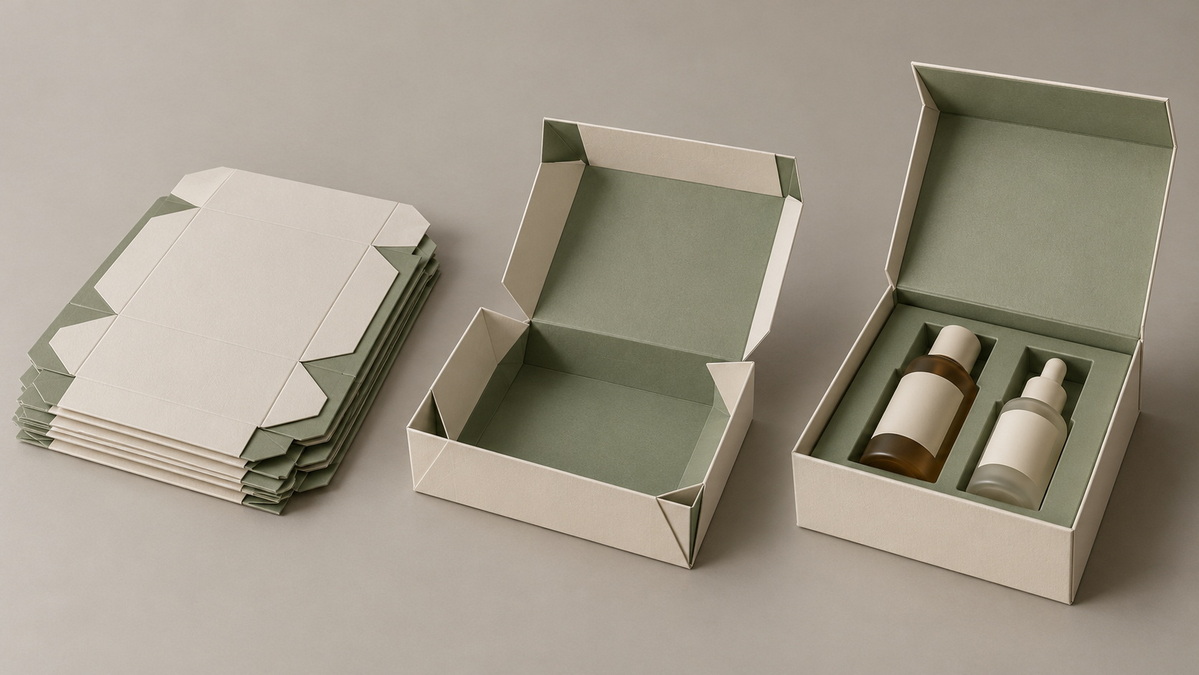
Folding gift boxes can offer a premium presentation while occupying less space before assembly than comparable assembled rigid boxes.
This can be useful for seasonal beauty collections, promotional kits, and brands with limited warehouse space.
The potential benefit comes from logistics efficiency—not from the word "folding" itself.
Compare:
- Packed volume per delivery carton.
- Number of boxes stored per pallet.
- Assembly time.
- Board weight.
- Closure materials.
- Product protection after assembly.
A folding magnetic gift box still contains magnets and may include other non-paper components. Its compact shipping format does not automatically make the complete box recyclable.
Evaluate the actual construction and transport arrangement. Flat-pack benefits should be measured against a defined alternative rather than assumed from the product category.
Magnetic boxes and rigid boxes remain useful for premium skincare sets, fragrance collections, and gift presentations.
They can also involve more material and greater complexity than simpler cartons. Magnets, ribbons, foam, and laminated wraps complicate an otherwise paper-based structure.
For brands that need this format, consider:
- Smaller dimensions with less empty space.
- Paper-based inserts where performance allows.
- Fewer decorative attachments.
- Clearly separable non-paper components where feasible.
- A genuine secondary use, such as organized storage.
Avoid promising reuse simply because a box feels durable. Customers need a practical reason to keep it.
If a magnetic closure is not essential, compare a lid-and-base rigid box or another closure design. Premium presentation should come from proportion, artwork, and workmanship—not unnecessary material.
Refill programs can extend the use of a primary container, but they require more than a new outer box.
The formula, refill container, dispensing method, hygiene instructions, and customer behavior must work together. Environmental benefits also depend on whether customers actually refill and how much additional packaging the system requires.
A paper-packaging manufacturer can support the surrounding system through appropriately sized refill cartons, organized bundle boxes, and protective shipping formats.
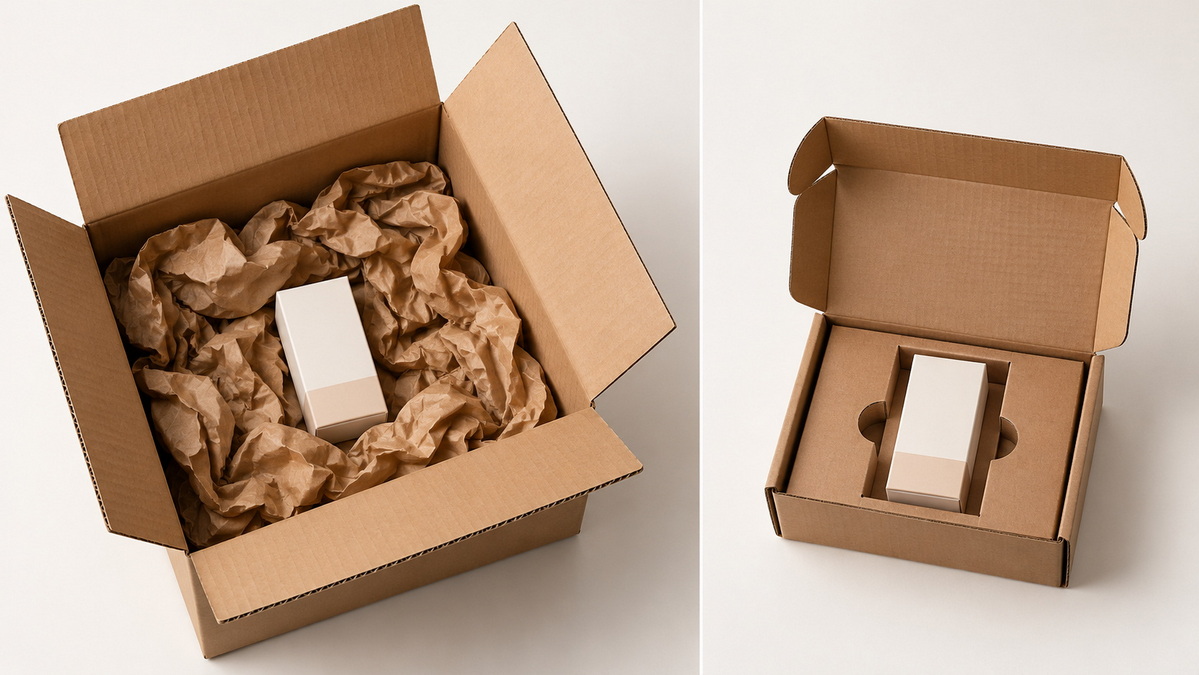
For online orders, select mailer boxes around the packed product rather than adding avoidable void space.
For retail, size paper shopping bags to the purchase and check handle strength. A paper bag is not environmentally preferable simply because it replaces plastic; material quantity, durability, reuse, and disposal still matter.

A clear brief prevents attractive ideas from becoming expensive or unreliable packaging.
Provide product dimensions, filled weight, closure details, and fragility.
Identify whether the package serves retail shelves, direct-to-consumer delivery, wholesale distribution, or gifting. These channels create different handling and protection requirements.
List the outer box, wrapping paper, insert, closure, labels, coatings, and accessories separately.
For each component, record material, weight, supplier evidence, and intended disposal route. This exposes mixed materials that broad descriptions such as "paper gift box" can hide.
Check product fit, print quality, surface durability, opening experience, and assembly.
Use representative materials whenever possible. A sample made from substitute board cannot fully confirm the appearance or performance of the final specification.
Include the product, insert, retail box, transit carton, and any void fill.
Document movement, breakage, scuffing, crushed corners, and closure failures. The objective is reliable delivery, not merely a stronger-looking box.
Confirm exactly what each statement describes.
"Outer box made with 80% recycled paperboard" is more specific than "eco-friendly packaging," but it still needs supporting documentation.
Do not print certification marks or environmental claims until the relevant evidence and permissions have been checked.
A redesign becomes more useful when buyers can compare measurable outcomes.
Consider tracking these indicators:
| Indicator | What it helps evaluate |
|---|---|
| Packaging weight per unit | Material use |
| Number of components | Assembly and separation complexity |
| Packed volume | Storage and transport requirements |
| Documented recycled content | Accuracy of material claims |
| Transit damage rate | Protection performance |
| Landed packaging cost | Overall commercial feasibility |
As an illustrative calculation, reducing secondary packaging from 120 grams to 90 grams saves 30 grams per unit. Across 10,000 units, that equals 300 kilograms of packaging material.
This is not a customer case study or a carbon-footprint result. Carbon comparisons require additional information about materials, production, transport, and end-of-life assumptions.
Keep the baseline consistent. Compare equivalent products and protection requirements rather than using different package sizes to create an exaggerated improvement.
A lower quoted unit price does not always mean a lower total packaging cost.
For custom cosmetic boxes, assess:
- Tooling and setup charges.
- Minimum order quantities.
- Freight and warehouse space.
- Assembly labor.
- Packing speed.
- Product damage and replacement costs.
Molded pulp may require dedicated tooling. Folding gift boxes may reduce incoming storage volume but add assembly work. A simpler insert may lower component cost yet increase packing time.
Request quotations against the same specification and delivery assumptions. This makes supplier comparisons more meaningful and reveals where a design change creates—or removes—cost.
Recycled content, recyclability, and compostability describe different properties.
A package can contain recycled material without being widely recyclable. A technically recyclable package may still lack collection access in its sales market.
In the United States, federal guidance calls for qualifying recyclable claims when suitable facilities are unavailable to at least 60% of the consumers or communities where the item is sold. Access alone does not resolve every aspect of a claim; the package must also be suitable for the stated recovery route.
Compostability requires evidence and appropriate qualification. Plant-derived ingredients do not establish that a complete package is home compostable.
Give customers clear, component-specific instructions wherever possible.
Sustainable beauty packaging begins with a clear brief and realistic trade-offs.
Maituohong Packaging brings more than 18 years of paper-packaging design and production experience to magnetic boxes, rigid boxes, folding gift boxes, mailer and shipping boxes, and paper shopping bags.
Send us your product dimensions, order quantity, sales markets, and current packaging structure. Request a comparison of suitable box formats, insert options, finishes, and pre-production samples before committing to your next production run.
There is no universal best option. Choose packaging that protects the product, avoids unnecessary material, uses documented sourcing, and fits available recovery systems. The answer may differ between a lightweight cosmetic tube and a heavy glass gift set.
Not automatically. The paperboard, magnets, adhesives, coatings, and accessories must be considered together. Separation options and local collection requirements matter. Avoid describing the complete box as universally recyclable without supporting evidence.
Not necessarily, but results depend on the grade, surface, artwork, and printing process. Approve a sample on the proposed stock, especially when color consistency, fine text, or premium finishing is important.
No. Molded pulp may simplify material composition, but protection requirements come first. Compare product fit, cushioning, tooling, moisture conditions, and transit results before selecting an insert.
Yes. Secondary boxes, inserts, shipping cartons, and shopping bags provide practical opportunities. Start with unnecessary components, oversized dimensions, and unsupported claims before considering more complex container changes.
Send product dimensions, filled weight, quantities, destination markets, sales channels, artwork, budget, and any required material claims. Include existing packaging samples and known delivery problems when available.
1. PakFactory. "7 Eco-Friendly Cosmetics Packaging Ideas." Published and updated October 9, 2026. Background source for the seven-idea framework, secondary-packaging opportunities, supplier documentation, and material trade-offs. [pakfactory]
2. Federal Trade Commission. "Environmental Claims: Summary of the Green Guides." Guidance on recycled-content statements, recyclable claims and the 60% availability threshold, compostability, and claim qualification. [ftc]
3. Forest Stewardship Council. "What the FSC Labels Mean." Official explanations of FSC Recycled and FSC Mix; supports the distinction between recycled material and certified or controlled sourcing. [fsc]
4. Forest Stewardship Council. "Paper & Packaging." Official guidance on reclaimed materials and the FSC Recycled label for paper and packaging products. [fsc]
5. Confederation of European Paper Industries. "Cepi Recyclability Test Method Version 3." Published March 13, 2025. Describes laboratory procedures covering pulping, screening, and sheet formation for assessing paper-based packaging. [cepi]
6. 4evergreen Alliance. "Recyclability Evaluation Protocol." Explains laboratory testing, technical evaluation, and performance scoring across different recycling technologies. Supports the distinction between technical recyclability and actual collection access. [4evergreenforum]


