
Views: 222 Author: Maituohong Packaging Publish Time: 2026-04-21 Origin: Site


In packaging manufacturing, corrugated cardboard is a multi‑layer paper structure consisting of a wavy fluted medium sandwiched between one or two flat linerboards. This structure creates a lightweight but very strong material that can withstand compression, stacking, and impact during shipping.
From a buyer's perspective, corrugated board matters because it determines:
- How well your products survive shipping
- How premium your unboxing experience feels
- How much you pay in material and freight
- How your brand performs on sustainability metrics [gushwork]
At Maituohong Packaging, we primarily convert corrugated board into:
- Custom mailer boxes for ecommerce and subscription brands
- Shipping cartons for bulk transport and fulfillment centers
- Rigid and specialty gift boxes that combine corrugated cores with premium outer papers [hktdc]
Buyers often use "cardboard" to describe any paper‑based box, but in manufacturing we distinguish between:
- Paperboard / chipboard – single‑ply, thinner board used for folding cartons (e.g., cereal boxes, cosmetic sleeves) and inserts.
- Corrugated cardboard – fluted medium + liner(s), designed for shipping, stacking, and protective packaging.
For mailer boxes and shipping boxes, you almost always want corrugated, not just paperboard, because:
- Corrugated has far higher crush and stacking strength for pallets and warehouse storage.
- Flutes provide cushioning against drops and vibration.
- Corrugated offers more closure and locking options for self‑locking mailers and e‑commerce boxes. [gushwork]
In short: use folding cartons for shelf display, but use corrugated mailer or shipping boxes for transport, fulfillment, and doorstep delivery. [altitudemarketing]
These are thin, often colored corrugated sheets used mostly for crafts, visual merchandising, and lightweight wrapping. As a manufacturer of shipping boxes, we rarely use them structurally, but we do see them used as:
- Decorative liners inside gift sets
- Protective wraps around individual products for extra cushioning
- Visual elements in point‑of‑sale displays
Chipboard is made from pressed paperboard and is flat, not fluted. It is useful for:
- Inserts and partitions inside corrugated boxes
- Backers for notebooks or retail displays
- Game boards or rigid components
In a typical ecommerce project, we might combine:
- A corrugated mailer box as the outer shell
- Chipboard inserts to hold products in place and improve unboxing presentation [gushwork]
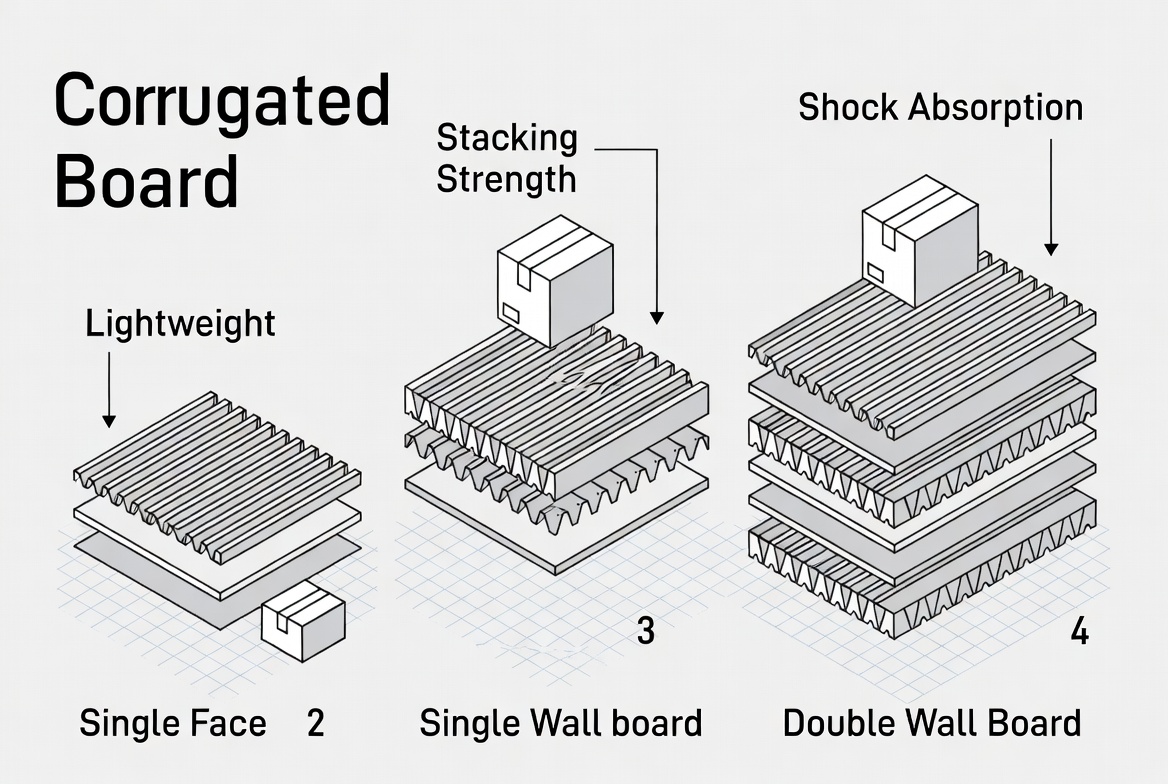
Single face material has one flat liner on top of exposed flutes, offering flexibility and cushioning. Practical uses include:
- Wrapping irregular or fragile items inside a master carton
- Using as pads between stacked products to minimize scratching
- Temporary corner or edge protection in transit
For buyers, single face is ideal when you want protective cushioning without committing to a full custom box size. [gushwork]
This is the standard three‑layer structure: outer liner + fluted medium + inner liner. It is widely used for:
- Mailer boxes (ecommerce, DTC brands, subscription boxes)
- Standard shipping cartons for light‑to‑medium weight products
- Retail‑ready boxes with high‑quality printing
Maituohong Packaging most frequently uses single wall board for custom mailer boxes, because it balances strength, weight, and print quality. [gushwork]
Double wall board uses two layers of fluting (typically B‑flute and C‑flute) sandwiched between three linerboards, creating extremely high stacking strength (often specified in the 250–350 lb range under standard tests).
We recommend double wall when you need to:
- Ship heavy or high‑value products
- Palletize multiple layers of cartons in warehouses
- Withstand long‑distance export with rough handling [hktdc]
For example, many of our B2B electronics and industrial clients use double wall shipping boxes for overseas freight to minimize damage and returns. [gushwork]
Flutes are the "waves" inside corrugated board, and they directly influence cushioning, printability, and fold behavior. While the original article only mentions that "A‑ and B‑flutes are more easily folded, whereas C‑flutes and higher are sturdier," we refine this using real‑world packaging practice:
- A flute
- Larger flutes, excellent cushioning
- Less common in ecommerce mailers today, but still useful for fragile items
- B flute
- Thinner profile, good crush resistance
- Better print surface, widely used for smaller cartons and wraps
- C flute
- Most common for shipping cartons
- Strong stacking performance and decent cushioning
- BC double wall
- Combination of B and C flutes
- Used for heavy, stacked, or export shipments [hktdc]
When we design a corrugated mailer box, our default starting point is often B or C flute single wall, unless the product is especially heavy or fragile. [gushwork]

From our experience working with thousands of box designs, successful packaging decisions usually start from five core questions:
1. What are you shipping?
- Weight, fragility, dimensions, and surface sensitivity
2. How is it transported?
- Courier, postal service, palletized freight, air vs sea
3. How often is it handled or repacked?
- Direct‑to‑consumer single ship vs bulk to warehouses
4. What experience do you want the customer to have?
- Premium unboxing vs purely utilitarian
5. What are your brand and sustainability goals?
- Recycled content, plastic‑free, FSC certifications, etc. [altitudemarketing]
| Scenario | Recommended board | Typical flute | Notes |
|---|---|---|---|
| Lightweight cosmetics in DTC mailer | Single wall | B or E | Focus on print + unboxing |
| Books and printed matter | Single wall | B or C | High edge crush strength |
| Small electronics with foam or pulp inserts | Single wall | B | Combine with protective insert |
| Heavy or multi‑unit appliance shipments | Double wall | BC | High stacking over long distances |
| Subscription box with rich printing | Single wall | B | Ideal balance of strength and surface [gushwork] |
A corrugated mailer is not just material; structural engineering and dieline design determine whether the box is easy to pack, survives shipping, and delights customers. [trewmarketing]
Key structural considerations we apply at Maituohong Packaging:
- Lock style
- Self‑locking mailers for fast hand‑packing
- Tuck‑top or front‑lock for tighter closure
- Board orientation
- Aligning flutes with the primary compression direction
- Scoring and creasing
- Correct score depth avoids cracking and ensures clean folds
- Assembly time
- Optimizing for 1–2 motion assembly in busy fulfillment centers [trewmarketing]
An experienced packaging engineer can often reduce material usage while improving strength simply by adjusting flute direction, panel sizes, or closure style – a nuance missing from most generic corrugated tutorials. [gushwork]

Generic articles rarely explain how printing behaves on corrugated board, yet for brand owners this is critical. Based on our production experience:
- Flexographic printing
- Cost‑effective for large runs
- Best for simple line art, logos, and limited color palettes
- Offset + litho‑lamination
- High‑resolution, photo‑quality graphics
- Ideal for premium gift and subscription boxes
- Digital printing
- Flexible for lower MOQs and frequent design changes
- Good for personalization, seasonal campaigns, and testing new offers [altitudemarketing]
We also advise clients to:
- Use high contrast designs for maximum impact on kraft surfaces
- Consider inside printing for a memorable unboxing reveal
- Pair printing with structural elements (cutouts, windows, inserts) for storytelling [altitudemarketing]

To translate your idea into a production‑ready corrugated mailer or shipping box, follow this simple process we use with new Maituohong clients:
1. Define the product and shipping journey
- Share product dimensions, weight, fragility, and how the box will be stored and shipped.
2. Set your performance requirements
- Clarify if you need drop resistance, stacking, or moisture resistance (e.g., for cold‑chain or humid environments).
3. Choose material and flute
- Work with your supplier to pick single vs double wall, and flute type (B, C, E, BC, etc.).
4. Confirm structural style
- Mailer (roll‑end front tuck, literature mailer, etc.) vs regular slotted carton (RSC) vs specialty gift box.
5. Align on branding and printing
- Decide on print method, color count, and whether you need inside printing or specialty finishes.
6. Review samples and testing
- Request white samples (unprinted) for fit and strength checks before mass production.
7. Lock in order quantities and lead times
- Clarify MOQs, pricing breaks, and shipping options to your destination. [linkedin]
By preparing this information, you help your manufacturer deliver faster quotes, fewer revisions, and more reliable performance.
Many buyers now prioritize eco‑friendly packaging. Corrugated cardboard is naturally aligned with this trend because it is typically made from a mix of virgin and recycled fibers and is widely recyclable in standard paper streams. [linkedin]
When we design sustainable corrugated mailer boxes, we focus on:
- Material choice
- High recycled content kraft liners where appropriate
- Avoiding plastic laminates that reduce recyclability
- Right‑sizing
- Reducing void space to minimize filler and freight emissions
- Monomaterial solutions
- Using corrugated inserts instead of plastic trays
- Certifications
- Offering materials that can meet FSC or similar standards when required by brand partners [hktdc]
For many brands, switching from mixed plastic packaging to well‑designed corrugated solutions reduces both environmental impact and logistics complexity.
From 18+ years of projects, we see the same avoidable issues:
- Under‑specifying strength
- Choosing thin single wall B flute for heavy items, leading to crushed corners and returns.
- Ignoring moisture and climate
- Shipping to humid or cold regions without considering board moisture resistance.
- Over‑decorating at the cost of performance
- Prioritizing heavy coatings or laminates that crack at folds or reduce recyclability.
- Not testing with real products
- Approving a box based on CAD or empty samples instead of loaded drop and stack tests. [trewmarketing]
Partnering closely with an experienced manufacturer significantly reduces these risks.
As a dedicated paper packaging and corrugated box manufacturer, Maituohong Packaging offers:
- 18+ years of specialized experience in corrugated mailer boxes, shipping boxes, and high‑end rigid packaging. [hktdc]
- Integrated structural design + printing support from dieline to finished box.
- Flexibility for small to large runs, including digital printing for emerging brands.
- Strong focus on export‑ready packaging, tuned for real‑world global logistics.
Whether you are a fast‑growing DTC brand, a manufacturer shipping B2B, or a retailer upgrading your unboxing experience, our team can help you choose, design, and produce the right corrugated solution for your products.
If you are planning a new packaging project or want to optimize existing corrugated mailer or shipping boxes, contact Maituohong Packaging for a tailored packaging consultation and quotation. Our engineers can review your products, shipping routes, and budget, then recommend the exact corrugated material and structure that will perform best.

1. Is corrugated cardboard the same as cardboard?
No. "Cardboard" is a general term, while corrugated cardboard specifically refers to fluted paper sandwiched between linerboards, designed for protective packaging and shipping.
2. Which flute type is best for ecommerce mailer boxes?
For most ecommerce mailers, B or C flute single wall offers a good balance of strength, cushioning, and print quality. Heavier or high‑value items may need BC double wall. [gushwork]
3. Can corrugated mailer boxes be fully recyclable and eco‑friendly?
Yes. By using uncoated kraft liners, high recycled content, and paper‑based inserts, corrugated packaging can be widely recycled in standard paper streams and align with most brand sustainability goals. [linkedin]
4. How do I know if I need single wall or double wall board?
If your products are light to medium weight and not stacked high, single wall is usually sufficient. For heavy, stacked, or export shipments, we strongly recommend double wall. [hktdc]
5. What information should I prepare before asking for a corrugated box quote?
Prepare product dimensions and weight, target shipping method, required quantity, printing needs, and desired delivery region. This allows your manufacturer to suggest the correct board grade, flute, and box style quickly. [linkedin]
1. Paper Mart Blog – "What is Corrugated Cardboard?" (source article for basic definitions and board types):
https://blog.papermart.com/buyers-guide/corrugated-cardboard/
2. Altitude Marketing – "SEO Strategies for Packaging Brands" (guidance on packaging SEO and content positioning):
https://altitudemarketing.com/blog/seo-for-packaging-brands/ [altitudemarketing]
3. Gushwork – "How SEO Helps Packaging Manufacturers Generate More Leads" (insights on high‑intent keywords and comparison content for packaging buyers):
https://www.gushwork.ai/blog/seo-packaging-manufacturers [gushwork]
4. LinkedIn – "SEO for Packaging Businesses" (best practices for targeting custom, sustainable, and wholesale packaging terms):
https://www.linkedin.com/pulse/seo-packaging-businesses-allaboutai-com-nqubf [linkedin]
5. Hong Kong Printpack Fair Listing – High‑End Corrugated Paper Boxes (real‑world application and positioning of corrugated boxes for valuables):
https://www.hktdc.com/event/hkprintpackfair/tc/product/1Z03NZNDA [hktdc]
6. Venntov – "Experience Matters: How to write content for Google's E‑E‑A‑T guidelines" (framework for demonstrating expertise and accuracy in product content):
https://venntov.com/blogs/blog/experience-matters-how-to-write-content-for-googles-e-e-a-t-guidelines [venntov]
7. Productive Blogging – "15 easy ways to improve your website's E‑E‑A‑T" (recommendations on linking to authoritative sources and demonstrating trust):
https://www.productiveblogging.com/eat/ [productiveblogging]
8. University of Washington – "How to write a technical paper or a research paper" (best practices for clarity and structure in technical writing):
https://homes.cs.washington.edu/~mernst/advice/write-technical-paper.html [homes.cs.washington]
9. TREW Marketing – "Content IS King: How to Write a Technical White Paper for Engineers" (inspiration for structuring problem–solution style content for technical buyers):
https://www.trewmarketing.com/blog/how-to-write-a-technical-white-paper-for-engineers [trewmarketing]


