Views: 222 Author: Maituohong Packaging Publish Time: 2026-06-16 Origin: Site


Content Menu
● What Are the Average Shoe Box Dimensions?
>> Typical Average Shoe Box Size
● Standard Shoe Box Dimensions by Category
>> Men's, Women's, and Children's Shoe Boxes
● Shoe Box Dimensions for Shipping and E‑commerce
>> Common Shipping Shoe Box Size
>> How Much Does a Shoe Box Weigh?
● How to Measure Shoe Box Dimensions Correctly (Step‑by‑Step)
>> Step 4: Record Dimensions in the Right Order
● Why Custom Rigid and Magnetic Shoe Boxes Outperform Standard Cartons
>> Brand and Consumer Experience
● Case Insight: Optimizing Shoe Box Dimensions to Cut Logistics Costs
● Practical Checklist: Choosing the Right Shoe Box Dimensions
● Expert Tips for Designing Premium Rigid or Magnetic Shoe Boxes
>> 1. Design From the Inside Out
>> 2. Reserve Space for Storytelling
>> 3. Consider Reuse and Secondary Life
● How Leading Brands Approach Shoe Box Dimensions
● Ready to Design Better Shoe Box Packaging?
● FAQs About Shoe Box Dimensions
If you have ever struggled with shoe box dimensions—whether for retail display, e‑commerce shipping, or premium gift packaging—you are not alone. As a custom rigid and magnetic box manufacturer with more than 18 years of experience, we see brands lose money every year simply because their shoe box sizes are not optimized for their products, logistics, or customer experience. [leser-packaging]
In this guide, you will learn the standard shoe box dimensions, how to measure a shoe box correctly, and when you should switch to custom rigid or magnetic shoe boxes to protect margins and elevate your brand. [packhit]
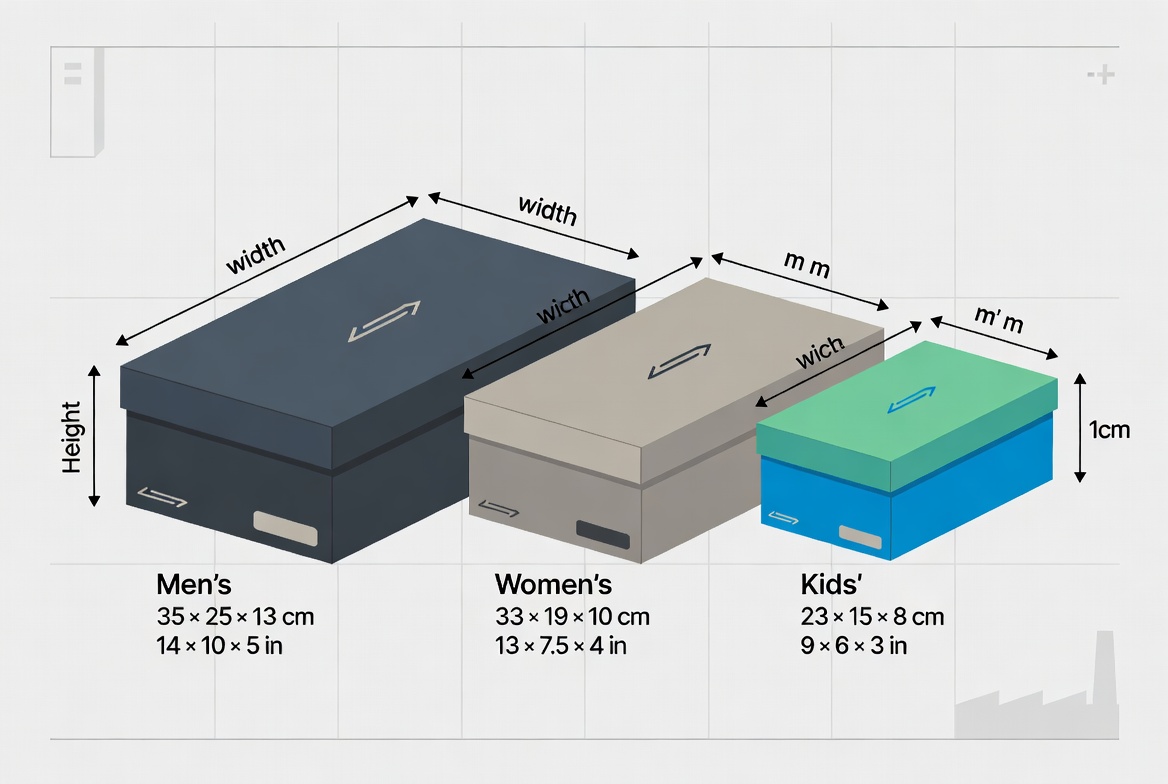
Most adult shoe boxes fall within a consistent size range, but the exact shoe box dimensions depend on shoe type and region. For standard adult footwear, many brands use boxes around 13 × 7.5 × 4.5 inches (approximately 33 × 19 × 11.5 cm). [ezcustomboxes]
To keep things practical, here is a quick overview of typical dimensions for everyday shoe packaging. [magetop]
- Inches: 13 in (L) × 7.5 in (W) × 4.5 in (H) [ezcustomboxes]
- Centimeters: 33 cm (L) × 19 cm (W) × 11.5 cm (H) [magetop]
These measurements work well for many men's and women's sneakers or dress shoes, but they are not ideal for every category, especially boots, luxury heels, or bulky sports footwear. [leser-packaging]
Standardization helps with storage and shipping, yet different footwear types still need specific shoe box sizes. Below are common size ranges used in the industry. [leser-packaging]
Most packaging suppliers and brands work within the following spans for standard corrugated or paperboard shoe boxes. [ezcustomboxes]
| Shoe type | Typical internal length | Typical internal width | Typical internal height | Common use case |
|---|---|---|---|---|
| Men's shoes | 13–14 in (33–35.5 cm) | 7–8 in (18–20 cm) | 4–5 in (10–13 cm) | Sneakers, dress shoes, casual shoes (magetop) |
| Women's shoes | 12–13 in (30.5–33 cm) | 7–8 in (18–20 cm) | 4–5 in (10–13 cm) | Heels, flats, fashion sneakers (magetop) |
| Children's shoes | 7–10 in (18–25.5 cm) | 5–6 in (13–15 cm) | 2–3 in (5–7.5 cm) | Toddler and kids' shoes (magetop) |
These ranges are useful starting points when you design custom rigid shoe boxes for a new line, especially if your brand sells across multiple regions with different shoe sizing systems. [magetop]
If you ship shoes directly to consumers, shipping dimensions can have as much impact on your profitability as the product itself. Most carriers calculate cost based on a combination of weight and dimensional weight, so packing a small product in an oversized shoe box is an invisible profit leak. [adeptpackaging]
Many brands use a shipping‑friendly shoe box size around 14 × 8 × 5 inches (35.5 × 20 × 12.5 cm) for a wide range of adult footwear. This footprint typically balances: [ezcustomboxes]
- Sufficient internal space for shoes plus protective padding
- Efficient palletization and cartonization for bulk shipping
- Lower dimensional weight compared with bulkier, non‑optimized cartons [adeptpackaging]
The weight of a shoe box varies mainly by material and construction. For standard corrugated footwear boxes, total packed weight often ranges from 1.5 to around 10 lb depending on box size and shoe type. Lighter yet rigid materials help reduce shipping costs while maintaining product safety, which is why many premium brands are now switching to engineered rigid board structures instead of cheap, flimsy cartons. [trillora]
As a manufacturer, we regularly receive design files where length, width, and height are mislabeled—leading to tooling errors, wasted samples, and shipment delays. To avoid this, always follow a consistent measurement method. [gentlever]
- Place the assembled shoe box on a flat surface.
- Measure the longest external side from outer edge to outer edge; this is the length. [packhit]
- Record both the external length (important for shipping) and, if needed, the internal usable length (external length minus the wall thickness of two side panels). [packhit]
- Identify the side perpendicular to the length and shorter than it. [gentlever]
- Measure across the midpoint, from external edge to external edge. [packhit]
- Use the widest point if the bottom tapers inward, and keep your definition of width consistent across all drawings and specifications. [gentlever]
- Measure from the base to the top edge of the assembled box. [packhit]
- For a single‑piece box with a hinged or magnetic lid, measure the full external height when the lid is closed. [packhit]
- For a base‑and‑lid structure, record separately (for example: base 3.5 in, lid 1.5 in, total 5.0 in). [packhit]
In packaging and logistics, the standard format is Length × Width × Height and you should always specify the unit (inches or centimeters) and any tolerances. For international trade, many brands use inches for tooling and purchasing while adding metric equivalents for technical documentation, such as: [packhit]
- 12.00 × 8.00 × 5.00 in — 30.48 × 20.32 × 12.70 cm [packhit]
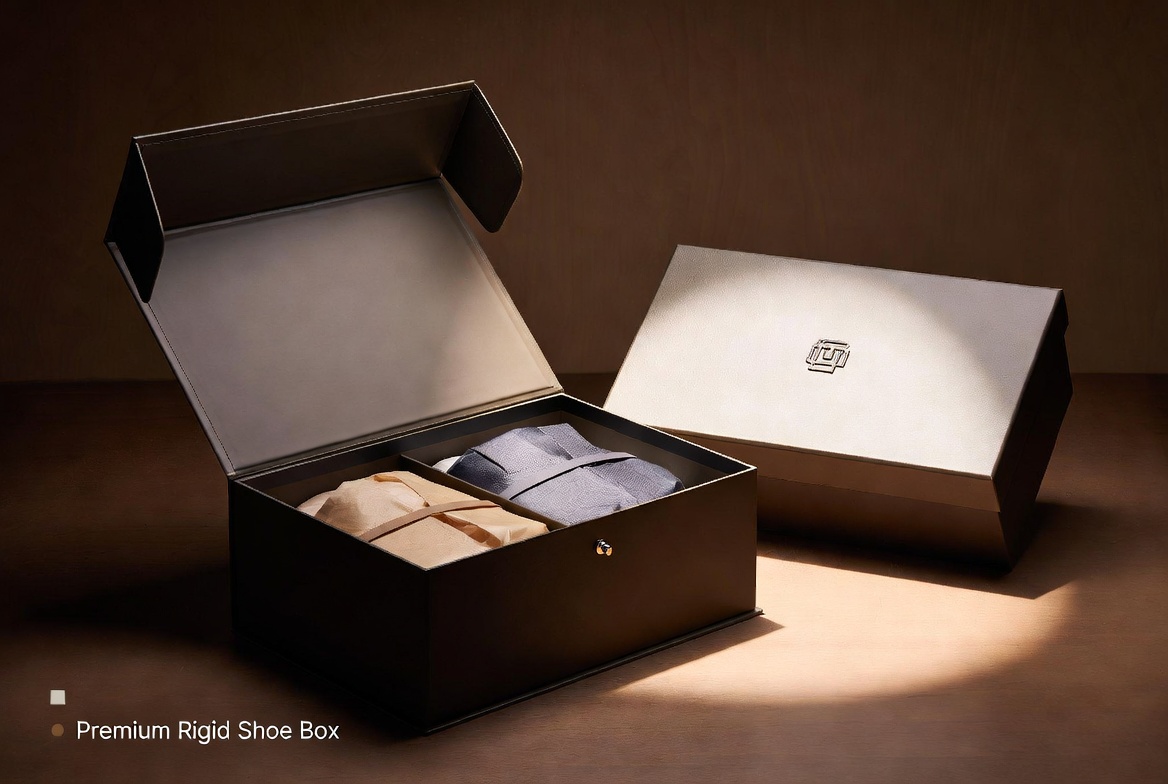
From an industrial packaging perspective, standard cardboard shoe boxes do the minimum: they hold the product and survive basic shipping. However, footwear is a highly visual, brand‑driven category, and custom rigid shoe boxes or magnetic closure boxes can dramatically change how customers perceive your product. [trillora]
- Higher compression strength: Rigid board and engineered inserts protect delicate uppers, embellishments, and custom soles far better than thin folding cartons. [trillora]
- Dimensional stability: Rigid boxes maintain precise internal dimensions, which is critical for high‑value sneakers, collectible drops, and limited editions that must arrive in flawless condition. [trillora]
- Better stacking and display: Flat, strong walls make warehouse storage and in‑store stacking more efficient and visually consistent. [adeptpackaging]
- Premium unboxing: A magnetic lid or rigid shoulder‑neck structure instantly signals value, even before the shoes are visible.
- Replayable experience: Customers are more likely to keep and reuse a high‑quality rigid shoe box, turning your packaging into long‑term brand media.
- Sustainability stories: When designed with recyclable or FSC‑certified boards, rigid boxes can support credible sustainability messaging while still feeling luxurious. [gushwork]
For brands positioning themselves in the mid‑to‑high‑end market, this combination of dimensional precision, protection, and perceived value is often worth far more than the incremental packaging cost.
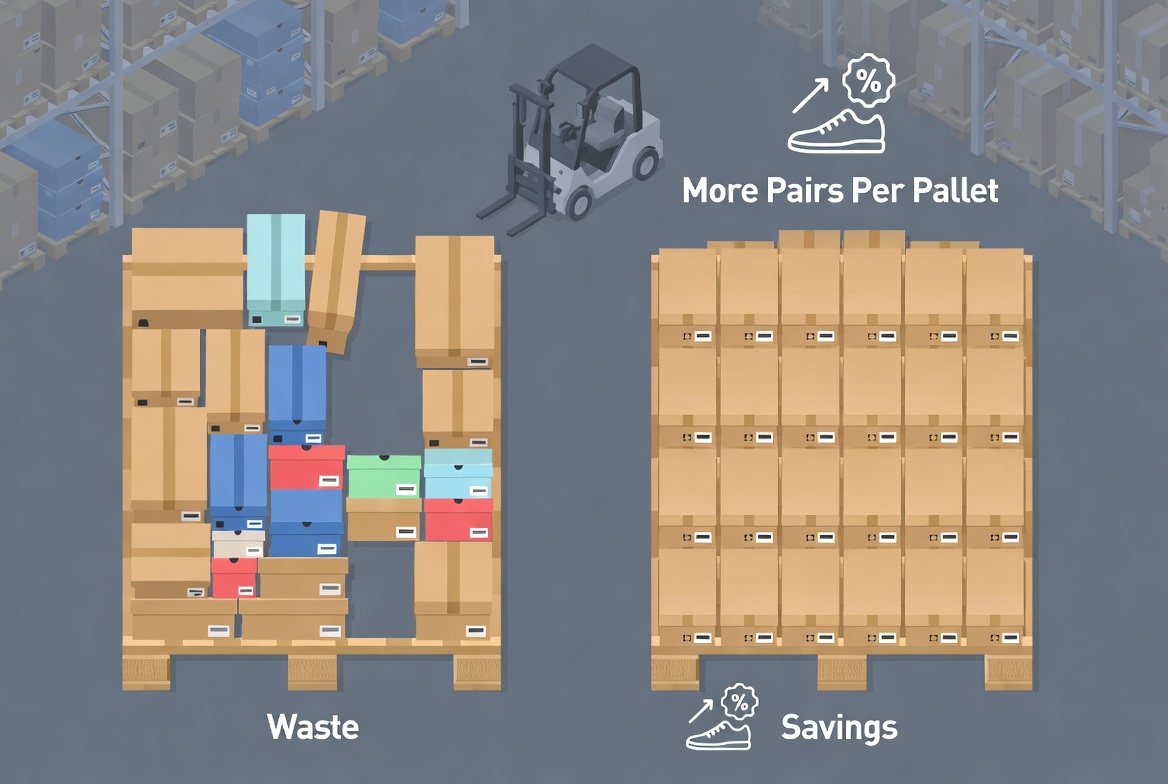
From our work with footwear and fashion clients, we see a recurring pattern: the "safe" option is to oversize the shoe box and fill the void with paper or air pillows. Over time, that strategy quietly erodes profit. [adeptpackaging]
Consider this typical scenario based on real‑world projects:
- A sneaker brand uses a box that is 1–1.5 inches longer and wider than necessary for their core models.
- At carton level, this reduces the number of shoe boxes that fit in a master carton and on a pallet layer.
- On a full container load, that mismatch translates into fewer pairs per container and higher freight cost per unit.
By re‑engineering the shoe box dimensions and board grade, we helped similar brands:
- Reduce empty volume in each box while still leaving 1–2 cm of clearance on all sides for protection. [leser-packaging]
- Increase pairs per carton and per pallet layer without compromising stacking strength.
- Switch from single‑use void fill to integrated internal supports made from the same recyclable board.
The lesson is simple: shoe box dimensions are not just a design detail; they are a profit lever in your supply chain.
When you brief your packaging team or supplier, use this decision checklist to quickly narrow down optimal dimensions.
1. Define shoe type and size range
- Are you packaging low‑top sneakers, high‑top boots, delicate heels, or kids' shoes?
2. Clarify sales channel
- Retail display only, DTC e‑commerce shipping, or both?
3. Set protection level
- Do you need extra room for dust bags, tissue, documentation, or accessories?
4. Check logistics constraints
- Carton size limits, pallet footprint, and carrier dimensional weight rules.
5. Choose structure and material
- Standard corrugated for cost‑driven SKUs, or rigid / magnetic boxes for premium lines.
6. Confirm measurement standard
- Agree on internal vs external measurements, units (in/cm), and tolerance range before tooling. [gentlever]
By running this simple framework before sampling, you avoid costly re‑work and ensure that your shoe box sizes support your business model instead of fighting it.
Drawing on our 18+ years in rigid and magnetic box production, here are practical recommendations for brands exploring premium shoe box packaging.
Start by defining the internal fit for your largest and smallest shoe sizes in a range. Then add board thickness, wrap material, and any inserts to arrive at final external dimensions that still ship efficiently. [leser-packaging]
Premium boxes should not only fit the shoes; they should carry your brand narrative. Allocate surface area for:
- Clear logo hierarchy on lid and side panels
- Product line storytelling or collaboration details
- Sustainability badges or care messages that justify the premium feel [searchengineland]
If your shoe box is rigid and visually appealing, many customers will use it for storage long after purchase. That makes:
- Clean, timeless design more effective than short‑lived campaign art
- Quality printing and finishing (lamination, foil, debossing) more impactful
- Consistent dimensions across seasons invaluable for home organization
When you plan for reuse, every box becomes a small billboard in your customer's home.
Global brands such as Nike, Adidas, Puma, and Reebok follow their own internal standards, but their box sizes generally fall within the ranges already discussed. For example, a typical athletic shoe box might be around 13–14 in long, 7–9 in wide, and 4–6 in high, adjusted for style and regional sizing. [magetop]
| Brand | Shoe type | Typical box footprint (inches) | Material focus |
|---|---|---|---|
| Nike | Men's sneakers | Around 13–14 × 8–9 × 4–5 | Branded corrugated (magetop) |
| Adidas | Women's sneakers | Around 12–13 × 7–8 × 4–5 | Printed paperboard (magetop) |
| Puma | Kids' shoes | Around 8–9 × 5–6 × 3 | Compact cardboard (magetop) |
| Reebok | Athletic shoes | Around 13 × 8–9 × 4–5 | Corrugated cartons (magetop) |
Smaller and mid‑size brands can borrow these reference dimensions as benchmarks, then adjust to their own sizing chart, aesthetic, and sustainability goals.
If you are planning a new footwear launch or want to review your current shoe box dimensions, this is the ideal time to rethink both engineering and brand experience. By combining optimized sizes, rigid or magnetic structures, and a clear measurement standard, you can cut hidden logistics costs and give your customers an unboxing moment that actually matches the quality of your shoes. [magetop]
If you share your core shoe types and desired brand position, we can propose tailored rigid or magnetic shoe box dimensions and structures that align with your logistics, budget, and sustainability goals.
1. What is the most common shoe box size for adult sneakers?
A widely used average for adult sneakers is around 13 × 7.5 × 4.5 inches (33 × 19 × 11.5 cm), though men's sizes may extend to 14 inches in length for larger shoe sizes. [ezcustomboxes]
2. How much extra space should I leave around the shoes inside the box?
A practical rule of thumb is to leave about 1–2 cm of extra space on each side to prevent crushing while minimizing unused volume. The exact gap can vary based on shoe construction and desired presentation. [leser-packaging]
3. Are shoe box dimensions measured internally or externally?
Technically, you need both. For fit and design, internal dimensions matter, while for logistics and shipping, external dimensions are critical. Professional specs usually clarify both and follow the Length × Width × Height format. [packhit]
4. When should I switch from standard cartons to rigid or magnetic shoe boxes?
Consider upgrading when your product is high‑value, your brand relies on unboxing experience, or you experience damage and deformation with standard cartons during shipping and retail handling. [trillora]
5. Can one shoe box size work for all my models?
Using a single universal size may simplify operations but often leads to wasted shipping space or poor product fit. Many brands achieve better results with 2–3 optimized sizes per category instead of a "one‑box‑fits‑all" approach. [adeptpackaging]
1. Ibex Packaging – "Understanding Shoe Box Dimensions: Everything You Need to Know." [Link] [magetop]
2. Leser Packaging – "Shoe box dimensions: standard sizes & customised solutions." [Link] [leser-packaging]
3. Packhit – "How to Measure Shoe Box Dimensions?" [Link] [packhit]
4. EZ Custom Boxes – "Standard and Custom Shoe Box Dimensions Guide for Packaging Solutions." [Link] [ezcustomboxes]
5. Gentlever – "鞋盒尺寸终极指南." [Link] [gentlever]
6. Trillora – "Behind the Scenes of Packaging Design Optimization." [Link] [trillora]
7. Adept Packaging – "Packaging Optimization." [Link] [adeptpackaging]
8. Gushwork – "Digital Marketing Strategies for Packaging Manufacturers." [Link] [gushwork]
9. Search Engine Land – "Modern SEO: Packaging your brand and marketing for Google." [Link] [searchengineland]