
Views: 222 Author: Maituohong Packaging Publish Time: 2026-06-15 Origin: Site


Content Menu
● Why Accurate Box Dimensions Matter for Your Business
● Internal vs External Dimensions: What You Really Need to Specify
>> Internal dimensions (for product fit)
>> External dimensions (for shipping and stacking)
● Understanding Length, Width, and Height in Box Design
>> Length: usually the longest opening side
>> Width: the shorter opening side
>> Height (or depth): bottom to top
● How to Measure a Box Step by Step (Manufacturer-Approved Method)
>> Step 1: Decide what you're measuring
>> Step 2: Prepare the box correctly
>> Step 3: Measure internal dimensions
>> Step 4: Measure external dimensions
>> Step 5: Double-check and confirm sequence
● Measuring Cylindrical and Irregular Products
>> Cylindrical items (bottles, jars, candles)
>> Irregular or multi-piece products
● Critical Factors for a Perfectly Fitting Box
>> 1. Always leave room for fingers
>> 2. Plan for cushioning and inserts
>> 3. Consider material thickness and board type
>> 4. Respect the order: L × W × H
● How Box Dimensions Affect Shipping Cost and Palletization
>> Dimensional weight and courier charges
>> Pallet and container optimization
● Common Measurement Mistakes (and How to Avoid Them)
● A Simple Manufacturer's Checklist Before You Approve Any New Box Size
● How an Experienced Packaging Manufacturer Adds Value
● When to Involve Your Packaging Partner
● Call to Action: Get Expert Help with Your Box Dimensions
● Frequently Asked Questions (FAQ)
The way you measure box dimensions directly determines how your products look, travel, and arrive in front of your customers. A few millimeters off can mean damaged goods, wasted freight, and a poor unboxing experience that quietly erodes your brand. [newaypkgshop]
In this guide, we'll walk through length × width × height (L × W × H) in real-world manufacturing scenarios, explain the difference between internal and external dimensions, and show you how experienced factories like Maituohong Packaging engineer accurate sizes for rigid gift boxes and paper packaging. [icustomboxes]

From an industrial packaging perspective, box dimensions are a cost and brand lever, not just numbers on a drawing. Getting them right helps you: [altitudemarketing]
- Protect products in transit by ensuring a snug internal fit and space for cushioning. [customboxesnow]
- Control logistics and palletization costs through optimized external dimensions and board thickness.
- Deliver a premium unboxing experience where the product sits correctly and is easy to remove. [expresspkg]
- Avoid waste and rework from ordering the wrong size box—even being off by 0.5 cm can make a full batch unusable. [customboxesnow]
As a manufacturer with over a decade of custom box production, we see that brands that treat box measurement as an engineering task—not guesswork—reduce claims, returns, and freight costs year after year. [altitudemarketing]
When you "measure a box", the first question is: Are you talking about internal or external dimensions? [icustomboxes]
Internal dimensions describe the usable space inside the box where your product and any inserts will sit. [customboxesnow]
- For most rigid paper boxes, you should base internal size on the finished product size, then add a small allowance.
- A common rule of thumb is to allow about 1/16 inch (1–2 mm) clearance on each side for easy insertion and removal. [icustomboxes]
- If you will use foam, molded pulp, or cardboard inserts, calculate insert thickness and cut-outs first, then confirm internal dimensions. [expresspkg]
Key point:
If you send a manufacturer only your product dimensions, you are one step short; you must confirm the target internal box size including clearance and padding. [icustomboxes]
External dimensions are measured from outside edge to outside edge and are critical for: [customboxesnow]
- Pallet layout and container loading
- Courier dimensional weight (volumetric weight)
- Shelf and display constraints at retail
Material thickness and construction (for example, rigid board vs standard folding carton) change external dimensions, even when internal dimensions stay the same. As an example, upgrading from a 1.0 mm to 2.0 mm greyboard can significantly increase outer size and affect how many units fit per pallet. [altitudemarketing]
For large production runs, we recommend modeling both internal and external sizes in your RFQ and asking your packaging supplier to validate them with prototypes. [expresspkg]
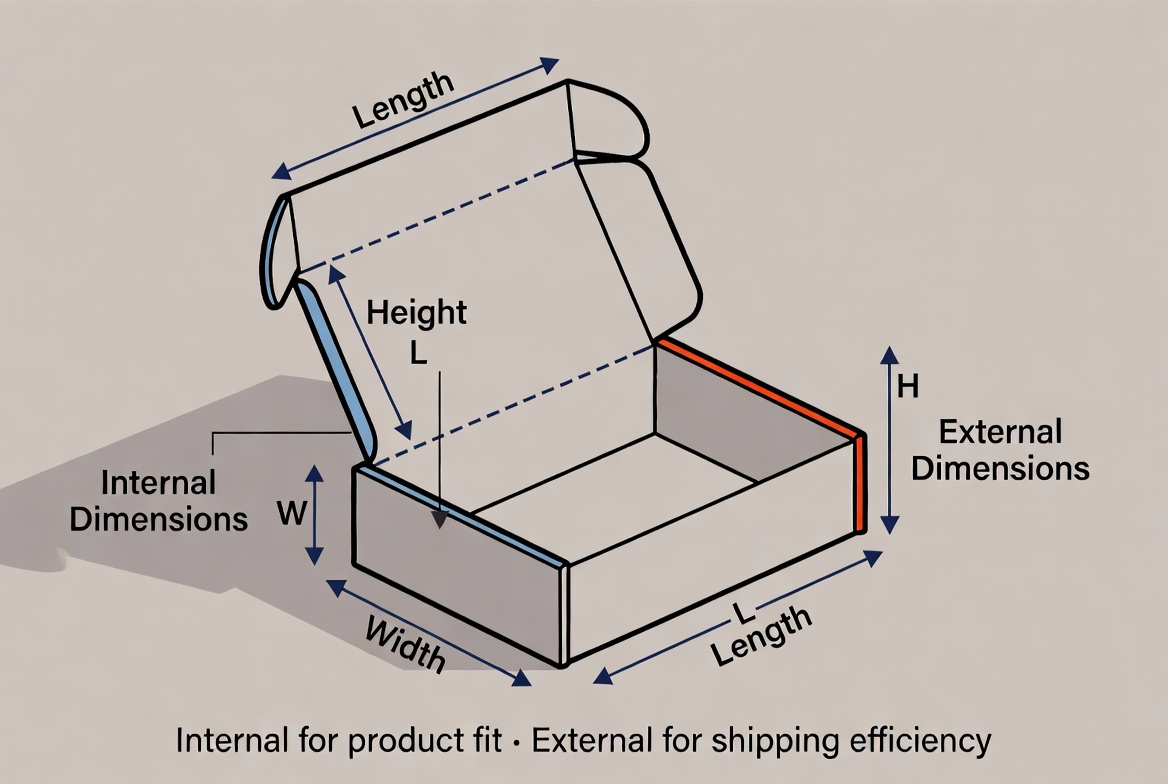
It is not enough to know that a box has three dimensions—you must know which side is which to avoid expensive mistakes. [icustomboxes]
- Typically the longest side of the open top of the box.
- Measured left to right on the main opening panel.
- Often carries the primary branding view in display packaging. [expresspkg]
- The shorter side of the opening, measured front to back.
- Also usually has a flap in folding cartons.
- Measured from the bottom panel up to the top edge or lid.
- On many gift boxes it is the shortest dimension, but on tall retail boxes it can be the longest.
In ordering forms and production specs, dimensions should always be listed as L × W × H in this order. Confusing the order (for example, swapping length and height) is one of the most common sources of wrong-size packaging. [icustomboxes]
Below is a simple procedure you can share with your team to ensure consistent measurements. [newaypkgshop]
- Are you measuring an existing box to reorder or optimize?
- Or determining a new box size based on product measurements?
For new projects, always measure the product first, then calculate box dimensions. [icustomboxes]
- Fully assemble the box and close the bottom. [newaypkgshop]
- For rigid boxes, ensure corners are square and the lid fits properly.
- Place the box on a flat surface to avoid distortions. [customboxesnow]
Using a rigid ruler or tape measure: [newaypkgshop]
1. Length: measure the longest internal side of the opening, from inside wall to inside wall. [icustomboxes]
2. Width: measure the shorter internal side of the opening.
3. Height: measure from the inside bottom to the inside top edge (or to where the lid will sit). [icustomboxes]
Write every value down immediately and note that these are internal dimensions. [customboxesnow]
Now repeat the process on the outside of the box: [customboxesnow]
- Measure length, width, and height from outer edge to outer edge.
- Confirm whether the lid adds extra height (for telescopic rigid boxes).
Clearly label these measurements as external and never mix the two sets of data in emails or artwork files. [customboxesnow]
- Re-measure at least once, preferably by two different people for high-volume projects. [customboxesnow]
- Confirm that your final specs are written as Length × Width × Height (L × W × H) and that both internal and external versions are stored in your internal database. [icustomboxes]
Many products—cosmetics, candles, bottles—do not have simple rectangular shapes. For these, you still end up with a rectangular outer box, but the way you measure the product changes. [expresspkg]
For a cylinder: [icustomboxes]
- Diameter becomes both the effective length and width for the box interior.
- Height is measured from the bottom of the cylinder to the very top, including cap or pump if it will be inside the box.
To create a snug-fit rectangular box, you typically:
- Take the diameter, add clearance on both sides and space for cushioning if needed, then set that as internal length and width. [customboxesnow]
- Add extra height for any top padding, dividers, or decorative paper.
For multi-component gift sets (for example, a bottle, leaflet, and accessory), the safest approach is to design a custom insert (paperboard or foam), then derive the box internal size from the insert footprint. This is an area where experienced manufacturers add real value through structural design. [expresspkg]
Over years of producing rigid paper boxes, we see the same small oversights repeatedly cause big issues for brands. Pay particular attention to the points below.
Never order a box with internal dimensions identical to the product size. If the fit is too tight, your team or customers will have to force the product in or tear the box to remove it, damaging both product and brand perception. [expresspkg]
A small clearance (1–2 mm per side for rigid boxes) makes the insertion smooth while still feeling premium and "snug." [icustomboxes]
If your product requires protective padding—bubble wrap, air cushions, foam, tissue, or molded pulp—you must include that in your dimension planning. [customboxesnow]
- For bubble wrap, adding 4–5 mm per side is often sufficient for small retail items.
- For fragile products, couriers frequently recommend about 2 inches of protective padding around breakable objects. [customboxesnow]
The safest approach is to build a prototype, pack the product with your chosen padding, and perform a basic drop test before confirming final dimensions. [customboxesnow]
For paper packaging, material selection changes external dimensions and structural behavior: [altitudemarketing]
- Rigid boxes with thick greyboard offer excellent dimensional stability and precise internal sizing.
- Folding cartons are more flexible; measuring internal dimensions accurately can be more challenging and requires attention to creases and folds.
When you change from one board thickness to another, always recalculate external size and check palletization and shipping plans again. [altitudemarketing]
Most packaging suppliers quote box sizes strictly in Length × Width × Height. A specification of 600 × 400 × 300 is completely different from 400 × 300 × 600, and a mix-up can ruin an entire production run. [icustomboxes]
Build a habit internally: never send dimensions without clearly indicating the sequence and, where possible, include a simple sketch. [icustomboxes]
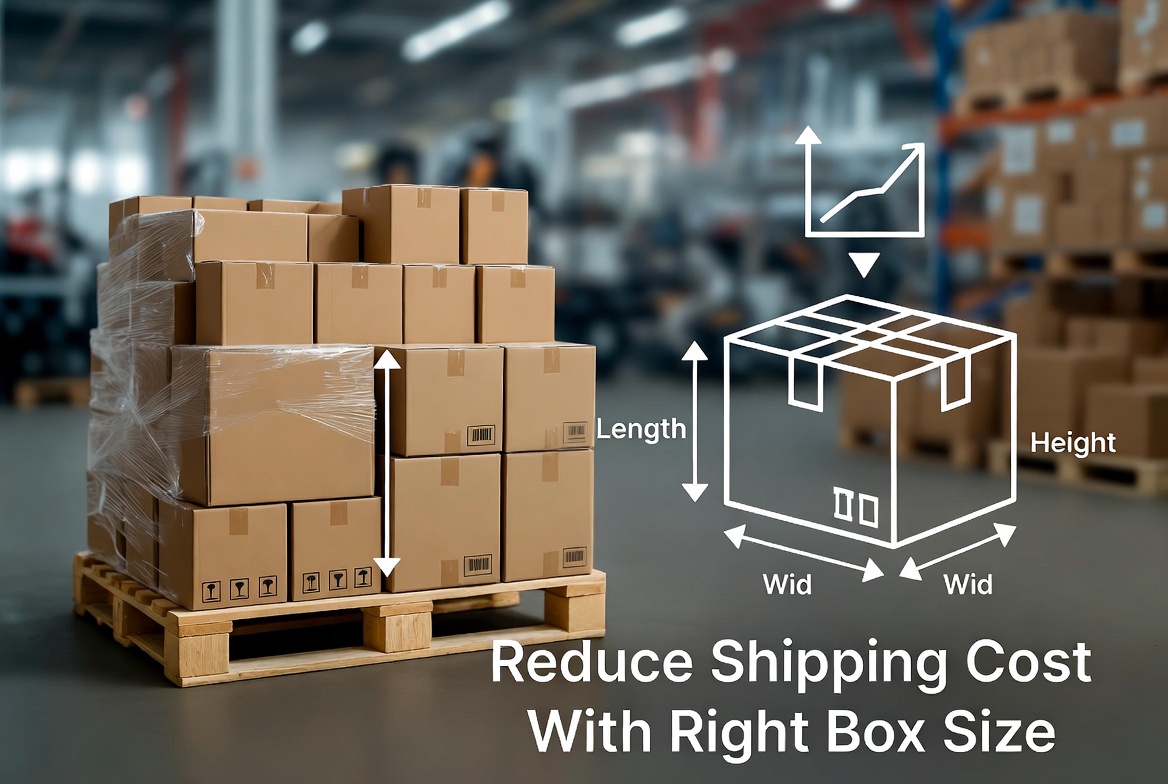
From a logistics standpoint, box dimensions determine not only how many units fit in a master carton, but also how many cartons fit on a pallet or in a container. [customboxesnow]
Many carriers charge by dimensional (volumetric) weight, which is based on L × W × H rather than actual product weight. Oversized boxes with lots of empty air cost you more with no added value. [altitudemarketing]
By tightening external dimensions—without compromising protection—you can:
- Ship more units per pallet. [customboxesnow]
- Avoid overpaying on courier invoices due to unnecessary volume. [altitudemarketing]
Experienced manufacturers model how a box size will:
- Nest inside master cartons
- Stack on standard pallets
- Load into typical containers (e.g., 20' and 40' HQ)
Even a 2–3 mm change in one dimension, multiplied across thousands of units, can influence how many cartons you can load. This is why we recommend involving your packaging supplier early, before locking size in your internal documentation. [altitudemarketing]
We regularly help brands fix packaging problems that trace back to simple measurement errors. Some of the most frequent include:
- Confusing internal and external dimensions when comparing supplier quotes. [customboxesnow]
- Using different units (inches vs centimeters) within the same project without clear labeling. [customboxesnow]
- Forgetting to account for product size changes during curing or shrinkage (for example, handmade soaps shrinking after production).
- Ignoring the extra space required for custom foam inserts in rigid boxes.
- Measuring only once, in a hurry, without a second check or prototype. [customboxesnow]
To avoid this, standardize internal SOPs: always record unit, dimension type (internal/external), version date, and approver for any box spec used in mass production. [shopify]
Use this brief pre-production checklist to protect your project:
1. Have we measured the finished product in its final state (no more shrinkage or expansion)?
2. Have we defined target internal dimensions, including clearance and any inserts? [icustomboxes]
3. Have we calculated external dimensions based on material thickness?
4. Have we confirmed L × W × H sequence in writing and in drawings? [icustomboxes]
5. Have we tested at least one physical prototype for fit, unboxing feel, and drop performance? [customboxesnow]
6. Have we checked palletization and shipping impact with the final external dimensions? [customboxesnow]
If any answer is "no", you are not ready to approve mass production.
A seasoned paper packaging producer does more than "follow your size list." Our engineering and production teams typically: [expresspkg]
- Review your product dimensions, weight, and fragility and recommend suitable board type, thickness, and internal clearance. [expresspkg]
- Suggest insert structures (paperboard, foam, or molded pulp) that lock products in position and improve perceived value.
- Optimize box sizing for shipping efficiency, helping you reduce overall landed cost, not just unit packaging price. [altitudemarketing]
- Provide pre-production samples and transit tests so you can validate everything with real products before committing to a full run.
For brands expanding into new markets or channels (e‑commerce, retail, cross‑border shipping), leveraging this expertise early can prevent costly redesigns later. [magetop]
For small, low-risk products, you might start with approximate dimensions and refine later. But you should involve your packaging manufacturer earlier if:
- You are launching a flagship product or high-value gift box. [expresspkg]
- The product is fragile or heavy relative to its size.
- You plan to ship internationally or via multiple logistics providers. [altitudemarketing]
- You are designing a multi-piece set requiring complex inserts.
Providing accurate measurements and clear expectations from day one makes it much easier for your supplier to design a solution that balances protection, aesthetics, and cost. [expresspkg]
If you are planning a new packaging project or struggling with damaged goods and oversized boxes, now is the time to audit your current box dimensions. [customboxesnow]
As a custom paper box manufacturer with deep experience in rigid gift boxes and tailored packaging solutions, Maituohong Packaging can: [expresspkg]
- Review your product sizes and current packaging
- Recommend optimized internal and external dimensions
- Prototype and test new structures before mass production
Reach out with your product measurements, photos, and shipping requirements, and our team will help you turn rough size ideas into engineered, production-ready box specifications. [expresspkg]
1. Should I measure my product or the box first?
Always measure your finished product first, then calculate the box's internal dimensions including clearance and padding. Measuring the box first can hide product tolerances and lead to poor fit. [icustomboxes]
2. What is the correct order to write box dimensions?
Packaging dimensions should be written as Length × Width × Height (L × W × H), where length is usually the longest opening side, width is the shorter opening side, and height runs from bottom to top. Mixing this order is a common cause of wrong-size packaging. [icustomboxes]
3. How much extra space should I leave for cushioning?
For light, non-fragile products, a few millimeters per side may be enough, but fragile items often require up to about 2 inches of padding around the product, depending on the courier and the material used. Always prototype and perform a basic drop test before finalizing dimensions. [customboxesnow]
4. Why do my quoted box sizes look different from what I measure?
Many suppliers list box sizes using internal dimensions, while you may be measuring external dimensions on a finished sample. Board thickness, coatings, and structural design all affect the external size. [customboxesnow]
5. How do box dimensions influence shipping cost?
Couriers frequently charge by dimensional weight calculated from length × width × height, so oversized boxes with a lot of empty volume increase freight cost even if the product is light. Optimizing external dimensions helps you fit more units per carton and pallet, reducing overall logistics costs. [altitudemarketing]
1. Ibex Packaging. "How to Measure Box Dimensions (Length Width Height of a Box)."
<https://ibexpackaging.com/measure-box-dimensions/>
2. Custom Boxes Now. "How to Measure Box Dimensions — The Complete Guide."
<https://customboxesnow.com/blog/how-to-measure-box-dimensions/> [customboxesnow]
3. iCustomBoxes. "How to Measure Box Dimensions Correctly: Ultimate Guide."
<https://www.icustomboxes.com/blog/how-to-measure-a-box-dimensions/> [icustomboxes]
4. Neway Packaging. "How to Measure a Box."
<https://www.newaypkgshop.com/blog/366/how-to-measure-a-box> [newaypkgshop]
5. Express Packaging. "Your Guide to Custom Box Design for Better Packaging."
<https://www.expresspkg.com/news/your-guide-to-custom-box-design-for-better-packaging/> [expresspkg]
6. Altitude Marketing. "SEO Strategies for Packaging Brands."
<https://altitudemarketing.com/blog/seo-for-packaging-brands/> [altitudemarketing]
7. Magetop. "How SEO Can Transform the Packaging Industry: A Guide for Manufacturers."
<https://www.magetop.com/blog/how-seo-can-transform-the-packaging-industry-a-guide-for-manufacturers/> [magetop]
8. Shopify. "SEO优化终极指南:43个SEO优化技巧."
<https://www.shopify.com/zh/blog/seo-checklist-online-store> [shopify]


