
Views: 216 Author: Maituohong Packaging Publish Time: 2026-11-24 Origin: Site


Content Menu
● What Is Kraft Paper Made From?
● Kraft Paper, Paperboard, and Corrugated Board: What Is the Difference?
● Main Types of Kraft Paper for Packaging
>> Coated or Barrier-Treated Kraft Paper
● How to Use Kraft Paper Across Different Packaging Formats
>> Magnetic Boxes and Rigid Gift Boxes
>> Mailer Boxes and Shipping Boxes
● How to Specify Kraft Paper Thickness and Strength
● Printing on Brown Kraft Paper: What Buyers Should Expect
>> Choose Graphics That Work With the Surface
>> Evaluate White Ink and Decorative Finishes Early
● Is Kraft Paper Sustainable and Recyclable?
>> Separate Fiber Sourcing From Recycled Content
>> Assess the Complete Package
>> Avoid Unsupported Environmental Claims
● A Practical Kraft Packaging Development Workflow
>> 1. Define the Product and Distribution Conditions
>> 2. Select the Construction Before Finalizing the Artwork
>> 3. Review an Unprinted Structural Sample
>> 4. Approve Materials and Print Together
>> 5. Test the Complete Packaging System
● Design Example: A Kraft-Covered Magnetic Gift Box
● How to Compare Custom Kraft Packaging Quotations
● Develop Kraft Packaging Around Your Product
● Frequently Asked Questions About Kraft Paper
>> 1. Is All Brown Paper Kraft Paper?
>> 2. Is Kraft Paper Waterproof?
>> 3. Can Kraft Paper Be Used for Luxury Packaging?
>> 4. Is Kraft Paper Suitable for Food Packaging?
>> 5. Does Recycled Kraft Always Perform Worse?
>> 6. Can a Kraft Rigid Box Replace a Shipping Carton?
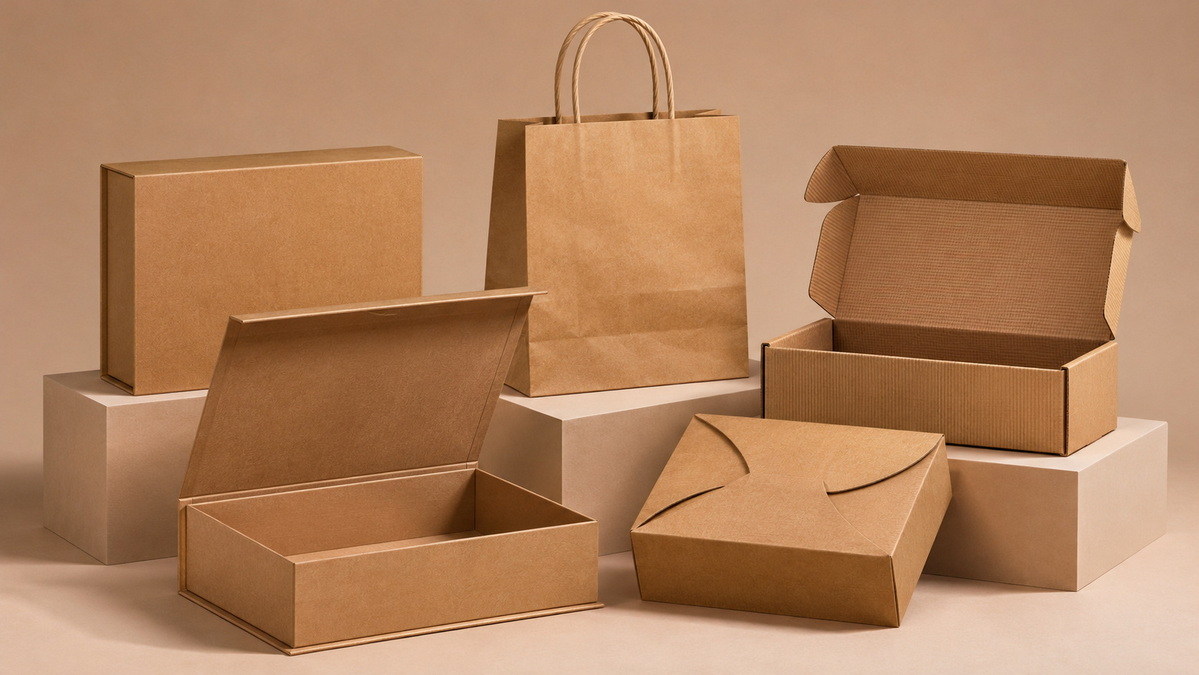
Kraft paper is a strong, versatile paper made using the kraft pulping process. In custom kraft paper packaging, it can serve as wrapping, a shopping bag material, a corrugated liner, or the decorative covering on a rigid gift box. However, its brown appearance alone tells you little about its strength, recycled content, or suitability for your product.
At Maituohong Packaging, we bring more than 18 years of experience in designing and manufacturing custom paper packaging. Our approach starts with a practical question: what must the finished package do?
This guide explains how kraft paper works, where it performs well, and how to specify it for packaging that balances protection, presentation, and cost.
Kraft paper is made from cellulose fibers separated from wood through chemical pulping. The process uses an alkaline cooking solution containing sodium hydroxide and sodium sulfide to remove much of the lignin that binds wood fibers together.
This creates pulp suitable for strong paper products. The resulting performance still depends on fiber selection, processing, sheet formation, and finishing.
Unbleached kraft paper typically retains a brown color. Bleached kraft grades offer a lighter appearance when brightness or print reproduction matters.
Importantly, "kraft" does not automatically mean:
- Made entirely from recycled fibers.
- Waterproof or greaseproof.
- Suitable for direct food contact.
- Recyclable in every collection system.
- Strong enough for any shipping application.
Buy the specification, not simply the appearance.
These materials perform different jobs, even when their surfaces look similar.
| Material | Main function | Typical packaging application |
|---|---|---|
| Kraft paper | Wrapping, covering, or forming flexible packaging | Bags, wrapping sheets, rigid-box covers |
| Folding paperboard | Providing a creasable carton structure | Retail cartons and some folding gift boxes |
| Rigid board | Providing a stiff structural core | Magnetic boxes and premium presentation boxes |
| Corrugated board | Providing cushioning and structural protection | Mailer boxes and shipping boxes |
A kraft-covered magnetic box usually gets its rigidity from the underlying board, not its outer paper.
Similarly, a kraft-colored shipping box relies on its complete corrugated construction. Liners, fluting, dimensions, and converting quality all influence performance.
Coated recycled board should not automatically be described as recycled kraft paper. Its fiber furnish and manufacturing specification must be checked separately.
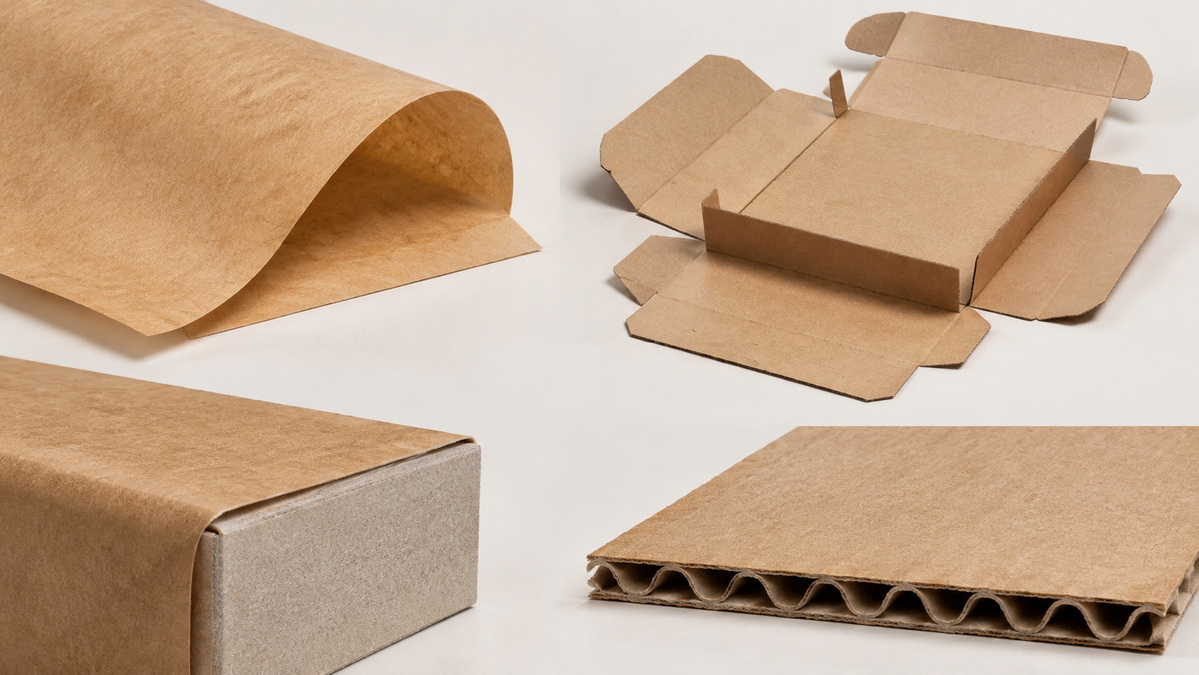
Virgin kraft paper uses newly produced fibers. Depending on the grade, it can provide useful strength for demanding bags, wrapping, and liner applications.
However, virgin content alone does not establish finished-package performance. Ask for relevant material specifications and evaluate a converted sample.
Recycled grades incorporate recovered fibers and can support purchasing objectives that prioritize recycled content.
Appearance, surface consistency, and mechanical properties vary between grades. Confirm the actual recycled percentage rather than assuming that brown paper is recycled.
Bleached kraft provides a lighter surface that can support brighter graphics and a cleaner visual style.
It may suit brands that want a paper-based appearance without the color influence of a brown substrate. Review physical print samples before selecting it.
Treatments can improve resistance to moisture, grease, or abrasion, depending on their formulation.
The trade-off is additional complexity. A coating may affect gluing, folding, printing, food-contact suitability, and recycling compatibility. Request documentation for the finished material, not just the untreated base paper.
For magnetic boxes and rigid boxes, kraft often acts as the visible covering over a structural board.
This combination can create an understated premium appearance. Material selection should consider:
- Wrapping behavior around corners.
- Adhesion to the board.
- Surface rubbing during transport.
- Compatibility with foil or embossing.
- Consistency between production batches.
Magnets, inserts, ribbons, and other components also need consideration when evaluating the complete package.
For mailer boxes and shipping boxes, prioritize structural performance before decorative appearance.
A visually attractive liner cannot compensate for an unsuitable board construction. Discuss product weight, fragility, stacking, delivery conditions, and internal protection with the manufacturer.
A retail presentation box may still require an outer shipping carton.
"Folding gift box" can describe either a creased paperboard carton or a collapsible rigid construction.
These require different materials and production methods. Clarify whether your priority is flat storage, premium rigidity, quick assembly, or repeated opening before comparing quotations.
For shopping bags, the sheet is only part of the structure.
Handle attachment, reinforcement patches, seams, and bottom construction affect carrying performance. Test the finished bag with its intended contents rather than approving it from paper weight alone.
One of the most common purchasing mistakes is treating GSM as a complete measure of quality.
GSM means grams per square meter: the mass of a paper sheet per unit area. It does not directly measure thickness, stiffness, tear resistance, or box compression performance.
Two papers with the same GSM can behave differently.
| Specification | What it helps establish | Buyer's question |
|---|---|---|
| GSM | Paper mass per area | What is the agreed production tolerance? |
| Caliper | Physical thickness | Will it work with the intended folds and wrapping? |
| Fiber composition | Material makeup | What virgin and recycled content is documented? |
| Tensile or tear properties | Sheet-level performance | Which property matters for this application? |
| Corrugated construction | Combined board structure | Which liner and flute combination is proposed? |
| Finished-package testing | Performance after conversion | Can the complete pack protect the product? |
Request measurements relevant to your application. Adding paper weight without identifying the actual failure mode can increase cost without solving the problem.
Brown kraft influences the appearance of printed colors. Artwork that looks bright on a white screen may appear darker or less saturated on the actual substrate.
For color-sensitive projects, approve a physical print sample on the proposed paper.
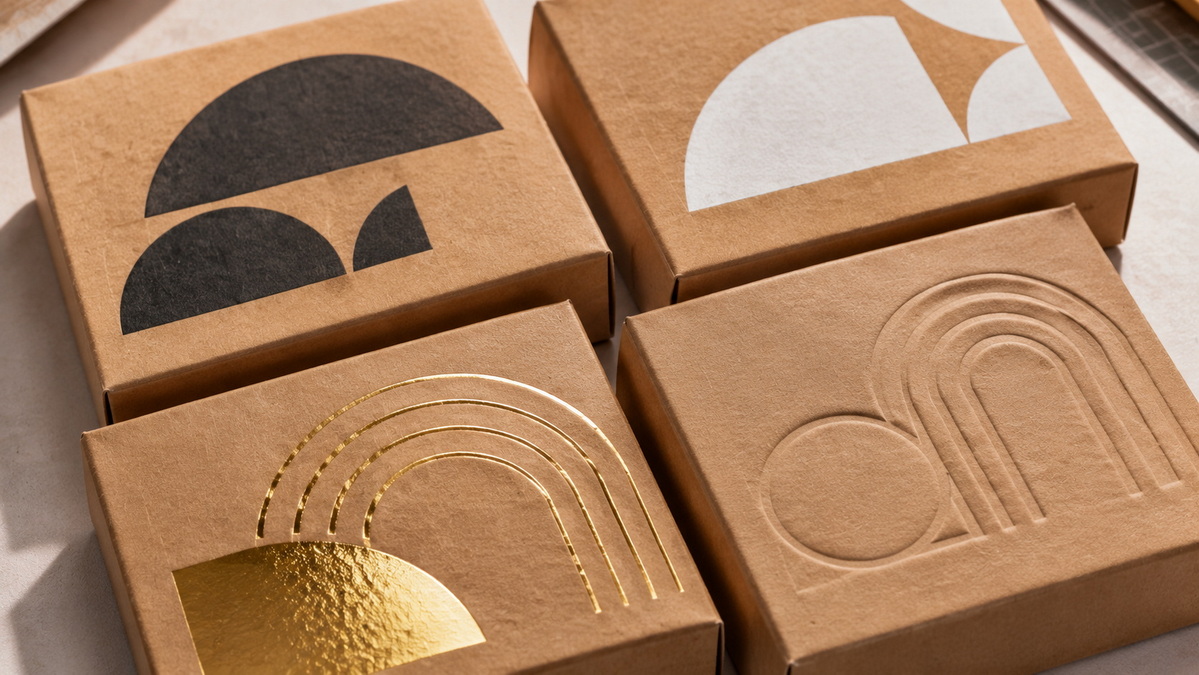
Simple graphics, strong contrast, and restrained color palettes often complement kraft's natural appearance.
Fine text, pale colors, and detailed images require closer evaluation. A textured or absorbent surface can affect ink coverage and edge definition.
A white underprint may help selected colors stand out, depending on the printing process and production setup. It should be discussed before artwork approval.
Foil stamping, embossing, and debossing can add contrast without covering the entire surface. However, fine details and deep impressions require testing.
Ask to see the intended finish on the actual substrate rather than judging it from an unrelated sample.
Kraft paper can support responsible packaging choices, but environmental performance depends on more than its color.
Fiber sourcing, material quantity, manufacturing, transport, product protection, and end-of-life handling all matter.
FSC labels communicate different sourcing claims:
- FSC 100% identifies material from FSC-certified forests.
- FSC Recycled identifies verified recycled material.
- FSC Mix covers eligible combinations of certified, recycled, and controlled sources.
These labels do not independently prove that a finished package is recyclable everywhere.
For an order requiring an FSC claim, confirm the supplier's applicable certification and the documentation available for that specific product.
Paper, adhesives, coatings, decorative components, and product residues can influence recycling compatibility.
The 2026 edition of 4evergreen's design guidance also addresses sorting disruptors: features that can send paper-based packaging into an inappropriate recycling stream.
This is especially relevant to elaborate gift boxes. Review the whole construction, not only the kraft covering.
Do not assume a finished kraft package is "impact-free," universally recyclable, or guaranteed to biodegrade within a fixed number of weeks.
A more useful approach is to document material composition, verify relevant claims, and provide disposal instructions appropriate to the destination market.
A structured approval process helps prevent avoidable disagreements between buyers, designers, and manufacturers.
Provide product dimensions, weight, fragility, and presentation requirements.
Also explain how the package will travel: retail distribution, individual parcel delivery, or another route. Identify likely exposure to handling, humidity, and stacking.
Decide whether the product needs a folding carton, rigid box, shopping bag, or corrugated shipper.
Then choose the kraft grade and finish. Reversing this sequence can produce attractive artwork on an unsuitable package.
Check product fit, assembly, opening, closure, and insert positioning.
For bags, examine handles and bottom construction. For collapsible boxes, confirm that staff can assemble them consistently.
Review the proposed kraft shade, artwork, finish, and production method as a combined system.
Record acceptable variation in color and surface appearance. Natural-looking materials still require clear approval standards.
For shipped products, assess the product, insert, presentation box, and outer carton together.
Agree on suitable tests and acceptance criteria before production. A successful empty-box sample does not establish protection for the packed product.
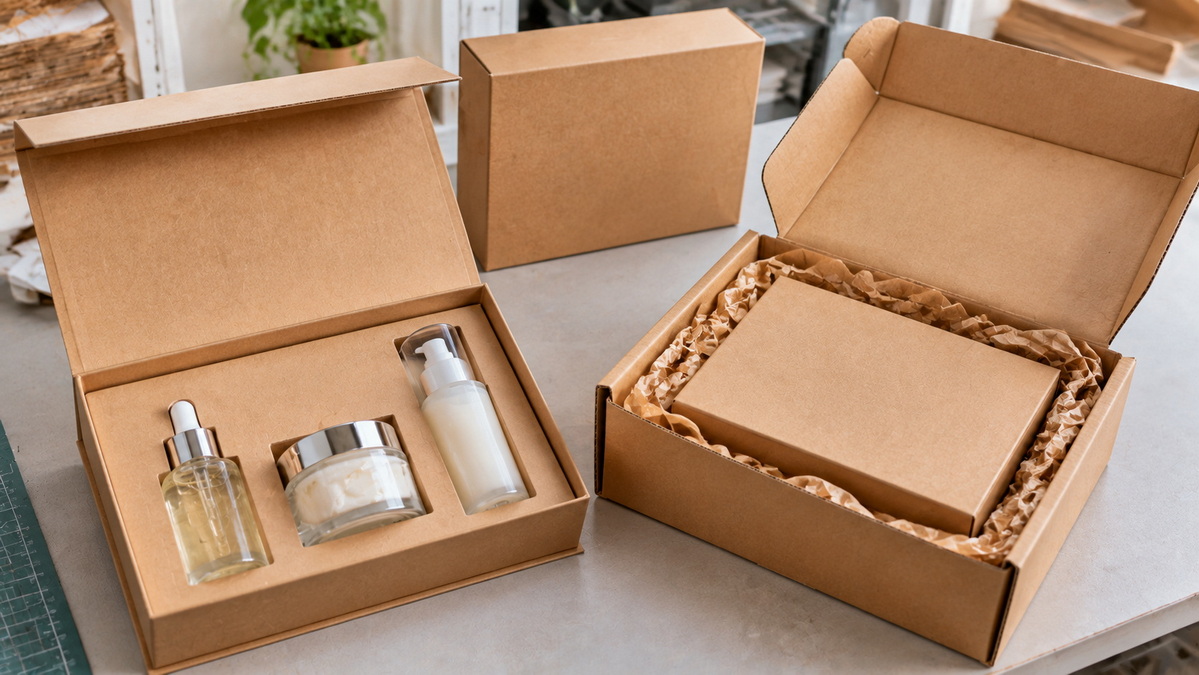
Consider a skincare brand developing a gift set with several glass containers. This is an illustrative scenario, not a documented customer project.
A kraft-covered magnetic box could provide presentation value, while a fitted insert holds the containers in position. A separate corrugated shipper may be needed for parcel delivery.
The development team should check:
- Whether containers can move or collide.
- Whether product leakage could stain the paper.
- Whether the closure stays secure during handling.
- Whether printed or foiled areas resist rubbing.
- Whether unnecessary components can be removed.
The key lesson is that kraft appearance and product protection are separate design decisions. Both must work together.
Compare equivalent specifications rather than unit prices alone.
Ask each supplier to identify the proposed material, construction, dimensions, printing, finishes, inserts, testing, and packing method.
Also clarify:
- Sample and tooling charges.
- Minimum order quantity.
- Approved material substitutions.
- Production lead time.
- Quantity per export carton.
- Flat-packed or assembled delivery.
- Quality acceptance criteria.
A lower quotation may reflect a different board, fewer components, or another packing arrangement. These differences are not necessarily unacceptable, but they should be visible before approval.
At Maituohong Packaging, we manufacture custom magnetic boxes, mailer and shipping boxes, rigid boxes, folding gift boxes, and paper shopping bags.
Send us your product dimensions, weight, order quantity, destination market, and artwork requirements. We can discuss the construction, kraft appearance, and sampling priorities needed to develop a package around your product—not simply around a brown paper finish.
No. Brown appearance does not establish the pulping process or fiber composition. Request the material specification when strength, sourcing, or recycled content matters.
Untreated kraft paper is not waterproof. Certain treatments improve resistance, but their suitability depends on exposure conditions and the finished packaging design.
Yes. Kraft can create a premium appearance through structural precision, considered graphics, and carefully selected finishes. Luxury presentation does not require a glossy white surface.
Only an appropriately specified material should be used for the intended food-contact application. Confirm relevant requirements for the paper, inks, coatings, adhesives, and conditions of use.
No. Performance depends on the grade, specification, and application. Evaluate whether the proposed material meets the package's requirements rather than judging it by recycled content alone.
Not automatically. A rigid gift box may protect presentation without providing sufficient distribution protection. Validate the complete shipping system with the actual product.
1. PakFactory — "What Is Kraft Paper and Why Is It a Popular Packaging Choice?" Published September 25, 2023. Original article reviewed for topic coverage, material terminology, and claims requiring qualification. [Read the article]. [pakfactory]
2. KnowPulp — "Principle of Chemical Pulping." Technical background on lignin removal and the roles of sodium hydroxide and sodium sulfide in kraft pulping. [View the technical explanation]. [knowpulp]
3. Forest Stewardship Council — "What the FSC Labels Mean." Primary guidance distinguishing FSC 100%, FSC Recycled, and FSC Mix sourcing claims. [Read the label guidance]. [fsc]
4. Forest Stewardship Council, United States — "On Product Labels." Guidance on sourcing labels and authorization to apply FSC labels to products and packaging. [Read the labeling guidance]. [us.fsc]
5. 4evergreen — "Circularity by Design Guideline," 2026 edition. Industry guidance covering recycling pathways, material compatibility, and sorting disruptors in paper-based packaging. [View the guideline overview]. [4evergreenforum]
6. 4evergreen — "Circularity by Design Guideline for Paper-Based Packaging," Version 4, February 2026. Detailed recommendations concerning coatings, adhesives, inks, integrated components, and recyclability assessment. [Read the full guideline]. [4evergreenforum]


