
Views: 215 Author: Maituohong Packaging Publish Time: 2026-11-21 Origin: Site


Content Menu
● Why Source Paper Carrier Bags from China?
>> What Recent Industry Data Actually Shows
● Selection Criteria: How This Supplier Shortlist Was Built
● Quick Comparison: Capacity, MOQ, and Certification Claims
● The Top 10 Paper Carrier Bags Manufacturers in China
>> 2. Xianda Printing Co., Ltd.
>> 3. Shenzhen XingKun Packing Products Co., Ltd.
>> 5. Long Win Display Shenzhen Limited
>> 6. Fujian Nanwang Environment Protection Scien-Tech Co., Ltd.
>> 7. Zhejiang Qianlin Packaging Technology Co., Ltd.
>> 8. Guangzhou Maibao Package Co., Ltd.
>> 9. Xiamen Huide Xiesheng Packaging Co., Ltd.
>> 10. Shanghai Forests Packaging Group Co., Ltd.
● Technical Buyer's Guide: Specify Performance Before Price
>> Choose Paper by Function, Not Appearance Alone
>> Define the Entire Bag Construction
>> Ask for Relevant Compliance Evidence
● Common Sourcing Traps—and How to Avoid Them
>> Material Substitution Without an Obvious Weight Change
>> Capacity Claims That Do Not Match the Product
>> An Attractive Price with an Incomplete Specification
● An Overlooked Procurement Risk: Approving the Right Sample Made by the Wrong Process
● Factory Verification, Sampling, and Logistics
>> Verify the Manufacturer Behind the Quotation
>> Make Sampling and Inspection Measurable
>> Calculate Landed Cost Before Choosing a Supplier
● Conclusion: Select the Supplier That Fits Your Production Program
>> 1. How Can I Check Whether a Supplier's ISO Certificate Has Expired or Been Suspended?
>> 2. Does an FSC Logo on a Supplier's Website Prove My Bags Will Carry an FSC Claim?
>> 3. How Can I Prevent Paper or Handle Substitution After Sample Approval?
>> 4. Why Might a Small-Quantity Order Cost Much More Per Bag?
>> 5. Can I Use the Same Paper Carrier Bag Specification for Every Export Market?
Choosing a paper carrier bags manufacturer is not simply a matter of comparing unit prices. For procurement managers, the more important question is whether a supplier can reproduce the approved paper quality, printing, handle strength, and delivery schedule across repeated orders.
China offers a broad sourcing base, from automated kraft-bag manufacturers serving retail chains to custom packaging producers developing coordinated shopping bags, gift boxes, and promotional packaging. The suppliers below represent different purchasing needs rather than interchangeable alternatives.
This guide evaluates manufacturers through five practical lenses: factory transparency, product-development capability, quality-control procedures, production suitability, and relevant compliance evidence. It also identifies information that still requires verification before a purchase order.
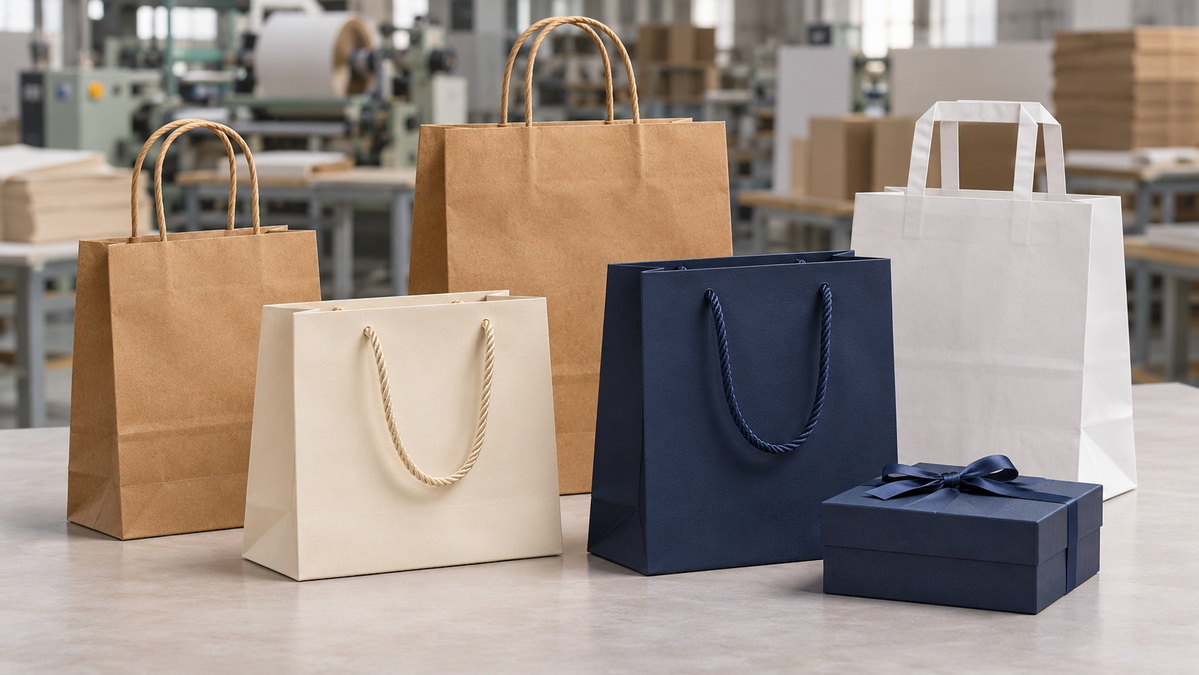
China's appeal extends beyond manufacturing cost. Buyers can source printed bags alongside rigid boxes, folding cartons, inserts, and other branded packaging, potentially reducing coordination across a packaging program.
The shortlisted suppliers illustrate several useful manufacturing locations:
- Dongguan and Shenzhen, Guangdong: Custom printing, gift packaging, and integrated branded packaging, represented here by Xianda and XingKun.
- Longgang and Wenzhou, Zhejiang: Kraft bags and food-service paper packaging, represented by Qianlin.
- Quanzhou and Xiamen, Fujian: Automated paper-bag production and export-oriented shopping-bag manufacturing, represented by Nanwang and Huide.
- Shanghai: Broad paper-packaging development and export services, represented by Forests Packaging.
Cepi's *Preliminary Statistics 2025*, released in February 2026, reported that China's paper and board production increased by 2.9% in 2025. The same report estimated a 1.0% increase in wrapping-paper production in Cepi member countries—the grade category that includes papers used for bag production. These are broader paper-industry indicators, not measurements of China's finished paper carrier bag market.
Cepi subsequently listed its *Key Statistics 2025* publication in July 2026. Buyers should distinguish the year a report was published from the year its data describes, and avoid treating broad packaging statistics as a paper-shopping-bag market forecast.
The procurement implication is straightforward: a substantial material supply base creates sourcing options, but does not prove that an individual converter has suitable equipment, available capacity, or reliable quality systems.
A useful supplier evaluation should consider more than attractive product photographs.
| Evaluation area | Evidence buyers should request | Why it matters |
|---|---|---|
| Factory identity | Business license, production address, contracting entity, and subcontractor disclosure | Establishes who manufactures and who carries contractual responsibility |
| Development capability | Structural drawings, material recommendations, prototypes, and revision records | Shows whether the supplier can develop a bag rather than merely reproduce artwork |
| Quality control | Incoming-material checks, in-process inspection, finished-bag testing, and retained samples | Helps control variation between the approved sample and bulk production |
| Production suitability | Relevant equipment, bag-specific output, bottleneck operations, and order loading | Tests whether claimed capacity applies to the required construction |
| Delivery management | Material-booking plan, approval deadlines, inspection window, and shipment milestones | Makes lead-time commitments measurable |
| Compliance evidence | Current certificates, applicable test reports, and traceable material documentation | Separates relevant evidence from unrelated certification logos |
No factory visits, confidential production records, or independent performance tests were conducted for this article. Where public information is incomplete or inconsistent, the limitation is stated.
The table separates paper-bag-specific disclosures from general packaging claims. "Not disclosed" means the reviewed sources did not provide a reliable, directly comparable figure.
| Manufacturer | Main sourcing fit | Published capacity evidence | Published MOQ position | Certification or compliance position |
|---|---|---|---|---|
| Maituohong Packaging | Coordinated custom bags and premium gift packaging | Bag-specific capacity not disclosed | Confirm by construction and quantity | Website states ISO 9001, ISO 14001, and FSC; verify current scope |
| Xianda Printing Co., Ltd. | Gift boxes with matching printed paper bags | Multiple production lines claimed; bag-specific output unclear | Confirm by project | Request current certificates and applicable test reports |
| Shenzhen XingKun Packing Products Co., Ltd. | Integrated printing and branded packaging | Bag-specific output not disclosed | Low-MOQ positioning; no universal bag MOQ published | Website states ISO 9001 and FSC and references BSCI |
| Bonito Packaging | Small-brand packaging development | General packaging order scale advertised; not verified bag capacity | From 100 units for certain boxes, not an established bag MOQ | Website references ISO 9001, FSC, BSCI, and REACH; verify the evidence type |
| Long Win Display Shenzhen Limited | Display-led retail packaging programs | Display facility information published; bag capacity unconfirmed | Bag MOQ unconfirmed | Website references FSC and ISO; verify entity and scope |
| Fujian Nanwang Environment Protection Scien-Tech Co., Ltd. | Large recurring retail and food-service programs | More than 2.7 billion paper bags annually, supplier-reported | Typically 10,000–20,000 pieces per size/design on its website | ISO and FSC claims; confirm supplying plant |
| Zhejiang Qianlin Packaging Technology Co., Ltd. | Kraft handle bags and food-service packaging | Public pages contain different capacity figures; obtain current line-specific data | Product-specific; some listings state 30,000 pieces | BRC/FSC claims on selected listings |
| Guangzhou Maibao Package Co., Ltd. | Integrated retail and food-service packaging | Multiple production bases; comparable bag output not established | Selected paper-bag listings state 10,000–20,000 pieces | ISO-related claims and certified-paper options; verify scope |
| Xiamen Huide Xiesheng Packaging Co., Ltd. | Custom shopping bags and retail carriers | Manufacturing information published; verify available capacity for the selected bag | Request quotation | Obtain current certificates and product-specific evidence |
| Shanghai Forests Packaging Group Co., Ltd. | Bags combined with cartons and other paper packaging | Bag-specific capacity not disclosed | Request quotation | Confirm certificates for the actual production site |
Sources: supplier websites and company profiles. All figures remain subject to quotation, factory verification, and current documentation.
Maituohong Packaging is a relevant starting point for brands seeking custom paper shopping bags alongside magnetic boxes, rigid gift boxes, folding gift boxes, and mailer packaging.
The company reports more than 18 years of packaging experience in the background supplied for this guide. Its reviewed About page does not establish an exact incorporation year; buyers should confirm that separately rather than convert experience into an assumed founding date.
Its published workflow covers consultation, design, quotation, sampling, approval, production, inspection, and delivery. It also describes a Heidelberg six-color press and incoming, in-process, final, and outgoing quality-control stages. These are useful foundations for coordinated packaging development.
- Establishment: Exact year to be confirmed; more than 18 years of experience reported.
- Customer markets: Global brand packaging; a geographic sales breakdown is not disclosed on the reviewed page.
- OEM/ODM scope: Custom structures, material selection, printing, finishing, samples, and coordinated paper-packaging development.
- Core advantage: An integrated development process that may suit small and growing brands needing technical guidance and coordinated packaging.
- Buyer verification point: Confirm paper-bag production arrangements, MOQ, handle-attachment methods, load-testing procedures, and available production slots.
Maituohong's practical positioning is value-conscious customization rather than a claim to the largest output. Its emphasis on direct specialist communication and end-to-end support makes it worth evaluating where specification changes and design coordination matter. Buyers should still test responsiveness during sampling and compare like-for-like landed costs.
Xianda's website includes paper bags within a wider range of gift, cosmetic, jewelry, flower, and presentation packaging. This makes it particularly relevant for buyers seeking matching bags and boxes rather than a standalone commodity carrier.
Its public company history requires clarification: the homepage states 2006 in several places but also contains a 2014 establishment statement. Buyers should reconcile the legal entity, business history, and production address before onboarding.
- Establishment: 2006 stated repeatedly; conflicting 2014 statement also appears.
- Customer markets: International gift, beauty, jewelry, and consumer-product packaging; geographic market shares are not disclosed.
- OEM/ODM scope: Packaging structures, custom printing, premium finishing, samples, and coordinated bags and gift boxes.
- Core advantage: Presentation-packaging breadth and in-house design and sampling claims.
- Buyer verification point: Request bag-specific production records rather than relying on overall box-manufacturing credentials.
XingKun positions itself as an integrated custom-printing supplier covering packaging boxes, paper bags, display stands, cards, labels, and other printed products. Its website states that it has operated in printing and packaging since 2004 and serves more than 30 countries and regions.
- Establishment: 2004, according to its website.
- Customer markets: International retail, e-commerce, entertainment, and education customers.
- OEM/ODM scope: Artwork support, packaging development, printing, finishing, and coordinated branded materials.
- Core advantage: Broad printed-product coordination for multi-component purchasing programs.
- Buyer verification point: Confirm whether the quoted paper-bag sample uses the same printing and assembly route as bulk production.
This last point matters because XingKun explicitly distinguishes digitally printed, hand-finished samples from samples made to resemble bulk-production methods. That transparency is useful, but buyers must select the appropriate approval sample.
Bonito Packaging's website emphasizes custom boxes, material selection, structural development, printing, finishing, and support for smaller launches. It reports more than a decade of experience and customers in more than 20 countries and regions.
However, the reviewed site provides stronger evidence for boxes than for dedicated paper carrier bag production. Bonito should therefore be treated as a conditional packaging-program candidate until its bag capability is documented.
- Establishment: Exact year not established on the reviewed website.
- Customer markets: Global brands, retailers, and e-commerce businesses.
- OEM/ODM scope: Confirmed website focus on custom boxes and packaging development; paper carrier bag scope requires confirmation.
- Core advantage: Low-volume development positioning and material-and-finishing support.
- Buyer verification point: Confirm the full contracting company name, bag-production location, subcontracting arrangements, and bag-specific MOQ. Do not apply the advertised 100-box starting quantity to shopping bags.
Similarly named packaging businesses appear in public directories. A business license and matching bank-beneficiary details are more reliable identifiers than the brand name alone.
Long Win Display Shenzhen Limited is primarily a point-of-purchase display and retail-packaging specialist. Its company page states that Long Win Display opened in 2018, while its broader experience claims exceed 20 years. These should be understood as different statements rather than interchangeable founding dates.
The company reports that its production facilities moved to Yiwu, Zhejiang, after 2020. Its published services include concept development, structural samples, production, prepacking, and shipment coordination.
- Establishment: 2018 company-opening milestone; longer industry-experience claim.
- Customer markets: International retail-display and promotional-packaging customers; geographic shares are not disclosed.
- OEM/ODM scope: Displays, gift and packaging boxes, structural design, and prepacking.
- Core advantage: Coordinating retail displays and packaging within a campaign.
- Buyer verification point: Paper carrier bags are not established as a core manufacturing category in the reviewed pages. Confirm capability before including it in a bag-only tender.
Nanwang is a more directly relevant candidate for large, recurring paper-bag programs. Its website states that it was established in 2010 and lists stock code 301355.
The supplier reports more than 400 automated production units across its packaging operations and annual paper-bag output exceeding 2.7 billion units. These are company-level claims, not proof of capacity available for an individual purchase order.
- Establishment: 2010.
- Customer markets: Global retail, food-service, and wholesale packaging.
- OEM/ODM scope: Custom paper bags, branded printing, food packaging, and bulk supply programs.
- Core advantage: Automated production scale.
- Buyer verification point: Confirm the supplying plant, material allocation, size-specific MOQ, and capacity reserved for repeat orders.
Qianlin identifies itself as a manufacturer of kraft paper handle bags and food-grade paper packaging in Longgang, Wenzhou. Its company profile states that it was founded in 2007.
Its product range includes twisted-handle bags, flat-handle bags, die-cut-handle bags, and food-service paper packaging. Public pages also state exports to more than 50 countries.
- Establishment: 2007.
- Customer markets: International food-service, retail, and packaging buyers.
- OEM/ODM scope: Custom dimensions, printing, paper selection, handle formats, and food-packaging development.
- Core advantage: Direct relevance to kraft handle-bag sourcing.
- Buyer verification point: Reconcile differing public capacity statements and distinguish sample or digital-order options from conventional production MOQs.
Maibao states that it was established in 2008. Its company-history page describes three production bases in Southern China and a service model combining consultation, design, production, and logistics.
The website also uses the name Guangzhou Maibao Paper and Plastic Products Co., Ltd. Buyers should establish which entity will issue the contract, invoice, and export documents.
- Establishment: 2008.
- Customer markets: Food service, fast-moving consumer goods, apparel, and general retail.
- OEM/ODM scope: Custom paper bags, food cartons and trays, printing, material selection, and logistics support.
- Core advantage: Broad packaging coordination across several product categories.
- Buyer verification point: Selected paper-bag listings show different MOQs, so request a construction-specific quotation rather than assuming one company-wide minimum.
Huide is a relevant shopping-bag specialist for buyers evaluating custom retail carriers. Public company information places its establishment in 2014. Its website distinguishes the sales company, Xiamen Huide Xiesheng Packaging Co., Ltd., from its China production company, Xiamen Huide Eco-friendly Paper Bag Co., Ltd.
- Establishment: 2014, according to its public company profile.
- Customer markets: International brands and retailers; its profile reports exports to more than 30 countries.
- OEM/ODM scope: Custom paper bags, branded printing, bag design, and retail-packaging development.
- Core advantage: A clear paper-bag product focus.
- Buyer verification point: Ensure certificates, factory audits, inspection bookings, and purchase documents identify the correct sales and manufacturing entities.
Forests Packaging offers paper shopping bags alongside a broader paper-packaging range. Its official group website traces its history to 1986. A public supplier profile gives 2006 as the establishment date of the listed legal company, so buyers should distinguish group heritage from entity incorporation.
- Establishment: Group history since 1986; contracting-entity date requires confirmation.
- Customer markets: International buyers of paper packaging.
- OEM/ODM scope: Custom shopping bags, printing, packaging structures, and coordinated paper-packaging programs.
- Core advantage: Breadth for buyers consolidating bags with other packaging purchases.
- Buyer verification point: Confirm the actual bag-converting plant, finishing arrangements, and bag-specific capacity.
A quotation stating "premium kraft paper" is incomplete. Buyers should define the paper grade, basis weight in grams per square meter, finish, intended load, and required appearance.
| Material option | Typical purchasing application | Questions to resolve |
|---|---|---|
| Brown kraft paper | Retail, takeaway, and natural-look packaging | What grade, recycled content, strength, and shade are required? |
| White kraft paper | Branded retail carriers | How will white shade, print appearance, and strength be controlled? |
| Coated printing paper | High-coverage graphics and gift bags | Does the finished construction resist cracking, rubbing, and handle failure? |
| Recycled paper | Programs with recycled-content requirements | What evidence supports the content claim and required performance? |
| Specialty paper | Premium presentation packaging | Can the same texture and shade be maintained on repeat orders? |
The specification should control the finished bag, not just the incoming sheet. Require the supplier to propose a construction and demonstrate that it supports the intended contents.
A complete technical specification should include:
- Finished width, gusset, and height, with tolerances.
- Paper grade, basis weight, and approved substitution rules.
- Handle material, length, attachment, and reinforcement.
- Top-turnover and bottom-reinforcement construction.
- Printing reference, finishing, and acceptable visual variation.
- Intended load and agreed test procedure.
- Packing quantity, carton dimensions, and traceability markings.
For food-contact applications, the assessment must cover the intended use and relevant materials, including printing and adhesives where applicable. Cepi's food-contact guidance emphasizes suitability documentation and traceability for paper-and-board articles, including converted bags.
Ordinary paper shopping bags do not become compliant simply because a supplier displays many logos.
- ISO 9001 concerns quality-management systems; verify the certified company, site, and scope.
- FSC claims require appropriate certification and documentation checks, not just a statement that some paper was purchased from a certified source.
- Social-compliance audit evidence should not be confused with finished-product certification.
- Chemical test reports should identify the tested materials, methods, results, and relevant requirements.
CE marking applies only to products covered by applicable legislation; it is not a general quality mark for ordinary paper carrier bags. RoHS concerns electrical and electronic equipment, and Cepi specifically cautions against treating it as generally applicable to pulp and paper products. Buyer-requested restricted-substance testing may still be useful, but should be described accurately.
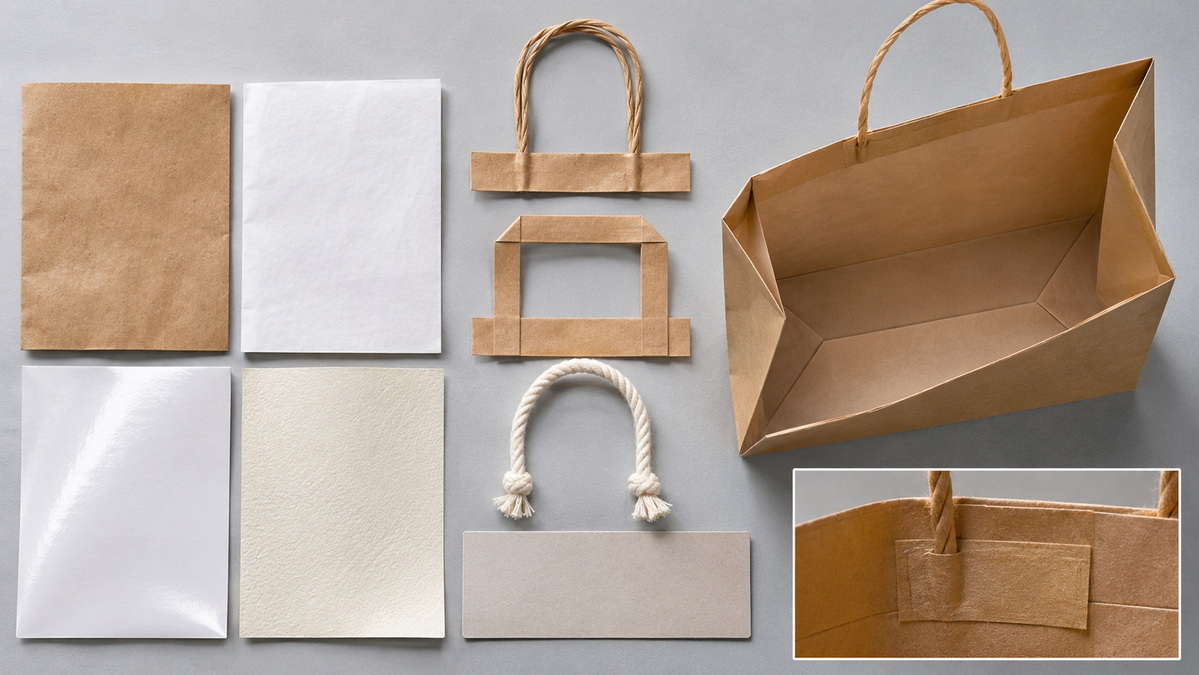
A bag may meet the quoted paper weight but differ from the approved sample in shade, feel, or performance. Avoid accepting basis weight as the sole acceptance criterion.
Recommended controls:
1. Record the approved paper specification.
2. Retain signed material and finished-bag samples.
3. Require written approval before substitutions.
4. Test randomly selected production bags against the agreed load requirement.
Overall factory output may include boxes, food bags, labels, or other products. It does not necessarily describe available capacity for rope-handle luxury carriers.
Ask for the planned manufacturing route, daily finished-bag output, labor-intensive operations, and confirmed order loading for your production window.
Compare quotations against the same bill of materials. Handle reinforcement, bottom cards, coatings, finishing, packing quantities, inspection, and freight terms should not be left implicit.
A lower unit price is not a saving if the bag fails in stores or arrives after a campaign.
A polished sample can validate appearance without validating mass production.
For example, XingKun's published sampling explanation distinguishes digital printing and hand finishing from samples intended to reflect bulk-production methods. This illustrates why buyers should ask how an approval sample was made rather than assuming all samples are production-equivalent.
A practical approval sequence is:
1. Structural prototype: Verify dimensions, fit, handle clearance, and intended contents.
2. Appearance sample: Review artwork, placement, color direction, and finishing.
3. Production-equivalent sample: Confirm the intended paper, printing route, adhesive, reinforcement, and assembly method.
4. Initial production check: Inspect randomly selected bags from the actual production run.
The less obvious contractual safeguard is to approve the manufacturing route alongside the physical sample. Require written authorization before changes to paper, printing method, handle attachment, reinforcement, or subcontractor.
This does not eliminate every defect, but it makes unauthorized process changes easier to identify and resolve.
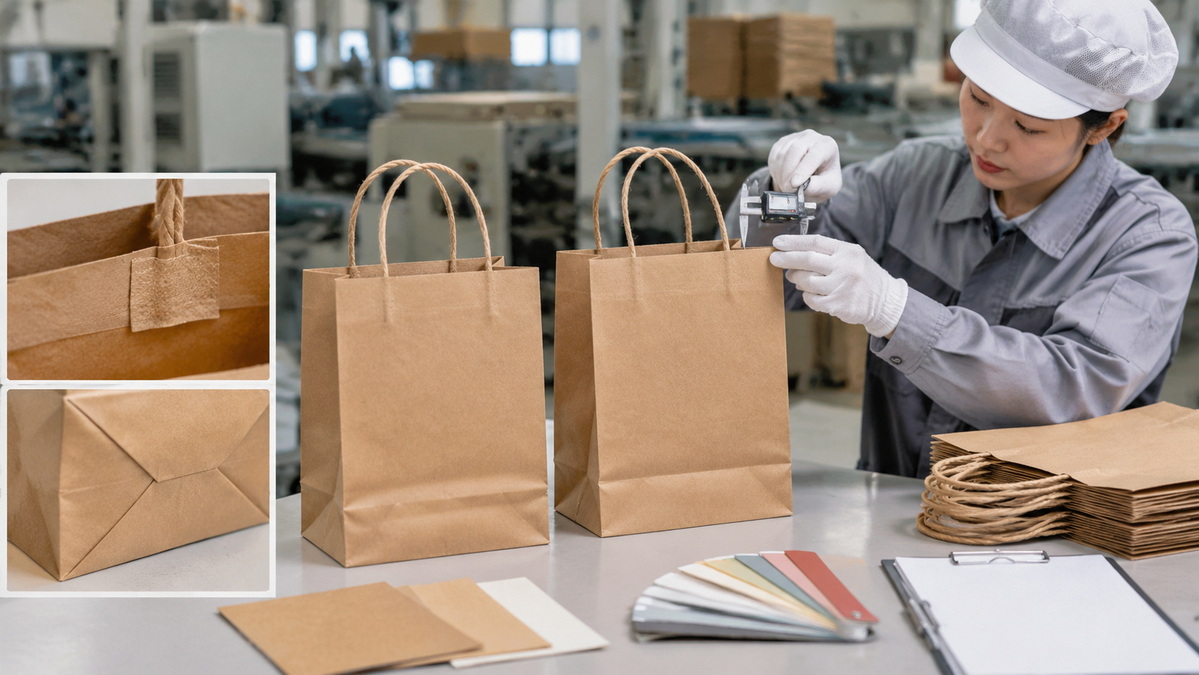
Request a business license, factory address, production-process list, and disclosure of outsourced operations. During a live video review or third-party audit, follow the actual product route rather than viewing only a showroom.
Match the supplier identity across the contract, bank beneficiary, certificates, invoices, and inspection instructions.
The purchase order should define:
- Which sample controls structure and which controls appearance.
- When production may begin.
- What constitutes a critical, major, or minor defect.
- How bags will be selected for inspection.
- What happens if the shipment fails inspection.
- Who approves rework and replacement.
Agree finished-bag tests with the supplier and testing provider based on real use. Include handle attachment, bottom integrity, loaded carrying performance, print rubbing, and crease appearance where relevant.
Request packing details early. Compare carton dimensions, gross weight, units per carton, freight, insurance, inspection, duties, and destination charges—not just the factory price.
For U.S.-bound orders, certain paper shopping bags from China are covered by trade-remedy proceedings and orders. The official scope includes many handled bags but also contains detailed conditions and exclusions. A customs broker should review the exact construction, exporter, producer, and current instructions before the order is finalized; historical investigation rates should not be treated as a current landed-cost quotation.
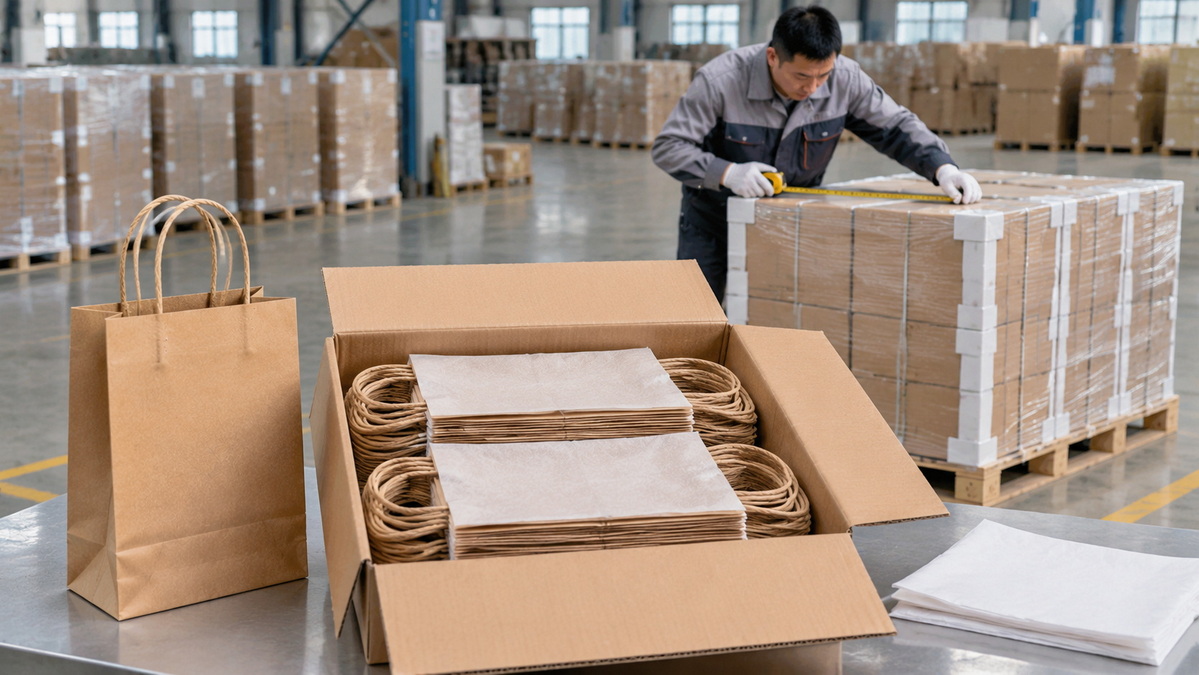
A long-term paper carrier bag partnership should be built around repeatable specifications, transparent manufacturing, verified documentation, and realistic delivery planning.
For large recurring kraft-bag programs, Nanwang and Qianlin merit evaluation for their directly relevant production focus. Huide is relevant to custom shopping-bag sourcing, while Xianda, XingKun, Maibao, and Forests offer broader packaging coordination. Bonito and Long Win require additional confirmation of bag-specific manufacturing capability before a bag-only tender.
Maituohong Packaging is worth considering where custom paper carrier bags form part of a coordinated gift-packaging program and buyers need support with structure, materials, printing, and sampling. Its published development and quality-control workflow provides a basis for that discussion, with bag-specific capacity and commercial terms to be confirmed during quotation.
To begin a project with Maituohong Packaging, provide your bag dimensions, intended contents and weight, artwork, quantity by design, destination, and required delivery date. Request a material recommendation, an itemized quotation, and a production-equivalent sampling plan before authorizing bulk production.
Search the company name or certificate number through IAF CertSearch. Review the current status, certified entity, site, standard, scope, issuing certification body, and accreditation details.
Do not rely only on a PDF's printed expiry date: a certificate can be suspended or withdrawn before that date. If the record cannot be reconciled, seek confirmation directly from the issuing certification body before treating it as verified.
No. A website logo is not order-specific evidence.
Ask for the relevant certificate information, confirm the supplying entity and permitted scope, and require the supplier to explain how the claim will appear on transaction documents and any approved product labeling. Make this a purchase-order requirement rather than an assumption.
Attach a controlled specification to the purchase order and retain signed reference samples. Require written change approval for paper, handles, reinforcement, adhesive, finishing, and manufacturing location.
Then inspect randomly selected production units—not only samples prepared specifically for the buyer. Contractual controls should be supported by material records and agreed performance checks.
Ask the supplier to separate setup, tooling, materials, printing, finishing, and assembly costs. A short run may distribute fixed preparation costs across fewer bags or require a different production route.
To reduce cost, request alternatives such as fewer sizes, fewer finishes, standard handles, or consolidated repeat orders. Approve any resulting change in appearance or performance before proceeding.
Not automatically. The intended use, destination requirements, environmental claims, food-contact status, and import treatment may differ.
For example, U.S. trade-remedy scope review is a separate issue from product quality, while food-contact suitability requires use-specific documentation. Have the importer, testing provider, and customs broker review the relevant requirements before finalizing a multi-market specification.
1.China Paper Association, *2024 Annual Report*, published May 2025: http://www.chinappi.org/reps/20250507090553272660.html
2.Cepi, *Preliminary Statistics 2025*, published February 2026: [https://www.cepi.org/wp-content/uploads/2026/02/FINAL-Cepi-Preliminary-Statistics-2025.pdf]
3.Cepi publication portal, including *Key Statistics 2025*: [https://www.cepi.org/]
4.U.S. International Trade Administration, paper shopping bag scope information: [https://beta.trade.gov/adcvd?adcvdcase=C-570-153]
5.U.S. International Trade Administration, current AD/CVD case search: [https://access.trade.gov/adcvd/]
6.U.S. International Trade Administration, EU labeling and marking requirements: [https://www.trade.gov/country-commercial-guides/eu-labelingmarking-requirements]
7.IAF CertSearch, certificate verification: [https://www.iafcertsearch.org/]
8.Maituohong Packaging: [https://www.mthpackagingbox.com/about.html]
9.Xianda Printing: [https://www.xiandagiftbox.com]
10.XingKun: [https://www.xkdisplay.com]
11.Bonito Packaging: [https://www.bonitopack.com]
12.Long Win Display: [https://www.longwindisplay.com/our-company.html]
13.Nanwang: [https://nanwangpack.com/]
14.Qianlin: [https://www.qianlinpack.com/about.html]
15.Maibao: [https://www.maibaopak.com/our-story/]
16.Huide Packaging: [https://hdpk.com/]
17.Forests Packaging Group: [https://www.forestspackaginggroup.com/]


