
Views: 268 Author: MTUOHONG PACKING Publish Time: 2026-11-16 Origin: Site


Content Menu
● What Is the Difference Between a Drawer Box and a Folding Carton?
● One USB-C Wall Charger, Two Packaging Designs
>> Everyday retail version — a tuck-end carton with a removable insert
>> Premium accessory version — a rigid drawer box with a fitted tray
>> If both versions will ship to customers
● How to Compare the Total Cost per Packed Unit
● How to Test Samples Before Approving Production
>> Are rigid drawer boxes more protective than folding cartons?
>> Can a folding carton hold a wall charger securely?
>> Are folding cartons cheaper than drawer boxes?
>> Can a drawer box be made from folding paperboard?
>> Can I use the same insert for different plug versions?
>> What should I send for a packaging quote?
Start with a tuck-end folding carton when your small product needs a compact retail box with space for specifications, a barcode, and instructions. Consider a rigid drawer box when you want customers to slide open a tray and see the product held in place.
A compact USB-C wall charger makes the difference easy to see. The same charger can sit in a removable insert inside a retail carton or in a fitted tray inside a rigid drawer box. Both designs need to hold the charger securely, leave room for the plug blades, and let the customer remove it easily.
A drawer box has an inner tray that slides into an outer sleeve. The tray and sleeve can be made from folding paperboard or thicker rigid board.
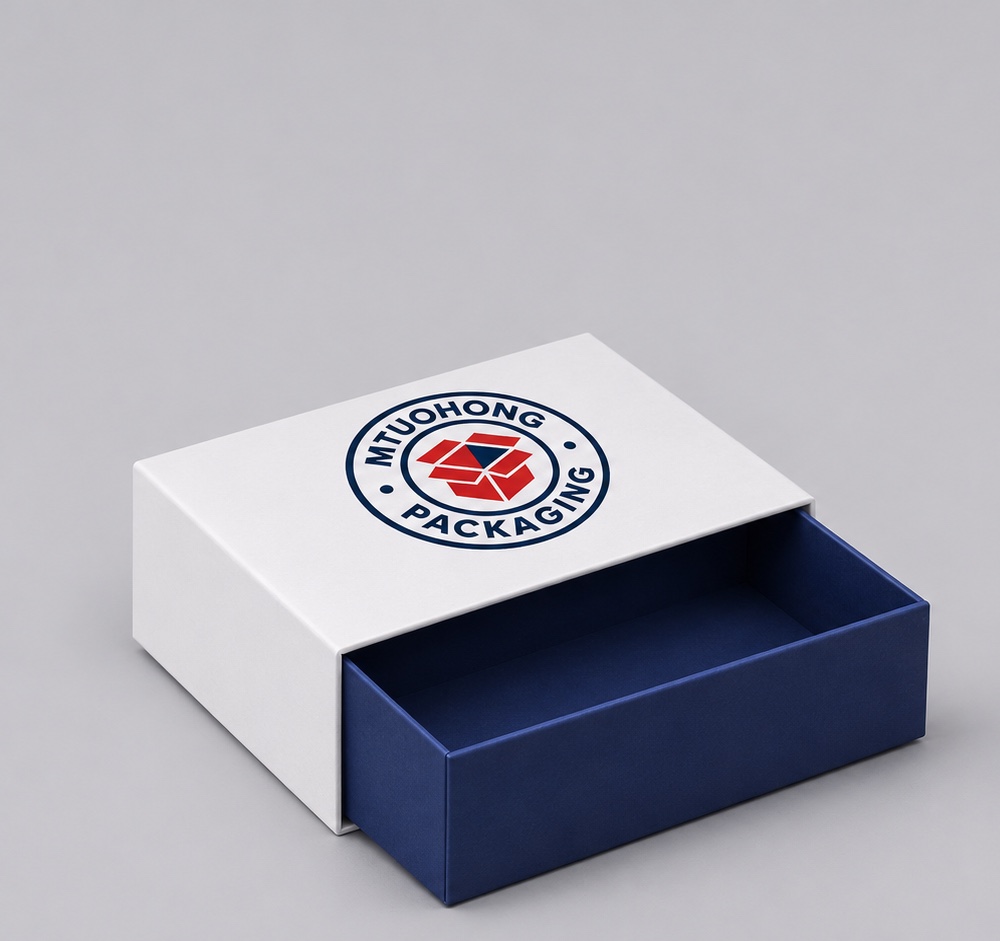
A folding carton is made from paperboard that is cut and creased, then folded into shape. It can be supplied flat and assembled during packing. Folding paperboard can also be used to make a sliding tray and sleeve, so confirm the material, opening mechanism, and delivery format when requesting a quote.

This comparison uses two specific designs: a preassembled rigid drawer box and a tuck-end folding carton supplied flat. Both styles are represented in the Maituohong Packaging catalog.
| What to compare | Preassembled rigid drawer box | Tuck-end folding carton |
|---|---|---|
| Opening | The customer pulls a tray out of a sleeve. | The customer opens a tuck flap and removes the product or insert. |
| Product presentation | A fitted tray can reveal the charger face-up. | Printed panels carry retail information. An insert holds the charger inside. |
| Packing steps | Load the tray and slide it into the sleeve. | Erect the carton, load the insert and product, and close the flaps. |
| Storage before packing | Allow space for the preassembled sleeves and trays. | Store cartons flat and account for inserts separately. |
| Quote variables | Sleeve and tray construction, wrap, insert, opening feature, and finish. | Board, dimensions, printing, finish, and insert. |
| First sample check | Does the tray slide smoothly with the charger loaded? | Does the loaded insert pass through the opening and allow the flap to close flush? |
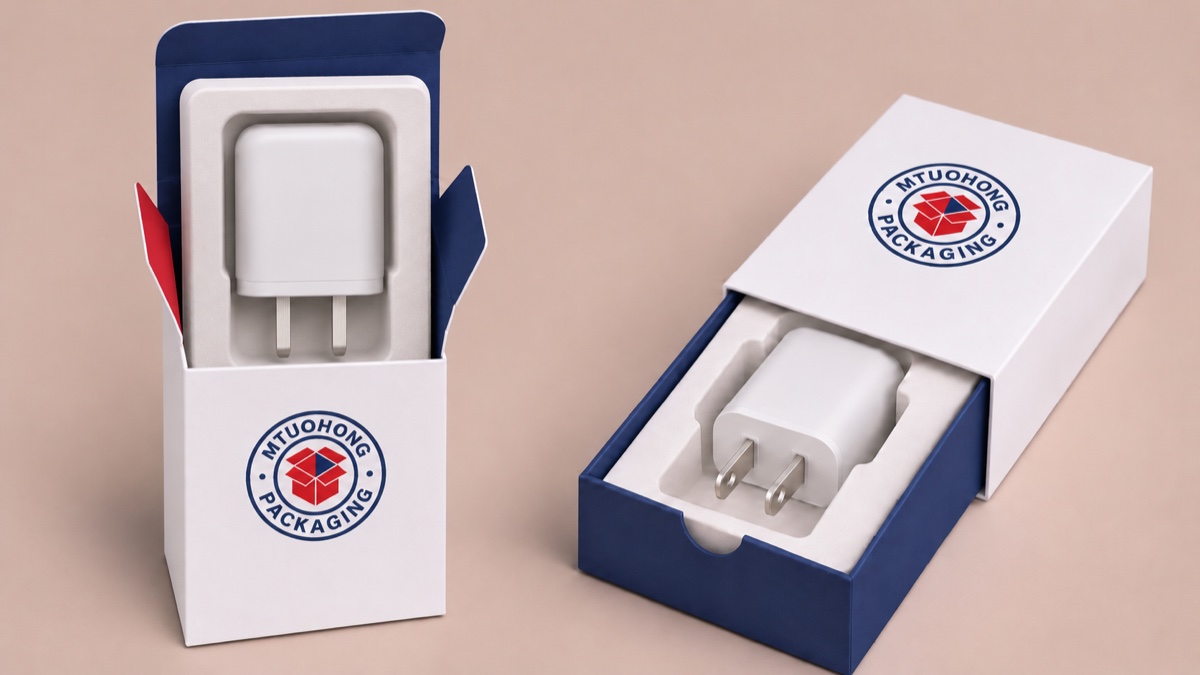
Consider a white, single-port USB-C charger with two flat plug blades. For the retail version, the front panel can identify the charger. The side or back panels can carry the wattage, port type, model number, and barcode. Use the product's approved specifications when preparing the artwork.
Measure the charger with the plug blades included. Then measure the charger seated in the insert. The loaded insert needs to pass through the carton opening, where the dust flaps and fold lines can reduce the available clearance.
During the packing trial, load the charger in the orientation your team will use. Check whether a blade catches on a flap or rubs against the board. Close the carton and look at it from the side. A bulge or a flap that springs back can indicate pressure from the insert or product.
Open the carton as a customer would. Check whether you can grip the insert and slide it out smoothly. If it catches, identify where it sticks. A change to the insert edge or flap clearance may solve the problem.
Lay the same charger flat in a fitted tray. Design the insert to support the charger body and leave clearance around the plug blades. A finger recess beside the body gives the customer a place to grip the charger.
Test the drawer with the charger and insert installed. An empty tray may slide easily, then bind after a tight insert pushes its walls outward. Open and close the loaded drawer several times. Pick up the closed box and check whether the tray shifts inside the sleeve.
Ask someone unfamiliar with the sample to open it and remove the charger. If they struggle to find the opening point, review the notch or pull tab. If they reach for the plug blades to lift the charger, give them more room to grip the body.
Put each presentation box into the outer mailer you intend to use. Check the finished parcel's dimensions, the amount of cushioning it needs, and whether the presentation box moves inside it. If customers may order more than one unit, check how those orders will be packed too.
Record the condition of the charger and the presentation box separately. A charger can arrive intact while a dented carton or scuffed drawer sleeve still falls short of the presentation you approved.
If your charger will ship as an individual parcel, explore our corrugated box options for an outer mailer sized to fit the presentation box and cushioning.
Ask suppliers to quote both structures for the same charger, order quantity, artwork requirements, and sales channel. Request an itemized quote. A drawer box price may include the sleeve, tray, and fitted insert. A folding carton price may cover the printed carton, with the insert priced separately.
Include these items in your comparison:
- Box and components. Confirm which inserts, pull tabs, leaflets, or seals are included.
- Samples and tooling. Ask which charges apply to the first order and which may recur after a design or artwork change.
- Packing labor. Time the same operator packing several units of each design. Include assembly, loading, adding the leaflet, and closing the box.
- Storage and inbound freight. Confirm how the empty packaging arrives, how many units fit in a case, and how much storage space the order will take.
- Shipping materials and delivery. Include any master case, parcel mailer, or cushioning. Check the finished parcel dimensions and weight against your intended shipping service.
For retail, compare the cost of one shelf-ready unit, including its share of the outer case. For individual orders, compare the cost of one ship-ready unit, including the presentation box and shipping materials. If you expect larger repeat orders, ask for a second quantity tier and use the same packing assumptions for both quotes.
1. Load both samples with the actual charger. Use the production plug configuration, insert, and any leaflet that will be included.
2. Check clearance and closure. Confirm that the plug blades have room, the carton closes flush, and the loaded drawer slides without rubbing.
3. Try the customer opening sequence. See whether someone can find the opening point and remove the charger comfortably.
4. Time packing and review the artwork. Note any step that causes snagging or rework. Scan the barcode on the assembled retail carton and check that important text sits clear of folds.
5. Evaluate the finished shipment and record the approved design. Check the intended shipping configuration. Keep the approved dimensions, insert layout, board specification, and artwork revision with the sample.
Use these observations to give your supplier specific feedback.
| What you observe | What to ask the supplier to review |
|---|---|
| A plug blade catches at the carton opening. | Review the loading direction, insert edge, and clearance around the flaps. |
| The carton flap springs back after loading. | Check whether the charger or insert is pressing against the closure. |
| The drawer slides when empty and binds when loaded. | Check whether the insert pushes the tray walls outward or the charger sits too high. |
| The charger is difficult to lift from the tray. | Add finger clearance next to the charger body. |
| The presentation box shifts inside the mailer. | Review the mailer dimensions and cushioning placement. |
For projects that need formal transit validation, ask a packaging lab which procedure fits your distribution route. ISTA Procedure 3A is an example for individual packaged products shipped through a parcel delivery system. Evaluate the complete shipping configuration, including the product, insert, presentation box, and outer mailer if used.
Protection depends on the board, insert, closure, and shipping configuration. For a charger, check whether the insert holds the body in position and keeps the plug blades clear of the box walls. Compare the loaded samples under the same handling conditions.
A fitted insert can hold the charger in a folding carton. Measure the charger with its blades included, then check how the loaded insert passes through the opening. Review the bottom closure with the actual product inside, especially if the box will be handled frequently at retail.
A folding carton may have a lower box price, depending on order quantity, print specification, and finish. Compare the full cost of each packed unit, including the insert, packing labor, storage, and any outer shipping materials.
Yes. The sliding tray and sleeve can be made from folding paperboard or rigid board. Ask how each component is made and delivered, then compare the loaded fit and packing steps.
Check each plug version with the physical charger. Changes in plug shape, blade position, or overall depth can affect clearance and retention. If you want one insert to serve several models, test each configuration before approving production.
Send the charger's dimensions and weight, a photo or drawing showing the plug blades, your order quantity, and any requirements for artwork or inserts. Tell the supplier whether the box is for retail display, gifting, or individual parcel delivery.
At Maituohong Packaging, we help buyers choose a box structure, material, and insert based on the product's dimensions, presentation needs, and shipping conditions.
Send us your product dimensions, photos or drawings, order quantity, and sales channel to contact us. For a charger, include the plug configuration and tell us whether a cable or leaflet will share the box. If you are considering both structures, request samples for the same product so you can compare fit, opening, and packing time side by side.
- [Paperboard Packaging Council — What Is Paperboard Packaging?]
- [International Safe Transit Association — Overview of Procedure 3A]
- [Maituohong Packaging — Product Catalog]


