
Views: 227 Author: Maituohong Packaging Publish Time: 2026-11-15 Origin: Site


Content Menu
● What Makes Packaging Materials Eco-Friendly?
>> Recycled, Recyclable, and Compostable Are Different
● Comparing Eco-Friendly Packaging Materials for Custom Projects
>> Recycled Paperboard for Rigid Gift Boxes
>> Kraft Paper for Shopping Bags and Wrapping
>> Corrugated Board for Mailer and Shipping Boxes
>> Molded Fiber and Paper Inserts
● Choosing Sustainable Packaging by Box Type
>> Magnetic Boxes: Review More Than the Paperboard
>> Rigid Boxes: Match Structure to Protection
>> Folding Gift Boxes: Measure Flat-Pack Benefits
>> Paper Shopping Bags: Design for Reliable Carrying
● Printing and Finishes: Where Paper Packaging Becomes Complicated
>> Water-Based Coatings Are Not an Automatic Guarantee
>> Keep Decorative Elements Purposeful
● A Six-Step Process for Specifying Better Packaging
>> 1. Define the Product and Distribution Route
>> 3. Request a Complete Material Breakdown
>> 4. Compare Samples Under Realistic Conditions
>> 5. Confirm the Disposal Route
>> 6. Approve Claims Before Production
● What Recycling Data and Certifications Actually Tell Buyers
● Develop a Packaging Specification With Maituohong Packaging
>> What Are the Best Eco-Friendly Packaging Materials for E-Commerce?
>> Are Magnetic Gift Boxes Recyclable?
>> Is Recycled Paperboard Always Better Than Virgin Paperboard?
>> Can Laminated Paper Boxes Be Recycled?
>> Does Compostable Packaging Belong in Paper Recycling?
>> How Can a Brand Reduce Packaging Without Increasing Damage?
Choosing eco-friendly packaging materials means looking beyond brown paper and environmental slogans. For custom magnetic boxes, mailer boxes, rigid gift boxes, and paper shopping bags, the better choice depends on product protection, material sourcing, transport efficiency, and what customers can actually do with the packaging afterward.
At Maituohong Packaging, we bring more than 18 years of experience in designing and manufacturing custom paper packaging. Our perspective is practical: start with the product, examine the complete packaging structure, and verify environmental claims before printing them.
This guide explains how to compare materials, avoid misleading assumptions, and develop packaging specifications that balance presentation, performance, and responsible resource use.

No material is automatically the most sustainable option for every application. A lightweight carton that fails during delivery can create additional waste through damaged goods, replacement products, and repeat shipments.
A useful assessment considers five questions:
- Does the packaging protect the product adequately?
- Can unnecessary material or empty space be removed?
- Is its sourcing or recycled content documented?
- Can customers separate and dispose of its components correctly?
- Are environmental claims supported for the intended market?
Consider the complete pack, not just its main material. A paperboard box may also contain magnets, foam, ribbons, adhesives, plastic films, and decorative finishes. These details influence how the finished package performs and how it can be processed after use.
Recycled content describes where a material comes from. Recyclable describes its potential recovery through an available collection and processing system.
Compostable describes breakdown under specified composting conditions. Industrial compostability does not automatically mean a package is suitable for a home compost pile.
Likewise, "biodegradable" does not establish where, how quickly, or under what conditions decomposition occurs. These terms should never be treated as interchangeable.
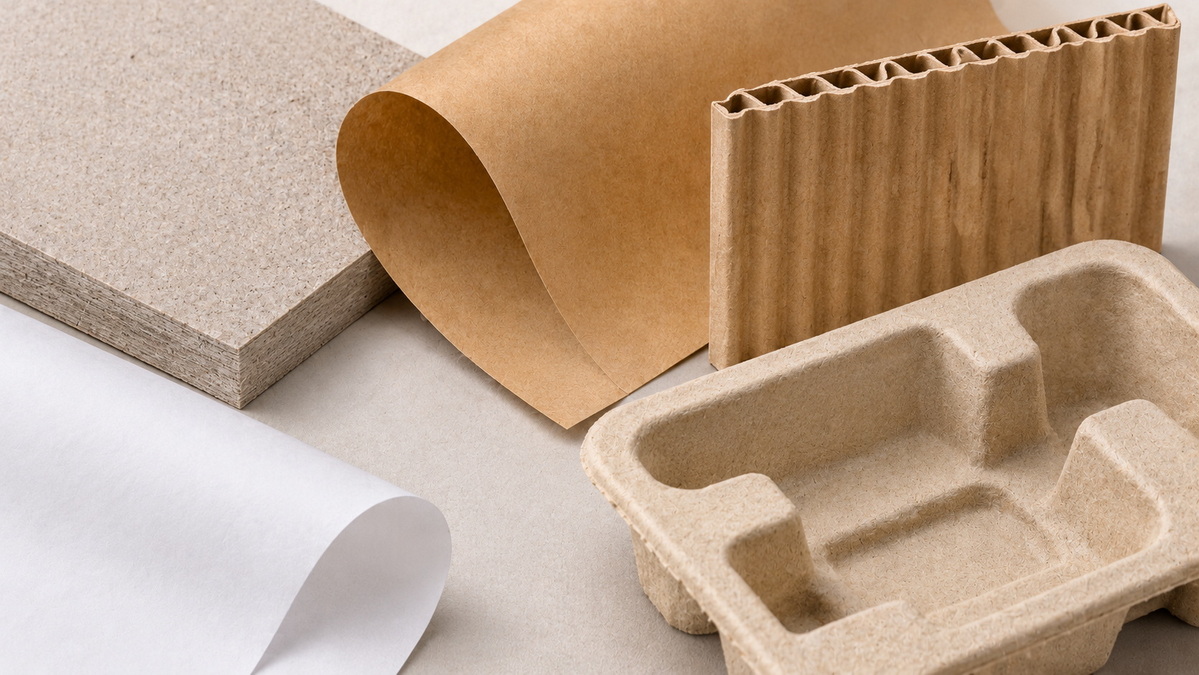
Use this table as an initial shortlist, not a guarantee of environmental performance.
| Material | Suitable applications | Main advantage | What to verify |
|---|---|---|---|
| Recycled paperboard | Rigid box cores, cartons, inserts | Uses recovered fiber | Recycled percentage, strength, surface quality |
| Kraft paper | Shopping bags, wrapping, box liners | Versatile paper-based construction | Fiber source, coating, finished-pack acceptance |
| Corrugated board | Mailer boxes, shipping boxes | Structural protection with customizable dimensions | Board grade, transit performance, empty space |
| Molded fiber | Protective inserts and product trays | Shaped cushioning without conventional foam | Fit, abrasion, moisture behavior, local acceptance |
| Certified virgin-fiber paper | Selected wraps, bags, structural applications | Documented sourcing when appropriately certified | Certification scope and authorized labeling |
Recycled paperboard is worth evaluating for the structural core of premium rigid boxes. The outer wrap can then provide the desired print quality and tactile finish.
However, specify the core and wrap separately. A recycled core does not make the whole box "100% recycled" if its covering paper or other components are not.
Request material declarations and representative samples. Assess stiffness, corner construction, wrapping quality, and resistance to handling rather than choosing by recycled percentage alone.
Kraft paper suits many custom paper shopping bags, protective wraps, and natural-looking packaging designs.
Its brown appearance, however, proves neither recycled content nor responsible sourcing. Those attributes require documentation.
For shopping bags, evaluate the complete construction: paper weight, handle attachment, bottom reinforcement, and any surface treatment. A visually attractive bag still needs to carry the intended product reliably.
Corrugated board is a practical starting point for e-commerce packaging because its structure can be tailored to different protection requirements.
Distinguish a presentation-led mailer box from an outer shipping carton. Some products need both; others can use one well-designed structure.
Specify internal dimensions, product weight, fragility, and distribution conditions before selecting the board grade. Reducing material without checking performance is not an improvement if damage increases.
Molded fiber, folded paperboard, and corrugated inserts are alternatives worth assessing when replacing conventional foam.
Their suitability depends on the product. A glass bottle, polished metal accessory, and delicate cosmetic compact have different cushioning and surface-protection needs.
Test movement, removal, abrasion, and transit behavior. For paper inserts, also check whether the construction uses unnecessary glue, mixed materials, or difficult-to-separate decorative layers.
Magnetic closure boxes offer a distinctive opening experience and may remain useful for storage. Nevertheless, possible reuse is not proof of a lower environmental impact.
Magnets, ribbons, foam inserts, and laminated wraps all deserve review.
For a magnetic box project, ask:
- Is the closure necessary for the product and positioning?
- Could a simpler closure meet the same functional need?
- Can non-paper components be separated safely and practically?
- Does the design offer a credible storage use after purchase?
Do not label a magnetic box fully recyclable simply because its largest component is paperboard.
Rigid boxes can be appropriate when presentation and structural support are important.
Start with the minimum structure that meets those requirements. Compare board thicknesses, eliminate oversized compartments, and examine whether one insert can replace several separate pieces.
For some products, a folding carton may provide sufficient protection. For others, reducing rigidity would compromise the pack. Make that decision through sampling, not appearance alone.
Folding gift boxes can reduce the space occupied by empty packaging before assembly.
The benefit depends on the actual collapsed dimensions, master-carton configuration, assembly requirements, and order size. Compare packed volume per usable box rather than relying on a generic shipping-saving percentage.
Also check whether folding mechanisms introduce additional adhesive, reinforcement, or assembly waste. Space efficiency is valuable, but it is only one part of the assessment.
A paper shopping bag should suit its intended load before decorative details are finalized.
Evaluate handles, reinforcement patches, seams, and base construction together. Consider paper handles where suitable, but confirm their performance with the actual product load.
If repeated use is part of the design brief, make the bag convenient to retain and carry. Avoid promising a fixed number of reuses without supporting tests.

A paper-based structure does not automatically produce a recyclable finished package.
Laminations, coatings, adhesives, metallic decoration, and integrated components can affect sorting and recycling. Their influence depends on formulation, quantity, application, and the receiving process.
"Water-based" describes an aspect of formulation; it does not independently prove recyclability or compostability.
Ask for evidence relevant to the finished construction and intended recycling route. A coating suitable for one packaging application may not support the same claim in another.
Apply the same discipline to soy-based or vegetable-based inks. These descriptions do not establish that every component in the printed box is environmentally preferable.
A premium appearance does not always require multiple finish layers.
Compare designs using:
- Carefully selected paper textures.
- Restrained ink coverage.
- Embossing or debossing where suitable.
- Smaller decorative areas.
- Fewer permanently bonded mixed-material components.
The objective is not to eliminate decoration indiscriminately. It is to understand what each finish contributes and whether a simpler design can achieve the same commercial purpose.
Record dimensions, weight, fragility, surface sensitivity, and storage conditions.
Identify whether the pack will travel through parcel networks, wholesale distribution, retail stores, or several channels. Protection requirements should guide the structure.
Measure the existing packaging before proposing improvements.
Record material weight, external dimensions, component count, packed volume, and observed damage rates. Without a baseline, claims such as "less packaging" are difficult to substantiate.
Ask suppliers to identify the board, wrap, insert, coating, adhesive, handles, closures, and accessories.
Request recycled-content documentation where relevant. For certified materials, confirm the applicable certificate, supply-chain requirements, and permission to use the intended label.
Check more than print quality.
Evaluate assembly, opening, product fit, stacking, handling, and the relevant distribution hazards. Select an appropriate test plan for the product and shipping route.
Check acceptance in the markets where customers receive the packaging.
A technically processable material may still lack an accessible collection route. Disposal instructions should reflect the complete package and any required component separation.
Review environmental wording alongside artwork approval.
Keep supporting documents linked to the actual material specification. If a coating, insert, or board changes, reassess whether the original claim remains valid.

The American Forest & Paper Association reported that, in the United States in 2024, 60%–64% of paper and 69%–74% of cardboard available for recovery were recycled.
These figures demonstrate substantial recovery activity. They do not establish that every individual paper package is accepted everywhere, and they should not be presented as global rates or guarantees for a custom box.
Certification also answers a specific question rather than every environmental question.
FSC Recycled identifies verified recycled forest-based material. FSC Mix can include certified, recycled, and controlled sources; it does not mean the product is entirely recycled.
Neither label independently establishes finished-pack recyclability, compostability, or a lower carbon footprint.
For U.S. marketing, the Federal Trade Commission's guidance calls for qualifying recyclable claims when suitable facilities are unavailable to at least 60% of consumers or communities where the product is sold. Other markets require their own assessment.
Better packaging begins with a clear brief, not a generic "green" material request.
For your next magnetic box, rigid box, folding gift box, mailer, shipping carton, or paper shopping bag, share:
- Product dimensions, weight, and protection needs.
- Destination markets and shipping method.
- Order quantity and budget.
- Presentation and printing requirements.
- Recycled-content or sourcing objectives.
- Any environmental claims you intend to make.
Corrugated board and paper-based inserts are useful starting points. The appropriate combination depends on fragility, shipping conditions, package dimensions, and local recovery options. Compare tested designs rather than selecting one material for every product.
Not automatically. Board, wrap, magnets, inserts, adhesives, and finishes must be considered together. Check local acceptance and provide component-removal instructions only where separation is safe and practical.
No universal ranking applies. Recycled content is valuable, but performance, sourcing, material quantity, and transport also matter. Choose the specification that meets the product's requirements with documented attributes.
Some constructions may be compatible with particular processes, while others create difficulties. Do not assume acceptance. Obtain relevant evidence for the finished package and verify the collection route in its destination market.
Do not assume so. Compostability and paper recyclability describe different processing routes. Follow instructions for the specific package and check whether the local composting or recycling operator accepts it.
Begin with accurate sizing and a fitted insert. Compare prototypes against the current design, checking material use alongside protection. Approve reductions only when the revised pack meets the required performance criteria.
1. PakFactory — "13 Environmentally Friendly Packaging Materials You Should Know."[pakfactory]
2. Federal Trade Commission — "Environmental Claims: Summary of the Green Guides."[ftc]
3. American Forest & Paper Association — "Paper Industry Announces 2024 U.S. Paper Recycling Rates," August 12, 2025.[afandpa]
4. Forest Stewardship Council UK — "FSC Labels."[uk.fsc]
5. 4evergreen Alliance — "Circularity by Design Guideline for Paper-Based Packaging," Version 4, February 2026.[4evergreenforum]


