
Views: 238 Author: Maituohong Packaging Publish Time: 2026-11-17 Origin: Site


Content Menu
● Start Your Soap Packaging Design with a Product Brief
● Choose Custom Soap Boxes Around the Sales Channel
>> Separate Retail Presentation from Shipping Protection
>> Match Gift Packaging to the Collection
● Select Paper Packaging Materials by Performance
>> Rigid Paperboard and Wrapped Gift Boxes
>> Kraft and Recycled Paper Options
● Assess Moisture, Oils, and Fragrance Before Production
>> Test the Complete Product and Package
>> Balance Exposure with Protection
● Create Soap Packaging Artwork Customers Can Navigate
● Check Soap Labeling Before Finalizing the Dieline
● Make Sustainable Soap Packaging Claims Specific
● Use a Practical Sampling and Approval Workflow
>> Step 1: Approve a Structural Sample
>> Step 2: Evaluate Product Compatibility
>> Step 3: Approve Printing and Finishing
>> Step 4: Validate the Shipping Configuration
● Compare Total Packaging Cost, Not Just Box Price
● Develop Custom Soap Packaging with Maituohong Packaging
● Frequently Asked Questions About Soap Packaging
>> 1. What Is the Best Packaging for Handmade Soap?
>> 2. Can Soap Be Packed Directly in a Paper Box?
>> 3. Are Magnetic Boxes Suitable for Soap Gift Sets?
>> 4. How Can a Brand Reduce Soap Packaging Costs?
>> 5. Is Kraft Soap Packaging Always Recyclable?
>> 6. What Information Should I Send for a Packaging Quote?
Good soap packaging design starts with the bar, not the artwork. Your packaging needs to protect the product, communicate its identity, and suit the way customers buy it. A handmade soap sold at a market requires a different solution from a luxury gift collection shipped internationally.
At Maituohong Packaging, our approach to custom soap packaging connects structure, presentation, and production practicality. Drawing on more than 18 years of experience in paper packaging design and manufacturing, we help brands consider the complete packaging system: the individual soap box, the gift presentation, and the shipping protection.
This guide explains how to choose suitable materials, compare box styles, prepare useful samples, and avoid expensive design mistakes.
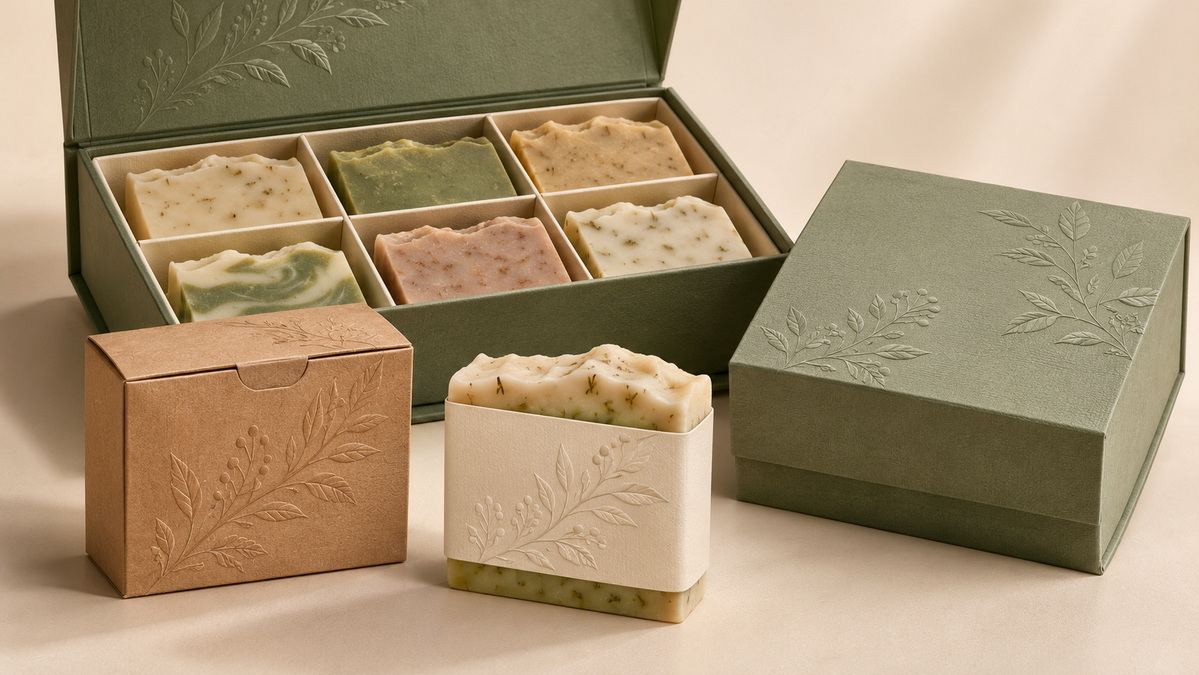
Before selecting colors or finishes, document what the packaging must accommodate.
Include:
- Soap dimensions and weight at the intended packing stage.
- Formula type and any existing wrapping requirements.
- Surface texture, decorative toppings, and vulnerable edges.
- Intended storage conditions and distribution destinations.
- Sales channel: retail, subscriptions, gifting, or online orders.
- Required label information and target packaging budget.
Measure several production bars rather than one perfect sample. Handmade products can vary, and a box designed around the smallest bar may create packing problems later.
My recommendation is to approve the product specification before approving the dieline—the flat technical drawing used to manufacture the box. Attractive artwork cannot compensate for an unsuitable fit.
Different packaging formats solve different problems. Compare them by function before comparing appearance.
| Packaging format | Suitable applications | Main advantage | Main limitation |
|---|---|---|---|
| Paper sleeve or band | Market stalls and simple retail displays | Leaves much of the bar visible | Limited coverage and handling protection |
| Folding carton | Individually boxed retail soap | Printable surfaces and compact storage | Not a substitute for shipping protection |
| Window carton | Decorative handmade soap | Shows the product before purchase | Opening or window material needs assessment |
| Rigid gift box | Premium collections and gift sets | Structured presentation | Greater storage and freight requirements |
| Magnetic closure box | Reusable gift presentations | Distinctive opening experience | Additional components complicate material choices |
| Corrugated mailer | Direct-to-consumer deliveries | Combines shipping structure with branding | Requires appropriate internal restraint |
A retail carton and a shipping box have different jobs.
The retail carton presents the soap and carries product information. The shipping box must accommodate handling, stacking, and movement during distribution.
For online orders, consider a coordinated system: individual soap cartons, fitted paperboard dividers, and an appropriately sized corrugated mailer.
Do not assume that a rigid gift box is ready to travel without an outer shipping carton.
For a multi-bar gift set, a rigid box or folding gift box can organize the assortment and create a coherent presentation.
Use inserts to separate bars and make removal easy. Avoid a layout that looks impressive in photographs but forces customers to damage the packaging to retrieve a product.
Paper shopping bags can complete an in-store gifting experience, but they should be treated as carry packaging rather than parcel protection.
"Premium paper" is not a complete material specification. Buyers need to understand the board, surface treatment, printing requirements, and intended product contact.
Paperboard cartons offer space for product names, ingredients where required, instructions, and brand storytelling.
When discussing board options, ask the manufacturer to evaluate:
- Stiffness at the proposed box dimensions.
- Crease quality and resistance to cracking.
- Print reproduction on the selected surface.
- Compatibility with coatings, adhesives, and finishes.
- Performance with the actual wrapped or unwrapped soap.
Board weight alone does not establish whether a carton will perform well.
Rigid boxes suit collections where presentation is part of the purchasing decision.
Their specification should cover the structural board, wrapping paper, insert, adhesive, and closure. These elements work together; selecting an attractive outer paper is only one part of the process.
For magnetic soap boxes, decide whether the closure adds enough customer value to justify the added components and assembly.
Kraft paper can support a restrained, natural-looking design. Recycled-content papers can support specific material sourcing objectives.
Neither appearance nor recycled content automatically proves that the finished package has a lower environmental impact.
Request material documentation and check whether your proposed claims describe the actual finished packaging.
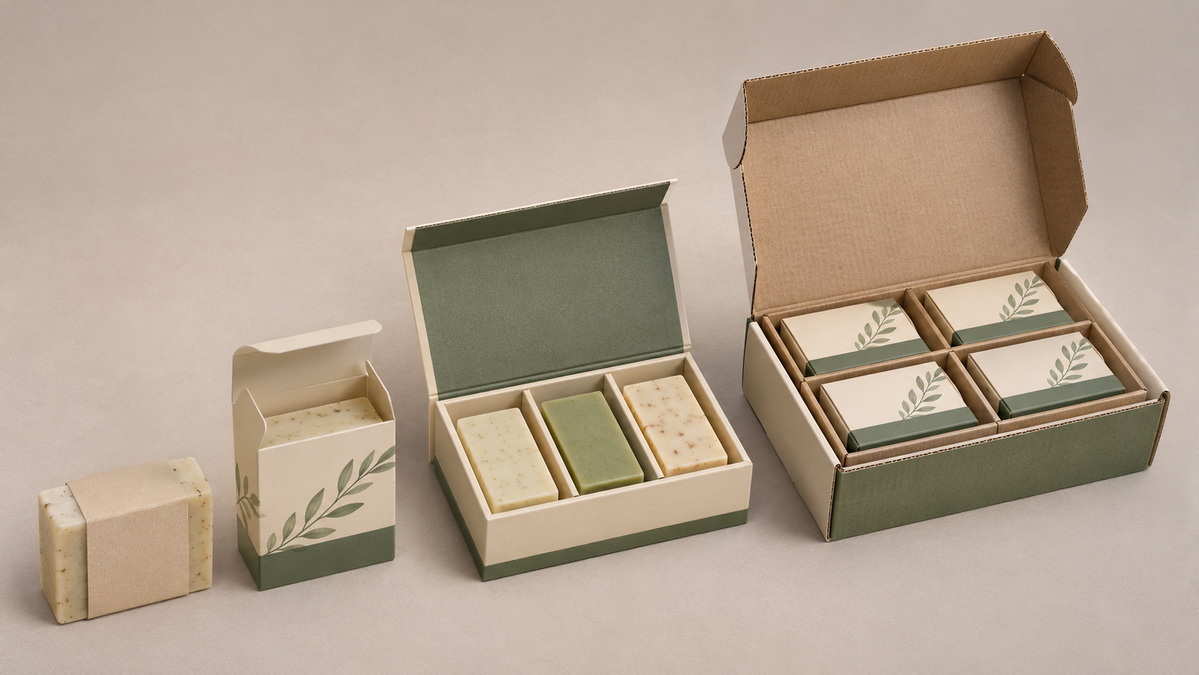
Soap packaging should be selected around the actual formulation and packing conditions. Avoid treating every handmade bar as the same product.
A paper carton provides structure and printing space. It should not automatically be treated as a moisture or fragrance barrier.
Use finished soap, the intended inner wrap if applicable, and production-representative packaging materials.
Check for:
- Visible staining or discoloration.
- Unwanted odor from inks, coatings, or adhesives.
- Changes to the soap surface.
- Fragrance transfer between different varieties.
- Label lifting or adhesive failure.
- Scuffing where the bar contacts the package.
Ask the soap maker to establish when the product is ready for packing. Packaging cannot replace the formulation's required preparation or curing process.
An open sleeve allows customers to see and smell the bar, but it leaves more of the product exposed.
An enclosed carton provides greater coverage, yet its suitability still depends on the soap, any inner wrapping, and storage conditions.
The useful question is not whether soap packaging should always be open or closed. It is which combination performs acceptably for your product and sales channel.
A clear information hierarchy helps shoppers distinguish the brand, the product, and the variant without searching through decorative elements.
Prioritize:
1. Brand name.
2. Product identity.
3. Scent or variant.
4. Relevant distinguishing information.
5. Required quantity declaration.
Keep secondary storytelling on another panel when space permits.
For a range of fragrances, retain a consistent layout while changing a controlled visual element, such as a color block or illustration. Confirm that variants remain distinguishable without relying on color alone.
Embossing, foil details, and textured papers can create contrast. They should support the design rather than compete with essential information.
Approve a physical sample when a finish affects readability or appearance. Small reversed text, subtle colors, and fine foil details may behave differently on paper than on screen.
Restraint is often more effective than combining every available finishing technique.
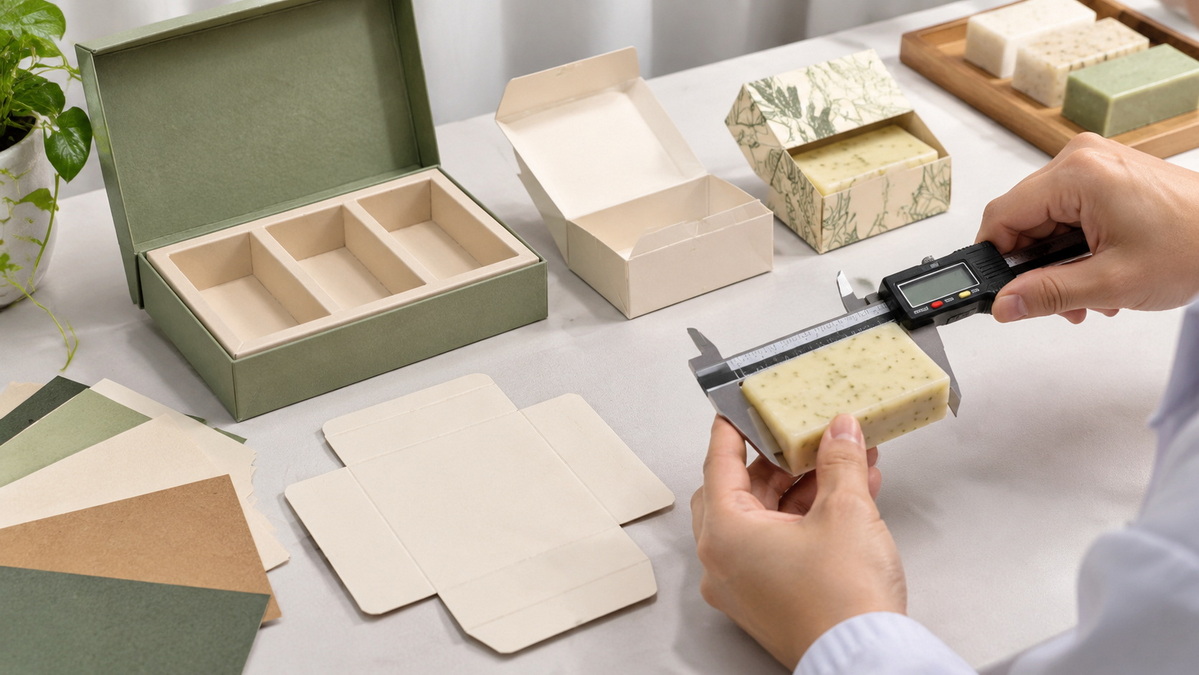
Label requirements depend on the destination market, formulation, and intended use.
In the United States, a product marketed as soap does not necessarily fall into the regulatory category of soap.
A qualifying traditional soap marketed solely for cleansing is regulated differently from a cosmetic cleanser. Claims about moisturizing or deodorizing can place a product within cosmetic regulation. Claims about treating acne or killing germs can trigger drug regulation.
This distinction matters before artwork approval because it can change the information and review the product requires.
For products regulated as cosmetics, plan appropriate space for applicable identity, net contents, business information, ingredient declarations, and warnings. Exact obligations and placement rules require product-specific review.
Have the responsible brand owner or qualified adviser approve the final labeling. A packaging manufacturer can help execute the layout but should not replace regulatory assessment.
Recycled content and recyclability describe different things.
The first concerns material sourcing. The second concerns whether the finished item can enter an appropriate collection and recycling system.
Avoid treating brown paper, a recycling symbol, or a paper-based structure as proof of universal recyclability.
Practical design questions include:
- Can unnecessary layers be removed?
- Does the box fit the product without excessive empty space?
- Can customers separate different components?
- Are inserts needed for protection or only appearance?
- Do coatings, windows, or closures affect local acceptance?
- Can the supplier document claimed recycled content?
Under the U.S. Federal Trade Commission's environmental marketing guidance, unqualified recyclable claims depend partly on appropriate facilities being available to at least 60 percent of consumers or communities where the item is sold. Other recyclability conditions also apply.
That percentage describes access to facilities, not the package's recycling rate. Check destination-market requirements before printing environmental claims.
A disciplined sampling process makes packaging decisions easier to verify.
Start with an unprinted sample. Check insertion, closure, product movement, and removal using representative bars.
For assortments, test every compartment rather than only the most convenient position.
Pack the real product and inspect it under conditions relevant to your distribution plan.
Agree on inspection intervals and acceptance criteria before testing. Record observations instead of relying on impressions such as "looks fine."
Review a production-representative sample for:
- Text accuracy and legibility.
- Color consistency.
- Barcode scanning where applicable.
- Crease cracking and surface scuffing.
- Foil, embossing, and adhesive placement.
Keep an approved reference sample for comparison during production.
Test the assembled delivery package, including soaps, inserts, retail boxes, and the outer carton.
Ask a qualified packaging laboratory to recommend a protocol appropriate to the delivery route and package type. A simple informal drop check should not be presented as proof of shipping performance.
Total packaging cost includes more than the quoted unit price.
Compare quotations using the same specification, then consider:
- Tooling and sample charges.
- Printing and finishing.
- Inserts and inner wrapping.
- Packing labor.
- Warehouse space.
- Freight volume.
- Replacements resulting from damage.
For example, a folding gift box may reduce storage demands compared with a similarly sized assembled rigid box, but assembly labor must also be evaluated.
Likewise, a smaller mailer may be attractive commercially only if the revised configuration still protects the product.
Request quotations at realistic order volumes. Ask suppliers to identify which specification changes meaningfully affect cost rather than requesting an undefined "cheaper version."
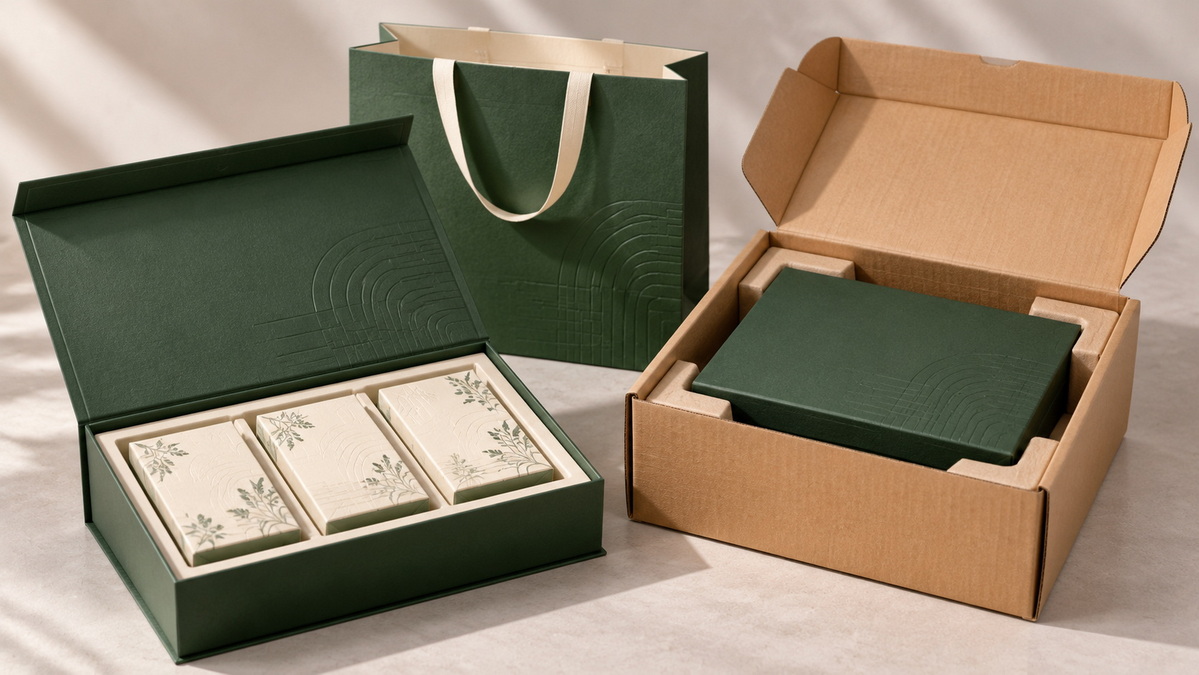
Successful soap packaging connects product compatibility, clear communication, reliable production, and suitable delivery protection.
Maituohong Packaging manufactures magnetic boxes, rigid boxes, folding gift boxes, mailer and shipping boxes, and paper shopping bags.
Send us your soap dimensions, assortment layout, target quantity, destination market, and preferred presentation. We can discuss a coordinated packaging specification and sampling plan before you commit to full production.
There is no universal best format. Sleeves suit visible retail presentation, cartons provide more coverage, and structured gift boxes organize collections. Select the format around the formula, handling conditions, and sales channel.
Potentially, but compatibility should be tested. Assess the actual soap against the intended paper, printing, coating, and adhesive system. Some products may need an appropriate inner wrap.
Yes, when the presentation justifies the additional components. Use fitted inserts and assess whether separate inner packaging is needed. Magnetic closure does not make the box moisture-resistant or shipping-ready.
Standardize suitable box sizes, simplify unnecessary finishes, compare realistic order quantities, and assess packing labor and freight. Avoid savings that create damaged products or difficult assembly.
No. Finished-package recyclability depends on construction, coatings, attached components, contamination, and available recycling systems. Assess the complete package rather than the paper's appearance.
Provide soap dimensions, product weight, quantity, box style, artwork requirements, inserts, delivery destination, and target launch date. Include real product samples when compatibility or fit needs verification.
1. [PakFactory — "The Guide to Soap Packaging Design"]. Original article reviewed for its coverage of materials, protective functions, branding, sleeves, cartons, cutout boxes, and wrapping options. Used as a starting point for an independently restructured guide. [pakfactory]
2. [U.S. Food and Drug Administration — "Frequently Asked Questions on Soap"]. Primary guidance explaining the regulatory definition of soap, the significance of formulation and intended use, and the distinction between soap, cosmetics, and drugs. [fda]
3. [U.S. Food and Drug Administration — "Cosmetics Labeling Guide"]. Detailed guidance supporting the discussion of cosmetic labeling, package terminology, and the need to establish the correct product classification before preparing artwork. [fda]
4. [U.S. Food and Drug Administration — "Summary of Cosmetics Labeling Requirements"]. Supports the discussion of identity, net contents, ingredient declarations, prominence, and other applicable cosmetic label information. [fda]
5. [Federal Trade Commission — "Environmental Claims: Summary of the Green Guides"]. Supports the distinction between recycled-content and recyclable claims, including the 60 percent access threshold and the need to qualify claims where appropriate. [ftc]
6. [Federal Trade Commission — "Guides for the Use of Environmental Marketing Claims"]. Detailed guidance on finished-package recyclability, collection and processing systems, and components that can limit recyclability. [ftc]


