
Views: 258 Author: Maituohong Packaging Publish Time: 2026-10-08 Origin: Site


Content Menu
● Drawer Boxes vs. Gift Boxes: Understanding the Comparison
● Differences Between Drawer Boxes and Gift Boxes at a Glance
● Construction and Materials: Where the Real Differences Begin
>> Drawer Box Construction Requires Controlled Sliding Fit
>> Conventional Gift Boxes Require Different Fit Checks
● Unboxing Experience and Customer Accessibility
>> Drawer Boxes Create a Staged Reveal
>> Gift Boxes Offer Immediate Visibility
● Product Protection: Compare the Complete System
>> Drawer Box Protection Considerations
>> Conventional Gift Box Protection Considerations
● Customization and Branding Opportunities
>> Branding on Custom Drawer Boxes
>> Branding on Rigid Gift Boxes
● Cost, Storage, and Packing Efficiency
>> Consider Total Cost, Not Just Unit Price
● Sustainability: Evaluate Components, Not Labels
● Expert Insight: A Practical Sample-Approval Workflow
>> Step 1: Define the Product and Customer Journey
>> Step 2: Compare Equivalent Prototypes
>> Step 3: Record Functional Performance
>> Step 4: Test Packing and Distribution
● Illustrative Applications: Which Format Fits the Brief?
>> A Multi-Product Skincare Set
● How to Choose Between Drawer Boxes and Gift Boxes
● Develop Your Custom Packaging with Maituohong Packaging
>> Are drawer boxes considered gift boxes?
>> Are drawer boxes more expensive than magnetic gift boxes?
>> Which box is better for fragile products?
>> Can rigid drawer boxes be recycled?
>> Can gift boxes be supplied flat?
>> What should buyers provide for an accurate quotation?
The differences between drawer boxes and gift boxes start with one important distinction: a drawer box describes an opening structure, while a gift box describes a packaging purpose. A drawer box can therefore also be a gift box. For buyers comparing custom rigid packaging, the practical choice is usually between sliding drawer boxes and conventional gift boxes with lift-off lids or hinged closures.
At Maituohong Packaging, our perspective comes from more than 18 years of experience in designing and producing high-quality rigid boxes and custom paper packaging. We approach this decision through product fit, presentation, manufacturing requirements, and delivery conditions—not appearance alone.
This guide compares both options and explains how to select packaging that supports your product, customers, and budget.
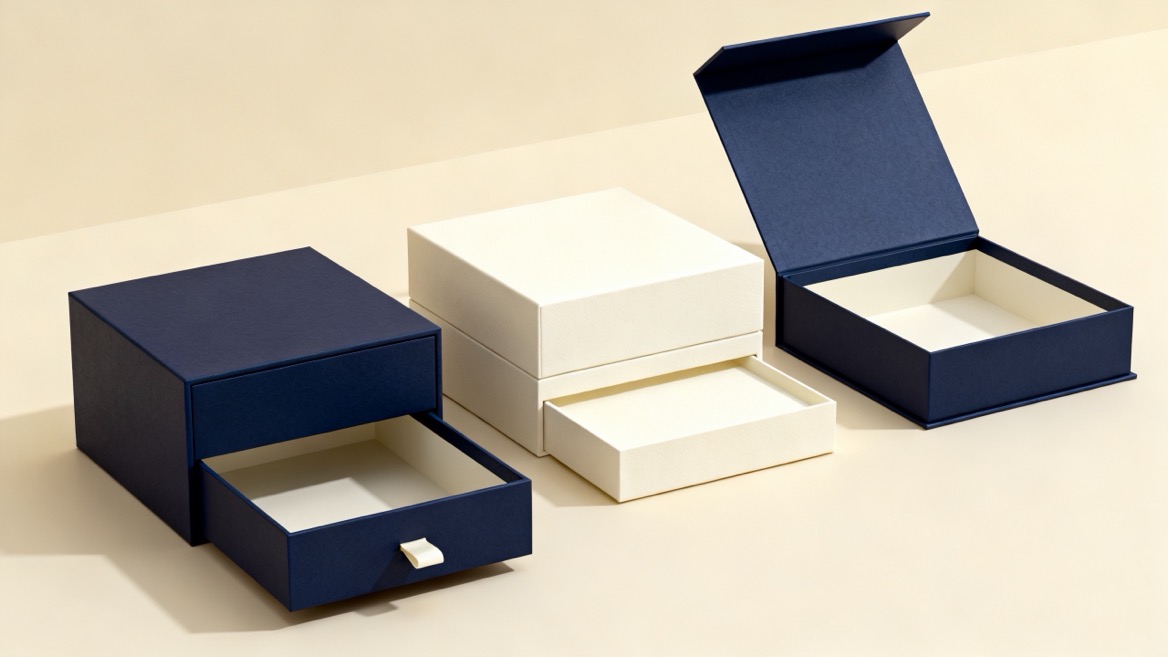
Drawer boxes combine an inner tray with an outer sleeve. The tray slides outward, revealing the product progressively. A ribbon pull, finger notch, or another opening feature can help customers access the contents.
Rigid drawer boxes typically use structural paperboard wrapped with decorative or printed paper. Their distinctive feature is the sliding mechanism, rather than a particular color, finish, or product application.
Gift boxes are containers designed to present products as gifts. The category includes drawer boxes, rigid lid-and-base boxes, hinged boxes, magnetic closure boxes, and folding paperboard cartons.
For a useful comparison, this article focuses on drawer boxes versus conventional rigid gift boxes: primarily lift-off lid-and-base designs and hinged magnetic designs.
The central distinction is structure: compare specific constructions, not "drawer" against "gift" as though they were mutually exclusive categories.
| Comparison point | Rigid drawer boxes | Conventional rigid gift boxes |
|---|---|---|
| Opening method | Tray slides from an outer sleeve | Lid lifts off or opens on a hinge |
| Product reveal | Progressive, directional reveal | Broad, immediate reveal |
| Essential fit | Tray-to-sleeve clearance | Lid-to-base fit or hinge alignment |
| Access space | Requires room in the sliding direction | Requires space above or behind the lid |
| Product arrangement | Suits products organized within a tray | Suits broad layouts and layered assortments |
| Common customization | Ribbon pulls, sleeve graphics, tray inserts | Lid graphics, inner-lid printing, magnetic closures |
| Main quality concern | Binding, looseness, or tray movement | Tight lids, loose lids, or closure misalignment |
| Shipping suitability | Depends on the complete packaging system | Depends on the complete packaging system |
| Relative cost | Specification-dependent | Specification-dependent |
Neither construction is automatically stronger, more luxurious, or more sustainable. Those outcomes depend on materials, dimensions, inserts, finishing, and execution.
A custom rigid drawer box has two interacting components. The tray must move smoothly inside the sleeve while remaining sufficiently controlled for handling.
This creates a practical manufacturing challenge. Structural board, wrapping paper, adhesive, folded edges, and the insert can all influence the final fit.
A tray that slides correctly before wrapping may behave differently after finishing. Likewise, an empty sample does not prove that the finished box will work correctly with a heavy product inside.
Our recommended approach is to approve the drawer mechanism using a production-representative sample containing the actual product.
A lid-and-base gift box depends on the relationship between the lid and base. An excessively tight lid can frustrate customers; a loose lid can reduce the sense of precision.
Hinged magnetic gift boxes introduce other variables:
- Hinge flexibility and alignment.
- Flap positioning.
- Closure alignment.
- Internal clearance around the product.
- Ease of opening without excessive force.
These are not necessarily simpler requirements. They are different requirements, and they should be evaluated separately.
Sliding drawer packaging reveals the product gradually. This can support a presentation built around one focal item, such as jewelry, a fragrance bottle, or a premium accessory.
The sleeve can introduce the brand, while the tray delivers the product reveal. Interior graphics or a printed message can extend that sequence.
However, the opening experience should remain intuitive. Customers should not have to guess which end opens or pull hard enough to risk dropping the contents.
Lift-off and hinged gift boxes expose a broader product arrangement at once. This can be useful for coordinated gift sets, where several items need to be understood together.
A hinged lid also provides an interior surface for instructions, product information, or a welcome message.
Accessibility deserves attention in both formats. Test whether customers can grip the opening feature, remove the product, and close the box comfortably. A premium experience should feel deliberate, not difficult.
Rigid packaging can provide shape and support, but box style alone does not establish protective performance.
The important questions are:
1. Does the insert prevent excessive product movement?
2. Does the product contact vulnerable edges or surfaces?
3. Can the closure remain controlled during handling?
4. Is there sufficient cushioning where required?
5. Does the outer shipping carton protect the presentation box?
The sleeve surrounds the tray, but the opening direction creates a potential movement path. Depending on the design and distribution conditions, the drawer may require additional restraint.
Possible solutions include an appropriate shipping arrangement, a removable band, or another closure feature validated through testing.
A lift-off lid may separate during handling unless the shipping system keeps it contained. A magnetic closure should not automatically be treated as a transport lock.
For parcel shipments, evaluate the actual product, insert, presentation box, and shipping carton together. ISTA Procedure 3A covers individual packaged products prepared for parcel delivery weighing 150 lb (70 kg) or less. The appropriate test should be selected for the intended distribution environment.
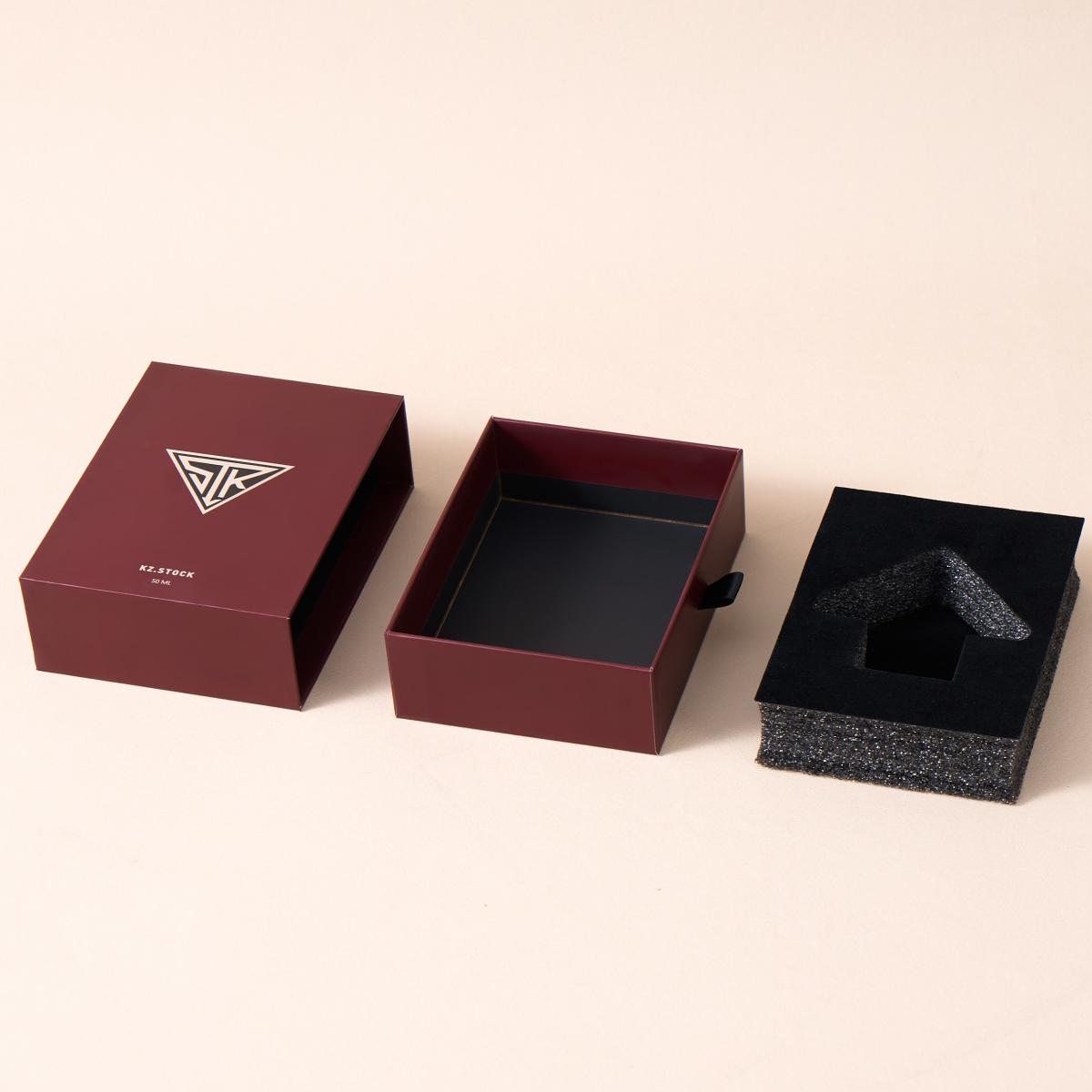
Both drawer boxes and conventional gift boxes support substantial visual customization.
Options can include:
- Printed wrapping papers.
- Textured papers.
- Foil stamping.
- Embossing or debossing.
- Interior printing.
- Product-specific inserts.
- Coordinated colors and graphic layouts.
The difference lies in where customers encounter the branding.
The sleeve often becomes the first visual surface. The tray then provides a second communication opportunity.
Plan graphics around the opening direction. Positioning a message where customers grip the box can make it difficult to read, while placing critical information on a concealed surface can reduce its usefulness.
A conventional gift box offers a prominent lid surface. Hinged designs also provide space inside the lid.
For multi-item sets, packaging graphics should explain the arrangement without competing with the products. A clear hierarchy is often more effective than decorating every available surface.
There is no reliable universal rule that drawer boxes cost more than gift boxes.
A plain drawer box may cost less than a magnetic gift box with specialty paper and a complex insert. Conversely, a tightly engineered drawer design may cost more than a simple lid-and-base box.
Compare quotations using equivalent specifications:
- Internal dimensions.
- Structural board.
- Wrapping paper.
- Printing and finishing.
- Insert construction.
- Accessories.
- Order quantity.
- Packing and delivery requirements.
The purchasing decision should include:
Total packaging cost=box cost+insert cost+packing labor+freight and storage+damage-related cost
This is a decision framework, not a standardized accounting formula.
Assembled rigid boxes occupy storage space. Some gift box constructions are designed to collapse, but not every magnetic box is collapsible. Verify the supplied configuration rather than assuming it.
Packing efficiency also varies. Time the actual process: loading the insert, placing products, closing the box, and preparing it for shipment.
"Paper-based" does not automatically mean that the finished package is readily recyclable everywhere.
Recyclability can be affected by coatings, adhesives, plastic components, metallic elements, and local collection systems. AF&PA's design guidance specifically addresses how non-fiber elements influence paper packaging recycling.
For either box format, consider:
- Right-sizing the package.
- Reducing unnecessary material layers.
- Choosing suitable paper-based inserts.
- Making non-paper accessories removable where practical.
- Reviewing coatings and finishes.
- Providing disposal instructions appropriate to the destination market.
Responsible sourcing is a separate consideration. FSC chain-of-custody certification concerns the sourcing and traceability of forest-based materials; it does not independently establish that every finished packaging combination is recyclable.
Do not claim that drawer boxes or gift boxes are inherently more sustainable without comparing their actual specifications.
The most useful comparison happens before mass production, with representative samples.
Provide the product's dimensions, weight, orientation, fragile areas, and intended presentation.
Explain whether customers will receive it through parcel delivery, retail purchase, or an in-person gifting event.
Use the same product and comparable material specifications in both designs.
Otherwise, differences in insert quality or board construction can distort the comparison.
Evaluate:
- Opening and closing behavior.
- Product movement.
- Insert retention.
- Surface rubbing.
- Corner appearance.
- Product removal.
- Closure alignment.
Repeat opening cycles to identify obvious wear or fit changes. Agree on an internal cycle target, but do not describe it as an industry standard unless an applicable standard exists.
Time assembly with the people who will perform it.
Then assess the complete shipping configuration through a test appropriate to the delivery route. Keep a record of the approved materials and construction.
The following examples are design scenarios, not reported customer case studies.
A drawer box can support a focused reveal, especially when the insert holds the item securely.
A lid-and-base box may be preferable when straightforward access is the priority. Compare how easily customers remove the item without disturbing its presentation.
A hinged gift box can reveal the entire assortment together and provide space for usage information inside the lid.
A drawer box can also work, but the combined weight and insert arrangement must not interfere with smooth movement.
For a notebook, accessory, and message card, a broad lid-and-base or hinged layout may simplify presentation.
If choosing a drawer format, check the opening space required on a desk and ensure that smaller items remain secured when the tray moves.
Choose a drawer box when your brief prioritizes:
- A progressive product reveal.
- A clearly organized tray.
- Sleeve-led branding.
- A sliding interaction that has been validated with the product.
Choose a conventional rigid gift box when your brief prioritizes:
- Immediate visibility.
- A broad multi-product layout.
- Interior-lid communication.
- Lift-off or hinged access.
For custom rigid packaging, the better option is the construction that meets the brief with fewer compromises—not the one with the most elaborate opening mechanism.
Send Maituohong Packaging your product dimensions, weight, target quantity, preferred finishes, and delivery requirements.
With more than 18 years of experience in rigid boxes and custom paper packaging, we can help develop a practical comparison between drawer and conventional gift box constructions. Begin with a clear brief and approve the product-loaded sample before committing to production.
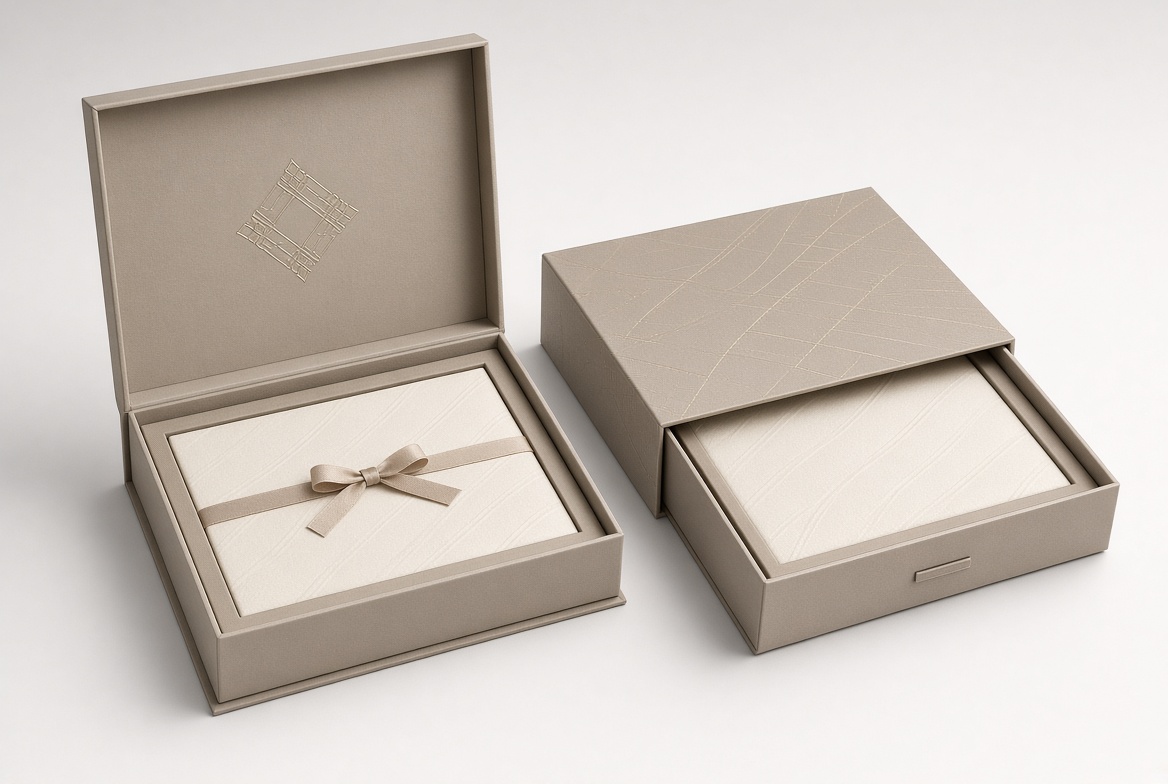
Yes. Drawer boxes describe a structural format, while gift boxes describe an intended use. A rigid drawer box designed for gifting belongs to both categories.
Not necessarily. Dimensions, materials, finishing, inserts, accessories, and quantity determine the comparison. Request quotations based on equivalent specifications.
Neither is automatically better. Product restraint, cushioning, closure behavior, and the outer shipping carton matter more than the opening style alone.
Potentially, but recyclability depends on the finished material combination and local acceptance. Review coatings, inserts, and non-paper accessories before making claims.
Some collapsible gift box constructions can be supplied flat. Conventional assembled rigid boxes generally retain their shape. Confirm the exact construction with the manufacturer.
Provide product dimensions and weight, quantity, preferred structure, artwork requirements, finishes, insert needs, delivery destination, and intended shipping method.
With more than 18 years of experience in rigid boxes and custom paper packaging, we can help develop a practical comparison between drawer and conventional gift box constructions. Begin with a clear brief and approve the product-loaded sample before committing to production.
The company name, specialization, and experience statement were supplied in the project brief. The workflow, selection framework, and illustrative applications are editorial recommendations rather than measured customer outcomes.
- [iPackU — Custom Rigid Drawer Boxes]. Commercial reference for sleeve-and-tray construction, wrapped chipboard, and insert options. [ipacku]
- [PakFactory — Custom Magnetic Boxes]. Commercial reference for rigid magnetic gift boxes, materials, surface finishes, and closure options. [pakfactory]
- [International Safe Transit Association — Test Procedures]. Official reference for Procedure 3A's parcel-delivery application and 150 lb (70 kg) scope. [ista]
- [International Safe Transit Association — Procedure 3A Overview]. Official overview of packaged-product testing and intended distribution conditions. [ista]
- [American Forest & Paper Association — Design Guidance for Recyclability]. Reference for the effects of non-fiber elements on paper packaging recyclability. [afandpa]
- [American Forest & Paper Association — What Types of Paper Can Be Recycled?]. Consumer guidance explaining material limitations and variation in local recycling rules. [afandpa]
- [Forest Stewardship Council — Paper & Packaging]. Official reference for responsible sourcing and chain-of-custody certification. [fsc]


