
Views: 247 Author: Maituohong Packaging Publish Time: 2026-10-23 Origin: Site


Content Menu
>> How Do Flat Packed Magnetic Boxes Work?
● What Are Pre-Assembled Boxes?
● Flat Packed Boxes vs. Pre-Assembled Boxes: Comparison Table
● 1. Storage Space and Inbound Freight
>> Compare Master-Carton Data, Not Product Photos
>> Separate Inbound Savings from Outbound Shipping
● 2. Assembly Labor and Packing Speed
>> Run a Complete Packing Trial
● 3. Strength and Product Protection
● 4. Appearance and Customer Experience
● 5. Total Cost: Look Beyond the Unit Price
>> A Hypothetical Break-Even Example
● 6. Sustainability and End-of-Life Considerations
>> Evaluate Materials Separately from Delivery Format
● How to Choose the Right Format for Your Business
>> Choose Flat Packed Boxes When:
>> Choose Pre-Assembled Boxes When:
● A Practical Sample-Approval Checklist
● Plan Your Custom Packaging with Maituohong Packaging
>> Are Flat Packed Boxes Always Cheaper?
>> Can Flat Packed Boxes Look Luxurious?
>> Do Pre-Assembled Gift Boxes Need Shipping Cartons?
>> Are Magnetic Boxes Always Pre-Assembled?
>> Will Flat Packing Reduce Customer Delivery Charges?
>> What Should I Request Before Ordering?
The main differences between flat packed boxes and pre-assembled boxes are their delivery format, storage requirements, assembly work, and total packaging cost. Flat packed boxes arrive collapsed and need forming before use. Pre-assembled boxes arrive in their finished three-dimensional shape, reducing setup work at the packing station.
For packaging buyers, however, the choice goes beyond convenience. It affects inbound freight, warehouse capacity, fulfillment speed, product protection, and presentation.
At Maituohong Packaging, our approach draws on more than 18 years of experience designing and manufacturing custom paper packaging. We recommend comparing the complete packaging workflow—not simply the price of an empty box.
This guide explains where each format works best and how to make a practical purchasing decision.
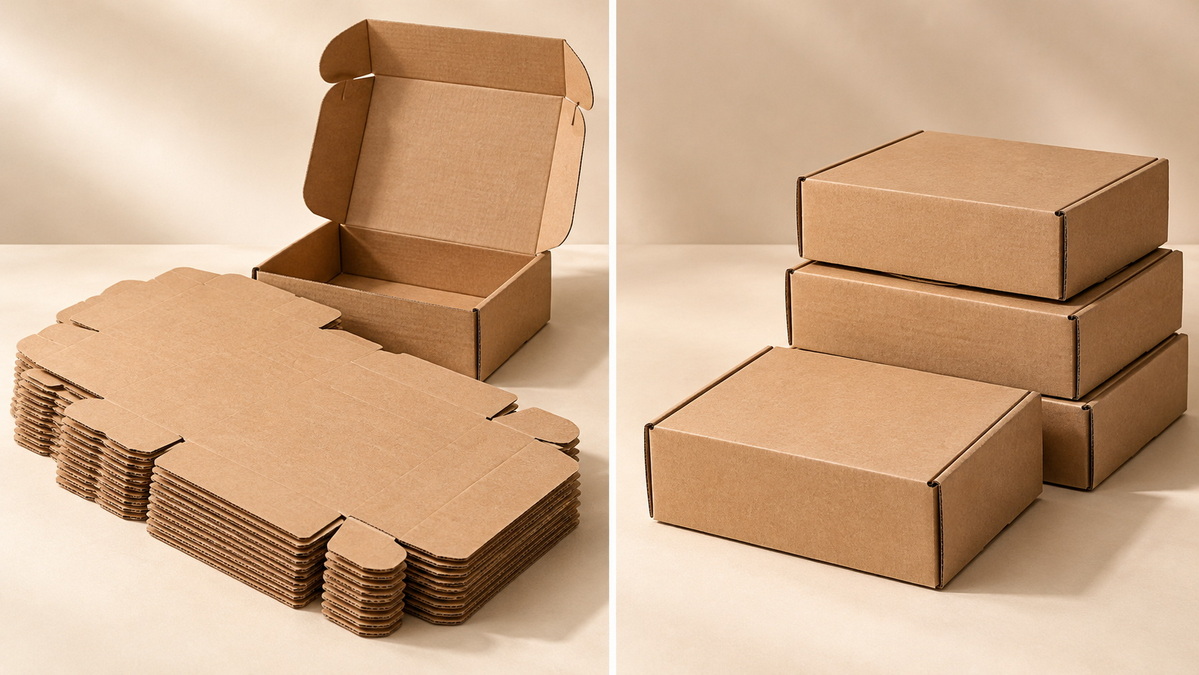
Flat packed boxes are supplied in a collapsed or flattened condition and erected when needed. Depending on their construction, assembly may involve folding panels, engaging locking tabs, applying tape, or securing adhesive corners.
Common examples include:
- Corrugated mailer boxes with interlocking panels.
- Regular slotted shipping boxes requiring tape.
- Folding cartons with tuck-end or glued closures.
- Collapsible rigid gift boxes with reinforced panels.
An important distinction: "flat packed" describes the delivery format, not the material quality.
A folding paperboard carton and a collapsible magnetic gift box can both arrive flat, although their construction, appearance, and intended applications differ considerably.
Collapsible magnetic boxes typically combine rigid board panels with flexible folding areas. During assembly, the side panels rise into position and are secured by the specified corner-locking or adhesive system.
The magnetic closure holds the lid shut; it does not necessarily secure the box's structural corners.
This format can combine compact delivery with a premium presentation, provided the hinges, corners, wrapping, and closure alignment are well engineered.
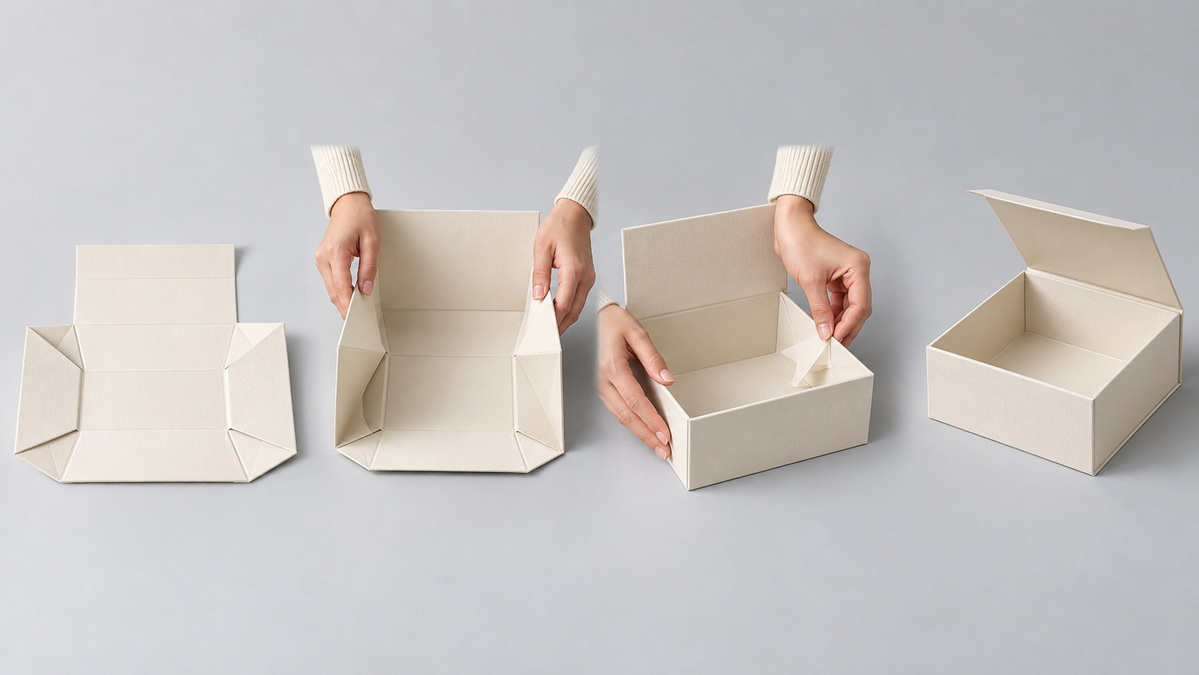
Pre-assembled boxes arrive already formed. Buyers generally need only to place products inside, add protective components, and close the packaging.
Examples include conventional rigid lid-and-base boxes, assembled shoulder boxes, and permanently formed magnetic gift boxes.
"Pre-assembled" does not mean completely packed or ready for dispatch. Inserts, tissue, product placement, sealing, and an external shipping carton may still be required.
It also does not automatically mean "rigid." An assembled corrugated box remains corrugated packaging. Buyers should specify construction and delivery format separately.
| Comparison factor | Flat packed boxes | Pre-assembled boxes |
|---|---|---|
| Delivery condition | Collapsed or flattened | Already formed |
| Storage before use | Usually occupies less space | Usually occupies more space |
| Setup at fulfillment | Requires erection | Minimal box-forming work |
| Inbound freight | Often more space-efficient | Often carries more empty volume |
| Structural performance | Depends on board, joints, and assembly | Depends on board and construction |
| Premium appearance | Possible with suitable design | Well suited to permanently formed styles |
| Packing consistency | Influenced by operator technique | Less dependent on onsite erection |
| Best-fit applications | Space-constrained storage and distributed fulfillment | Presentation-led packaging and fast manual packing |
These are directional comparisons. Actual performance depends on the specific design, master-carton configuration, product, and packing process.
Flat packed boxes usually have their clearest advantage before products are packed.
Collapsing the structure reduces the volume occupied by empty packaging. This can improve storage density and reduce the number of inbound cartons required.
Pre-assembled boxes retain their full shape during transport and storage. Unless the design permits safe nesting, buyers are effectively moving and storing the empty space inside each box.
However, do not accept a universal claim such as "flat packing saves 80%." Savings vary with box depth, folded thickness, protective wrapping, and carton layout.
Ask the manufacturer for:
- External master-carton dimensions.
- Boxes per master carton.
- Gross carton weight.
- Total cartons for the order.
- Pallet configuration, where applicable.
Calculate inbound volume per box by dividing the master carton's external volume by its box quantity.
For example, a carton occupying 0.12 cubic meters and holding 100 flat boxes allocates 0.0012 cubic meters per box. A 0.10-cubic-meter carton containing 20 assembled boxes allocates 0.005 cubic meters per box.
These hypothetical figures illustrate the method, not a promised saving.
A box arriving flat does not automatically reduce delivery charges to the final customer.
Once erected and filled, the finished parcel may have exactly the same dimensions as its pre-assembled alternative. Parcel carriers can charge according to dimensional weight or actual weight, whichever is greater.
Flat delivery primarily addresses empty-packaging logistics. Outbound savings require improvements to the finished shipping package.
Flat packed packaging transfers some box-forming work to the buyer's operation.
A straightforward corrugated shipper may fit an established manual or automated process. A collapsible gift box may require operators to square the walls, secure corners, and check alignment.
Pre-assembled boxes remove much of this erection work. That can help businesses with limited packing staff or short promotional deadlines.
Nevertheless, faster setup does not guarantee faster overall fulfillment. Difficult inserts, tissue wrapping, or awkward product placement can dominate the packing cycle.
Compare both options using the same product and operators.
Measure:
1. Removing packaging from its storage carton.
2. Erecting or inspecting the box.
3. Installing the insert.
4. Loading the product.
5. Closing and preparing the shipment.
Repeat the trial after operators become familiar with each design. Record rejected boxes and rework as well as speed.
This produces a more useful comparison than timing one perfectly assembled sample.
Pre-assembled boxes are not automatically stronger, and flat packed boxes are not automatically weaker.
Protection depends on the complete system:
- Board type, thickness, and specification.
- Box dimensions and unsupported spans.
- Corner and joint design.
- Product weight and fit.
- Insert performance.
- Moisture exposure.
- Outer shipping protection.
For corrugated shipping boxes, board selection and stacking requirements deserve particular attention. For rigid gift boxes, corner integrity, panel stiffness, and insert support are central considerations.
An attractive empty box is not evidence of transport performance.
Evaluate the actual product, insert, presentation box, and shipping carton together. Where relevant, select an appropriate distribution-testing procedure with a qualified laboratory.
ISTA Procedure 3A, for example, addresses individual packaged products weighing 150 pounds or less moving through parcel delivery systems.
The appropriate test depends on the distribution route. A retail presentation box should not be treated as a validated shipping container simply because it feels sturdy.
Both formats can support custom printing, textured papers, embossing, foil decoration, and carefully fitted inserts, subject to the chosen construction.
The more useful question is which structure delivers the intended presentation consistently.
A permanently formed rigid box may suit a design requiring uninterrupted corners or a particular lid-and-base relationship. A collapsible magnetic box may suit a premium gift program where storage efficiency also matters.
Review these details on physical samples:
- Corner gaps and squareness.
- Visible folds and hinge lines.
- Lid alignment.
- Magnetic closure engagement.
- Insert fit.
- Surface scuffing after handling.
For collapsible boxes, inspect the assembled result—not only the flattened sample. For pre-assembled boxes, inspect units after realistic transport and storage.
The most useful purchasing metric is total cost, not the quoted box price alone.
A practical comparison includes:
> Box purchase cost + inbound freight + storage + assembly labor + additional consumables + expected damage and rework.
Avoid assuming that either format is always cheaper. Order quantity, decoration, board specification, packing method, and delivery route can change the result.
Suppose an assembled box costs $0.45 more per unit after combining purchase price, inbound freight, and allocated storage.
Suppose the flat alternative adds 20 seconds of assembly labor at a fully loaded labor rate of $24 per hour.
That labor costs approximately $0.13 per box. The flat option retains approximately $0.32 per unit before accounting for consumables, rework, or damage.
These are illustrative assumptions, not Maituohong quotations or industry averages.
The lesson is simple: measure the labor penalty and compare it with verified savings elsewhere.
Neither delivery format is automatically more sustainable.
Flat packing may reduce empty transport volume, but environmental performance also depends on material quantity, sourcing, product damage, reuse, and the recycling system available to the customer.
A lightweight design that fails and causes product replacement may undermine its intended benefits.
Likewise, a reusable gift box should not be presented as environmentally superior without considering whether customers actually reuse it.
Ask about:
- Paper and board sourcing.
- Recycled content and its verification.
- Coatings, laminates, adhesives, and attachments.
- Whether non-paper components can be separated.
- Recycling guidance for the destination market.
FSC certification concerns responsible forest-based sourcing and chain-of-custody requirements. It should not be treated as proof that a finished package is recyclable everywhere.
For magnetic boxes, review the complete material combination rather than relying on a generic "paper packaging" claim.
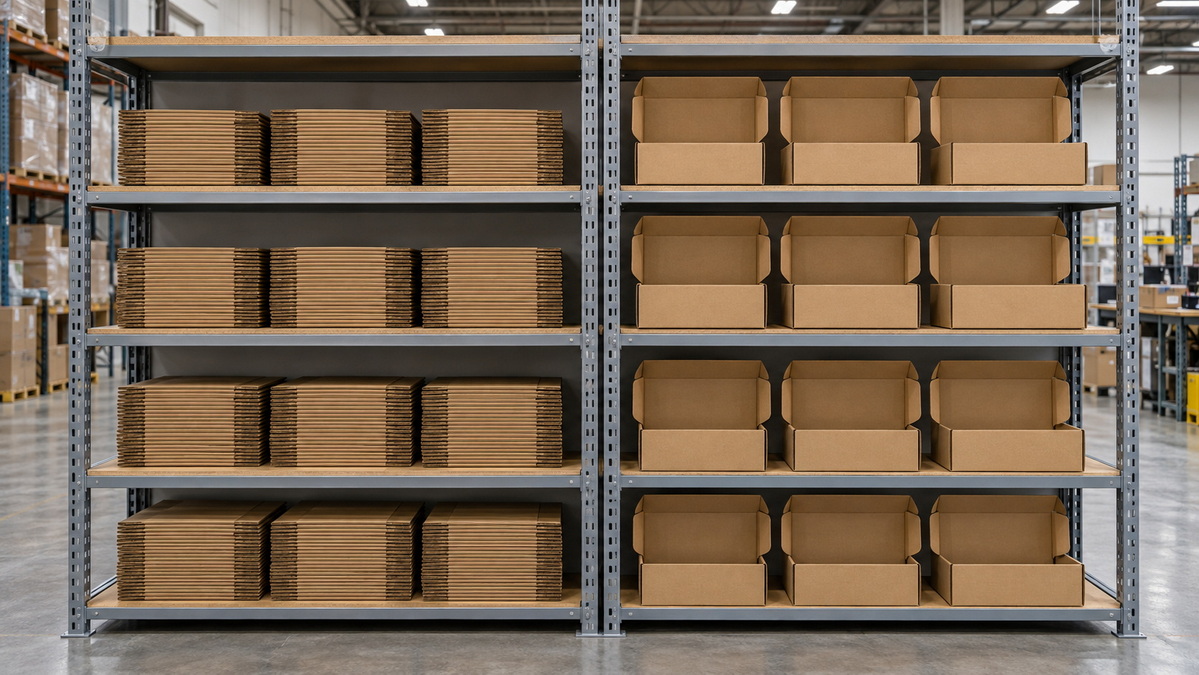
- Empty-packaging storage is restricted.
- Inbound freight volume is a significant expense.
- Staff or equipment can handle assembly efficiently.
- Packaging is supplied to multiple fulfillment locations.
- A collapsible structure meets the presentation requirements.
- Eliminating onsite erection is operationally valuable.
- Available labor is limited or expensive.
- The desired construction requires permanent assembly.
- Packing consistency matters more than storage density.
- The business can accommodate the inbound volume.
A mixed strategy may also work. For example, one brand might use pre-assembled presentation boxes for flagship retail sets and flat packed mailers for routine online orders.
The decision should follow each product's distribution route, not a company-wide assumption.
Before approving production, compare equivalent specifications. Otherwise, apparent differences may come from materials rather than delivery format.
Use this checklist:
1. Confirm internal dimensions against the actual product.
2. Agree on board, wrapping, printing, and finishing specifications.
3. Inspect the assembled appearance and closure.
4. Test insert installation and product removal.
5. Measure complete packing time.
6. Verify master-carton dimensions and quantities.
7. Assess transport performance using the intended packaging system.
8. Document acceptable defects and an approved reference sample.
Keep cost assumptions separate from verified measurements. This makes supplier comparisons clearer and reduces misunderstandings after production.

Maituohong Packaging manufactures custom magnetic boxes, mailer and shipping boxes, rigid boxes, folding gift boxes, and paper shopping bags.
Our recommendation is to start with your product and packing process—not a preferred box format.
Send us your product dimensions, weight, order quantity, destination, presentation requirements, and available assembly resources. Request a comparison of suitable flat packed and pre-assembled designs, including structural samples and master-carton packing details.
That gives your team a practical basis for balancing appearance, protection, storage, and fulfillment cost.
No. They can reduce empty-packaging freight and storage, but assembly labor, consumables, and rework may offset those savings. Compare the complete cost per usable packed unit.
Yes. Collapsible rigid gift boxes can provide a premium presentation. Evaluate corner alignment, wrapping quality, closure performance, and the assembled sample before approval.
Often, yes. A decorative gift box may require an outer corrugated carton and protective components. Determine this through the product's distribution requirements and package testing.
No. Magnetic boxes can be permanently formed or collapsible. Specify the delivery condition and corner-securing method when requesting a quotation.
Not necessarily. If the final packed parcel has unchanged dimensions and weight, flat delivery of the empty box may provide no outbound shipping benefit.
Request structural samples, material specifications, artwork requirements, assembly instructions where applicable, master-carton details, and a clearly defined quality standard.
1. European Federation of Corrugated Board Manufacturers. "FEFCO Code." Official overview of the internationally used system for identifying corrugated packaging designs. This classification applies to corrugated construction and should not be confused with terminology for luxury wrapped rigid boxes. [fefco]
2. FedEx. "What Is Dimensional Weight?" Explanation of package-volume-based pricing and the relationship between dimensional weight and actual weight. [fedex]
3. International Safe Transit Association. "Test Procedures." Official description of distribution-testing categories, including Procedure 3A for parcel delivery system shipments of 150 pounds or less. [ista]
4. International Safe Transit Association. "Procedure 3A Overview." Scope and purpose of testing individual packaged products against parcel-distribution stresses. [ista]
5. Forest Stewardship Council, United States. "Paper, Print & Packaging." Background on responsible sourcing of paper-based packaging materials. [us.fsc]
6. 4evergreen. "About." Overview of the initiative's work on fiber-based packaging recyclability assessment and compatibility with recycling systems. [4evergreenforum]


