
Views: 211 Author: Maituohong Packaging Publish Time: 2026-10-13 Origin: Site


Content Menu
● Paper Liquor Bags vs. Rigid Boxes: Quick Comparison
>> Materials and Structural Features
● What Are Rigid Boxes for Liquor Packaging?
● Bottle Protection: Carrying Strength Is Not Shock Protection
>> Paper Liquor Bag Protection
>> When the Bottle Will Be Shipped
● Branding and Customer Experience
>> Paper Bags Extend Branding Beyond the Store
>> Rigid Boxes Create a Controlled Reveal
● Cost Comparison: Look Beyond Unit Price
>> What Drives Paper Liquor Bag Costs?
>> What Drives Rigid Box Costs?
● A Better Buying Metric: Total Cost per Successful Delivery
● Environmental Comparison: Assess the Finished Package
>> Separate Fiber Sourcing from Recyclability
>> Be Careful with Broad Recycling Statistics
● Three Practical Packaging Scenarios
>> Scenario 1: A Liquor Store Selling Individual Bottles
>> Scenario 2: A Corporate Spirits Gift
>> Scenario 3: An Online Premium Spirits Order
● How to Specify Custom Liquor Packaging
>> Step 1: Document the Bottle
>> Step 2: Define the Distribution Journey
>> Step 3: Set Presentation and Material Requirements
>> Step 4: Approve a Physical Sample
>> Step 5: Confirm Production Acceptance Criteria
● Choosing Packaging with Maituohong Packaging
>> Are paper liquor bags strong enough for heavy spirits bottles?
>> Do rigid boxes protect liquor bottles during shipping?
>> Are paper liquor bags cheaper than rigid boxes?
>> Can a rigid liquor box fold flat?
>> Which option is better for premium liquor gifts?
>> Can both formats be recyclable?
Paper liquor bags and rigid boxes serve different purposes in spirits packaging. Paper liquor bags prioritize convenient carrying, compact storage, and economical retail presentation. Rigid boxes provide a structured enclosure, more options for bottle positioning, and a more elaborate gifting experience. The right choice depends on how the bottle will be sold, handled, presented, and delivered—not simply which package looks more expensive.
At Maituohong Packaging, our approach to custom paper packaging starts with fit: the fit between the bottle, the packaging structure, and the customer's buying experience. With more than 18 years of experience in high-quality rigid gift boxes and paper packaging solutions, we recommend evaluating both formats against the same practical requirements.
This guide compares their construction, protection, customization, costs, environmental considerations, and purchasing specifications.
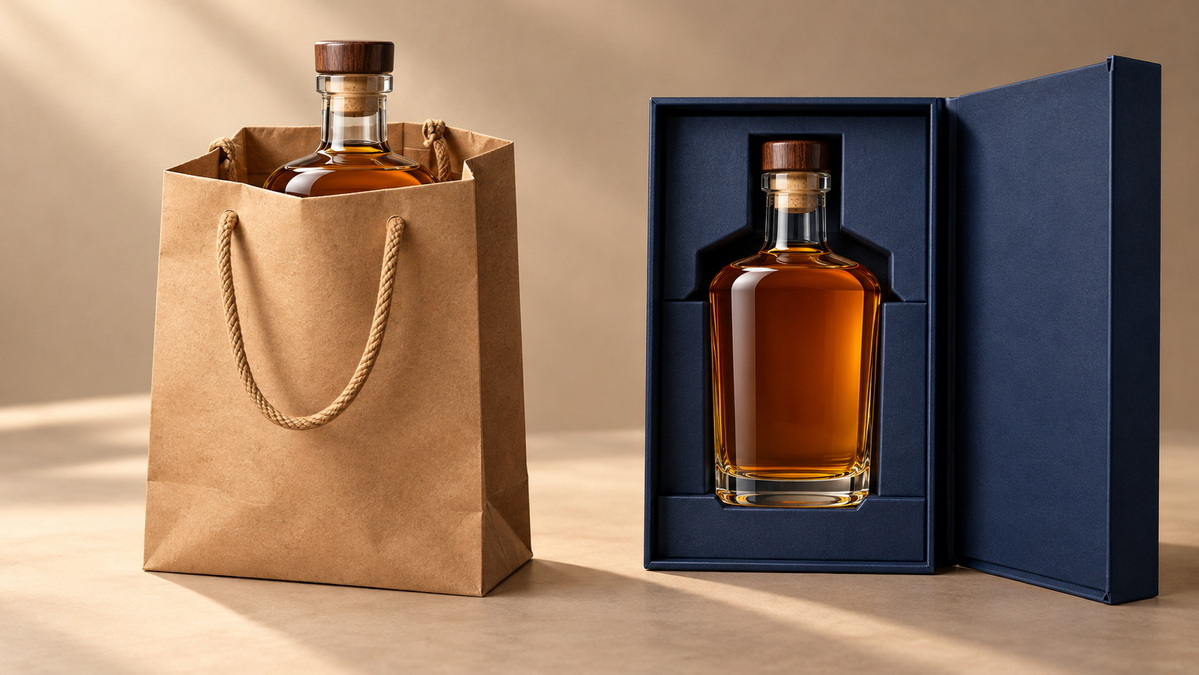
For this comparison, "paper liquor bags" means paper retail carry bags for bottled spirits, including reinforced, handled designs. "Rigid boxes" means thick-board presentation boxes, not corrugated shipping cartons.
| Comparison factor | Paper liquor bags | Rigid boxes |
|---|---|---|
| Main purpose | Carrying and retail handover | Presentation and structured enclosure |
| Construction | Folded and glued paper, sometimes reinforced | Thick paperboard covered with decorative paper |
| Bottle positioning | Usually limited without added supports | Can incorporate fitted inserts |
| Impact protection | Limited cushioning by itself | Depends on the insert and overall design |
| Branding | Visible during customer carrying | Visible during display, opening, and storage |
| Storage | Usually supplied flat | Set-up boxes occupy more space; collapsible designs vary |
| Cost tendency | Usually lower for comparable orders | Usually higher because of materials and assembly |
| Typical application | Liquor stores, tasting rooms, events | Premium spirits, gifting, collector editions |
| Parcel shipping | Not a stand-alone shipping solution | Usually needs a separate protective shipping system |
These are design tendencies, not guaranteed performance ratings. Specifications and testing determine what an individual package can withstand.
Paper liquor bags are paper-based carriers sized for wine or spirits bottles. They range from simple kraft sleeves to printed shopping bags with reinforced handles and bases.
Their main advantage is convenience. A retailer can store them flat, open them quickly, and hand a packaged purchase to the customer.
Common material options include kraft paper and coated printing papers. Depending on the design, a bag may incorporate:
- Reinforcement patches around handle attachment points.
- A supporting bottom card.
- Folded top reinforcement.
- Twisted-paper, flat-paper, or rope handles.
- Dividers for multiple bottles.
Paper grammage alone does not establish carrying capacity. Handle attachment, paper properties, glue bonds, bag dimensions, and reinforcement all influence performance.
For custom paper liquor bags, the purchasing specification should identify the filled bottle weight and intended carrying conditions rather than simply requesting "heavy paper."
Rigid boxes are structured presentation packages made from thick paperboard, commonly wrapped with printed or specialty paper. Industry guides describe approximately 2–3 mm board as common, although the appropriate thickness depends on dimensions and design.
Unlike ordinary folding cartons, conventional set-up rigid boxes retain their shape. Some collapsible rigid gift boxes combine reinforced panels with fold-flat construction.
Popular configurations for spirits packaging include:
- Lift-off lid boxes.
- Book-style magnetic closure boxes.
- Drawer boxes.
- Hinged presentation boxes.
- Collapsible magnetic gift boxes.
An internal insert can locate the bottle and create space for glasses, tasting notes, or accessories.
However, a substantial-looking box is not automatically protective. The insert, bottle clearance, closure, and shipping arrangement must work together.
The most important distinction is between supporting bottle weight and protecting glass against impact.
A reinforced paper bag may carry a heavy bottle successfully while providing little cushioning if dropped. A rigid box may resist surface pressure but still allow damage if the bottle moves inside.
Paper bags are most appropriate for controlled retail handover and short customer carrying journeys.
Potential failure points include:
- Handles pulling away from the bag.
- Bottom seams separating.
- Bottle corners stressing the paper.
- Two bottles striking each other.
- Moisture weakening vulnerable components.
A reinforced base supports the load, but it does not replace a cushioning system.
A rigid liquor box offers more opportunities to control bottle movement. A fitted insert can separate the glass from the outer walls and support selected areas of the bottle.
Insert options include folded paperboard, molded pulp, corrugated structures, and foam. Selection should consider protection, appearance, assembly, and end-of-life requirements.
Avoid assuming that a tight fit is always safer. Excessive pressure around a cap, decorative shoulder, or fragile accessory can create new problems.
Neither format should be treated as parcel-ready without verification.
For individually packaged products shipped through parcel systems, ISTA Procedure 3A provides a general simulation framework for packages weighing 150 lb (70 kg) or less.
Evaluate the complete system: filled bottle, presentation packaging, cushioning, and outer shipping carton. Testing an empty gift box does not establish protection for the finished shipment.
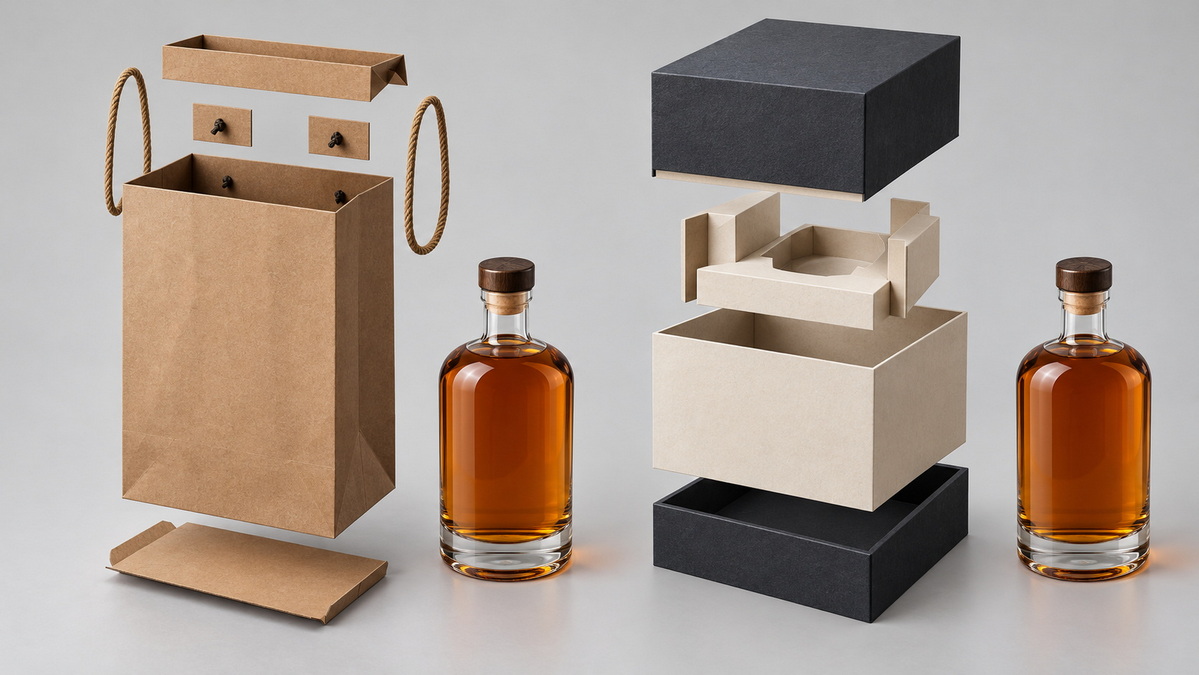
Paper liquor bags and rigid boxes create value at different stages of the purchase journey.
A printed bag accompanies the customer after checkout. Its visible surfaces can carry a logo, recognizable colors, and restrained messaging.
For liquor retailers and tasting rooms, practical usability matters as much as graphics. Comfortable handles and an appropriately sized bag support a better handover experience.
A premium paper bag does not need excessive decoration. Consistent printing and clean construction can communicate quality effectively.
Rigid boxes allow brands to organize how the customer encounters the bottle.
A lid, magnetic flap, or drawer can reveal the label first, followed by a tasting card or accessory compartment. Interior printing can explain the spirit's origin or serving suggestions.
This makes rigid boxes useful for gift-oriented products. However, packaging alone does not prove that customers will accept a higher price. Evaluate the design alongside the bottle, brand positioning, and actual sales channel.
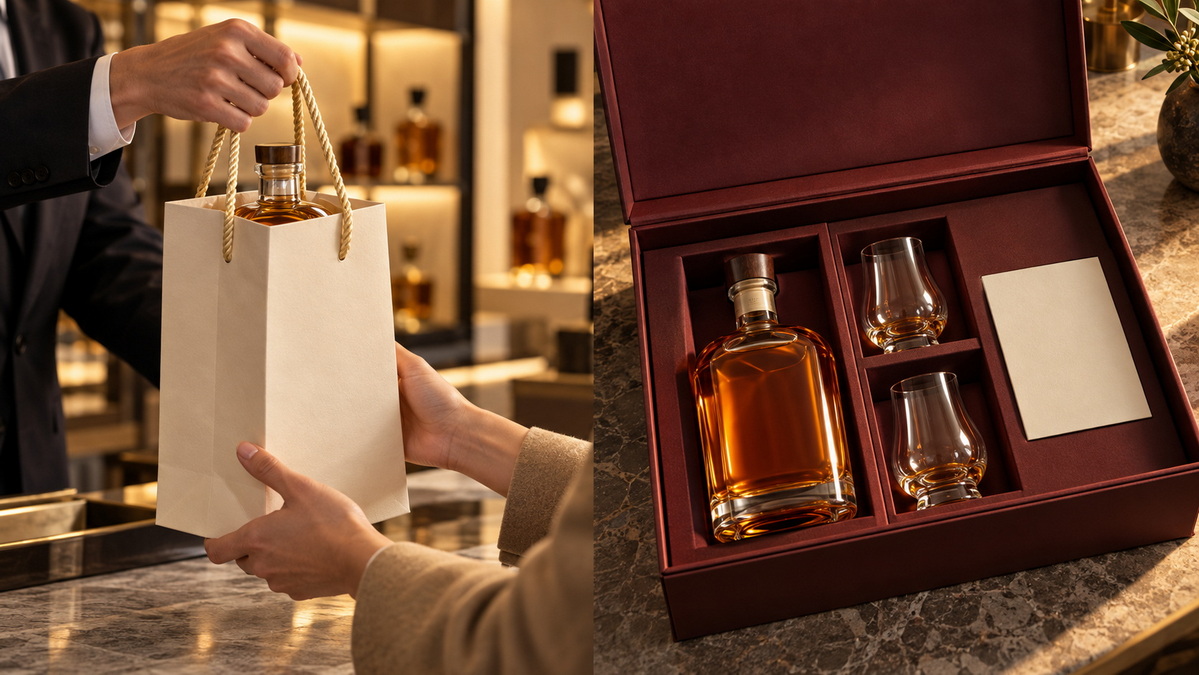
Paper liquor bags usually cost less than elaborate rigid boxes, but a useful quotation comparison requires matching quantities, dimensions, finishes, and delivery terms.
Important variables include:
- Paper grade and grammage.
- Bag dimensions and material yield.
- Handle type and reinforcement.
- Print coverage and finishing.
- Order quantity and packing method.
A highly decorated bag with specialty handles can narrow the price difference against a simpler box.
Rigid box pricing can include board, wrapping paper, inserts, magnets, finishing, and assembly.
Set-up boxes also occupy space before use. Collapsible designs may reduce inbound storage and freight volume, but their actual benefits depend on packed dimensions and assembly requirements.
Ask suppliers to quote the presentation package and shipping protection separately. Otherwise, a cheaper quotation may simply exclude necessary components.
One useful procurement improvement is to compare total cost per successfully delivered order rather than packaging price alone.
Include:
1. Packaging purchase cost.
2. Inbound freight and storage.
3. Packing labor.
4. Outbound shipping.
5. Expected damage and replacement costs.
Consider a hypothetical comparison. One design saves $0.50 per order, but its damage rate is two percentage points higher. If each damaged order costs $40 to replace, that difference adds $0.80 in expected replacement cost per shipment.
The example does not establish that bags or boxes have a particular failure rate. It shows why a lower purchase price can produce a higher overall cost.
Use your own trial results, replacement expenses, and shipping charges before making the decision.
Neither paper liquor bags nor rigid boxes are automatically the more sustainable choice.
A meaningful comparison considers material quantity, sourcing, coatings, inserts, transport volume, reuse, and local recycling acceptance.
FSC labels communicate verified sourcing or recycled-material categories. They do not establish that every finished package is recyclable in every community.
Likewise, recycled content and recyclability describe different characteristics. A package can contain recycled fiber while incorporating components that complicate local collection or processing.
Ask for documentation that matches the specific material claim. Do not assume that a paper sample or supplier brochure verifies the complete finished product.
The U.S. EPA reports an 80.9% recycling rate for paper and paperboard packaging in 2018. That historical category includes corrugated boxes and should not be presented as the recycling rate for luxury liquor boxes or paper shopping bags.
For U.S. environmental marketing, FTC guidance also calls for qualifications when appropriate recycling facilities are unavailable to at least 60% of consumers or communities where an item is sold.
Practical design questions include:
- Can unnecessary components be eliminated?
- Can inserts be removed easily?
- Are coatings and decorations compatible with intended recycling systems?
- Can the same protection be achieved with less material?
A heavier package may prevent costly damage, but that benefit should be demonstrated rather than assumed.
These scenarios illustrate selection logic; they are not reported customer case studies.
A reinforced paper liquor bag is a practical starting point when customers collect bottles in person.
Priorities include reliable handles, base support, quick checkout packing, and compact storage. Multiple bottles may require separation rather than simply a wider bag.
A rigid box can organize the bottle, message card, and accessories into one presentation.
If the recipient must carry the gift, add a correctly sized paper shopping bag. The formats can complement each other rather than compete.
Start with shipping protection, then integrate presentation.
A rigid gift box may sit inside a corrugated shipping carton with appropriate cushioning. Validate the complete configuration before committing to production quantities.
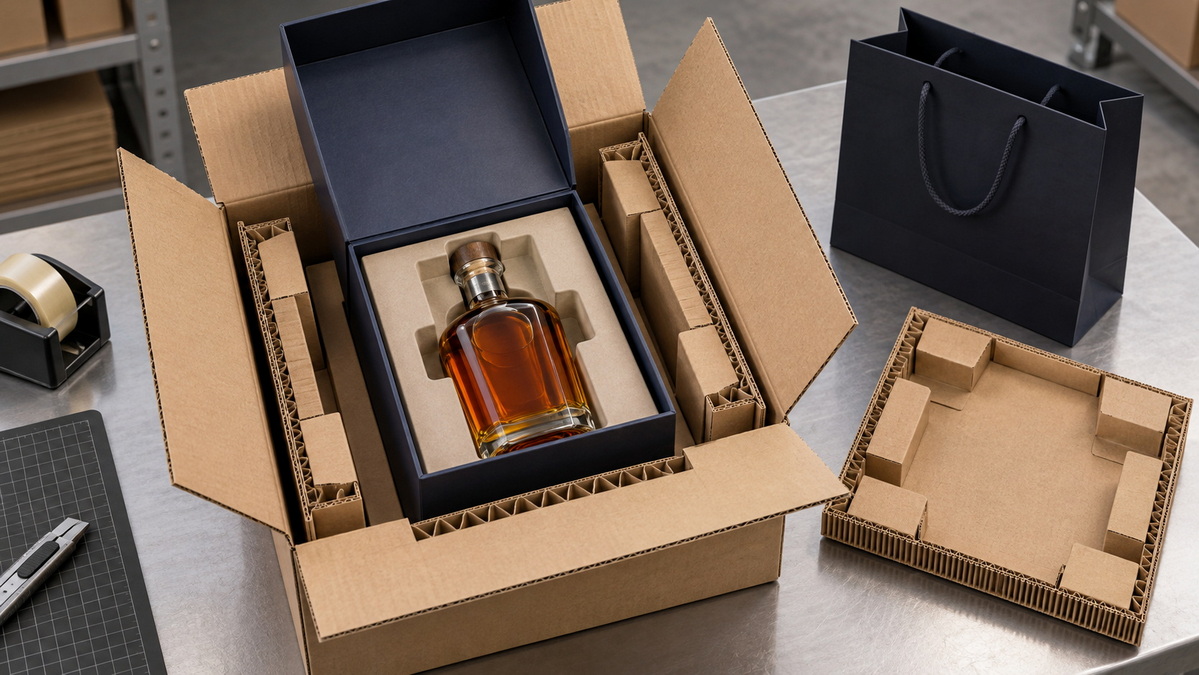
A clear brief helps suppliers recommend a suitable structure and provide comparable quotations.
Provide maximum height, width or diameter, filled weight, cap dimensions, and photographs or drawings.
Include unusual shoulders, embossed surfaces, and accessories that affect fit.
State whether the package is for retail collection, gifting, event distribution, or individual parcel delivery.
Specify the number of bottles and whether they travel upright, horizontally, or in several orientations.
Identify printing, finishes, colors, insert preferences, and any substantiated sourcing requirements.
Distinguish essential features from optional upgrades.
Check bottle fit, handle comfort, closure operation, scuffing, insert removal, and packing time.
For load-bearing bags, evaluate the actual filled load. For shipped products, arrange suitable distribution testing with representative samples.
Agree on dimensions, workmanship, color references, assembly requirements, and inspection methods before production.
A signed sample is useful, but measurable requirements reduce ambiguity.
Maituohong Packaging produces custom magnetic boxes, mailer and shipping boxes, rigid boxes, folding gift boxes, and paper shopping bags.
Our recommendation is to start with the bottle and distribution requirements, then select the presentation format—not the reverse.
Send your bottle dimensions, filled weight, order quantity, target market, artwork, and delivery method to request a packaging assessment and quotation. Ask for separate options covering retail carrying, gift presentation, and shipping protection so you can compare the complete solution.
They can be when the complete design suits the load. Verify handles, reinforcement, bottom construction, and performance using the actual filled bottle.
Not necessarily on their own. Protection depends on the insert, cushioning, outer carton, and tested performance of the complete shipment.
Usually, for comparable quantities and relatively simple specifications. Specialty papers, complex finishes, and premium handles can change the comparison.
Yes. Collapsible rigid boxes use structures designed for flat storage and later assembly. Confirm assembled strength, setup time, and actual shipping dimensions.
Rigid boxes provide more control over presentation and accessory placement. A premium paper bag can add carrying convenience and complete the gifting experience.
Potentially, but acceptance depends on the finished materials and local facilities. Avoid blanket claims based only on the presence of paper.
1.PakFactory. "Rigid Box Packaging – The Master Guide." Construction, typical board thickness, and rigid box manufacturing. [pakfactory]
2.Relis & Roth. "Paper Shopping Bags for Liquor & Wine Bottles." Reinforced handles, reinforced bottoms, and paper bottle-carrier features. [relisandroth]
3.International Safe Transit Association. "Test Procedures." Procedure 3A scope and parcel-distribution application. [ista]
4.International Safe Transit Association. "3A Overview." Complete packaged-product scope and the 150 lb (70 kg) weight limit. [ista]
5.U.S. Environmental Protection Agency. "Containers and Packaging: Product-Specific Data." Historical 2018 paper and paperboard packaging recycling figures. [epa]
6.Federal Trade Commission. "Environmental Claims: Summary of the Green Guides." Recyclability qualifications and access to recycling facilities. [ftc]
7.Forest Stewardship Council. "On Product Labels." FSC sourcing categories, recycled labels, and supplier verification. [us.fsc]


