
Views: 287 Author: Maituohong Packaging Publish Time: 2026-10-07 Origin: Site


Content Menu
● 1. Start Food Packaging Design With a Product Brief
>> Separate Presentation From Preservation
● 2. Choose Food Packaging Materials for Their Intended Use
>> Distinguish Direct and Indirect Food Contact
>> Match Materials to Product Risks
● 3. Select the Right Custom Folding Gift Box Structure
>> Compare Structures Before Committing
>> Evaluate Closures and Inserts Together
● 4. Make Food Packaging Information Clear and Honest
>> Reserve Space for Required Information
>> Design for Readability, Not Just Decoration
● 5. Create Shelf Appeal and a Better Unboxing Experience
>> Test the Design in Its Selling Environment
● 6. Make Sustainability Claims Specific and Verifiable
>> Understand Recyclability Claims
>> Improve the Design Before Adding Claims
● 7. Validate Food Gift Packaging Before Production
>> Follow a Practical Sample-Approval Sequence
>> Keep Shelf-Life Validation Separate
● 8. Turn Customer Feedback Into Measurable Improvements
● Develop Your Food Gift Packaging With Maituohong Packaging
>> Are folding gift boxes suitable for food products?
>> Can a rigid gift box extend food shelf life?
>> What information should I provide for a packaging quotation?
>> Are magnetic folding gift boxes recyclable?
>> How should I test packaging for online food gift sales?
>> How can one packaging design support multiple flavors?
Food packaging design should make a product appealing without compromising protection, clarity, or convenience. For brands selling chocolates, biscuits, tea, and seasonal assortments, custom folding gift boxes can combine a premium presentation with a practical storage format. However, a beautiful box is only successful when its materials, structure, and information suit the food inside.
At Maituohong Packaging, we bring more than 18 years of experience in designing and manufacturing high-quality rigid gift boxes and custom paper packaging. Our approach starts with the product, not the decoration: understand what needs protection, then build an attractive experience around it.
This guide explains how to develop food gift packaging that supports customer confidence, reliable production, and everyday usability.
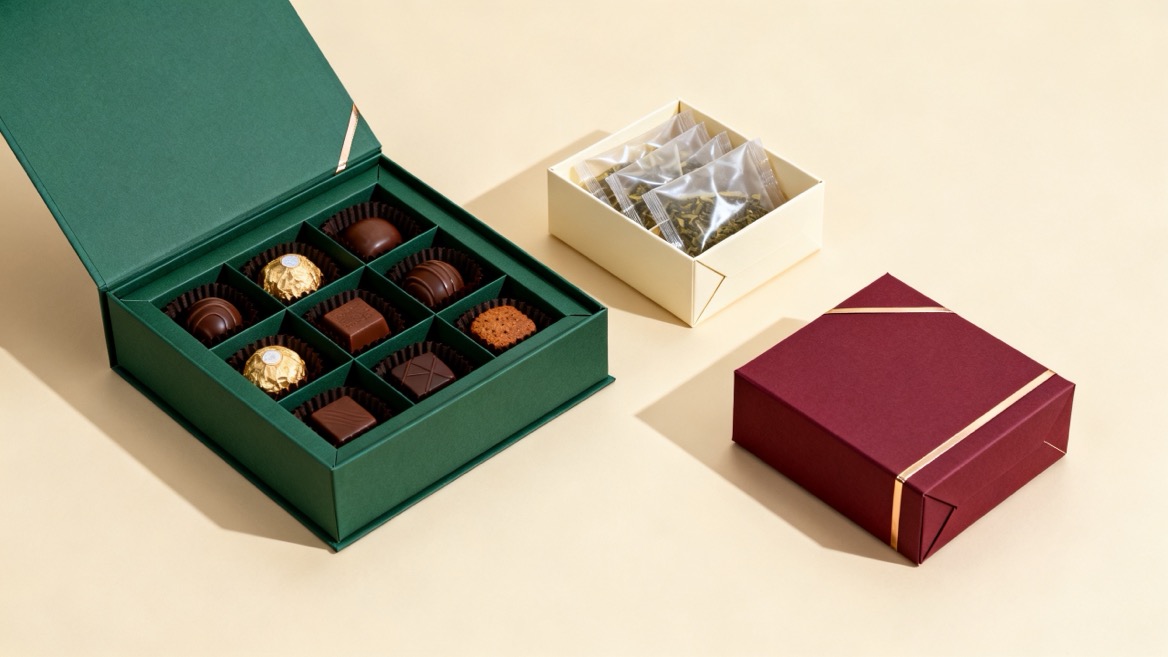
Before choosing colors or finishes, establish what the packaging must accomplish. A gift assortment sold online faces different demands from a biscuit box displayed in a store.
A useful brief answers six questions:
- What are the product's dimensions, weight, and arrangement?
- Is each item individually sealed?
- Does the food require protection from moisture, oxygen, grease, or light?
- Where will the product be sold?
- How will the finished package travel?
- What should customers understand immediately?
Also identify the purchasing occasion. Corporate gifts may need space for personalized messages. Seasonal products may require interchangeable artwork. Everyday premium ranges may benefit from a recognizable design that works throughout the year.
A decorative gift box and a food-preservation package perform different jobs.
A rigid outer box can organize products and support presentation. It should not automatically be expected to preserve freshness or provide a validated barrier.
For example, chocolates may sit in sealed trays inside a folding gift box. Tea may require sealed pouches. Biscuits may need protective inner packaging to help manage moisture exposure and breakage.
Define the complete packaging system before designing its outer appearance.
Protection should guide material selection.
For food-contact applications, suitability depends on more than whether a material looks clean or feels sturdy. Consider the complete construction, including paper, coatings, adhesives, printing inks, and any component that could transfer substances to food.
In the United States, the regulatory status of a food-contact material depends on its constituent substances and their intended conditions of use. Requirements elsewhere must be checked separately.
Ask your supplier whether the proposed component will touch food directly or sit outside an independently sealed inner package.
This distinction helps define the documentation and testing needed. However, an outer layer should not be dismissed automatically: assess whether migration could occur through the complete packaging system.
Request documentation that matches:
- The actual material and construction.
- The intended food type.
- Expected contact duration.
- Relevant temperature conditions.
- The destination market.
Avoid treating a general "food-grade" statement as sufficient evidence for every application.
| Product category | Main design concern | Packaging priority |
|---|---|---|
| Chocolates | Movement, temperature exposure, surface damage | Secure arrangement and suitable inner packaging |
| Biscuits | Breakage and moisture exposure | Cushioning, compartment sizing, and appropriate barriers |
| Tea | Aroma retention and moisture exposure | Suitable sealed inner packs |
| Greasy baked goods | Staining and material interaction | Verified contact materials and appropriate grease resistance |
These are starting points, not final specifications. Validate the proposed system using the actual product.
A folding rigid gift box is different from a conventional folding carton. It uses rigid panels with a construction that allows the box to collapse before assembly.
This format can be useful for premium food gifts when brands want a substantial presentation without storing every empty box fully assembled.
However, the benefits depend on its dimensions, folding mechanism, and assembly requirements.
| Structure | Potential advantage | Important consideration |
|---|---|---|
| Folding rigid gift box | Premium appearance with flat storage | Assembly time and panel alignment |
| Conventional folding carton | Lightweight, adaptable format | Protection requirements and perceived value |
| Setup rigid box | Ready-to-use, substantial presentation | Empty-box storage and shipping volume |
| Sleeve with inner tray | Flexible branding and organized contents | Tray retention and sliding behavior |
Do not select a structure solely because it photographs well. Check how it behaves when filled, opened, carried, and packed for transport.
Magnetic closures, ribbons, tabs, and adhesive assembly systems create different opening experiences.
The closure should remain secure without making the package frustrating to open. Inserts should hold products in position while allowing customers to remove them easily.
For mixed assortments, check every cavity against the actual item. An attractive insert becomes a liability if chocolates rattle or biscuit sleeves fit too tightly.
Customers should quickly understand what the package contains.
Build a clear visual hierarchy:
1. Brand name.
2. Product name or assortment type.
3. Flavor, variety, or distinguishing feature.
4. Quantity or net contents.
5. Supporting product information.
Use realistic photography or illustrations that accurately represent the contents. Avoid imagery that suggests larger portions, more pieces, or ingredients not supplied.
Label requirements vary by market and product category. Confirm applicable rules before artwork approval.
Depending on the product, required information may include ingredients, allergen declarations, nutrition information, net quantity, and business details. Date marking, storage instructions, and traceability information also need appropriate consideration.
For products sold in the United States, applicable allergen-labeling requirements must be addressed.
Do not assume that information on an inner wrapper always resolves the labeling needs of the outer retail package.
Review essential information at actual print size.
Check:
- Contrast between text and background.
- Readability across folds and edges.
- Space around barcodes and variable printing.
- Legibility on textured or reflective surfaces.
- Whether decorative elements compete with product details.
A premium appearance should make information easier to navigate, not harder.

Strong food packaging design communicates consistently across a retail shelf, an online product image, and a customer's hands.
Choose a limited visual system: a recognizable color palette, consistent typography, and one dominant design element.
For a product family, retain the same layout while changing clearly defined elements, such as flavor colors or assortment names.
For retail products, compare prototypes beside neighboring products. For online sales, review the packaging as a small thumbnail.
Ask whether someone unfamiliar with the brand can identify:
- What the product is.
- Which variant they are viewing.
- Why it suits the intended occasion.
Then test the opening sequence. Customers should not need excessive force or unclear instructions to assemble, open, or unpack the box.
Leave enough finger access around products and inserts. Small usability improvements can make an elaborate package feel more considered.
Paper packaging is not automatically recyclable in every location. Coatings, laminations, adhesives, closures, contamination, and local collection systems can influence the outcome.
Replace broad environmental language with claims supported by evidence.
The U.S. Federal Trade Commission's Green Guides explain that unqualified recyclable claims depend on access to suitable recycling facilities. The guidance defines a "substantial majority" as at least 60% of consumers or communities where the item is sold.
That threshold is a marketing-claim consideration, not proof that a particular box is recyclable.
Assess the finished package and the destination market before choosing disposal wording. Check current local requirements as well.
Practical questions include:
- Can unnecessary layers be removed?
- Can inserts be separated easily?
- Is a laminated finish necessary?
- Can the structure accommodate several related products?
- Can disposal instructions explain the components clearly?
A folding format may reduce empty-box storage volume, but it does not establish a lower overall environmental impact by itself. Compare actual materials, packing density, transport arrangements, and end-of-life options.
A digital rendering cannot confirm fit, assembly quality, or transport performance.
Approve a physical sample with the real products inside whenever possible. Use representative inner packs and inserts rather than approximate substitutes.
1. Confirm internal dimensions and product clearance.
2. Check insert retention and removal access.
3. Assemble and collapse the box repeatedly.
4. Inspect closure alignment and security.
5. Review printed artwork at actual size.
6. Examine corners, wrapped edges, and visible adhesive.
7. Test the complete shipping configuration.
8. Record acceptance criteria before production.
For parcel shipments, ISTA Procedure 3A provides a general simulation framework for eligible packaged products weighing 70 kg or less. A qualified testing provider should confirm the appropriate procedure for the actual distribution route.
Test the shipping system—not only the decorative gift box.
A successful transport test does not demonstrate food shelf life.
Freshness, barrier performance, seal integrity, and storage conditions require separate evaluation by the responsible food business and appropriate specialists.
Packaging changes that affect the inner food-contact system should trigger a review of those requirements.
Customer comments are most useful when translated into specific design questions.
Do not rely only on whether people describe a box as "beautiful." Ask what they could identify, open, remove, and dispose of without assistance.
| Feedback to investigate | Design response to evaluate | Useful measure |
|---|---|---|
| Products move inside | Adjust insert geometry | Movement or damage after testing |
| Opening feels difficult | Reassess closure and access | Opening time and observed difficulty |
| Contents are unclear | Improve hierarchy and imagery | Correct product identification |
| Assembly is inconsistent | Simplify folding sequence | Assembly time and error rate |
| Disposal is confusing | Clarify component instructions | Understanding during user review |
These are suggested evaluation categories, not reported customer reviews.
Compare alternatives under similar conditions. Keep a record of what changed and why, so future product launches benefit from the same learning.

Successful food packaging combines an appropriate inner protection system, a reliable outer structure, clear information, and a satisfying opening experience.
Maituohong Packaging supports brands developing custom folding gift boxes and high-quality paper packaging with more than 18 years of design and manufacturing experience.
Send our team your product dimensions, packed weight, destination market, order quantity, delivery requirements, and artwork preferences. Include details of the inner food packaging and any food-contact requirements.
Use that brief to discuss suitable structures, materials, inserts, and physical samples before confirming production.
Yes, when the complete packaging system suits the food. A folding gift box often serves as secondary packaging around sealed pouches, wrappers, or trays. Direct-contact applications require suitable materials and supporting documentation.
Not by itself. Shelf life depends on the product, processing, inner packaging, seals, and storage conditions. Do not infer preservation performance from the outer box's thickness or appearance.
Provide product dimensions, packed weight, quantity, destination market, preferred structure, printing requirements, inserts, and delivery expectations. Clarify whether any component touches food and describe the inner packaging.
The answer depends on the complete construction and local recycling systems. Magnets, coatings, adhesives, and other components need assessment. Provide evidence-based disposal instructions instead of assuming all paper-based boxes are accepted.
Evaluate the filled gift box inside its intended shipping carton, with all cushioning included. Confirm an appropriate transport-testing procedure with a qualified provider. Assess food preservation separately.
Keep the main layout and brand elements consistent. Change controlled features such as flavor names, accent colors, or illustrations. Verify that customers can distinguish variants without relying on color alone.
1. [PakFactory — "6 Tips for Creating Tasteful Food Packaging Designs"]. Background source for the original article's themes, including functionality, clarity, product representation, shelf impact, and versatility. [pakfactory]
2. [U.S. Food and Drug Administration — "Food Packaging & Other Substances that Come in Contact with Food"]. Basis for the discussion of food-contact substances and intended-use authorization. [fda]
3. [U.S. Food and Drug Administration — "Determining the Regulatory Status of Components of a Food Contact Material"]. Basis for evaluating constituent substances, migration, specifications, and limitations. [fda]
4. [U.S. Food and Drug Administration — "Food Allergies"]. Basis for the discussion of applicable U.S. allergen-labeling requirements. [fda]
5. [Federal Trade Commission — "Guides for the Use of Environmental Marketing Claims," 16 CFR Part 260]. Basis for recyclable-claim qualifications and the 60% access threshold. [ftc]
6. [International Safe Transit Association — "Test Procedures"]. Basis for the description of general simulation testing and Procedure 3A's parcel-shipment scope. [ista]


