
Views: 289 Author: Maituohong Packaging Publish Time: 2026-10-02 Origin: Site


Content Menu
● What Makes a Milk Carton Box Unique?
>> Design for the Product Journey
● Start With a Clear Packaging Strategy
>> Define the Brand Positioning
● Choose the Right Carton Structure
>> Match Board Strength to Actual Use
● Create a Shelf-Ready Visual Hierarchy
>> Choose Typography for Real Reading Conditions
● Add Premium Details Without Overdesigning
>> Effective Finishing Options
● Make Sustainability Claims Carefully
>> Consider the Full Supply Chain
● Build Trust Through Clear Product Information
>> Create an Information Panel Customers Can Scan
● Use Inserts and Added Value Carefully
● A Practical Development Process
>> Step 2: Confirm Structural Engineering
>> Step 3: Review Artwork at Full Scale
>> Step 4: Run a Physical Sample Test
>> Step 5: Approve Production Standards
● Why Work With an Experienced Packaging Manufacturer?
>> What is the difference between a milk carton and a folding carton?
>> Can a paper carton be used directly for liquid milk?
>> Which finish is best for premium milk gift packaging?
>> How can I make milk carton packaging more sustainable?
>> What information should appear on a milk carton?
>> Are printed inserts suitable for dairy packaging?
>> What should I provide before requesting a custom carton quote?
A milk carton is more than a container—it is a food-protection system, a communication tool, and a daily brand experience. For dairy brands, plant-based beverage companies, cafés, farm shops, and promotional-gift businesses, the right milk carton box design can improve shelf recognition, make product information easier to read, protect contents through handling, and create a stronger reason for customers to choose the product again.
At Maituohong Packaging, we have spent more than 18 years designing and manufacturing custom paper packaging, premium rigid gift boxes, and folding cartons. From our experience, the most effective carton designs are not simply colorful or expensive. They combine structural reliability, clear information hierarchy, appropriate materials, practical production choices, and a distinctive brand story.
This guide explains how to create unique milk carton boxes that look memorable, work efficiently in real-world distribution, and support a better unboxing or purchasing experience.
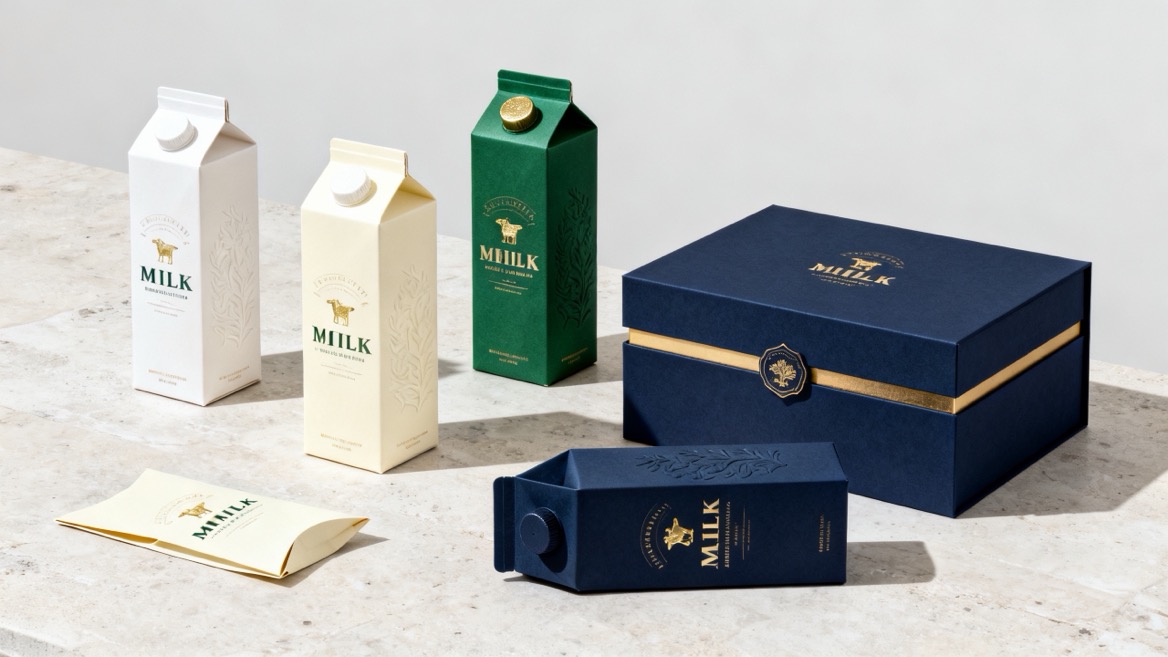
A unique milk carton box does not need to use every possible visual effect. In fact, the strongest designs often achieve more by focusing on a few well-executed details.
For liquid dairy products, the primary package must be designed around food protection, filling equipment, sealing performance, and required product information. A paper carton may use multiple functional layers, depending on the product, processing method, market, and shelf-life target. A decorative outer carton, gift-style carrier, or promotional folding carton has a different purpose: it can improve presentation, organize multipacks, communicate seasonal campaigns, or make a premium product easier to give as a gift.
The first design decision is therefore simple: identify whether you are creating:
- A primary carton for milk or another beverage
- A secondary carton for multipacks or retail display
- A promotional sleeve or seasonal gift box
- A folding carton that holds a bottle, pouch, or inner beverage pack
- A dairy-themed carton for events, sample kits, children's products, or brand activations
Each format has different requirements for board strength, moisture resistance, printing, die-cutting, assembly, and shipping.
Before choosing colors or finishes, map the carton's journey from production to the customer's hands.
Ask practical questions:
1. Will the carton be stacked in transport cartons?
2. Will it be stored in refrigerated conditions?
3. Will it face condensation, splashes, or handling with wet hands?
4. Is it designed for supermarket shelves, direct-to-consumer delivery, cafés, or gift retail?
5. Does the customer need to open, carry, reseal, recycle, or reuse it easily?
6. Will the product be sold in a single unit, a multipack, or a seasonal set?
A visually impressive carton can still fail if it scuffs easily, loses stiffness in humid conditions, opens during transit, or hides essential information. Great packaging works because every element serves a purpose.
A carton becomes more effective when brand, product, customer, and production requirements are aligned at the beginning. This avoids costly late-stage changes, especially after artwork, sampling, and die-line approval.
Your carton should immediately answer one question: What kind of milk or beverage is this?
A family-focused fresh milk brand may use warm colors, friendly illustrations, and clear nutritional messaging. An organic farm dairy may use natural paper tones, restrained graphics, and origin-focused storytelling. A high-protein beverage may emphasize functional benefits, bold typography, and an active lifestyle. A premium gift-oriented milk product may use refined printing, tactile board, and elegant finishing.
Use a short brand-positioning statement before design begins. For example:
> "A premium local dairy beverage made for health-conscious urban families who value freshness, transparent sourcing, and simple ingredients."
This statement becomes a practical filter. If a graphic, color, slogan, or finish does not reinforce the positioning, it may not deserve space on the carton.
The same milk carton structure can communicate very different things depending on the audience.
| Target buyer | Packaging priority | Effective design direction |
|---|---|---|
| Families with children | Easy recognition, trust, clear nutrition details | Friendly illustrations, simple color coding, readable type |
| Premium grocery shoppers | Ingredient quality, provenance, visual refinement | Minimal layouts, tactile finishes, source-story panels |
| Café and foodservice buyers | Handling efficiency, volume clarity, reliable packing | Strong carton structure, clear product coding, practical multipack design |
| Gift buyers | Presentation, emotional appeal, perceived value | Premium board, special finishes, handles, inserts, seasonal artwork |
| Eco-conscious shoppers | Material transparency, disposal guidance, reduced excess | Clear recycling information, efficient format, honest material messaging |
The goal is not to appeal to everyone. It is to make the intended buyer feel that the product was designed with them in mind.
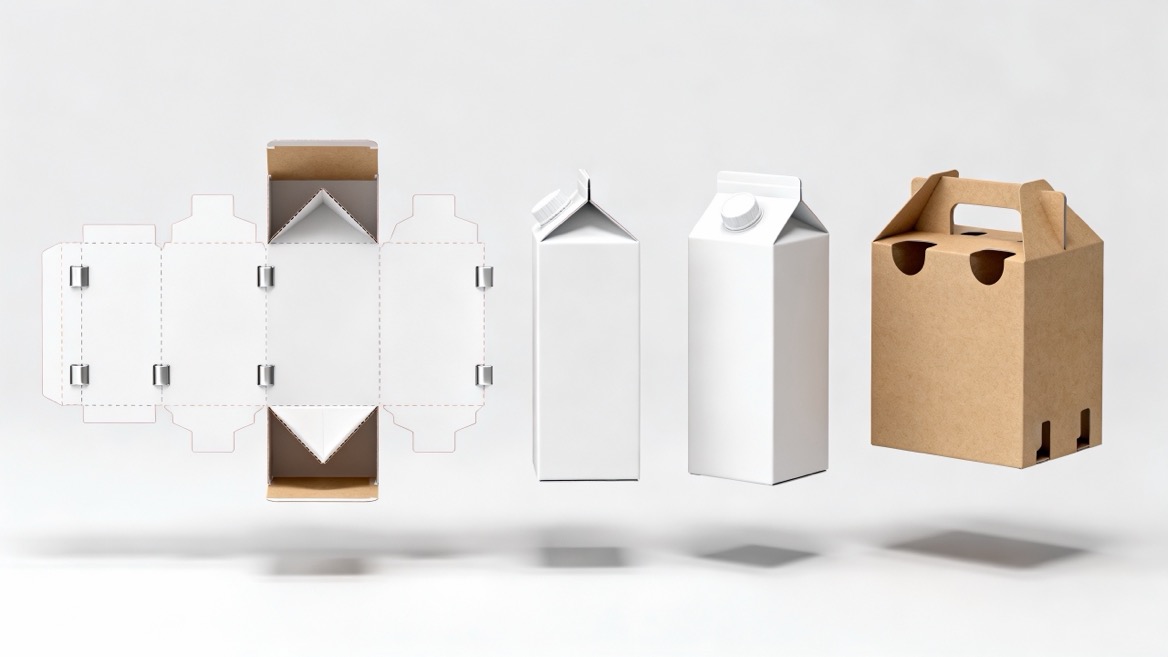
Structure determines how the carton performs before design makes it attractive. For custom paper packaging, this includes the board grade, thickness, crease design, closure style, internal support, and final assembly method.
Gable-top cartons are recognizable because of their folded top and carry-friendly shape. They can create a traditional, farm-inspired impression and provide a large printable surface.
Aseptic-style beverage cartons are commonly used for shelf-stable products. These are typically specialized multilayer systems and require technical compatibility with high-speed filling and sealing processes.
Folding carton sleeves can wrap a bottle, pouch, or inner beverage container. They are useful when a brand wants more graphic space or a premium retail appearance without changing the primary pack.
Multipack carriers hold several individual milk cartons or bottles together. They must balance carrying strength with material efficiency.
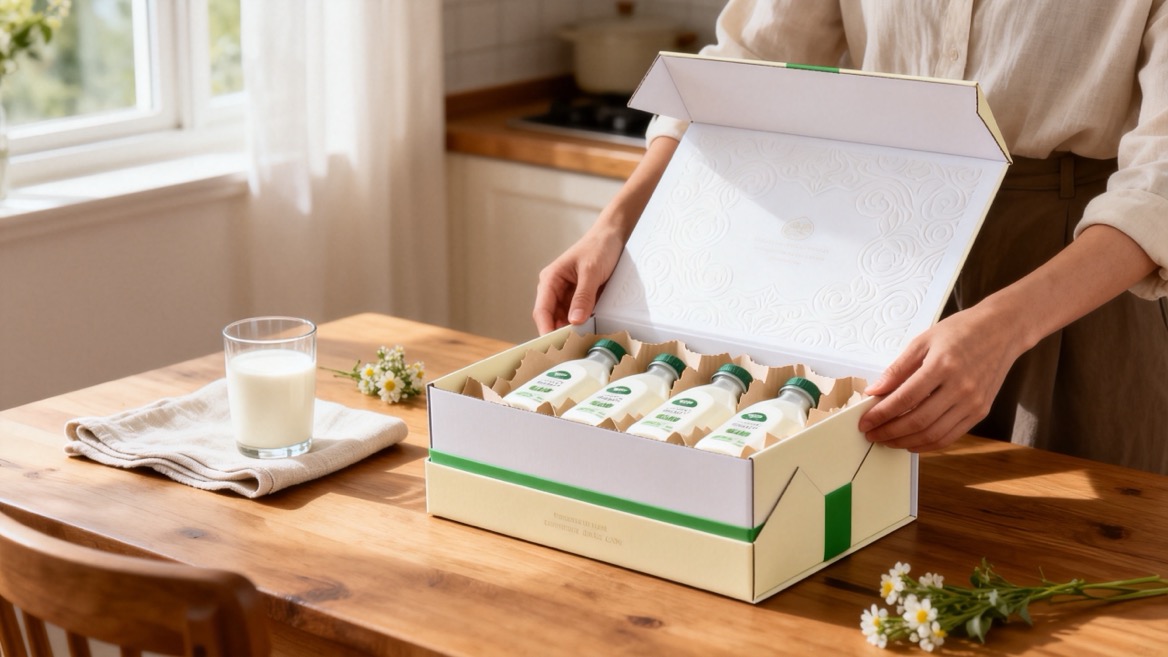
Gift-style folding boxes can be used for holiday milk sets, dairy gift collections, flavored beverage assortments, or branded sample kits. A well-designed insert can keep products stable while adding a premium presentation.
Paperboard selection should depend on the carton's real operating environment, not only on appearance.
For example, a carton used in a dry retail environment may prioritize print quality and smoothness. A multipack carrier may require stronger paperboard and reinforced handle areas. A refrigerated or moisture-exposed application requires closer consideration of coatings, barriers, board behavior, and the limits of decorative finishing.
When developing a custom box, test the carton under conditions similar to its final use:
- Compression during stacking
- Vibration during transport
- Repeated opening and closing
- Exposure to low temperatures or humidity
- Abrasion from shelf handling
- Performance of glued seams and locking tabs
- Scuff resistance of dark colors and metallic finishes
A physical sample is essential. Flat artwork cannot reveal whether a handle cuts into the hand, whether a closure opens smoothly, or whether the product shifts inside the package.
A milk carton has only a few seconds to communicate on a shelf. Shoppers should be able to understand the product at a glance, even from a distance.
A practical front-panel hierarchy usually includes:
1. Brand name or logo
2. Product name
3. Product type or key differentiator
4. Flavor, fat level, or formula variation
5. Net quantity
6. A simple visual cue, such as an ingredient illustration or color block
For U.S.-regulated packaged foods, the principal display panel generally includes the food's identity statement and net quantity statement. Other required information may appear on an adjacent information panel, depending on the product and applicable regulations. The exact requirements vary by market and product type, so brands should confirm final artwork with qualified regulatory professionals before production.
Color is one of the fastest recognition tools in packaging. It can create a strong family look across different SKUs while helping customers distinguish product variants.
For instance:
- Blue can support a classic dairy or chilled-freshness association.
- Green may help communicate organic, plant-based, or lower-impact positioning.
- Cream, white, and soft neutral shades can create a clean and premium appearance.
- Bold accent colors can separate chocolate, strawberry, vanilla, protein, or lactose-free varieties.
- Dark shades combined with metallic accents can signal a gift-ready or premium product line.
However, color should never reduce readability. Text printed over busy images, low-contrast backgrounds, or reflective foil can become difficult to read in retail lighting. Keep the most important product information highly legible.
Typography affects both credibility and usability. A display font may look attractive for a short product name, but ingredient details, handling instructions, and nutritional information require clean and readable type.
Use no more than two or three coordinated font families. Create contrast through size, weight, spacing, and hierarchy instead of mixing many decorative typefaces.
A strong carton typically uses:
- One recognizable display style for the brand or product name
- One highly readable typeface for supporting information
- Consistent weight and spacing rules across all product variations
Avoid placing important copy too close to folds, seams, die-cut windows, or curved edges. Artwork may look balanced on screen but become distorted after converting flat artwork into a three-dimensional carton.
Finishing can transform a simple folding carton into a memorable product presentation. But effects should reinforce the product's position, not distract from it.
Matte lamination gives a soft, refined, low-glare appearance. It works well for premium dairy gifts, organic concepts, and minimalist designs.
Gloss coating can make bright colors, product photography, and playful graphics look more energetic. It may suit children's milk products or flavored beverage cartons.
Spot UV adds contrast by applying gloss only to selected areas, such as a logo, milk splash, product name, or illustrated icon.
Foil stamping creates a premium highlight for limited editions, festive gift packaging, anniversary collections, or high-end dairy sets.
Embossing and debossing add a tactile brand detail. A raised logo or pressed pattern can create a memorable physical interaction before the carton is opened.
Textured paperboard can support a natural, artisanal, or handmade brand story, especially for farm-shop products and seasonal gift collections.
The best finishing strategy is often selective. A single well-placed foil logo and embossed mark can feel more sophisticated than a carton covered in multiple competing effects.
Packaging buyers increasingly ask about renewable materials, recyclability, reduced material use, and practical disposal. These expectations are important, but sustainability communication must be specific and accurate.
Avoid vague claims such as "100% green," "zero impact," or "fully eco-friendly" unless they can be substantiated for the exact package and market. Instead, explain what the package actually does.
More useful examples include:
- "Made with paperboard from responsibly managed sources," when supported by relevant documentation.
- "Designed to reduce unnecessary secondary packaging."
- "Please check local recycling guidance before disposal."
- "This folding carton is designed for efficient flat shipping before assembly."
A meaningful packaging improvement may involve less material, better nesting during shipping, improved pack-out efficiency, easier separation of components, or longer product protection. The right solution depends on the complete packaging system—not just the outer carton.
A beautiful carton is only one part of the environmental and operational picture. Consider:
- Material yield per production sheet
- Flat-packed shipping efficiency
- Weight and cube utilization during transport
- Production waste from complex die-cuts
- Compatibility with the packing line
- Damage rate during handling
- Whether an insert can be eliminated through smarter structure
- Whether a multipack carrier can replace additional bags or wraps
In our packaging projects, we often find that simplifying the structure produces better results than adding material. A well-designed locking system, properly sized insert, or improved carton geometry may reduce damage without requiring an oversized box.
For milk and dairy-related products, customers rely on the package to make informed decisions. The carton should present essential information clearly rather than turning the entire surface into advertising.
Depending on your market and product, key information may include:
- Product name and variety
- Net quantity
- Ingredients
- Nutrition information
- Allergen declaration
- Storage instructions
- Use-by or best-before information
- Manufacturer, packer, or distributor information
- Country-of-origin information, where required
- Recycling or disposal guidance
- Batch or production coding
Milk is recognized as a major allergen under U.S. food-allergen labeling requirements, and food labels must provide required information in accordance with applicable rules. If a product contains milk ingredients, dairy brands should work with regulatory and quality teams to confirm the correct declaration and placement before printing.
A useful information panel should be easy to navigate. Use sufficient spacing between sections, maintain contrast between text and background, and avoid tiny copy whenever possible.
A practical layout might group information in this order:
- Ingredients and allergen statement
- Nutrition information
- Storage instructions
- Brand or manufacturer details
- Recycling guidance
- Batch and date-code area
Reserve a clear, unprinted or low-ink area where date and batch codes will remain visible. This is a small design decision that can prevent major operational issues later.
Printed inserts, cards, coupons, and small brand messages can improve the customer experience—especially for gift packs, sampling kits, subscription boxes, and direct-to-consumer dairy products.
Useful insert ideas include:
- A thank-you card for first-time buyers
- A QR code that leads to recipe ideas or farm-origin stories
- A coupon for the next purchase
- A reusable recipe card
- A seasonal greeting
- A product pairing guide
- A short message explaining how to store or enjoy the product
For food packaging, do not let promotional materials obscure required labeling or create confusion about product use. Inserts should add value without competing with safety information.
A structured development process reduces revision cycles and makes the final carton easier to manufacture consistently.
Provide your packaging manufacturer with:
- Product dimensions and weight
- Product format and inner packaging
- Target market and retail channel
- Expected order quantity
- Preferred material and finish
- Required certifications or compliance considerations
- Brand guidelines and logo files
- Copy requirements
- Reference images or competitor examples
- Delivery method and destination
The better the brief, the faster the project can move from concept to sampling.
The packaging team should develop or review the die-line, folding sequence, glue areas, locking features, and internal fit. For multipacks or gift boxes, product samples should be tested inside the intended structure.
Check artwork on a full-size printed proof or prototype whenever possible. Pay special attention to:
- Text near creases
- Barcode placement and contrast
- Alignment of logos across panels
- Image quality
- Color consistency
- Visibility of small legal copy
- Date-code space
- Areas that may rub during transport
A sample should be assembled, filled with representative products, closed, stacked, and handled. If the carton will be shipped, test its interaction with outer shipping cartons.
Before mass production, confirm the approved sample, color target, material specification, finishing method, tolerances, packing method, and quality expectations.
A reliable manufacturer does more than print artwork. The right partner helps identify production risks before they become expensive problems.
At Maituohong Packaging, our approach is built around practical manufacturing experience in premium rigid boxes, folding gift boxes, and custom paper packaging. We help brands evaluate structure, material, printing, finishing, inserts, and packing details as connected parts of one solution.
For a milk carton-inspired project, this may mean recommending a folding structure that ships flat, a reinforced insert for better stability, a matte finish for premium positioning, or a simplified design that improves both readability and production efficiency.
The most successful carton is not necessarily the most complicated one. It is the one that protects the product, communicates clearly, represents the brand well, and performs consistently from factory to customer.
If you are developing custom milk carton boxes, dairy gift packaging, beverage multipack carriers, or branded folding cartons, send Maituohong Packaging your product size, target quantity, design concept, and preferred finish. Our team can help turn your idea into a practical, high-quality packaging solution built for your market.
A milk carton is usually designed as a primary package for holding liquid products, often with specific barrier, filling, sealing, and food-contact requirements. A folding carton is commonly used as secondary packaging, a retail sleeve, a multipack carrier, or a gift box around an inner container.
It depends on the packaging system. Liquid milk packaging requires suitable food-contact materials, barrier performance, sealing technology, filling compatibility, and compliance with the rules in the target market. Decorative paperboard alone is not automatically suitable for direct liquid contact.
Matte lamination paired with selective spot UV, foil stamping, or embossing is often an effective premium combination. The best choice depends on the brand position, artwork, budget, and the carton's exposure to refrigeration or moisture.
Start by reducing unnecessary material, optimizing carton dimensions, selecting suitable paperboard, minimizing excessive plastic components, and improving shipping efficiency. Make only specific, supportable material and disposal claims.
Requirements vary by market, but food packaging commonly includes the product name, net quantity, ingredients, allergen information, nutrition information, storage instructions, date coding, and business details. Confirm final requirements with a qualified regulatory specialist for the sales market.
Yes, especially for gift sets, promotional packs, subscription boxes, and direct-to-consumer orders. Inserts can include recipes, coupons, thank-you messages, or QR codes, but they should not conceal mandatory information or create food-safety confusion.
Share your product dimensions, product weight, quantity, target market, preferred material, finishing requirements, artwork files, reference images, packing method, and delivery destination. These details allow a manufacturer to recommend the right structure and quote accurately.
1. [U.S. Food and Drug Administration: Guidance for Industry—Food Labeling Guide]
2. [Electronic Code of Federal Regulations: 21 CFR Part 101—Food Labeling]
3. [U.S. Food and Drug Administration: Standards of Identity for Food]
4. [U.S. Food and Drug Administration: Food Allergen Labeling Requirements for Bulk Containers]
5. [U.S. Food and Drug Administration: Summary of Changes in the 2022 FDA Food Code]
6. [University of Maine Cooperative Extension: Reduced Oxygen Packaging Requirements]
7. [Tycoon Packaging: Learn How to Create Unique Milk Carton Boxes]


