
Views: 218 Author: Maituohong Packaging Publish Time: 2026-08-28 Origin: Site


Content Menu
● Paper vs. Cardboard at a Glance
● What Does "Cardboard" Actually Mean?
● Paperboard: The Material Behind Many Retail Boxes
● Corrugated Cardboard: Built for Shipping Protection
>> When Corrugated Board Is the Better Choice
● Greyboard: The Core of a Premium Rigid Gift Box
>> Why Brands Choose Rigid Boxes
● How to Choose the Right Material
>> 1. Start With Product Protection
>> 2. Define the Customer Experience
>> 3. Review Printing and Finishing Requirements
>> 4. Balance Cost Against Total Value
● Common Material Selection Mistakes
>> Using Paperboard as a Shipping Box
>> Treating Sustainability as a Surface Claim
● Work With Maituohong Packaging
● FAQ
>> Is cardboard thicker than paper?
>> Is paperboard the same as cardboard?
>> What is the best material for a luxury gift box?
>> Should I use a folding carton or a rigid box?
>> Can a paperboard box be used for e-commerce shipping?
>> What does GSM mean in packaging?
>> What cardboard is best for shipping fragile items?
When buyers ask us about the difference between paper and cardboard, they are usually not asking a purely technical question. They want to know which material will protect their product, support their brand image, print beautifully, and arrive in customers' hands in perfect condition.
After more than 18 years designing and manufacturing custom paper packaging and high-quality rigid gift boxes, the Maituohong Packaging team has seen one issue repeatedly: people use "paper," "paperboard," and "cardboard" as if they mean the same thing. In packaging production, however, they can lead to very different decisions on structure, cost, printing, protection, and customer experience.
This guide explains the practical difference between paper and cardboard, including paperboard, corrugated board, and rigid box board—so you can specify the right packaging material with confidence.
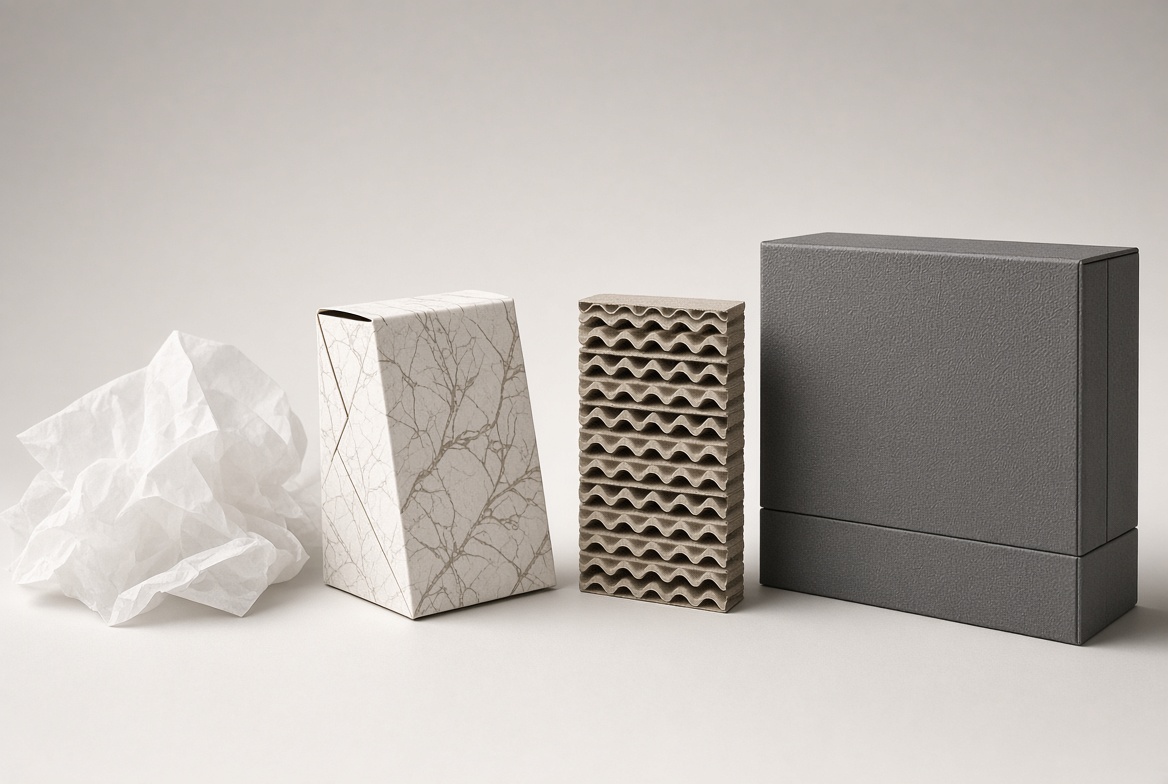
Paper is generally thin, flexible, and easy to fold or wrap. Cardboard is an everyday term for thicker paper-based materials, but it is not a precise material specification. In professional packaging, it may refer to paperboard, corrugated fiberboard, or greyboard used inside rigid boxes.
| Material | Structure | Main Strength | Common Packaging Uses |
|---|---|---|---|
| Paper | Thin, flexible fiber sheet | Light weight and easy wrapping | Tissue paper, wrapping paper, paper bags, inserts |
| Paperboard | Thick, smooth, solid sheet | Print quality and foldability | Folding cartons, sleeves, cosmetic boxes, food boxes |
| Corrugated board | Liner sheets with a fluted middle layer | Cushioning and stacking strength | Shipping cartons, e-commerce boxes, heavy-product packaging |
| Greyboard / chipboard | Dense, compressed recycled fiber board | Rigidity and structural support | Luxury rigid boxes, gift boxes, jewelry boxes, presentation boxes |
The most important point is simple: paper is often chosen for flexibility, while board materials are chosen for structure and protection.
Paper is made from plant-based fibers that are processed into thin sheets. It can be produced with virgin fiber, recycled fiber, or a blend of both. Depending on its grade, paper may be smooth, textured, coated, uncoated, colored, kraft-finished, or highly decorative.
In packaging, paper works best when the package does not need to carry major structural loads.
Typical uses include:
- Tissue paper for luxury product wrapping
- Kraft paper for bags and protective wrapping
- Art paper for printed labels, inserts, and box wraps
- Glassine paper for food, cosmetic, and delicate-product protection
- Specialty textured paper for premium gift-box surfaces
- Paper hang tags, instruction leaflets, and thank-you cards
Paper can create a strong first impression. A textured wrap paper, embossed logo, or carefully selected color can make a rigid gift box feel more refined before the customer even opens it.
However, paper alone is usually unsuitable when the packaging must resist compression, protect fragile items, stack during transport, or retain a fixed box shape.
- Flexible: Easy to fold, wrap, crease, and convert into lightweight formats
- Print-friendly: Suitable for graphic designs, branding details, and many finishing options
- Versatile: Available in many colors, textures, coatings, and fiber compositions
- Efficient: Often a practical option for inserts, wraps, bags, and lightweight secondary packaging
- Recyclable: Many uncoated paper formats can enter common paper-recycling streams, subject to local collection rules
Paper becomes less suitable when the project requires high rigidity or transport protection. It can tear, crease, absorb moisture, and lose shape under pressure. Coatings, lamination, and specialty finishes may improve performance, but they also affect recycling compatibility and cost.
"Cardboard" is a useful everyday word, but packaging professionals need more detail. It does not describe one exact material, thickness, or performance level.
In common conversation, cardboard may mean:
1. Paperboard, the solid sheet used for retail folding cartons.
2. Corrugated fiberboard, the fluted material used for shipping boxes.
3. Greyboard, the dense board used as the core of a rigid gift box.
This distinction matters because each material performs differently. A luxury skincare carton and an e-commerce shipping box may both be called cardboard boxes, yet their material construction, manufacturing process, and purpose are entirely different.
Industry guidance describes corrugated board as a construction made from linerboard and a fluted medium. The fluted layer creates spacing between the outer liners, which helps the board absorb impacts and resist compression.
Paperboard is a thick, solid, and relatively smooth paper-based sheet. It is commonly used to produce folding cartons, product sleeves, retail boxes, display packaging, and printed inserts.
Unlike corrugated board, paperboard does not contain a fluted inner layer. It is valued for its clean surface, accurate die-cutting, foldability, and strong printing results.
For consumer-facing packaging, paperboard is often the best balance of visual quality, moderate protection, and production efficiency.
| Paperboard Type | Typical Characteristics | Suitable Applications |
|---|---|---|
| SBS board | Bright white, smooth, strong print surface | Cosmetics, beauty products, confectionery, premium retail cartons |
| FBB | Multi-layer board with a lighter middle layer | Food cartons, personal-care packaging, consumer goods |
| Kraft board | Natural brown appearance and durable feel | Eco-positioned packaging, apparel boxes, subscription packaging |
| CCNB / duplex board | Recycled-content board, often coated on one side | Value-oriented cartons, household goods, general retail packaging |
| Specialty paperboard | Textured, colored, metallic, or decorative surface | Luxury packaging, invitation boxes, high-end gift sets |
GSM matters, but it is not the whole story. GSM means grams per square meter and indicates material weight. In many packaging projects, a higher GSM can contribute to a denser and more supportive feel, but stiffness also depends on fiber quality, board construction, moisture content, grain direction, and the final box structure.
As a broad working range, paperboard around 250–350 GSM is commonly used for standard cartons, while 350–450 GSM may be selected when the package needs a more substantial retail presence. These figures should be treated as starting points—not universal rules—because the correct board depends on product weight, box dimensions, and the required finish.
Corrugated cardboard, more accurately called corrugated fiberboard, is made of at least three layers:
- An outer liner
- A fluted inner medium
- An inner liner
The fluting acts like a series of small arches. It gives the board thickness, creates cushioning, and helps it handle stacking forces better than a solid paperboard sheet of similar weight.
This is why corrugated packaging is the preferred material for transport cartons, warehouse storage, e-commerce fulfillment, and large or fragile goods.
Choose corrugated board when your packaging must:
- Protect products during long-distance transportation
- Resist crushing in stacked warehouse or courier environments
- Hold heavier products
- Cushion fragile glass, electronics, ceramics, or bottles
- Support direct-to-consumer shipping
- Create large-format displays or mailer boxes
Single-wall corrugated board is widely used for standard shipping cartons. Double-wall and triple-wall structures provide more strength for heavier loads, longer supply chains, or industrial applications.
In the United States, corrugated packaging and displays represent an industry valued at more than $42 billion annually, reflecting its central role in modern distribution systems.

For premium packaging, greyboard is one of the most important materials to understand. It is a dense, thick board made by compressing recycled fibers. It is usually not intended to be the visible outer surface. Instead, it forms the internal structure of a rigid box and is wrapped with printed paper, textured specialty paper, fabric-like paper, or other decorative materials.
At Maituohong Packaging, we use this construction when a brand needs packaging that feels substantial, durable, and gift-worthy.
A rigid box is not simply "thicker cardboard." It is an engineered packaging format. The board thickness, box dimensions, product weight, lid style, insert design, wrap material, and finishing details must work together.
- Premium tactile experience: A firm box communicates value immediately.
- Excellent brand presentation: High-end wraps, foil stamping, embossing, debossing, and spot finishes can be applied to the outer surface.
- Reusable format: Customers often keep rigid boxes for storage, which extends brand visibility.
- Custom structural options: Magnetic closures, shoulder-and-neck boxes, drawer boxes, collapsible rigid boxes, and hinged lids are possible.
- Better unboxing moments: Inserts can hold products precisely and make presentation feel intentional.
A perfume set, jewelry collection, premium tea gift, luxury candle, electronics accessory kit, or corporate gift box may all benefit from a rigid packaging structure.

The best packaging material is not the thickest one. It is the one that meets your product, logistics, branding, and budget requirements without adding unnecessary cost or waste.
Use this practical selection process.
Ask the following questions:
- Is the product fragile, heavy, sharp-edged, or moisture-sensitive?
- Will it be shipped individually through courier networks?
- Does it need internal partitions, foam, molded pulp, or paper inserts?
- Will it be stacked during transport or retail storage?
- Can the product itself reinforce the box, or must the package carry the load?
A lightweight skincare tube may need only a folding carton. A glass bottle set may need a rigid box plus a corrugated shipper. The strongest packaging strategy is often a two-layer system: presentation packaging for the customer and protective transport packaging for delivery.
Packaging is part of the product experience, especially for giftable and premium goods.
If customers see the box on a retail shelf, print quality and structure are critical. If the box is opened on social media or given as a gift, a rigid construction, custom insert, and tactile finishing can make a meaningful difference.
For example, a premium cosmetics brand might use:
- A 350 GSM printed folding carton for a single everyday item
- A wrapped rigid box with a magnetic closure for a holiday gift set
- A corrugated outer shipper for safe e-commerce delivery
Each layer performs a different job. Combining them thoughtfully protects the product while avoiding the mistake of using an expensive luxury box as the only shipping container.
Paperboard and wrapped rigid boxes generally offer the best surface for refined visual branding. They can support:
- Offset printing
- Digital printing for shorter runs or variable artwork
- Matte or gloss lamination
- Soft-touch lamination
- Hot foil stamping
- Embossing and debossing
- Spot UV
- Window patching
- Metallic or textured specialty papers
Corrugated board can also be printed effectively, especially for branded mailers and shipping cartons. However, its surface and flute structure may not deliver the same fine-detail appearance as a high-quality coated paperboard carton or wrapped rigid box.
Material selection should consider the full packaging journey, not just the unit price.
A lower-cost carton may not be economical if it leads to damaged products, poor shelf presentation, or a weak unboxing experience. Likewise, a highly elaborate rigid box may not be necessary for a low-margin product that customers replace frequently.
Consider these cost drivers:
- Material grade and thickness
- Box size and structural complexity
- Printing colors and coverage
- Surface finishing
- Custom inserts
- Order quantity
- Packing method and shipping volume
- Assembly requirements
- Damage risk during distribution
The goal is fit-for-purpose packaging, not maximum material consumption.
GSM is useful, but it does not fully define box performance. A heavier board may not always fold better, print better, or resist compression better. Board grade, grain direction, structure, scoring quality, and product fit all matter.
A folding carton can look excellent but may not survive parcel shipping without added protection. Use corrugated mailers, shipping cartons, or protective void fill when products travel through courier networks.
A premium outer box cannot compensate for a poorly designed insert. If the product moves inside the package, it may arrive damaged or feel cheap during unboxing. The insert should secure the product, support efficient packing, and reinforce the intended presentation.
Paper-based packaging can be a strong material choice, but responsible design requires more than a natural-looking kraft finish. Ask about fiber sourcing, recycled content, coatings, adhesives, inks, mono-material design, and the recycling conditions in your target market.
The difference between paper and cardboard is not merely about thickness. It is about choosing the correct packaging system for the product journey—from factory packing and international shipping to retail display and the final unboxing moment.
Maituohong Packaging brings more than 18 years of experience in custom paper packaging, rigid gift boxes, folding cartons, and tailored packaging solutions. We help brands turn product requirements into practical structures, material specifications, print finishes, and protective inserts.
Share your product size, product weight, target market, order quantity, packaging style, and artwork requirements with our team. We can recommend a custom paperboard, corrugated, or rigid-box solution that protects your product and makes your brand stand out.
Usually, yes. Paper is generally thinner and more flexible, while cardboard is an informal term that often refers to thicker paperboard, corrugated fiberboard, or dense rigid-box board. However, material thickness alone does not determine performance.
Not exactly. Paperboard is a specific solid, thick paper-based material commonly used for folding cartons. Cardboard is a broad everyday term that may refer to paperboard, corrugated board, or greyboard.
A wrapped rigid box made with greyboard is often the preferred choice for luxury gift packaging. It offers a firm structure and can be finished with premium wrap papers, foil stamping, embossing, magnetic closures, and custom inserts.
Use a folding carton for lightweight products, efficient shipping, and strong retail graphics. Use a rigid box when the product has a higher perceived value, needs an elevated gifting experience, or benefits from a durable reusable package.
A paperboard box can be used inside an e-commerce shipment, but it often needs a corrugated mailer or outer shipping carton for transport protection. This is especially important for fragile, heavy, or premium products.
GSM means grams per square meter. It measures the weight of a paper or paperboard sheet. It is useful for comparing materials, but it should be evaluated alongside thickness, stiffness, fiber composition, and box structure.
Corrugated fiberboard is generally the best choice for shipping fragile items because its fluted interior provides cushioning and compression resistance. Combine it with a correctly designed insert and appropriate outer-carton sizing for better protection.
1. [Arkay — Cardboard vs. Paperboard: Structure, Finish & Function]
2. [Fibre Box Association — What Is Corrugated?]
3. [Fibre Box Association — The Corrugated Industry]
4. [Box Genie — Cardboard Thickness Guide]
5. [Gentlever — Choose the Right Paperboard Thickness for Packaging]
6. [Tycoon Packaging — What Is the Difference Between Paper and Cardboard?]


