
Views: 227 Author: Maituohong Packaging Publish Time: 2026-06-27 Origin: Site


Content Menu
● Core Structural Differences: Corrugated vs Cardboard
>> Load‑Bearing and Compression Strength
>> Cushioning and Shock Absorption
● Practical Performance Comparison in E‑commerce and B2B
>> Use Cases for Corrugated Boxes
>> Use Cases for Cardboard Boxes
● Structural Comparison Table – Corrugated vs Cardboard
● Flute Profiles, Board Grades, and Design Implications
>> Flute Types and Performance
>> Board Grades and Edge Crush Test (ECT)
● Industry Case Insight – Why Modern Brands Prefer Corrugated Mailer Boxes
● Expert Design Guidelines – How to Choose the Right Box Type
>> Step‑by‑Step Selection Process
>> Structural UX Considerations
● Where Maituohong Packaging Adds Structural and UX Value
● Action‑Oriented Recommendations for Packaging Decision Makers
● Ready to Optimize Your Packaging Structure? (CTA)
● FAQ
Corrugated boxes and cardboard boxes serve different structural, protective, and branding roles in modern packaging, and understanding these differences is critical for making smart packaging decisions that balance cost, performance, and customer experience. [b2bwiki.baidu]
The terms corrugated box and cardboard box are often used interchangeably in everyday business conversations, but from a packaging engineering perspective they refer to two structurally different materials and performance profiles. For manufacturers and brand owners working with mailer boxes and shipping boxes, clarifying this distinction helps avoid under‑spec'd packaging that fails in transit or over‑engineered solutions that waste budget. [gentlever]
Corrugated boxes are built from corrugated fiberboard, a composite structure formed by a fluted (wavy) medium sandwiched between one or two flat linerboards. This multi‑layer design creates a lightweight but high‑strength material that resists crushing, provides cushioning, and tolerates stacking pressure in logistics environments. [b2bwiki.baidu]
Typical corrugated box types include:
- Regular Slotted Cartons (RSC) – standard shipping cartons for bulk transport. [b2bwiki.baidu]
- Corrugated mailer boxes – die‑cut self‑locking boxes for e‑commerce packaging and branded unboxing. [tw.huandaopackaging]
- Double‑wall and triple‑wall boxes – heavy‑duty options for industrial and export packaging. [b2bwiki.baidu]
From a structural standpoint, the key advantage is the fluted core, which acts as a shock‑absorber and load‑bearing structure during transport. [b2bwiki.baidu]
In packaging practice, "cardboard" usually refers to paperboard or solid board: a single, relatively dense sheet without internal flutes. Cardboard boxes are commonly used for folding cartons, retail sleeves, and rigid gift boxes where visual appeal and precise printing matter more than high stacking strength. [milliontoppapers]
Common cardboard box formats include:
- Folding cartons for cosmetics, pharmaceuticals, and small consumer goods. [b2bwiki.baidu]
- Rigid cardboard gift boxes with greyboard or chipboard cores, often wrapped with art paper. [milliontoppapers]
- Sleeves and inserts used inside corrugated shippers for product presentation and separation. [b2bwiki.baidu]
Because cardboard lacks a fluted core, it offers less cushioning and compression strength but a smoother print surface and sharper die‑cut details for premium branding. [b2bwiki.baidu]
- Corrugated boxes: Linerboard + fluted medium; single‑wall, double‑wall, or triple‑wall constructions. [b2bwiki.baidu]
- Cardboard boxes: Solid paperboard or greyboard; single‑ply or laminated but typically non‑fluted. [b2bwiki.baidu]
This fundamental difference in material composition drives performance in stacking, impact resistance, and overall durability. [b2bwiki.baidu]
Independent packaging guides consistently show that corrugated fiberboard offers significantly higher compression strength than comparable thickness cardboard due to its I‑beam‑like structure created by the flute and liners. Corrugated boxes can sustain vertical stacking loads during warehousing and transport, while cardboard boxes are more prone to panel bowing and edge crushing under similar conditions. [b2bwiki.baidu]
The air pockets within the fluted medium in corrugated board provide built‑in cushioning, reducing the need for additional void‑fill materials for many product categories. Cardboard boxes, in contrast, rely more heavily on inserts, foam, or wraps to protect fragile items, because the solid board itself contributes little to shock absorption. [b2bwiki.baidu]

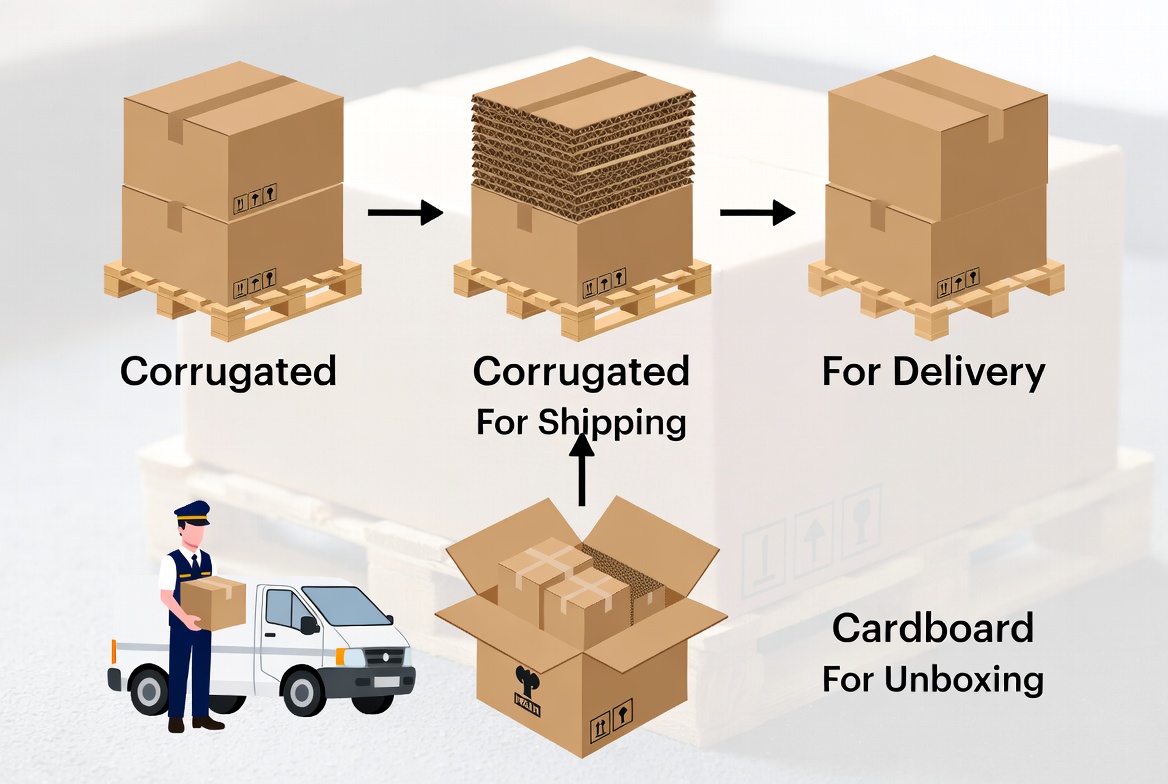
For companies shipping products through parcel networks, the structural choice between corrugated and cardboard directly impacts damage rates, freight efficiency, and unboxing experience. From an operational perspective, corrugated boxes dominate outbound logistics and shipping, while cardboard boxes play a leading role in retail presentation and inner packaging. [gentlever]
- Primary shipping carton for B2B orders and e‑commerce deliveries requiring stackability and drop resistance. [gentlever]
- Custom corrugated mailer boxes for D2C brands seeking branded packaging that still meets carrier performance requirements. [tw.huandaopackaging]
- Heavy or multi‑item shipments where dimensional stability and compression strength are critical. [b2bwiki.baidu]
- Retail‑ready packaging with high‑end printing, spot UV, or foil stamping for shelf impact. [milliontoppapers]
- Rigid cardboard gift boxes for premium products, luxury sets, and corporate gifting where tactile feel and perceived value matter. [milliontoppapers]
- Product‑level inner cartons placed inside a corrugated shipping box to separate SKUs and enhance presentation. [b2bwiki.baidu]
| Factor | Corrugated Boxes | Cardboard Boxes |
|---|---|---|
| Internal structure | Fluted medium + linerboards (b2bwiki.baidu) | Solid paperboard or greyboard (b2bwiki.baidu) |
| Compression strength | High; suitable for stacking and palletization (b2bwiki.baidu) | Moderate; limited stacking capacity (b2bwiki.baidu) |
| Cushioning | Built‑in shock absorption due to air pockets (b2bwiki.baidu) | Minimal; relies on external cushioning (b2bwiki.baidu) |
| Weight‑to‑strength ratio | Optimized; strong yet relatively light (b2bwiki.baidu) | Heavier for equivalent strength (b2bwiki.baidu) |
| Printability | Good; now compatible with high‑quality digital/offset printing (yucai-box) | Excellent; smoother surface for fine graphics (milliontoppapers) |
| Typical applications | Shipping boxes, mailer boxes, industrial cartons (tw.huandaopackaging) | Folding cartons, rigid gift boxes, retail sleeves (b2bwiki.baidu) |
This structural comparison illustrates why most packaging strategies combine both materials rather than relying on just one across the entire supply chain. [b2bwiki.baidu]
Corrugated boxes can be specified with different flute profiles (such as B‑flute, C‑flute, E‑flute) to balance cushioning, print surface, and space efficiency. Larger flutes enhance cushioning and stacking strength; smaller flutes offer better printability and more compact box designs for e‑commerce mailers. [b2bwiki.baidu]
Designers often use E‑flute corrugated for branded mailer boxes that require both structural integrity and refined graphic reproduction, making it a hybrid solution between logistics performance and retail aesthetics. [tw.huandaopackaging]
Board grades and performance metrics such as Edge Crush Test (ECT) are standard tools for structurally specifying corrugated boxes for particular weights and stacking conditions. By selecting the right ECT rating and flute type, packaging engineers can precisely match box strength to product mass and shipping environment, minimizing both failures and unnecessary material usage. [b2bwiki.baidu]
Recent e‑commerce packaging practices show that many D2C and subscription brands have shifted from plain cardboard cartons to custom corrugated mailer boxes for outer packaging, while retaining cardboard inserts or sleeves for internal presentation. This hybrid approach recognizes that customer satisfaction depends on both transit performance and unboxing quality. [tw.huandaopackaging]
In practice, businesses specify corrugated mailer boxes with branded printing on the outer and inner panels, then use cardboard dividers, rigid gift boxes, or folding cartons inside to elevate product display and perceived value. This structural hierarchy ensures that the transport packaging absorbs impact and stacking stress, while the inner cardboard elements focus purely on aesthetics and product storytelling. [tw.huandaopackaging]
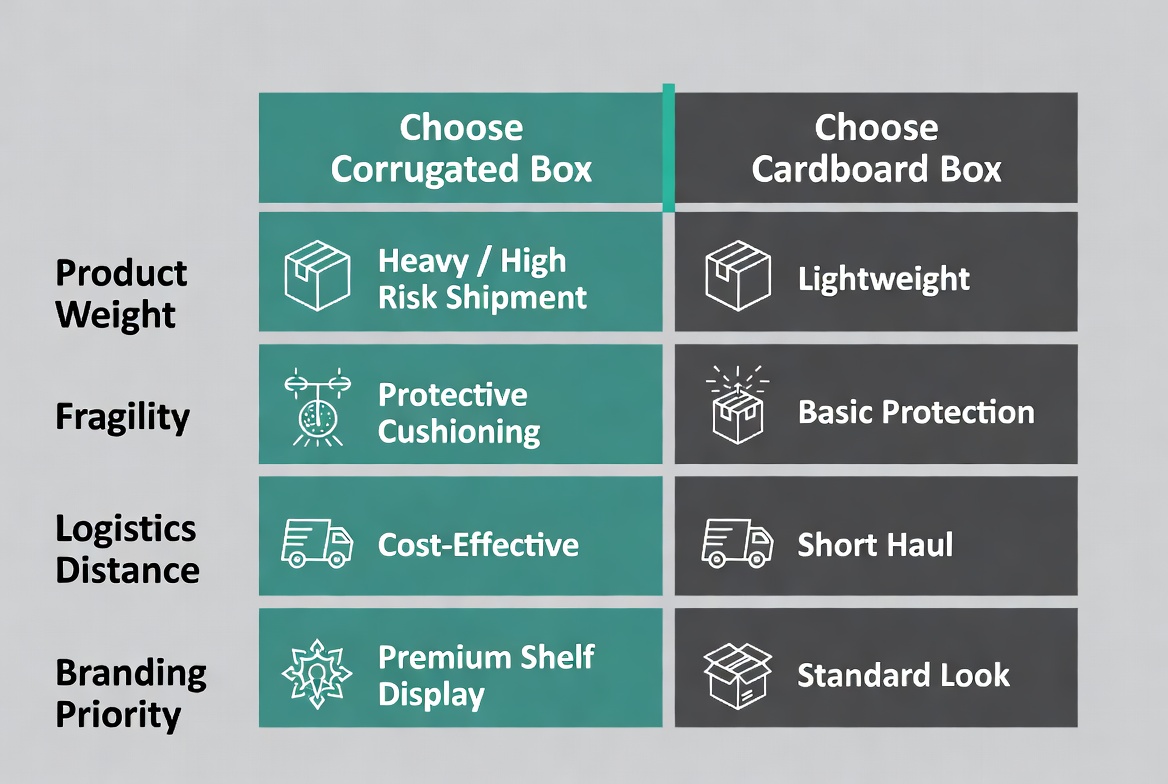
From a packaging and UX standpoint, the most effective approach is to match structural decisions to product risk profile, logistics route, and brand positioning. The following practical steps provide a decision path that packaging managers and e‑commerce teams can use. [b2bwiki.baidu]
1. Assess product fragility and weight
- High‑risk, heavy, or multi‑item shipments usually require corrugated boxes as the primary structure. [b2bwiki.baidu]
- Low‑risk, lightweight items can often be placed in cardboard cartons inside a corrugated shipper. [b2bwiki.baidu]
2. Map the logistics journey
- Long‑distance, multi‑hub, or international routes favor corrugated boxes because of superior compression and impact resistance. [b2bwiki.baidu]
- Short‑distance B2C deliveries may allow more flexibility but still benefit from corrugated mailers to reduce damage rates. [gentlever]
3. Define brand experience goals
- If unboxing and visual storytelling are central to the brand, integrate printed cardboard elements (rigid boxes, sleeves, inserts) inside corrugated outers. [milliontoppapers]
- Use higher‑grade corrugated with better print surfaces (such as coated liners) to keep the outer shipper aligned with brand visuals. [yucai-box]
4. Optimize material usage and sustainability
- Match board grade and flute profile to the exact load case to avoid over‑specification that increases material use and freight weight. [b2bwiki.baidu]
- Consider recyclable mono‑material solutions where both corrugated and cardboard components are fiber‑based and easily sorted. [bmpack]
From a UX perspective, customers rarely distinguish "corrugated versus cardboard" explicitly, but they immediately notice crushed corners, dented panels, or flimsy boxes in transit. Thoughtful structural selection, therefore, becomes part of the overall user experience, supporting brand trust and perceived product quality even before the product is touched. [gentlever]
As a manufacturer specializing in custom mailer boxes, shipping boxes, and high‑quality rigid cardboard gift boxes, Maituohong Packaging operates at the intersection of structural engineering and branded presentation. With decades of experience in paper‑based packaging solutions, such producers typically support global clients by translating product requirements into practical corrugated‑and‑cardboard combinations tailored to each use case. [bmpack]
This dual capability means businesses can source:
- Corrugated shipping and mailer boxes engineered to specific ECT, flute, and stacking requirements for B2B and e‑commerce channels. [b2bwiki.baidu]
- Rigid cardboard gift boxes and premium sleeves that elevate the unboxing experience and serve as long‑term storage or display packaging. [milliontoppapers]
For brands looking to unify structural performance with visual impact, collaborating with a specialist packaging manufacturer enables integrated design reviews that cover logistics testing, material specification, and graphic execution in one workflow. [bmpack]
For procurement managers, e‑commerce leaders, and brand owners, the practical takeaway is to stop treating "corrugated vs cardboard" as a binary choice and instead view them as complementary tools in a tiered packaging architecture. Doing so supports both operational KPIs (damage rate, freight efficiency) and marketing KPIs (brand perception, repeat purchase intent). [b2bwiki.baidu]
To move from theory to implementation:
- Use corrugated boxes as your default outer packaging for any shipment that experiences stacking, long‑distance transport, or multi‑carrier handling. [gentlever]
- Reserve cardboard boxes for inner packaging, rigid gift sets, and high‑impact retail cartons where structural load is low but visual quality must be high. [milliontoppapers]
- Work with specialized packaging partners to validate board grades, flute profiles, and print methods through prototypes and transit simulations before scaling. [bmpack]
If your brand is currently using generic "cardboard boxes" for all shipments, there is a strong chance you are either over‑paying for materials or under‑protecting your products in transit. Partnering with a dedicated mailer box and shipping box manufacturer allows you to redesign your structural mix, combining corrugated outers with cardboard inners to improve protection, enhance unboxing, and reduce total packaging cost over time. [bmpack]
To take the next step, review your top SKUs, damage reports, and customer feedback, then engage a packaging specialist to re‑engineer your box specifications and sampling plan around the principles outlined in this article. [b2bwiki.baidu]
Q1: Are corrugated boxes always stronger than cardboard boxes?
Corrugated boxes generally provide higher compression strength and better shock absorption than cardboard boxes because of their fluted internal structure, though exact performance depends on board grade and design. [b2bwiki.baidu]
Q2: Can I print high‑quality graphics on corrugated boxes?
Yes, modern corrugated packaging supports high‑quality offset and digital printing, especially when using finer flute profiles and suitable top liners, making it viable for branded mailer boxes and retail‑ready shippers. [yucai-box]
Q3: When should I choose rigid cardboard gift boxes over corrugated mailers?
Rigid cardboard gift boxes are ideal when the packaging must function as a long‑term storage or display box, with premium finishes and a luxury feel, while corrugated mailers remain better suited for shipping and logistics performance. [milliontoppapers]
Q4: How can I reduce damage rates in e‑commerce shipping?
You can lower damage rates by specifying corrugated boxes with appropriate flute types and board grades, using inserts where needed, and validating designs with transit testing before scaling. [b2bwiki.baidu]
Q5: Are corrugated and cardboard packaging both recyclable?
Most corrugated and cardboard packaging is fiber‑based and widely recyclable, though recyclability can be affected by coatings, laminates, or mixed‑material components, so design choices should consider downstream sorting and recovery. [bmpack]
1. Baidu B2B Wiki – Packaging material classification and selection guide. https://b2bwiki.baidu.com/article/d0iv4q9ftjspaspagf2g
2. Gentlever – Overview of mailer vs shipping box performance in business logistics. https://gentlever.com/%E9%82%AE%E5%AF%84%E7%9B%92%E4%B8%8E%E8%BF%90%E8%BE%93%E7%9B%92/
3. Huandao Packaging – Mailer box types, materials, and brand‑fit guidance. https://cn.huandaopackaging.com/newsinfo-what-is-a-mailer-box.html
4. Yucai Packaging – "Colored Corrugated Mailer Boxes – Durable, Customizable and Eye‑Catching Packaging" – Insights into high‑quality printed corrugated mailer boxes. https://www.yucai-box.com/colored-corrugated-mailer-boxes-durable-customizable-and-eye-catching-packaging/
5. BMPACK – Standard packaging materials for mailer boxes, cartons, and paper boxes. https://bmpack.com/articles/Material2
6. Million Top Papers – Custom paper box packaging manufacturer – Portfolio of rigid cardboard gift boxes and paper packaging solutions. https://www.milliontoppapers.com/


