
Views: 268 Author: Maituohong Packaging Publish Time: 2026-09-04 Origin: Site


Content Menu
● What Is E-Commerce Packaging?
● Why Custom Shipping Boxes Matter
● Start With the Product, Not the Artwork
>> A Simple Packaging Fit Formula
● Choose the Right Corrugated Material
>> Common Material Considerations
● Design for Protection Before Unboxing
>> Protective Features Worth Considering
● Test a Prototype Before Ordering in Bulk
● Build a Better Unboxing Experience
● Reduce Total Packaging Cost, Not Only Box Price
>> Questions to Ask Before Selecting a Box
● Responsible Packaging Choices
● Work With a Custom Packaging Manufacturer
● Create Packaging That Performs
>> What is the best material for custom mailer boxes?
>> What is the difference between a mailer box and a shipping box?
>> How do I choose the right size shipping box?
>> Can custom mailer boxes be printed inside and outside?
>> Do I need an insert inside a shipping box?
>> Are kraft shipping boxes suitable for premium brands?
>> Should I approve a sample before bulk production?
For an online brand, packaging is not simply a container for delivery. Custom e-commerce packaging protects the product, controls fulfilment costs, communicates brand quality, and shapes the customer's first physical interaction with the order.
At Maituohong Packaging, we have spent more than 18 years designing and manufacturing custom paper packaging, including mailer boxes, shipping boxes, rigid gift boxes, and tailored packaging systems. From our production-floor perspective, the most successful e-commerce box is rarely the most decorated one. It is the box that fits the product accurately, survives its delivery journey, opens easily, and makes the customer feel that the brand has paid attention to every detail.
This guide explains how to choose, design, test, and improve custom mailer boxes and shipping boxes for modern e-commerce operations.

E-commerce packaging is the complete packaging system used to prepare an online order for storage, shipping, delivery, unboxing, and—when necessary—returns.
It may include:
- A custom mailer box or corrugated shipping box
- Inner paperboard trays, dividers, or inserts
- Tissue paper, paper void fill, or protective wraps
- Branded stickers, thank-you cards, and instruction cards
- Tamper-evident labels or sealing tape
- Return information and product-care guidance
The outer box has a practical job: it must help the product arrive intact. But it also has a commercial job. It introduces the brand before the customer sees the product itself.
A weak packaging system can create multiple problems at once: damaged items, more customer-service work, poor reviews, unnecessary shipping volume, and a forgettable unboxing moment. A well-planned packaging system can reduce those risks while helping a brand look more consistent and professional.
Custom shipping boxes matter because an online purchase has no store shelf, salesperson, or physical display to reassure the customer. The parcel is the brand experience.
When a customer receives an order, they notice several things almost immediately:
1. Whether the box looks clean and undamaged
2. Whether the parcel feels appropriately sized for the item
3. Whether the package is easy to open
4. Whether the product is protected inside
5. Whether the presentation feels aligned with the price they paid
This means packaging influences perception before the product is even used.
A custom corrugated mailer box can help a business create a stronger delivery experience without adding unnecessary complexity. It can carry a logo, brand color, simple instructions, a message of thanks, or a QR code that leads customers to product guides, reorder pages, or support information.
However, branding should not come at the expense of function. Protection comes first; presentation works best when it is built on a reliable structure.
Although the terms are often used interchangeably, a mailer box and a shipping box can serve different roles.
| Packaging Type | Typical Structure | Best For | Main Advantage | Key Consideration |
|---|---|---|---|---|
| Custom mailer box | Self-locking corrugated box with an attached lid | Apparel, cosmetics, gifts, subscription kits, small electronics, lifestyle products | Strong unboxing presentation and simple assembly | Must be sized correctly to avoid internal movement |
| Corrugated shipping box | Regular slotted carton or custom die-cut shipper | Bulkier products, heavier items, warehouse shipments, secondary packaging | Flexible, durable, and cost-efficient for transport | Usually needs tape and may require protective inserts |
| Rigid gift box | Premium paperboard construction, often with separate lid or magnetic closure | Luxury gifts, premium cosmetics, jewelry, high-value sets | High perceived value and refined presentation | Often needs an outer shipping carton for transit |
| Paperboard folding carton | Lightweight printed carton | Retail-ready products, lightweight goods, inner packaging | Excellent print quality and shelf presentation | May not provide sufficient protection alone |
For many brands, the best answer is a two-layer system:
- A branded folding carton or rigid box presents the product.
- A corrugated mailer box or shipping box protects it during delivery.
This approach is particularly useful for premium products. It allows the inner package to look refined while the outer mailer handles compression, drops, vibration, and handling during transportation.
One of the most common mistakes in custom packaging projects is starting with colors, logos, or visual inspiration before confirming the product's packaging requirements.
In our experience, brands achieve better results when they begin with the physical reality of the item:
- Product dimensions
- Product weight
- Fragility level
- Surface sensitivity
- Number of items per order
- Required accessories or documents
- Expected delivery route
- Storage environment
- Return process
For example, a skincare set with glass bottles needs a very different solution from a folded T-shirt, even if both are sold through the same online store. The skincare set may need a fitted insert, protective spacing, and reinforced corrugated board. The apparel brand may benefit from a lightweight, branded mailer box that minimizes empty space and keeps the garment neatly folded.
The goal is not to make the box as small as possible. The goal is to create controlled space.
A practical structure is:
Box interior=product size+protective allowance+packing tolerance
Too little allowance can cause pressure damage, difficult packing, or crushed corners. Too much allowance can allow the item to shift, increase material usage, and raise dimensional shipping costs.
A proper fit should let the packing team load the product efficiently while preventing unnecessary movement inside the box.
Corrugated board is popular for e-commerce packaging because it combines low weight with useful structural strength. It can also be converted into many styles, from simple kraft mailer boxes to high-impact full-color shipping boxes.
The correct material depends on the item, distribution route, and desired appearance.
Single-wall corrugated board is widely used for standard mailer boxes and lightweight-to-medium products. It offers a balance between protection, cost, and print flexibility.
Double-wall corrugated board is more suitable for heavier, fragile, or larger products. It provides greater strength but adds material, weight, and cost.
Kraft linerboard gives a natural, industrial, or environmentally conscious appearance. It works especially well with black ink, one-color logos, minimal graphics, and simple typography.
White linerboard provides a cleaner surface for branded printing. It can make colors appear brighter and is often chosen by beauty, apparel, gift, and consumer-product brands.
Recycled-content board can support material-reduction and responsible-sourcing goals, but it should still be selected based on performance needs. A box should not sacrifice product protection merely to make a broad environmental claim.
The right specification is always connected to the actual delivery environment. A box used for local direct delivery may need a different construction than a box sent through multiple sorting facilities, long-haul transportation, or international fulfilment.
A beautiful mailer box is not successful if the product arrives broken, scratched, leaking, or loose.
For fragile or high-value items, build protection into the design from the start rather than adding excessive filler later. This approach often produces a cleaner unboxing experience and a more consistent packing process.
- Die-cut inserts to hold products in a fixed position
- Corrugated dividers to separate multiple items
- Paperboard sleeves to protect delicate surfaces
- Corner protection for framed goods, electronics, and glass products
- Paper void fill to reduce movement in larger boxes
- Tamper-evident seals for products that need added customer confidence
- Moisture-aware material choices for products exposed to humidity or temperature changes
For a glass candle set, for instance, a correctly designed insert can keep each vessel separated and centered. This is usually more effective than placing several loose candles in a large box with a large amount of filler.
A well-engineered insert also makes packing faster because the warehouse team does not need to decide how to arrange the contents each time.
A physical sample is one of the most valuable steps in any custom packaging project.
Digital artwork can show layout, color placement, and approximate proportions. It cannot fully confirm the feel of the material, the accuracy of the fit, the folding sequence, the opening experience, or how the box performs with the actual product inside.
Before approving a large production order, test a prototype using the real product and the real packing method.
1. Confirm that the product fits without excessive pressure.
2. Shake the packed box gently to check for internal movement.
3. Review whether inserts are easy for staff to assemble.
4. Open the box as a customer would and look for frustration points.
5. Check logo placement, print clarity, color consistency, and barcodes.
6. Evaluate whether the package can be resealed for returns if required.
7. Simulate basic handling by checking corners, closures, and compression resistance.
8. Ask fulfilment staff whether the design slows down or simplifies packing.
For products with higher shipping risk, brands should consider formal transit-performance testing. E-commerce testing protocols can simulate hazards such as drops, vibration, impacts, and environmental conditioning. Packaging programs associated with major marketplaces also emphasize easy opening, reduced excess material, and performance during distribution.
The lesson is straightforward: do not rely on appearance alone to approve packaging.

Unboxing does not need to be expensive to be memorable. In many cases, clarity and consistency matter more than elaborate decoration.
A simple branded corrugated mailer box can create a strong impression when it includes:
- A clean exterior logo
- A carefully placed opening message
- Tissue paper or a protective paper wrap
- A product-care card or welcome note
- A QR code for setup guidance, support, reviews, or reordering
- A clear return instruction card
The best unboxing experience feels intentional. It should guide the customer naturally from opening the box to seeing the product, understanding how to use it, and knowing what to do if they need help.
Avoid making the customer work too hard. Excess tape, difficult-to-remove seals, confusing layers, and oversized boxes can make a premium product feel inconvenient rather than special.
Consumer packaging research continues to highlight the connection between packaging quality, delivery condition, and brand perception. Recent survey findings also show that parcel damage remains an important concern for online shoppers, even as reported damage rates have improved over time. This reinforces the value of getting the packaging system right before it reaches the customer.
The lowest unit price is not always the lowest packaging cost.
A cheaper box can become expensive if it increases product damage, needs extra labor, occupies more warehouse space, or raises freight charges because of unnecessary size.
A more useful way to assess packaging is through total cost:
Total Packaging Cost=Box Cost+Packing Labor+Freight Impact+Damage Cost+Return Cost
For example, a slightly stronger custom mailer box may cost more per unit than a standard stock carton. But if it removes the need for additional void fill, speeds up packing, and reduces damage-related replacements, it may create a better overall result.
- Does the box reduce unused internal volume?
- Can one person assemble it quickly?
- Does it require tape, labels, or extra packing materials?
- Can it stack efficiently in storage?
- Does it protect the product through the expected shipping route?
- Will its dimensions affect carrier charges?
- Can it support the brand's desired customer experience?
- Is the minimum order quantity aligned with actual sales volume?
A good packaging supplier should discuss these questions early. The purpose is not merely to sell a box. It is to help create a system that works across procurement, warehousing, fulfilment, transport, and customer experience.
Many buyers now expect packaging to use materials thoughtfully and avoid obvious waste. But responsible packaging is not only about choosing a recycled-looking material or printing a sustainability message on the box.
A more credible approach considers the full system:
- Use a box size that reduces unnecessary empty space.
- Choose paper-based materials that match the actual protection requirement.
- Reduce avoidable layers, plastic components, and excess filler.
- Design inserts that secure the product efficiently.
- Use clear disposal guidance only where it is accurate for the relevant market.
- Consider reuse or easy return designs where appropriate.
- Avoid claims that cannot be verified or understood by customers.
The most practical principle is material reduction without product compromise. A damaged product may require replacement shipping, additional packaging, and disposal of both the original item and its package. Preventing damage is therefore part of responsible packaging design.
A strong packaging project requires clear communication between the brand and manufacturer. The more complete the initial brief, the faster the development process becomes.
When requesting a quotation for custom mailer boxes or shipping boxes, prepare the following information:
- Box style and intended use
- Internal length, width, and height
- Product weight and dimensions
- Expected order quantity
- Required board material or preferred look
- Print colors and artwork files
- Finishing requirements, such as matte coating, gloss coating, foil stamping, embossing, or spot effects
- Insert or divider requirements
- Delivery destination and schedule
- Whether samples or prototypes are required
At Maituohong Packaging, we support brands that need more than a standard carton. Our team can help turn product requirements into practical paper packaging solutions, from protective shipping boxes to presentation-focused mailer boxes and premium rigid gift boxes.
The best time to involve a packaging manufacturer is before the design is finalized. Early collaboration can prevent costly problems related to sizing, structure, printing limitations, assembly, and transport protection.
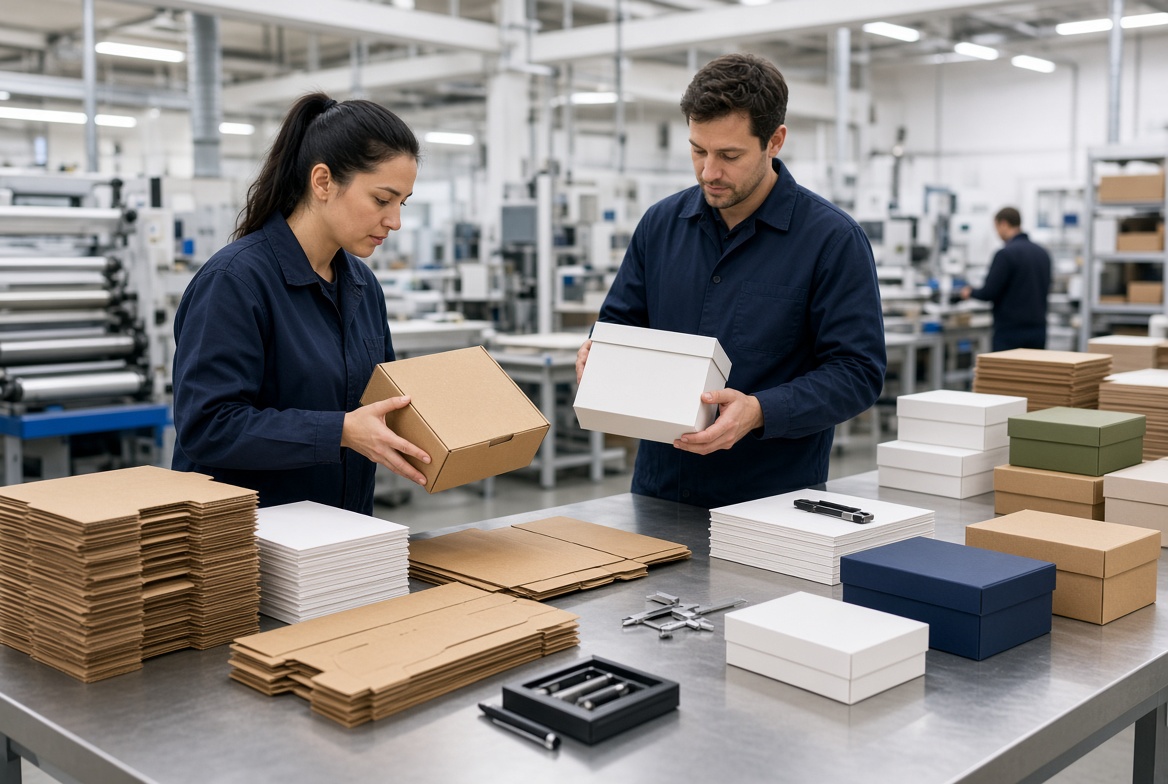
The right custom e-commerce packaging protects the product, supports efficient fulfilment, and turns delivery into a meaningful brand moment. It should be appropriately sized, easy to pack, easy to open, visually consistent, and strong enough for the realities of distribution.
If you are developing custom mailer boxes, shipping boxes, rigid gift boxes, or paper packaging inserts, Maituohong Packaging can help you move from concept to production with practical structural guidance and tailored manufacturing support. Share your product dimensions, artwork, target quantity, and delivery requirements to begin building a packaging solution that fits your brand and your supply chain.
Corrugated board is usually the best starting point for custom mailer boxes because it offers useful protection, low weight, flexible sizing, and strong branding potential. The required board grade should be selected according to the product's weight, fragility, and shipping route.
A mailer box is commonly a self-locking, presentation-friendly corrugated box used for direct-to-consumer orders. A shipping box is a broader term that may include taped cartons, heavy-duty corrugated cartons, and other transport-focused structures.
Measure the product at its widest points, then add enough space for protective materials and packing tolerance. The box should prevent the product from moving freely but should not compress the product or require excessive force to close.
Yes. Printing can be added to the outside, inside, or both, depending on the box style, artwork, print method, and project budget. Inside printing can add impact to the unboxing experience, while outside printing strengthens delivery-stage brand recognition.
An insert is recommended when the product is fragile, contains multiple components, has an irregular shape, or needs to stay in a specific orientation. Inserts can reduce movement and make packing more consistent.
Yes. Kraft boxes can look premium when paired with clean typography, strong logo placement, refined print choices, and a well-designed opening experience. Premium packaging depends on execution, structure, and customer usability—not only on bright colors or heavy decoration.
Yes. A physical sample helps confirm dimensions, fit, print appearance, material feel, folding performance, and ease of opening. For products with high damage risk, further transit testing should also be considered before scaling production.
1. [Tycoon Packaging — E-Commerce Packaging: A Beginner's Guide]
2. [International Safe Transit Association — Packaging Testing and Standards]
3. [Tektronix — Amazon APASS Package Testing]
4. [Sustainable Packaging Coalition — Packaging Design Resources]
5. [Packaging Dive — Sustainable Packaging Development Principles]
6. [Macfarlane Packaging — 2025 Unboxing Survey Highlights]
7. [VistaPrint — Shipping, Returns, and Brand Perception Survey]


