
Views: 210 Author: Maituohong Packaging Publish Time: 2026-09-22 Origin: Site


Content Menu
● Paper Bags vs. Corrugated Boxes at a Glance
● What Is a Paper Shopping Bag?
>> Key Strength Factors for Paper Bags
>> Why Corrugated Boxes Protect Products Better
● The Most Important Differences: Carrying vs. Shipping
>> 3. Shipping Cost and Dimensional Efficiency
● When Should You Choose Paper Bags?
● When Should You Choose Corrugated Boxes?
● How to Select the Right Packaging Format
>> Step 1: Map the Handling Journey
>> Step 2: Identify the Primary Risk
>> Step 3: Build a Layered Packaging System
● Environmental Considerations: Look Beyond the Material Name
>> Practical Ways to Improve Paper-Based Packaging
● Expert Insight: The Cost of Under-Packaging
● Common Packaging Mistakes to Avoid
>> Choosing by Appearance Alone
>> Oversizing Corrugated Boxes
>> Ignoring Handle Load Capacity
>> Treating One Package as the Entire Solution
● FAQ
>> 1. Are paper bags stronger than plastic bags?
>> 2. Can paper bags be used for e-commerce shipping?
>> 3. What is the difference between cardboard and corrugated cardboard?
>> 4. Which is better for luxury packaging: a paper bag or corrugated box?
>> 5. Can corrugated boxes be custom printed?
>> 6. How do I choose the right paper bag size?
>> 7. How do I choose the right corrugated box strength?
Choosing between paper bags and corrugated boxes is not simply a question of appearance. It affects product protection, freight efficiency, customer experience, printing possibilities, assembly time, and the final impression your brand leaves after a purchase or delivery.
At Maituohong Packaging, we have spent more than 18 years developing custom paper packaging, including Paper Shopping Bags, rigid gift boxes, and tailored paper-based packaging solutions. From our production-floor experience, the best choice depends on one critical question: Is the packaging mainly for carrying, presenting, protecting, or shipping the product?
Paper bags are usually designed for convenient carrying and brand visibility at the point of sale. Corrugated boxes are engineered primarily for structural strength, stacking performance, and transport protection. In many successful packaging programs, companies use both: a corrugated box for logistics and a branded paper bag or gift package for the customer-facing experience.
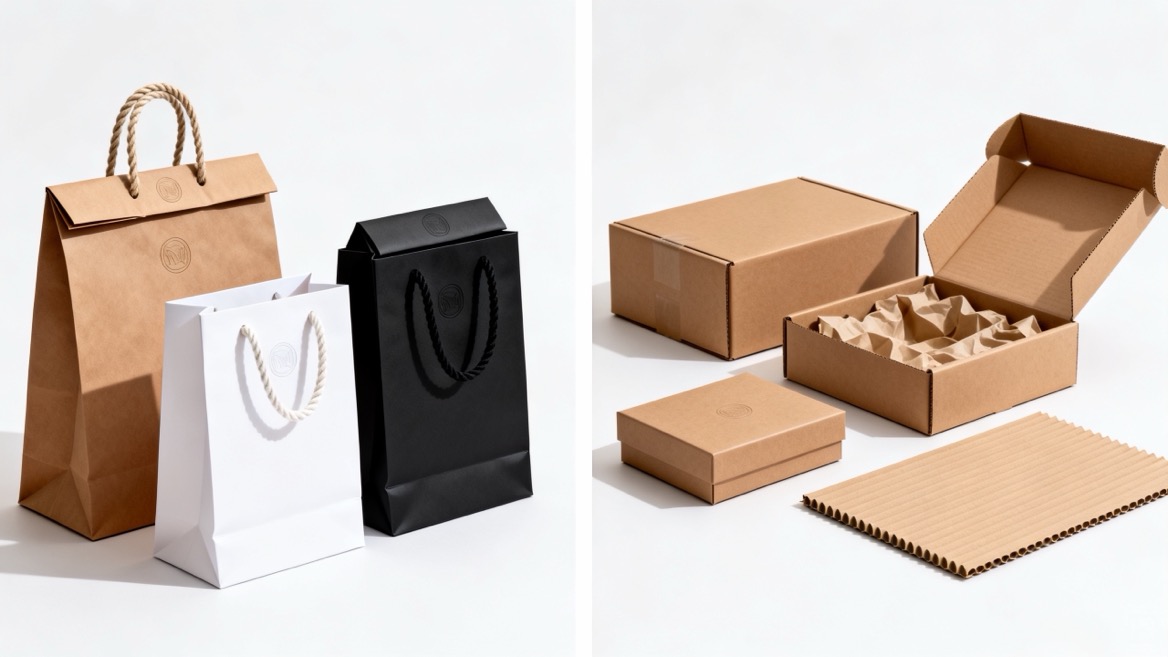
The table below summarizes the primary differences between a paper shopping bag and a corrugated cardboard box.
| Feature | Paper Bags | Corrugated Boxes |
|---|---|---|
| Main purpose | Carrying purchases, retail presentation, gift packaging | Shipping, storage, stacking, product protection |
| Material structure | Single-layer or multi-layer paper, often kraft paper or coated art paper | Fluted corrugated medium placed between linerboards |
| Strength | Suitable for lightweight to medium-weight items when properly specified | Suitable for heavier, fragile, bulky, or stacked products |
| Brand presentation | Excellent for logos, colors, finishes, handles, and premium retail appeal | Good for shipping graphics, instructions, barcodes, and transport branding |
| Shipping protection | Limited unless combined with inserts or secondary packaging | Strong resistance to compression, puncture, and impact |
| Reusability | Often reused by consumers for shopping, storage, or gifting | Often reused for returns, storage, moving, and shipping |
| Typical applications | Boutiques, cosmetics, apparel, food service, events, gifts | E-commerce, export shipments, electronics, industrial parts, bulk distribution |
| Assembly | Usually supplied ready to use | May arrive flat and require forming, taping, or locking |
| Freight efficiency | Efficient for retail distribution but less protective in transit | Ships flat before assembly and protects goods efficiently in transit |
| Best use case | In-store customer experience | Product transportation and warehouse distribution |
The simplest rule: choose paper bags when your priority is presentation and portability; choose corrugated boxes when your priority is protection and logistics.
A paper shopping bag is a carry bag made from paper-based materials, typically kraft paper, white paper, coated paper, or specialty textured paper. It may include twisted paper handles, flat paper handles, cotton rope handles, ribbon handles, die-cut handles, or reinforced folded tops.
Unlike a shipping carton, a paper bag is visible to customers during and after a purchase. It functions as both packaging and a mobile brand display.
The right paper grade changes how a bag looks, feels, and performs.
- Brown kraft paper offers a natural, durable, and understated look. It is commonly selected for grocery, takeaway, organic products, coffee shops, and environmentally conscious retail brands.
- White kraft paper provides a cleaner surface for colorful artwork while retaining a paper-based appearance.
- Coated art paper supports sharper printing, richer colors, and premium finishing options such as lamination, foil stamping, embossing, and spot UV.
- Recycled paper can communicate resource-conscious positioning, although its surface texture, color consistency, and print quality should be reviewed before final approval.
- Specialty paper can add tactile value for luxury gifts, cosmetics, jewelry, fashion accessories, and high-end promotional campaigns.
A premium paper shopping bag can become part of the product experience. For example, a boutique may use a thick art-paper bag with cotton handles, hot stamping, and a reinforced base. The customer does not see it as disposable packaging alone; they may keep and reuse it.
A paper bag's performance does not depend on paper weight alone. It depends on the complete construction.
Important factors include:
- Paper type and basis weight
- Bag width, gusset depth, and height
- Bottom construction and glued seams
- Reinforced cardboard bottom inserts
- Reinforced folded top cards
- Handle material and handle attachment method
- Product weight and shape
- Whether the contents have sharp corners, moisture, or uneven weight distribution
A bag designed for a lightweight scarf will not necessarily work for glass bottles, hard-cover books, ceramic products, or multiple boxed items. For heavier retail goods, reinforced bottoms and handle patches are essential.
A corrugated box is made from corrugated fiberboard. This material has at least three layers: an outer linerboard, a fluted medium, and an inner linerboard. The fluted layer creates air spaces that improve cushioning, stiffness, and compression strength.
This structure is why corrugated boxes are widely used for e-commerce, export packaging, warehousing, industrial distribution, and retail replenishment.
The flute is the wavy middle layer inside corrugated board. Different flute profiles influence thickness, cushioning, crush resistance, and print appearance.
Common options include:
- Single-wall board: One fluted medium between two linerboards. Suitable for many general shipping applications.
- Double-wall board: Two fluted layers and three linerboards. Suitable for heavier products, longer transport routes, and higher stacking requirements.
- Triple-wall board: Three fluted layers and four linerboards. Often used for very heavy industrial goods and palletized shipments.
Box strength is not determined by thickness alone. A well-designed carton must also consider dimensions, board grade, flute type, moisture exposure, stacking height, product weight, internal void space, and handling conditions.
Corrugated boxes are built to manage the stresses of distribution. They can help protect products from:
- Compression during pallet stacking
- Drops and impacts during handling
- Punctures from adjacent parcels or warehouse equipment
- Vibration during road, air, rail, or ocean transport
- Damage caused by excessive empty space inside the carton
- Dust and surface abrasion during storage
For fragile items, a corrugated box is usually only one part of the system. Internal protection may still be needed, such as paper void fill, molded pulp trays, corrugated partitions, honeycomb paper wrap, edge protectors, or custom inserts.
The most useful way to compare paper bags and corrugated boxes is to evaluate the job each package must perform.
Corrugated boxes are the stronger option for transport and storage. Their fluted construction distributes pressure across the board and provides cushioning during handling.
Paper bags can carry products effectively, but they offer minimal protection against crushing, impacts, puncture, and moisture. A branded paper bag should not be treated as the only outer package for fragile or high-value goods moving through a parcel network.
For example, a skincare brand may place individual products in a rigid gift box, ship that box inside a corrugated mailer or carton, and provide a printed paper shopping bag for in-store purchases. Each format serves a different purpose.
Paper bags usually create the better retail experience. They are easy to hand to customers, comfortable to carry, and highly visible in public. They can support premium finishes that help people recognize the brand before they even see the product.
Corrugated boxes can also carry branding, especially in e-commerce. A clean printed mailer, branded interior message, or custom unboxing insert can create a memorable delivery experience. However, corrugated packaging typically communicates practicality and protection more strongly than luxury.
Shipping cost is influenced by weight, dimensions, packing density, destination, and carrier rules. A paper bag is lightweight, but it does not protect products efficiently in parcel shipping. If it requires additional protective materials, the total shipping system may become less efficient.
Corrugated boxes ship flat before use, which can reduce inbound storage volume for empty packaging. Once filled, they can be designed to fit product dimensions closely, reducing void space and improving pallet utilization.
The goal is not to choose the lightest package. The goal is to choose the lightest package that reliably protects the product through the full distribution journey.
Paper bags generally offer greater decorative flexibility for customer-facing use.
Popular paper bag customization options include:
- One-color or multi-color logo printing
- Offset printing for detailed artwork
- Flexographic printing for simpler designs
- Hot foil stamping
- Embossing and debossing
- Spot UV
- Matte or gloss lamination
- Ribbon, cotton, paper rope, or die-cut handles
- Custom gussets and reinforced bases
Corrugated boxes can be printed with flexographic, offset-laminated, digital, or screen-printing methods depending on order volume, artwork, board type, and desired appearance. They are excellent for logos, product handling icons, carton markings, instructions, QR codes, batch details, and brand graphics.
For high-end consumer products, the strongest result often comes from combining formats: a rigid box for presentation, a corrugated carton for transport, and a paper bag for retail carry-out.
Choose custom paper shopping bags when the package must look attractive in a store, at an event, or in the customer's hands.
Paper bags are especially suitable for:
- Apparel and fashion accessories
- Cosmetics and beauty products
- Jewelry and gift items
- Bakery, café, and takeaway products
- Bookstores and stationery stores
- Boutique retail
- Promotional events and trade shows
- Department-store purchases
- Premium gift packaging
- Small boxed products purchased in person
For a paper bag project, start by defining the maximum product weight, product dimensions, desired handle style, preferred paper appearance, brand colors, and retail environment.
Choose corrugated boxes when a product must travel through a warehouse, fulfillment center, courier network, export container, or retail distribution channel.
Corrugated boxes are especially suitable for:
- E-commerce shipping
- Export cartons
- Electronics and appliances
- Glassware and ceramics
- Food and beverage cases
- Industrial components
- Subscription boxes
- Heavy or bulky products
- Multi-item shipments
- Products requiring pallet stacking
- Returnable shipping packaging
If your products face long-distance shipping, repeated handling, or multiple transfer points, corrugated packaging is usually the safer foundation.
A practical packaging decision should begin with the product journey rather than the visual design.
Ask where the package will go after it leaves your facility.
- Will it be handed directly to a retail customer?
- Will it travel through a courier system?
- Will it be loaded on pallets?
- Will it be exposed to humidity during sea freight?
- Will the product be stored for weeks or months?
- Will consumers need to carry it home?
- Will the package be used for gifting?
A package that works well at a boutique counter may fail during international shipment.
Every product has a different packaging risk.
| Product Risk | Better Primary Choice | Reason |
|---|---|---|
| Heavy product weight | Corrugated box | Better load-bearing capacity |
| Fragile surfaces | Corrugated box with inserts | Better cushioning and protection |
| Premium gift presentation | Paper bag with rigid gift box | Strong visual and tactile experience |
| In-store portability | Paper bag | Easy customer carrying |
| Long-distance export shipment | Corrugated box | Better stacking and transit performance |
| Brand visibility in public | Paper bag | Functions as a mobile brand touchpoint |
| Multiple items in one order | Corrugated box | More secure consolidation |
| Luxury retail purchase | Paper bag | Supports elevated finishes and handles |
Many companies make the mistake of asking one package to do every job. The more effective approach is to assign a clear role to each layer.
A typical layered system may include:
1. Primary packaging protects or presents the product itself.
2. Retail packaging improves shelf appearance or gifting appeal.
3. Transit packaging protects the item through logistics.
4. Carry packaging helps the customer transport the purchase comfortably.
This approach can reduce damage while preserving a premium brand experience.
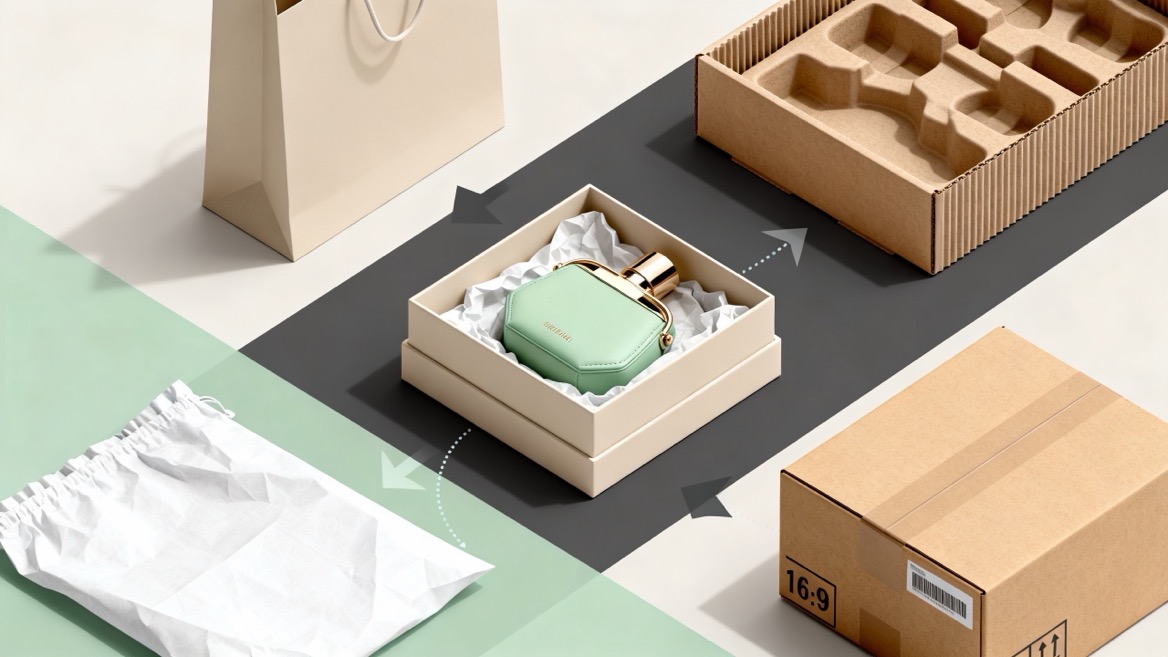
Paper bags and corrugated boxes are both fiber-based packaging formats, but their actual environmental performance depends on design choices, sourcing, reuse, shipment efficiency, and local recovery systems.
According to U.S. Environmental Protection Agency data for 2018, corrugated boxes had a reported recycling rate of 96.5%, while paper and paperboard packaging overall had a recycling rate of 80.9%. The same dataset reported that paper containers and packaging excluding corrugated boxes had a lower recycling rate of 20.8%. These figures highlight how established collection streams for corrugated material can influence recovery outcomes.
The Fibre Box Association states that the average corrugated box contains 52% recycled content and reports that more than 33 million tons of cardboard were recycled in the United States in 2025. Actual recovery outcomes still vary by region, collection infrastructure, and whether a package is contaminated by food, oil, wax, or other materials.
- Use packaging sized closely to the product.
- Avoid unnecessary empty space inside shipping cartons.
- Select the right board grade instead of automatically choosing the heaviest board.
- Use water-based or recycling-compatible materials where appropriate.
- Minimize mixed-material decorations that are difficult to separate.
- Add clear disposal guidance when it is appropriate for your market.
- Design paper bags strong enough for realistic reuse.
- Test samples with actual products before mass production.
Sustainability is not achieved simply by choosing a paper material. It comes from balancing material efficiency, product protection, shipment performance, reuse potential, and recovery compatibility.
A lower-cost package can become expensive if it causes product damage, returns, replacement shipments, negative reviews, or lost retailer confidence.
From a packaging manufacturer's perspective, under-packaging often happens when buyers select a bag or carton based only on unit price. The real cost should include the entire delivery outcome:
Total Packaging Cost=Packaging Price+Damage Risk+Return Cost+Replacement Cost+Brand Impact
For example, replacing a low-cost corrugated box with a correctly specified board grade and a well-fitted insert may slightly increase packaging cost per unit. But if it reduces breakage during delivery, the total commercial result can be much better.
The same principle applies to paper bags. A stronger handle attachment, bottom board, or reinforced top may cost more than a basic bag, but it can prevent a highly visible failure when a customer leaves the store with a heavy purchase.
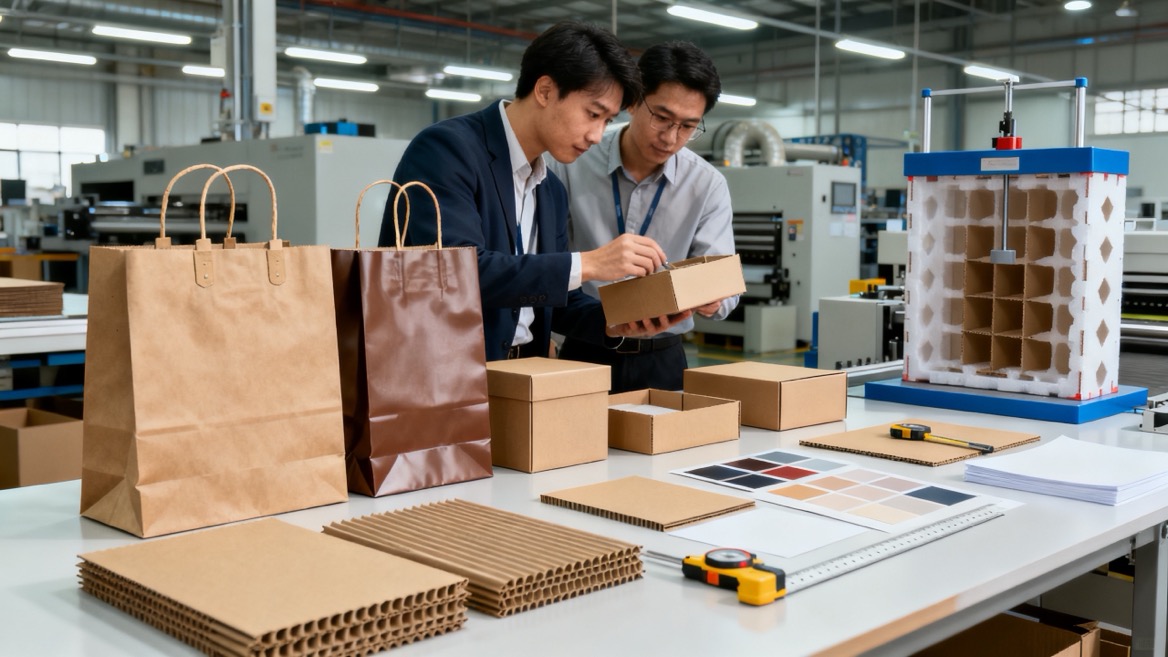
A beautiful paper bag may be ideal for retail, but it is rarely sufficient for a product that will move through courier sorting centers or overseas freight.
An oversized box can increase freight cost, reduce pallet efficiency, and allow the product to move inside the carton. Right-sizing is often more valuable than simply adding more filler.
Do not assume all handles perform the same way. Handle material, adhesive area, reinforcement, product weight, and carrying duration all matter.
Digital artwork approval does not confirm packaging performance. Test filled samples for carrying, stacking, vibration, drop exposure, and real-life handling before production.
Premium packaging often needs multiple layers. A rigid box, paper shopping bag, protective insert, and corrugated shipping carton can work together without being redundant when each layer has a defined function.
The difference between paper bags and corrugated boxes comes down to function. Paper bags are designed to carry and communicate your brand. Corrugated boxes are designed to protect and transport your products.
If your business sells products in physical retail locations, custom paper shopping bags can strengthen your customer experience and make your brand more visible after the sale. If your products move through e-commerce fulfillment, export shipments, warehouses, or delivery networks, corrugated boxes should be the foundation of your protective packaging strategy.
For many brands, the best answer is not paper bags or corrugated boxes. It is a carefully planned packaging system that uses each format where it performs best.
Maituohong Packaging can help you develop custom paper shopping bags, rigid gift boxes, and paper packaging solutions based on your product weight, dimensions, retail positioning, printing requirements, and shipping conditions. Share your product specifications and packaging goals to start with a practical sample recommendation.
It depends on the bag design, paper grade, handle construction, and product weight. Reinforced kraft paper bags can carry many retail products reliably, but they are more vulnerable to moisture and sharp corners than many plastic bags. For heavy or fragile goods, use suitable reinforcement or a protective secondary package.
Paper bags can be used as an internal branded layer inside an e-commerce order, but they are usually not suitable as the primary protective outer package for most shipped products. A corrugated mailer or shipping carton is generally more appropriate for transit protection.
In everyday language, "cardboard" can refer to many paperboard materials. Corrugated cardboard, more accurately called corrugated fiberboard, contains a fluted middle layer between linerboards. This structure provides improved cushioning, stiffness, and stacking strength.
For luxury customer presentation, a premium paper bag is usually more suitable because it supports decorative finishes, elegant handles, and high-quality printing. For luxury products that must be shipped, use a rigid gift box or premium retail box inside a corrugated shipping carton.
Yes. Corrugated boxes can be customized with logos, product information, handling symbols, barcodes, color graphics, and inside-print messages. The best printing method depends on order quantity, artwork complexity, board type, and the desired visual effect.
Measure the product's length, width, and height, then allow enough space for easy loading and carrying. Consider whether the product is boxed, whether multiple items will be placed inside, and whether the bag needs a bottom board or top reinforcement.
Start with product weight, dimensions, fragility, shipping distance, stacking requirements, expected humidity, and internal protection needs. A packaging supplier can recommend a suitable board construction and perform sample testing based on these conditions.
1. [U.S. Environmental Protection Agency — Containers and Packaging: Product-Specific Data]
2. [U.S. Environmental Protection Agency — Paper and Paperboard: Material-Specific Data]
3. [Fibre Box Association — Corrugated Is Recyclable]
4. [Fibre Box Association — Corrugated Life Cycle Assessments]
5. [Corrugated Packaging Alliance — Corrugated Packaging Life-Cycle Assessment Summary Report]
6. [Packaging Dive — Life-Cycle Assessment Reports Lower Corrugated Packaging Emissions]


