
Views: 231 Author: Maituohong Packaging Publish Time: 2026-10-28 Origin: Site


Content Menu
● Rigid Boxes vs. Corrugated Boxes: Quick Comparison
>> Common Rigid Box Styles and Uses
>> Corrugated Mailer Boxes vs. Shipping Boxes
● Rigid Boxes vs. Corrugated Boxes: Cost Comparison
>> Why Rigid Boxes Usually Cost More
>> Compare Total Delivered Cost, Not Just Unit Price
>> Illustrative Cost Model: When the Cheaper Box Loses
● Protection: Which Box Is Stronger?
>> Corrugated Board Ratings Need Context
>> Test the Product and Packaging Together
● Branding and Unboxing: Where Rigid Boxes Excel
● Hidden Logistics Cost: Empty Space and Dimensional Weight
● Sustainability: Evaluate the Complete Packaging System
● A Practical Five-Step Packaging Selection Process
● Find the Right Packaging with Maituohong Packaging
>> Are Rigid Boxes Better Than Corrugated Boxes?
>> Can Rigid Boxes Be Shipped Without an Outer Carton?
>> Are All Magnetic Boxes Rigid Boxes?
>> Are Corrugated Boxes Always Cheaper?
>> Can Corrugated Packaging Look Premium?
>> What Information Should I Send for a Custom Packaging Quote?
The main differences between rigid boxes and corrugated boxes are construction, presentation, shipping performance, and total cost. Rigid boxes suit premium gifting and carefully controlled product presentation. Corrugated boxes generally suit parcel delivery, protective shipping, and efficient fulfillment. For some products, the best solution combines both.
At Maituohong Packaging, our approach starts with a practical question: what must this package accomplish before, during, and after delivery? With more than 18 years in custom paper packaging, we focus on matching construction to the product rather than choosing by appearance alone.
This guide compares rigid boxes vs. corrugated boxes and explains how to choose a packaging system that balances protection, customer experience, and commercial value.
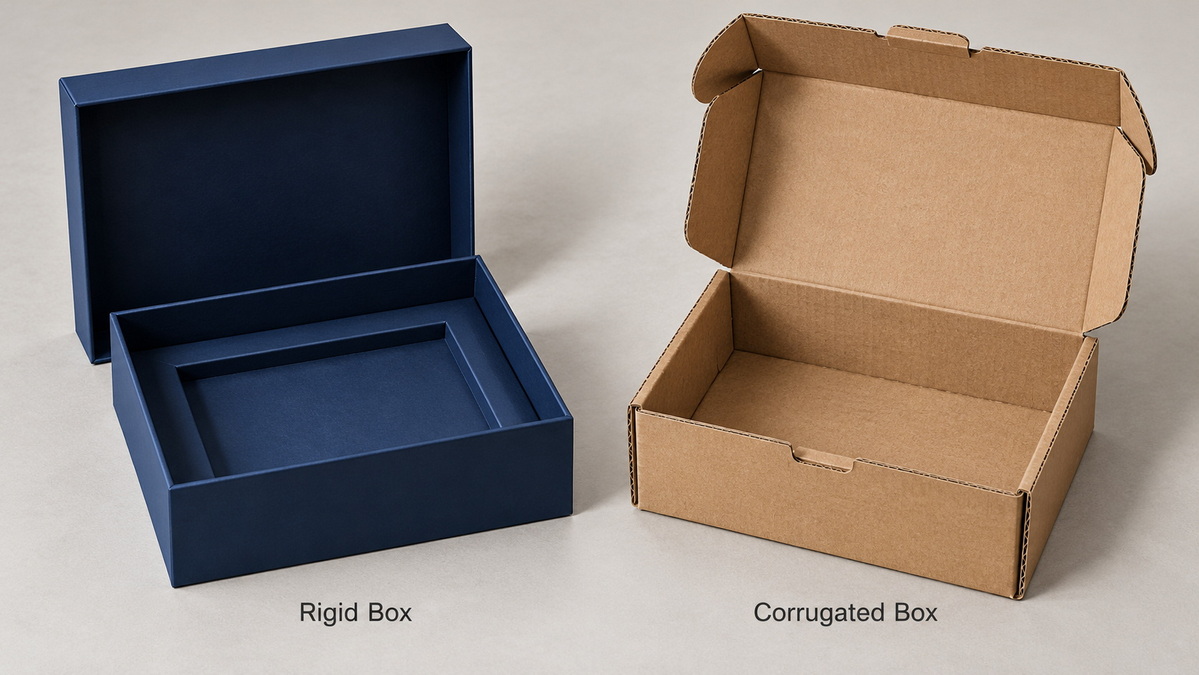
| Factor | Rigid boxes | Corrugated boxes |
|---|---|---|
| Core construction | Dense paperboard wrapped with decorative material | Fluted paper bonded to flat linerboards |
| Main role | Premium presentation and organized product display | Shipping protection and distribution efficiency |
| Typical formats | Lid-and-base, drawer, magnetic closure | Mailer, regular shipping carton, die-cut shipper |
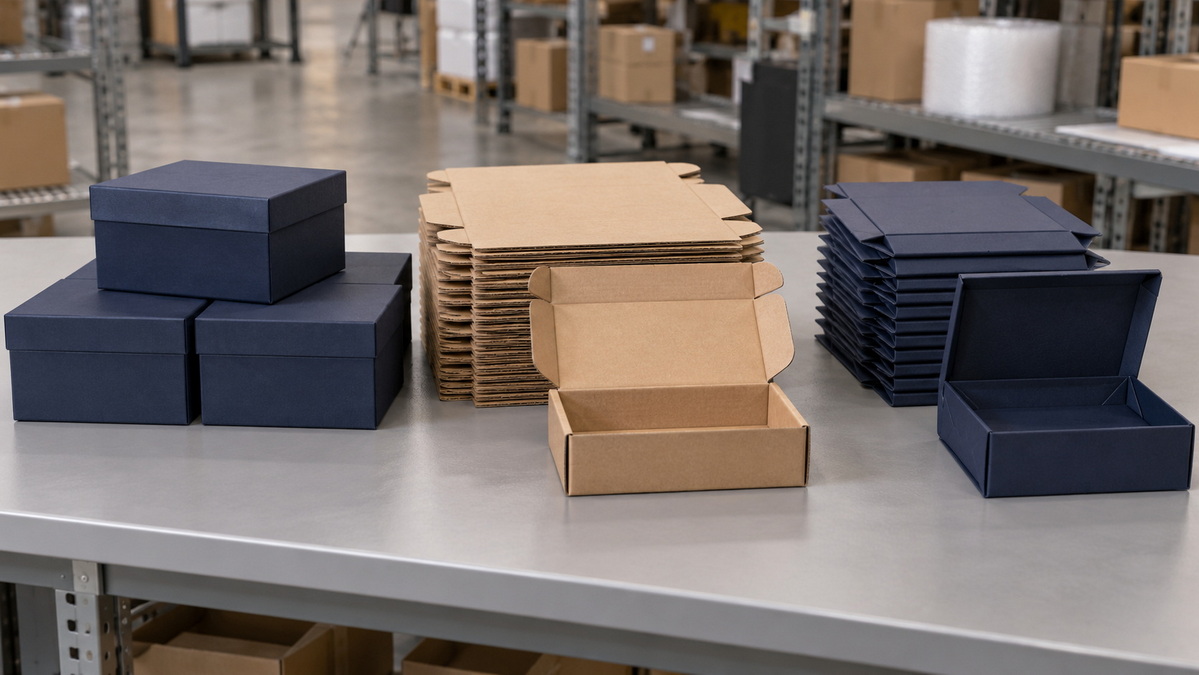
| Empty-box logistics | Conventional designs ship assembled; collapsible options exist | Many designs ship flat |
| Cost tendency | Higher for comparable premium specifications | Often lower for straightforward shipping designs |
| Surface character | Smooth wrapped surfaces and refined edges | Surface depends on flute, liner, and printing method |
| Main limitation | Presentation quality does not establish shipping suitability | Premium decoration can add cost and complexity |
Neither category has a universal weight limit or protection rating. Dimensions, materials, inserts, closures, and the distribution environment determine performance.
Rigid boxes use a dense paperboard core, commonly called greyboard or chipboard, covered with printed or decorative wrapping material. They retain their shape and provide a substantial presentation surface.
They differ from lightweight folding cartons, which are generally cut and creased from thinner paperboard. A folding gift box may instead use a collapsible rigid construction, so buyers should confirm the actual structure rather than rely on the product name.
- Lid-and-base boxes for cosmetics, accessories, and gift sets.
- Magnetic boxes for curated kits and premium gifting.
- Drawer boxes for jewelry and smaller presentation items.
- Collapsible rigid boxes for projects needing premium presentation with flatter inbound shipping.
Magnetic closure describes how a box closes, not its transport strength. Magnets do not replace secure shipping closures or transit testing.
Rigid packaging also supports fitted compartments, printed messages, and controlled product orientation. These features can improve presentation, but they should serve a clear customer need rather than add decoration without purpose.
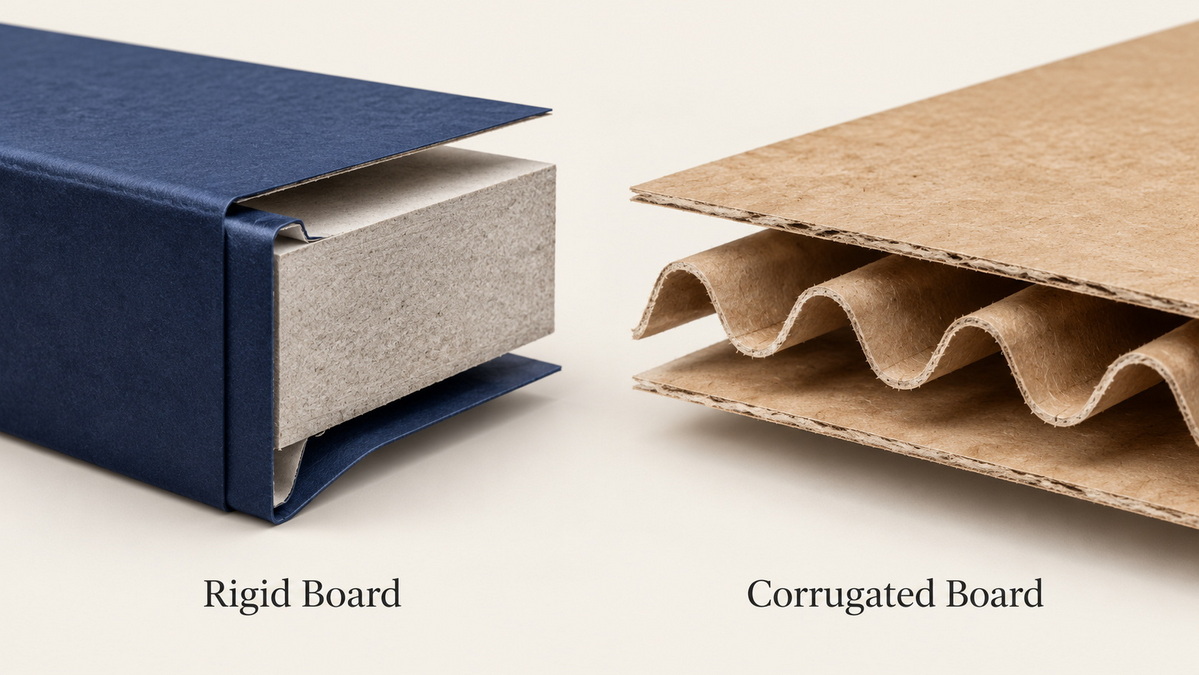
Corrugated boxes contain fluted paper bonded to flat linerboards. The fluted structure separates the liners and contributes stiffness, cushioning, and compression resistance.
Single-wall board has one fluted layer between two liners. Double-wall board adds another fluted layer and liner. More layers can support demanding applications, but the correct specification still depends on the complete package.
A corrugated mailer usually uses a die-cut structure with a hinged lid and locking features. It can combine branded presentation with parcel packaging.
A conventional shipping carton commonly has flaps secured with tape. It is useful for individual products, grouped orders, or protecting an inner presentation box.
Do not assume every product labeled "mailer box" uses corrugated board. Confirm the material, closure, board specification, and intended delivery conditions when requesting quotations.
Rigid packaging requires board preparation, wrapping, corner finishing, and assembly. Magnets, ribbons, fitted trays, and decorative finishes add materials and production steps.
Conventional assembled boxes also occupy their full volume during inbound transportation and storage. Collapsible rigid boxes can reduce this volume, although assembly labor and design complexity still require evaluation.
Corrugated packaging often offers efficient converting and flat delivery. However, a large, heavily decorated, double-wall corrugated box can cost more than a small, simple rigid box. Compare equivalent requirements, not category labels.
Ask suppliers to separate these cost components:
1. Box, insert, and closure materials.
2. Printing, finishes, tooling, and setup.
3. Inbound freight and warehouse space.
4. Packing labor and additional protection.
5. Outbound transportation.
6. Expected damage, replacement, and return costs.
An inexpensive box is not economical if it creates preventable replacements. Equally, premium packaging needs a commercial purpose; a higher selling price or conversion improvement should not be assumed without evidence.
Consider two hypothetical packaging systems, not supplier quotations or industry averages:
| Cost per dispatched order | System A | System B |
|---|---|---|
| Packaging and packing | $1.00 | $1.40 |
| Assumed damage rate | 3% | 1% |
| Cost per damage incident | $30.00 | $30.00 |
| Expected damage cost | $0.90 | $0.30 |
| Combined expected cost | $1.90 | $1.70 |
System B saves $0.20 per order despite its higher initial cost. This example does not establish that either box category performs better. It shows why measured damage rates belong in a purchasing decision. Freight and other costs are excluded here.
"Stronger" can mean resistance to stacking, drops, vibration, puncture, or cosmetic damage. No single material description answers every question.
The Edge Crush Test, or ECT, measures the edgewise compression resistance of corrugated board. It helps assess a board property relevant to stacking performance.
An ECT value is not a complete package rating. Finished-box dimensions, closure, manufacturing quality, humidity, stacking pattern, and contents also affect results. Avoid selecting a box solely because a board number appears high.
A rigid box may protect presentation well while still needing a corrugated outer carton for parcel delivery. Conversely, a corrugated mailer can fail if the product moves inside or the closure opens.
Evaluate the actual product, insert, box, and shipping closure as one system. Select testing that reflects the delivery route, including relevant handling, vibration, and compression hazards.
Assess cosmetic damage separately from product breakage. A functioning device inside a badly scuffed gift box may still be unacceptable to the customer.
Rigid boxes provide smooth wrapped surfaces, defined edges, and controlled opening sequences. They suit products where presentation is part of the purchase: premium skincare, jewelry, corporate gifts, and curated collections.
Corrugated packaging can also deliver strong branding. Printed interiors, carefully chosen liners, and suitable print processes can create an attractive experience without a separate presentation box.
The important distinction is purpose. A premium retail gift set may justify a rigid box. A replenishment order may benefit more from a compact branded mailer that opens easily and protects reliably.
Do not assume packaging alone increases sales. Compare customer feedback, repeat purchases, damage complaints, and packing efficiency when evaluating a redesign.
Packaging dimensions affect more than material use. Carriers may calculate dimensional weight from parcel volume and compare it with actual weight when determining billable weight.
For illustration, reducing an outer parcel from 30 × 25 × 15 cm to 30 × 25 × 10 cm lowers its volume from 11,250 to 7,500 cubic centimeters: a 33.3% reduction.
That is not automatically a 33.3% freight saving. Actual weight, rounding rules, service, rate structure, and dimensional factors determine the charge.
Review three separate logistics stages:
- Empty packaging arriving from the manufacturer.
- Packaging stored before fulfillment.
- Filled orders dispatched to customers.
A collapsible rigid box may improve the first two stages without changing the final parcel size. Keep these savings separate when comparing proposals.
Neither rigid nor corrugated packaging is automatically the more sustainable choice. Evaluate material quantity, transport volume, product protection, reuse, and the recycling options available to the customer.
Coatings, adhesives, foil, windows, magnets, and inserts deserve attention. Their effect depends on the material combination and the receiving recycling system; an added component does not automatically make an entire package unrecyclable.
Practical improvements include:
- Right-sizing the box without sacrificing protection.
- Using removable inserts where feasible.
- Reducing unnecessary mixed-material components.
- Providing disposal instructions appropriate to the destination.
- Avoiding unsupported claims such as "100% eco-friendly."
A reusable gift box may offer value, but reuse is a possibility, not a guaranteed environmental benefit. Evidence should support specific claims.
| Application | Starting recommendation | Main consideration |
|---|---|---|
| Premium retail gift set | Rigid box | Presentation and fitted organization |
| Routine subscription shipment | Corrugated mailer | Packing speed and delivery efficiency |
| Fragile premium product sold online | Rigid inner box plus corrugated shipper | Protect both product and presentation |
| Heavy or grouped products | Engineered corrugated shipping system | Compression, restraint, and handling |
| Space-constrained gift packaging | Collapsible rigid box | Flat delivery and assembly requirements |
These are starting points, not performance guarantees. Validate the final structure against the actual product and distribution route.

1. Define the product: dimensions, weight, fragility, surface sensitivity, and accessory arrangement.
2. Map the journey: retail handling, parcel shipment, pallet transport, or a combination.
3. Establish acceptance criteria: allowable movement, cosmetic condition, opening experience, and damage limits.
4. Compare equivalent prototypes: include all inserts, closures, print finishes, and outer cartons.
5. Validate before scaling: conduct appropriate tests, run a packing trial, and review a pilot shipment where practical.
My recommended purchasing rule is simple: specify the job before choosing the box. This prevents a visually appealing sample from becoming an unsuitable production standard.
Maituohong Packaging manufactures custom magnetic boxes, mailer and shipping boxes, rigid boxes, folding gift boxes, and paper shopping bags, backed by more than 18 years of design and production experience.
Send us your product specifications, order quantity, delivery destination, and presentation goals. Request a comparison of suitable rigid and corrugated structures, with inserts, shipping configuration, and sample requirements clearly defined before production approval.
Rigid boxes generally suit premium presentation. Corrugated boxes generally suit shipping efficiency. The better option depends on the product, route, customer expectations, and validated packaging performance.
Possibly, but do not assume suitability. Confirm closure security, surface protection, carrier requirements, and transit performance. Premium wrapped surfaces often benefit from an appropriate outer shipper.
No. Magnetic closure alone does not identify the board construction. Ask whether the box uses wrapped rigid board, a collapsible rigid structure, or another material system.
No. Size, board grade, order quantity, print method, inserts, and finishes can change the comparison. Request quotations based on equivalent product protection and presentation requirements.
Yes. Appropriate liners, refined graphics, interior printing, and fitted inserts can support premium presentation. Request a production-representative sample to evaluate print quality and surface appearance.
Provide product dimensions and weight, quantity, destination, intended box style, artwork requirements, inserts, delivery conditions, and target schedule. Include a product sample or drawings when available.
1. Fibre Box Association. "What Is Corrugated?" Industry explanation of corrugated construction, linerboards, flutes, and structural performance. Supports the material and construction comparison. [fibrebox]
2. PakFactory. "A More Cost Effective Alternative to Rigid Boxes." Explains rigid-box cost drivers, including wrapping, assembly, storage, and transportation, and discusses alternative structures. Used for qualitative comparisons, not universal price estimates. [pakfactory]
3. Mecmesin. "Edge Crush Test (ECT) of Corrugated Cardboard." Defines ECT, its measurement method, and reporting units. Supports the distinction between board properties and complete-package performance. [mecmesin]
4. UPS. "Packaging Guidelines." Carrier guidance on outer containers, cushioning, inner packaging, and box weight limits. Supports the discussion of protective shipping systems. [ups]
5. UPS. "Shipping Dimensions and Weight." Explains parcel measurement, dimensional weight, and comparison with actual weight. Specific calculation rules vary by service and market. [ups]
6. American Forest & Paper Association. "Design Guidance for Recyclability." Research-based guidance on how coatings, adhesives, foils, plastics, and other non-fiber elements affect paper-packaging recycling. Supports the qualified recyclability discussion. [afandpa]
7. QinPrinting. "Paperboard vs. Corrugated vs. Rigid Boxes." Manufacturing overview of the three constructions, including conventional and collapsible rigid boxes. Used for structural distinctions, not its generalized price or load comparisons. [qinprinting]


