
Views: 267 Author: Maituohong Packaging Publish Time: 2026-08-09 Origin: Site


Content Menu
● Why Box Thickness Matters When Shipping Art
● There Is No Single Minimum Thickness
● Understand Thickness, Flutes, GSM, and Strength
>> GSM Is Not a Complete Strength Rating
>> Thickness Must Match the Load
● The Better Rule: Build a Protective System
>> Layer 1: Surface Protection
>> Layer 3: Cushioning Clearance
>> Layer 4: Outer Shipping Box
● When Should You Use a Double-Box Design?
● How to Choose Box Thickness Step by Step
>> 1. Measure the Artwork Correctly
>> 2. Identify the Most Vulnerable Point
>> 3. Select the Transport Risk Level
● Common Mistakes That Increase Damage Risk
>> Choosing Board by Thickness Alone
>> Using a Box That Is Too Large
>> Using a Box That Is Too Tight
>> Treating "Fragile" Labels as Protection
● A Practical Specification for Custom Art Mailer Boxes
● Work With a Packaging Partner Early
● FAQ
>> What is the minimum box thickness for shipping artwork?
>> Is 3 mm cardboard thick enough for shipping art?
>> Is double-wall cardboard necessary for framed paintings?
>> How much cushioning should artwork have inside a shipping box?
>> Can bubble wrap touch a painting directly?
>> What is better for shipping art: a mailer box or a regular carton?
>> Should art prints be shipped flat or rolled?
>> How can I reduce shipping costs without reducing protection?
Shipping artwork safely is not simply a matter of choosing the thickest box available. The right solution combines corrugated board strength, protective clearance, internal cushioning, moisture control, and a box style that matches the artwork's weight, dimensions, and shipping route.
At Maituohong Packaging, we have spent more than 18 years designing and manufacturing custom paper packaging, rigid gift boxes, mailer boxes, and shipping boxes. In our experience, art damage rarely comes from one single issue. It usually results from movement inside the box, insufficient edge protection, weak compression performance, or a packaging design that does not match real transport conditions.
This guide explains how to select the minimum box thickness for shipping art while balancing protection, material use, shipping cost, and presentation quality.
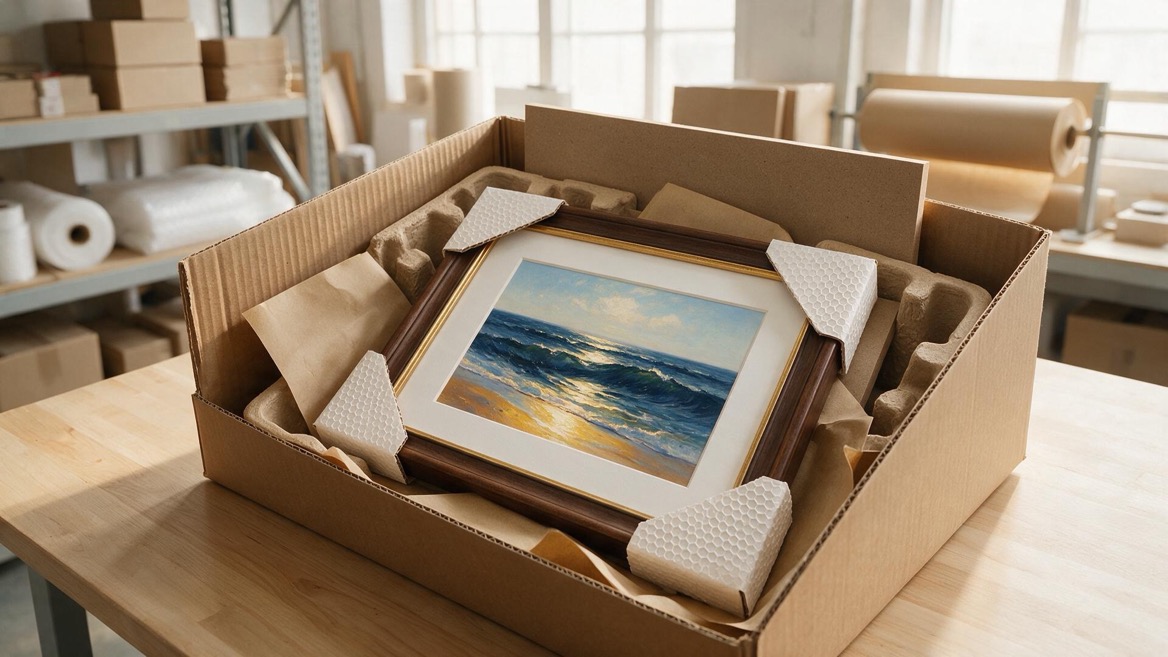
Artwork faces more than a simple delivery journey. A package may be lifted, stacked, dropped, moved between vehicles, exposed to vibration, or stored temporarily in changing temperatures and humidity.
A thicker corrugated box can help resist:
- Puncture from sharp edges, corners, or other parcels
- Compression from stacking during warehousing and transport
- Bending that can damage prints, panels, frames, or glass
- Impact from handling and accidental drops
- Abrasion caused by movement inside the package
However, thickness alone does not guarantee protection. A heavy double-wall box with poor internal support can still allow a framed painting to slide, strike the box wall, or crack at the corners.
The real objective is simple: create a packaging system that keeps the artwork stable, cushioned, dry, and separated from external forces.
There is no universal minimum box thickness for every type of artwork. A rolled poster, an unframed fine-art print, a glass-covered photograph, and a large framed canvas have very different risks.
For most custom art shipping boxes, corrugated board is a more practical choice than ordinary folding carton board. Folding carton may be suitable for retail presentation or lightweight boxed products, but it is not usually designed to absorb the handling forces associated with parcel delivery.
The following guide offers a useful starting point.
| Artwork Type | Recommended Outer Packaging | Typical Board Construction | Protection Focus |
|---|---|---|---|
| Rolled prints or posters | Paper mailing tube | Thick paperboard tube | Crush resistance and end-cap protection |
| Small unframed prints | Flat mailer box | E-flute or B-flute corrugated board | Bend resistance and corner protection |
| Mounted photos or art panels | Flat shipping box | B-flute or C-flute corrugated board | Rigidity and puncture resistance |
| Framed artwork without glass | Telescopic or custom mailer box | C-flute single-wall or double-wall board | Edge cushioning and movement control |
| Framed artwork with glass | Double-box system | C-flute or double-wall corrugated board | Shock absorption and glass-breakage control |
| Large, heavy, or high-value art | Reinforced carton or crate system | Double-wall or triple-wall board, often with a crate | Compression, vibration, and handling protection |
For many standard framed artworks, single-wall C-flute corrugated board can be an effective starting point when the design includes proper internal cushioning and a correctly sized outer box. For heavier, fragile, oversized, or long-distance shipments, double-wall corrugated construction provides a more reliable safety margin.
Packaging specifications can be confusing because several measurements may appear on the same quotation. They are related, but they do not mean the same thing.
Corrugated board is built from liner paper and a fluted medium. The flute creates air space, which improves cushioning and gives the board structural strength.
Typical flute profiles include:
| Flute Type | Approximate Thickness | Common Use |
|---|---|---|
| E-flute | About 1.5 mm | Premium mailer boxes, small lightweight products, high-quality printing |
| B-flute | About 3 mm | Mailer boxes, flat packs, compact shipping cartons |
| C-flute | About 4 mm | General shipping boxes and framed artwork cartons |
| A-flute | About 5 mm | Greater cushioning for fragile or heavier items |
| Double-wall | About 6–7 mm | Heavy, fragile, or long-distance shipments |
| Triple-wall | About 10–12 mm | Industrial loads, very heavy products, palletized transport |
For an art mailer box, E-flute may look refined and print beautifully, but it is not automatically the best option for a framed piece. A C-flute or double-wall box may be more appropriate when the artwork has weight, depth, glass, or a long shipping route.
GSM means grams per square metre. It indicates the weight of paper or board, but it does not independently confirm how well a shipping box will perform.
A heavier paper can contribute to stronger corrugated board, but a packaging buyer should also consider:
- Flute profile
- Number of corrugated walls
- Liner quality
- Edge crush performance
- Burst strength
- Box dimensions
- Product weight
- Stacking height
- Internal packaging design
A 400 GSM paperboard sheet and a 400 GSM corrugated material can perform very differently. For shipping art, ask the manufacturer about the full board construction rather than choosing a box only because it has a high GSM figure.
A large box made with thin material can flex under its own size, even when the artwork inside is lightweight. Likewise, a compact but heavy framed piece may require stronger board because its weight concentrates on a smaller area.
As a practical rule, increase box strength when any of the following changes:
- The artwork becomes heavier
- The frame becomes deeper or more valuable
- The shipping distance increases
- The parcel will enter a multi-carrier network
- The box will be stacked with other parcels
- The shipment includes glass, ceramics, or fragile projections
- The outer dimensions become large enough to flex easily
A reliable art shipping package normally has several protective layers. The outer box provides containment and compression strength, but each internal layer has a different job.
Never allow rough cushioning materials to touch painted, varnished, printed, or delicate surfaces directly.
Use a clean protective barrier appropriate for the artwork, such as:
- Acid-free tissue or glassine for sensitive surfaces
- Clean paper wrap for protected framed pieces
- Protective film only where it will not trap moisture or adhere to finishes
- Corner protectors for frames, panels, and mounted prints
For paintings, bubble wrap should generally not touch the painted surface directly. Direct contact can leave marks, stick to coatings, or create unwanted texture impressions.
Unframed prints, photographs, and works on paper need stiff support to prevent bending.
A common method is to place the artwork between two rigid boards, such as corrugated pads, foam board, or suitable protective panels. The boards should be larger than the artwork so the edges and corners are not exposed.
For flat art, the support layer often matters more than simply increasing the thickness of the outer mailer box.
The artwork should not sit directly against the outer carton. Leave controlled space for cushioning on every side.
For many framed artworks, a clearance of approximately 50 mm, or 2 inches, around the piece is a useful practical target. This space allows the cushioning to absorb shock and prevents the frame corners from receiving direct impact.
The Canadian Conservation Institute notes that shock, vibration, compression, puncture, water, humidity, and temperature changes are all relevant transport hazards. Its guidance also shows that thicker cushioning can substantially reduce transmitted shock compared with a thin cushioning layer.
The outer box must hold the full system together. It should remain closed, resist stacking pressure, and protect the internal layers from puncture or crushing.
For standard artwork, a custom corrugated mailer box can offer an efficient balance of protection and branding. For premium framed works or glass-covered pieces, a double-box configuration is often the safer choice.
Double-boxing means placing a protected inner package inside a larger outer carton with cushioning between them. It is especially valuable when damage would be expensive, difficult, or impossible to repair.
Use a double-box solution when shipping:
- Artwork with glass or acrylic glazing
- High-value original paintings
- Antique or irreplaceable pieces
- Large framed canvases
- Heavy artworks with concentrated weight
- International shipments
- Artworks moving through parcel networks with repeated transfers
The inner package protects the artwork from surface damage and puncture. The outer package manages handling impact, stacking pressure, and rough contact with other freight.
A gallery shipping guide based on practical experience recommends allowing at least 2 inches of clearance around an artwork, then using cushioning and an additional protective box layer to reduce movement and impact risk.
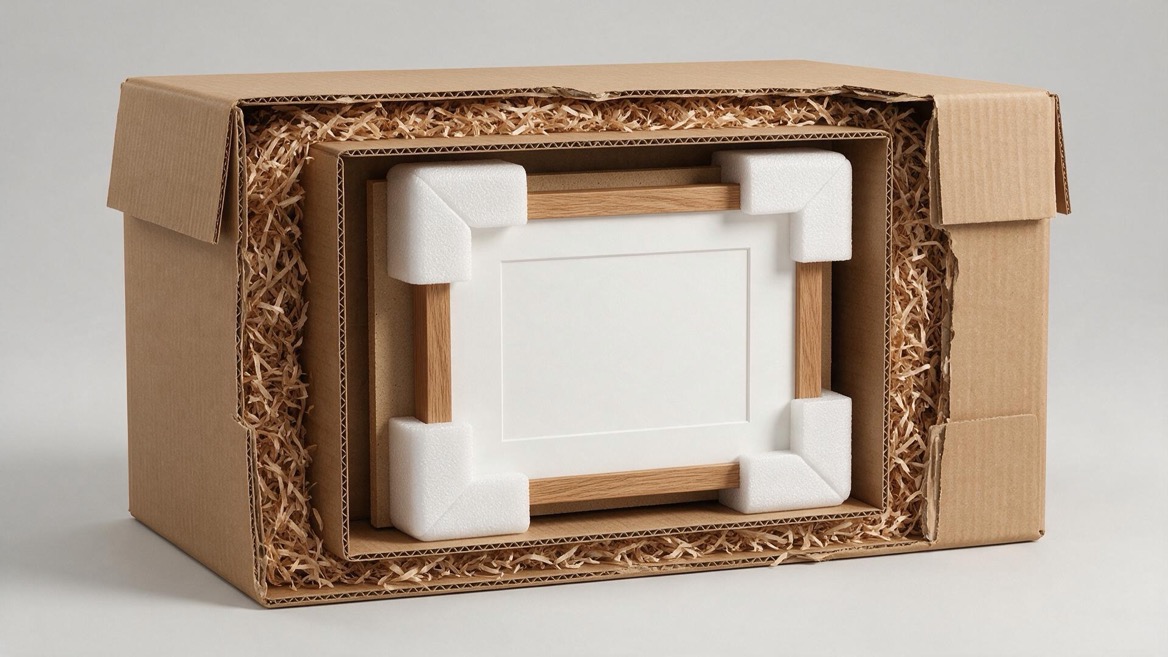
Measure the complete item, including:
- Length
- Width
- Depth
- Frame thickness
- Hanging hardware
- Corner protectors
- Internal support boards
- Cushioning space
Do not design the box only around the visible artwork dimensions. The usable internal size must account for every protective layer.
The weakest point may be different from one artwork to another.
Examples include:
- Glass corners on a framed photograph
- Canvas edges on a stretched painting
- Raised texture on an oil painting
- Thin paper corners on a fine-art print
- Heavy hardware on the rear of a frame
Design the internal structure around the most fragile feature, not the easiest dimension to package.
A local hand-delivered shipment requires a different box from an international parcel shipment.
| Shipping Situation | Suggested Packaging Level |
|---|---|
| Local delivery with careful handling | Custom single-wall mailer with fitted supports |
| Domestic parcel shipment | C-flute or reinforced single-wall box with cushioning |
| Long-distance or multi-stop shipment | Double-wall corrugated box or double-box system |
| International or high-value shipment | Double-box system, moisture barrier where appropriate, reinforced corners |
| Large or extremely fragile artwork | Engineered carton plus crate or specialist transport solution |
Empty space is one of the most common reasons artwork gets damaged. If the item moves inside the carton, the package can turn every handling shock into an internal collision.
Before sealing the box, perform a simple movement check:
1. Hold the package level.
2. Gently move it from side to side.
3. Listen and feel for internal shifting.
4. Add fitted cushioning if movement is detected.
5. Recheck before final sealing.
The goal is not to pack the artwork tightly against hard materials. The goal is controlled immobilization with cushioning that can absorb impact.
A strong box can still fail if the closure opens. Use high-quality packing tape and seal all main seams.
For larger or heavier art cartons, use the H-tape method:
- Seal the centre seam
- Seal both edge seams
- Reinforce the bottom before loading
- Apply tape across the carton width and length when needed
This creates a more secure closure and reduces the chance of flaps catching during transport.
A thick box may still collapse if the material has weak liners, poor flute quality, or insufficient compression performance. Ask about the complete corrugated specification.
Oversized packaging increases shipping volume and allows movement. More void fill is not always better; properly fitted internal supports are more effective.
A box with no cushioning clearance transfers impact directly to the artwork. Tight-fitting packaging can be especially risky for framed corners and glass.
A used box may look acceptable but have weakened corners, crushed flutes, or reduced stacking strength. For valuable art, a new custom shipping box is usually the safer choice.
Labels can communicate handling needs, but they cannot replace structural design. The packaging should protect the artwork even when the parcel experiences normal transport stress.
When requesting a quotation for custom mailer boxes or shipping boxes, provide a clear packaging brief. This helps the manufacturer recommend the correct board structure instead of offering a generic carton.
Include:
- Artwork dimensions and weight
- Whether the artwork includes glass
- Shipping destination and transport method
- Expected order quantity
- Required print design
- Whether the box is for direct-to-customer delivery
- Desired internal inserts or corner supports
- Environmental considerations, such as recyclable materials
- Whether the package needs to support stacking or palletization
For example, a 60 × 80 cm framed canvas shipped domestically may use a custom C-flute mailer box, fitted corner protectors, rigid pads, and 50 mm cushioning clearance. A similar-size framed artwork with glass and international delivery may require double-wall corrugated board, a separate inner carton, and reinforced edge protection.
The best time to solve packaging problems is before production begins. A sample box, a fitted insert, and a basic transit test can reveal issues that are difficult to see in a flat dieline or digital mock-up.
At Maituohong Packaging, we help brands, galleries, art sellers, and product businesses develop custom mailer boxes and shipping boxes that combine reliable structure with a professional unboxing experience. Whether you need lightweight branded mailers for art prints or reinforced corrugated boxes for framed work, our team can help translate your product requirements into a practical packaging solution.
Contact Maituohong Packaging to discuss your artwork dimensions, shipping route, and protection requirements, and receive a custom box recommendation built for your products.

For lightweight prints and small flat artwork, E-flute or B-flute corrugated mailer boxes may be sufficient when paired with rigid backing boards. For framed artwork, C-flute single-wall board is often a practical starting point. Heavy, fragile, oversized, or glass-covered pieces usually need double-wall corrugated board or a double-box design.
A 3 mm B-flute box can work for small, lightweight, well-supported artwork. It is usually not enough by itself for heavy frames, glass-covered art, or large canvases. The final decision should depend on weight, size, route, cushioning, and internal movement control.
Not always. A lightweight framed painting may ship safely in a well-designed single-wall C-flute box with proper internal protection. Double-wall board becomes more appropriate for heavier, larger, fragile, valuable, or long-distance shipments.
A practical guideline is about 50 mm, or 2 inches, of cushioning clearance around the artwork. The exact amount depends on the artwork's fragility, weight, and transport risk. The cushioning must prevent movement without placing excessive pressure on delicate surfaces.
It is better to avoid direct bubble-wrap contact with a painted or varnished surface. Use a clean protective barrier first, then add bubble wrap as an external cushioning layer. This reduces the risk of surface marks, adhesion, or texture transfer.
A custom mailer box is often ideal for flat prints, small framed pieces, and direct-to-customer presentation. A regular corrugated carton may be more suitable for larger or deeper artworks. High-value or fragile work may need a mailer-style inner box placed inside a stronger outer shipping carton.
Ship prints flat when they are valuable, limited edition, mounted, delicate, or likely to crease. Rolled shipping can be suitable for flexible posters and prints that can safely be unrolled. Use a rigid mailing tube with secure end caps for rolled artwork.
Use a custom-sized box that minimizes unnecessary empty space and dimensional weight. Select the lightest board structure that still meets the real shipping risk, then improve performance with fitted inserts, corner protectors, and efficient cushioning rather than simply choosing the thickest possible carton.
1. Canadian Conservation Institute. "[Features of Effective Packaging and Transport for Artwork – Technical Bulletin 34]." Detailed guidance on shipping hazards, cushioning, shock, vibration, handling risks, and packaging design for cultural objects. [canada]
2. Tycoon Packaging. "[Minimum Box Thickness for Shipping Art — The Ultimate Guide for Effective Packaging]." Overview of corrugated flute profiles, board thickness ranges, GSM, and corrugated board constructions. [tycoonpackaging]
3. Xanadu Gallery / RedDotBlog. "[How to Ship Paintings: A Step-by-Step Guide for Artists and Galleries]." Practitioner guidance on clearance, double-boxing, cardboard pads, protective wrapping, taping, and shipping framed artwork. [reddotblog]
4. Project Art. "[Packaging Guide]." Guidance on allowing sufficient box clearance and filler protection around artwork during transport. [projectart]
5. The Arts Commission and Toledo Museum of Art. "[Handling and Packing Artwork with Care]." Educational guidance on cushioning depth, false bottoms, and safe internal support for artwork. [theartscommission]
6. Hot Springs Area Cultural Alliance. "[A Guide to Packing and Shipping Works of Art]." Recommendations on rigid supports, margins, cushioning space, and packaging for fragile artwork. [hotspringsarts]


